

Did you recently see splashy ads for Ads2Cash – promising you can earn money by watching ads, filling surveys, and referring friends, with a $5 signup bonus? Before you rush to create an account on ads2cash.com, pause. The glossy pitch hides a tangle of specific red flags: the site was registered in March 2025, yet it already boasts “thousands” of users and massive payouts; it leans on fake executives and prestige logos; and users report blocked withdrawals, suspended accounts, and unreachable support. If a promotion, video, or review pointed you to Ads2Cash, Jaxpine.site or Paytube, as a quick path to cash, treat that as a warning rather than an invitation.
Scams of Ads2Cash‘s type are known to steal personal data and passwords. Install SpyHunter Pro to scan for risks, remove any dangerous trackers, and enable real-time protection.

Try Free For 7 Days*
Buy now15% OFF if you buy straight without trial.
 OFFER
OFFERAds2Cash – is it legit?
Let’s talk about that engine. The workflow is simple on purpose: complete small tasks, watch a few videos, download an app, send a referral or two, and watch a dashboard counter climb toward a $100 minimum withdrawal. That threshold isn’t a decorative flourish. It’s the treadmill. The higher the wall, the longer you run, the more clicks, installs, and data you pour in. Then, right at the finish line, the pattern shows up: payouts get delayed “indefinitely,” or accounts are suspended the moment a larger withdrawal is requested. See the sequence? Work first, excuses later.
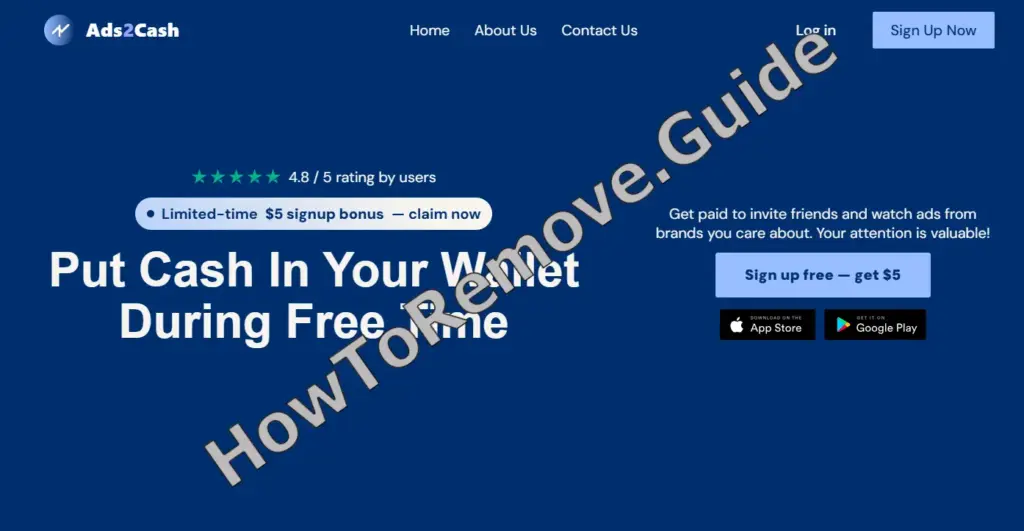
Now, the costume. Scammers know optics sell trust, so they stage an “About” page with named executives – businesslike titles, confident headshots, tidy bios. Look closer and the portraits are AI-generated; the people don’t exist. That borrowed credibility folds the second you touch it. The same trick appears in a glossy row of prestige logos – famous entertainment and business brands – arranged to imply coverage and endorsement. Chase the implication and you find no articles, no videos, nothing at all. Logos without sources are stickers, not proof.
Contact details are supposed to anchor a company to reality. Here, they float. The physical address is copied or fake. The customer-service phone number doesn’t connect. That isn’t “we’re experiencing high call volume”; that’s “we don’t plan to answer.” And those proud buttons promising mobile apps on the major stores? Tap them and you boomerang back to the website’s signup page. No listing, no app – just a funnel that always leads to the intake form. When every path reroutes to “create account,” you’ve learned where value truly flows.
Precision beats vibes, so pin down the timeline. The domain registration lands in March 2025 – brand new. Meanwhile, the marketing trumpets “thousands” of users and “massive payouts.” That time compression is your second red flag. Real scale leaves fingerprints: documentation, third-party mentions, and boring receipts. When a newborn site wears a veteran’s reputation, it’s inviting you to trust a story that history doesn’t support.
Recognizing Warning Signs of the Ads2Cash Scam
What happens when people push past the polish and try to withdraw? We have windows into that. One reviewer leaves two stars and says they’ll update if it ever pays, while calling out the $100 minimum as the central friction. Another says they can’t move a “locked subscription” to a wallet, that it expired, and that support doesn’t reply. A third reports withdrawing $5 twice early on, then getting suspended when they aimed for a larger amount – and being told to create a new account. That last nudge is especially revealing: the “solution” resets your progress while preserving theirs.
Zoom out and the business model snaps into focus. This is an engagement farm. Every time you complete an offer, sign up for a free trial, or download an app, someone earns advertiser revenue. That someone isn’t you. You supply the labor – time, clicks, referrals – while the operators collect the proceeds. You get a number on a dashboard that mimics wealth. If those digits were cash in your account, there would be nothing to argue about. The argument exists precisely because the money doesn’t arrive.
There’s choreography in the public narrative, too. You’ll see reviews that look suspiciously similar – same rhythm, same vague reassurance, often mentioning being redirected to the platform – nudging the undecided without offering anything verifiable. Right alongside them sit grounded complaints repeating the same themes: the $100 threshold, stalled withdrawals, suspended accounts, and silence from support. Repetition without resolution isn’t noise; it’s a pattern. When separate accounts converge on the same choke points, believe the convergence.
How do you navigate this without turning into a full-time investigator? Carry a pocketful of heuristics. Treat a high minimum withdrawal as a structural warning, not a quirk. Distrust “executive” pages padded with AI-polished headshots that have no independent footprint. Test claims directly: click the app-store badges and see whether you land on an actual listing or get bounced back to signup. Call the number. Verify the address. You’re not being paranoid; you’re doing the baseline diligence any real service should pass without drama.
Also, watch how fast the promises outrun the evidence. You’ll hear about daily bonuses, fast payouts, even fantastical earnings that flirt with “too good to be true.” Ask the boring questions. Where are the unglamorous receipts? Where are the ho-hum bank statements? Where are the tedious, verifiable details that accompany genuine payouts? Scams trade in spectacle because spectacle discourages verification. Reality is dull, documented, and consistent.
What to Do If You’ve Fallen for the Ads2Cash Scam
If you’re already inside and feeling that cold edge of doubt, you still have agency. Stop completing new offers. Don’t hand over additional personal information. If a balance is “locked” and the unlock condition is “do more tasks,” you’re not unlocking anything; you’re being gamed by the rules. Decline the invitation to “create a new account.” Resetting doesn’t fix a rigged system; it only resets your leverage while keeping their funnel full. The right time to stop digging is the moment you realize you’re holding the shovel.
Let’s revisit trust indicators that actually mean something. Age matters. A site born in March 2025 doesn’t get to claim the reliability of a veteran platform in April. Verification matters. Prestige logos with no linked coverage are stage props, not endorsements. Leadership matters. Names paired with AI-generated faces and no independent traces – no interviews, no profiles, no history – are placeholders, not people. When the anchors that should tie a platform to reality collapse on contact, you’ve learned enough to walk.
What about those early success anecdotes – tiny payouts that seem to prove legitimacy? Those can be part of the script. Early wins keep the treadmill moving. They create a sunk-cost itch and encourage users to push for that $100 mark. Past the line, the script flips: delay, deny, suspend, repeat. The progression isn’t accidental; it’s functional. The longer people grind, the more advertiser money flows to the operators, whether or not withdrawals ever land. The game rewards contribution and punishes cash-out.
This is why complaints cluster at the same chokepoints. They aren’t bugs; they’re gates. A high threshold prevents casual cash-outs. An unreachable phone number prevents accountability. AI-generated “executives” provide borrowed polish without the risk of scrutiny. App-store buttons that lead back to signup prevent third-party oversight. Suspiciously similar reviews seed doubt while drowning specifics. A newborn domain pretending to be established keeps the lights bright and the receipts dim. Each detail matters; together, they map the system’s incentives.
Here’s the doctrine to keep in your pocket: believe what systems do, not what they say. A platform that makes it effortless to give value – your time, attention, and data – but consistently difficult to retrieve value is telling you what it optimizes for. In that equation, you are the input, not the beneficiary. If the platform truly delivered meaningful payouts, you would see ordinary, verifiable proof: transfers that clear, records that match, support that answers. You wouldn’t need motivational slogans or glossy badges to fill the silence.
Bottom Line
One last note on hope before you close the tab. It’s human to want the $5 signup credit to signal generosity instead of bait, to want the climbing counter to be a preview of money headed your way. But the concrete details outweigh the wish: AI-generated leadership, unreachable contacts, a copied or fake address, prestige logos with no coverage, app links that loop back to signup, a fresh March 2025 registration pretending to wear years of trust, and a $100 wall that triggers delays and suspensions. Add the lived experiences – tiny early withdrawals followed by suspension, “locked subscription” balances that expire, support that doesn’t reply – and the picture is complete.
So step off the treadmill. Keep your time, your data, and your money. The operators get paid the moment you click, install, and refer; you get paid – according to the reports – never or almost never. That asymmetry is the only proof you need. And once you’ve seen it here, you’ll recognize it everywhere: the costume, the treadmill, the choreography, the gates. Believe the pattern. Then avoid it, and spend your effort where the receipts are boring and the results are real.
