

If you stumbled upon Deotax through a viral TikTok clip or a flashy YouTube ad featuring Elon Musk supposedly endorsing it, stop right there – what you saw was likely a deepfake. Deotax is presented as a next-gen crypto casino where you can “win big” with zero risk and a generous starting bonus, but in reality, it’s nothing more than a polished scam.
The site mimics real gambling platforms – it has flashy buttons and graphics, testimonials from supposed winners, and (fake) white papers to make everything seem more legitimate.
The goal of all this is to get you to play with the promised bonus. The games are rigged so that it seems like you are winning it big, so that you’ll inevitably want to withdraw at a given point.
Then comes the deposit requirement – it can be framed as a withdrawal tax, a verification fee, or some other nonsense. In any case, it’s the scam’s core – any money you deposit at this point is gone for good. As for your supposed “winnings”, they were never really there.
If you’ve already interacted with Deotax, Xesodex, or Merihex, act now to contain risk. Crypto transfers are typically irreversible and uploaded ID can fuel identity abuse.
Lock down accounts, document everything, and refuse all “unlock” or “fee-to-withdraw” demands – follow-up “recovery” outreach is just the same actors trying again.
Scams of Deotax.com‘s type are known to steal personal data and passwords. Install SpyHunter Pro to scan for risks, remove any dangerous trackers, and enable real-time protection.

Try Free For 7 Days*
Buy now15% OFF if you buy straight without trial.
 OFFER
OFFERIMPORTANT! READ BEFORE PROCEEDING!
If you have interacted with Deotax, treat it as an urgent security incident. Crypto moves finalize fast and ID uploads expand the blast radius. Secure accounts immediately, capture evidence, and decline all “unlock” or “VIP” payments. Use the steps below to stabilize first, then consider reporting paths.
- Change passwords on email, exchanges, and wallets; enable strong 2FA everywhere to cut off account-takeover attempts.
- Report quickly: file with your national police/cybercrime unit and notify any exchanges you used so addresses can be flagged.
- Move remaining crypto to brand-new wallets with fresh seed phrases; don’t reuse compromised credentials.
- Preserve evidence: save TXIDs, wallet addresses, screenshots, emails/chats, domains, and timestamps for investigators.
- Do not pay “unlock,” “processing,” or “tax” fees or any “verification deposit” – these are the core advance-fee tactic.
How We Know Deotax is a Scam
To set expectations, here’s why Deotax matches the blueprint: withdrawals morph into paywalls, legitimacy is staged with unverifiable badges, and identity-harvesting checks expand harm beyond money. Seen together, these signals align with the crypto advance-fee casino scam pattern.
Any request to pay to withdraw
Withdrawals aren’t payments – they’re paywalls: “processing” or “compliance” deposits appear only after you’ve “won,” and no payout follows.
License claims you can’t verify
Badges don’t click through to a regulator entry or a lab’s live certificate; they’re static images or borrowed numbers that don’t validate.
Early “wins” that inflate balances
Games “perform” in your favor early so balances balloon and you overestimate fairness and profitability.
Crypto-only cashiering + new domain
Crypto-only rails plus a fresh, privacy-masked domain remove chargeback pressure and accountability.
Fake social proof
Bot chats, planted reviews, and influencer codes simulate community and success while dodging independent scrutiny.
Template clones and domain churn
Clone front-ends and relentless domain churn let operators rebrand when complaints rise, scattering the paper trail.


How the Deotax Scam Deception Funnel Works
Before diving in, realize that scams like Deotax rely on a repeatable pipeline: pull you in with attention-hacking media, make depositing effortless, inflate apparent success, then obstruct cash-outs with shifting hurdles. Understanding this choreography helps you spot and exit the script quickly.
To start, glossy ads or short-form videos promise outsized wins and push bonus codes. Next, the landing flow is low-friction – quick registration, crypto-only deposits, and pop-ups that urge “limited-time” multipliers. Then, games “perform” in your favor so balances balloon and trust builds. After that, the trap springs: at withdrawal, you face KYC uploads plus “compliance,” “tax,” or “security deposit” fees. Furthermore, scripted support escalates pressure, dangling “expedited review” if you pay. Finally, if you resist or complain, the site ghosts, blocks, or redirects to a fresh clone.
⮟ Promo hooks and influencer codes
Glossy ads, seeded comments, and DMs dangle “limited” bonuses and fake testimonials to start the funnel and manufacture urgency.

⮟ Casino skin and bonus theater
The landing page mimics a legitimate casino, flashes giant crypto bonuses, and promises “provably fair” play to create instant credibility.

⮟ Inflated balances, then the gate
Early “wins” swell your on-screen balance, then withdrawal triggers KYC and a “verification deposit” or “processing fee” to proceed.
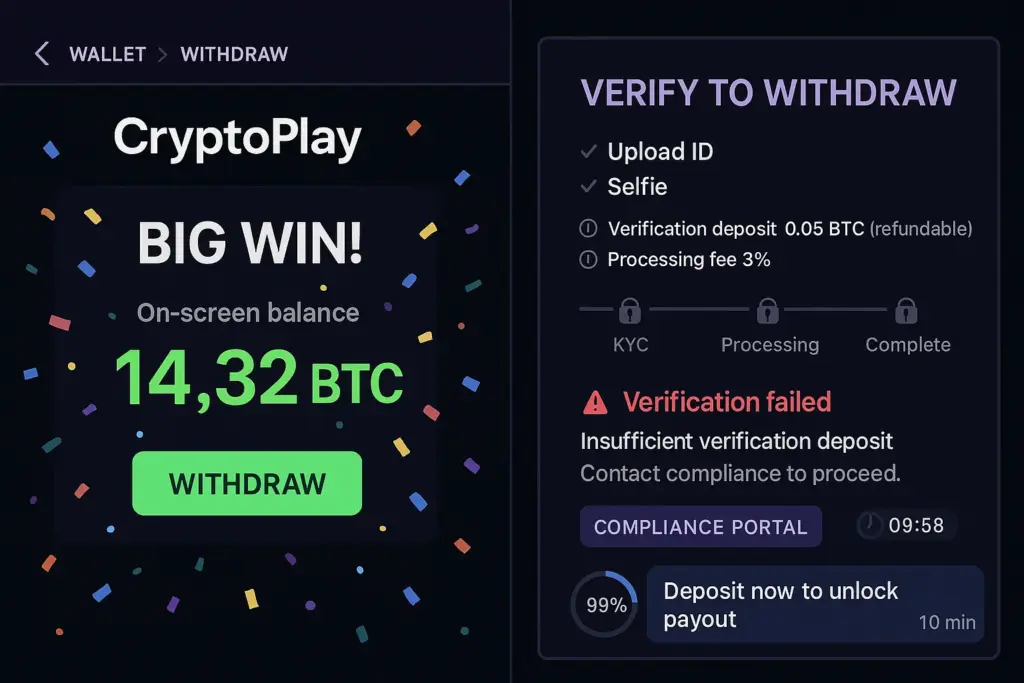
⮟ Fee-gates and KYC harvest
Each step adds a pretext—VIP upgrades, AML checks, taxes—while siphoning more crypto and collecting high-value identity documents.

⮟ Stalling, rebrands, and “recovery” bait
Support scripts empathy while adding hurdles, then the site ghosts and pivots to a new domain. Soon after, a “recovery agent” appears to sell the encore scam.
Staying safe from scam casino traps like Deotax
By shifting from reactive to preventative habits, you dramatically cut exposure to repeat victimization. The practices below help you verify claims before committing, limit initial risk, and preserve evidence if something goes wrong.
⮟ Verify licenses on official registers
Start with licensing: verify the operator on a regulator’s official register and confirm the exact domain matches the listing, not just the brand.
⮟ Inspect domain age and clone patterns
Third, assess the domain itself: brand-new age, privacy-masked ownership, and templated siblings across multiple names are stop signs.
⮟ Refuse up-front withdrawal “fees”
Fourth, trial withdrawals before trust: any reputable platform processes a small cash-out without “unlock” or “collateral” payments.
⮟ Prefer platforms with real recourse
Favor operators with verifiable licenses, fiat payment rails, and clear dispute processes; crypto-only fronts maximize irreversibility.
⮟ Reduce wallet exposure
Sixth, minimize wallet blast radius: use fresh addresses per platform, avoid broad token approvals, and routinely revoke permissions.
⮟ Validate “provably fair” claims
Next, validate fairness claims: genuine testing houses provide click-through certificates hosted on their own domains – screenshots don’t count.
⮟ Document quickly and report
Seventh, keep an evidence kit: TXIDs, addresses, chats, screenshots, and a timeline; report to your national cybercrime unit and any exchanges you used.
⮟ Practice a slow-down reflex
Heuristics help: huge signup bonuses, countdown timers, “guaranteed” wins, or any request to send crypto to receive crypto are classic tells.
Useful Resources for Scam Reporting and Prevention (By Country)
Report quickly: file with your national police/cybercrime unit and your national CERT; in the U.S., submit to IC3; notify the exchanges you used; and post the wallet and domain on public scam trackers to aid investigations.
Click here to report the scam in your country
| Country / Agency | URL | Category / Use-case | Phone/Email |
| Australia – Crime Stoppers | https://www.crimestoppers.com.au | Anonymous tips about crime | 1800 333 000 |
| Australia – National Anti-Scam Center (Scamwatch) | https://www.scamwatch.gov.au/report-a-scam | General scams; phishing; texts/emails | |
| Australia – Police Assistance Line (non-emergency) | https://www.police.gov.au | Local police report | 131 444 |
| Australia – ReportCyber (ACSC) | https://www.cyber.gov.au/report | Cybercrime (hacks, fraud, extortion) | |
| Canada – Canadian Anti-Fraud Center (CAFC) | https://www.antifraudcentre-centreantifraude.ca/report-signalez-eng.htm | General scams incl. phone/text/email | |
| France – DGCCRF (SignalConso) | https://signal.conso.gouv.fr | Consumer scams/deceptive practices | |
| France – PHAROS – Internet-Signalement | https://www.internet-signalement.gouv.fr | Online content & cybercrime reports | |
| Germany – Bundeskriminalamt / Local Police | https://www.polizei.de/Polizei/DE/Home/home_node.html | Report online fraud | |
| Germany – Weißer Ring – Victim Support | https://weisser-ring.de | Victim support | 116 006 |
| India – DoT Helpline (Sanchar Saathi) | https://sancharsaathi.gov.in | Fraudulent telecom/SIM related | 155260 |
| India – National Consumer Helpline | https://consumerhelpline.gov.in | Consumer scams | 1800-11-4000 / 1915 |
| India – National Cyber Crime Reporting Portal | https://cybercrime.gov.in | Cybercrime incl. online fraud | 1930 |
| Japan – Consumer Affairs Agency (CAA) | https://www.caa.go.jp/policies/policy/consumer_policy/caution/cybercrime/ | Consumer scams | |
| Japan – National Police Agency – Cybercrime | https://www.npa.go.jp/bureau/cyber/ | Cybercrime reporting | |
| Mexico – Guardia Nacional (National Guard) | https://www.gob.mx/gn | Cybercrime reporting | |
| Mexico – Instituto Federal de Telecomunicaciones (IFT) | https://www.ift.org.mx | Telecom/online services scams | |
| Mexico – PROFECO | https://www.gob.mx/profeco | Consumer fraud & ecommerce | |
| Netherlands – AFM – Report investment fraud | https://www.afm.nl/en/consumenten/themas/beleggen/misleiding-misbruik | Investment/crypto | |
| Netherlands – Fraudehelpdesk | https://www.fraudehelpdesk.nl/melden | General scams (incl. phishing/SMS) | 088-7867372 |
| Netherlands – Politie – Meldpunt Internetoplichting | https://www.politie.nl/themas/internetoplichting.html | Online shopping fraud | |
| New Zealand – CERT NZ | https://www.cert.govt.nz/individuals/report-an-issue/ | Phishing, identity scams | |
| New Zealand – Department of Internal Affairs – Spam | https://www.dia.govt.nz/Spam-Contact-Us | Email/SMS spam | [email protected] |
| New Zealand – IDCARE | https://www.idcare.org | Victim support (identity compromise) | 0800 121 068 |
| New Zealand – Netsafe – Report | https://www.netsafe.org.nz/report/ | Online harms & scams | |
| New Zealand – New Zealand Police (non-emergency) | https://www.police.govt.nz/use-105 | Report fraud/online crime | 105 |
| Nigeria – Economic & Financial Crimes Commission (EFCC) | https://www.efcc.gov.ng | Financial scams incl. crypto/investment | [email protected] |
| Nigeria – Nigeria Police Special Fraud Unit (SFU) | https://www.specialfraudunit.org.ng | Serious fraud | Voice/SMS: 0708 227 6895; WhatsApp: 0812 760 9914 |
| Poland – CERT Polska (CERT.PL) | https://cert.pl/en/report/ | Cyber incidents & phishing | |
| Poland – Dyzurnet.pl | https://dyzurnet.pl | Illegal online content (esp. child protection) | |
| Poland – Polish Police (Policja) | https://www.policja.pl | Report scams to police | |
| Singapore – Anti-Scam Centre / Anti-Scam Helpline | https://www.scamalert.sg | General scams; texts; calls | 1800-722-6688 |
| Singapore – Monetary Authority of Singapore (MAS) | https://www.mas.gov.sg/investor-alert-list | Investment/crypto checks | |
| Singapore – Singapore Police Force | https://www.police.gov.sg/iwitness | Police report (cybercrime) | |
| South Africa – Cybersecurity Hub (CSIRT) | https://www.cybersecurityhub.gov.za | Cyber incidents incl. scams | |
| South Africa – South African Fraud Prevention Service (SAFPS) | https://www.safps.org.za | Identity fraud support | 011-867-2234 |
| South Africa – South African Police Service (SAPS) | https://www.saps.gov.za | Police report (cybercrime unit) | |
| South Korea – Korea Communications Commission (KCC) | https://www.kcc.go.kr | Telecom-related fraud | |
| South Korea – Korea Internet & Security Agency (KISA) | https://www.kisa.or.kr | Phishing, online harms | |
| South Korea – Korean National Police Agency – Cyber Bureau | https://ecrm.cyber.go.kr | Cybercrime reporting | |
| Spain – INCIBE – Oficina de Seguridad del Internauta (OSI) | https://www.osi.es/es/reporte | Cybersecurity & online fraud | |
| Spain – Policía Nacional / Guardia Civil | https://www.policia.es | Report scams to police | |
| Sweden – Crime Victim Authority (Brottsoffermyndigheten) | https://www.brottsoffermyndigheten.se | Victim support & compensation | 090–70 82 00 |
| Sweden – Polisen (Swedish Police) | https://polisen.se | Report fraud/cybercrime | 114 14 (non-emergency); 112 (emergency) |
| Sweden – Swedish Consumer Agency (Konsumentverket) | https://www.konsumentverket.se | Unfair business practices | |
| United Arab Emirates – Abu Dhabi Police – Aman Service | https://www.adpolice.gov.ae | Cybercrime tips/reporting | SMS 2828; 800 2626 |
| United Arab Emirates – Dubai Police – eCrime | https://www.dubaipolice.gov.ae | Cybercrime reporting | 04 606 1600 |
| United Arab Emirates – Ministry of Interior – Cyber Crime Dept. | https://www.moi.gov.ae | Cybercrime incl. online scams | |
| United Arab Emirates – Telecommunications Regulatory Authority (TRA) / TDRA | https://www.tra.gov.ae | Telecom-related scams/phishing | |
| United Kingdom – Action Fraud (NFIB) | https://www.actionfraud.police.uk | General scams & cybercrime (non-emergency) | 0300 123 2040 |
| United Kingdom – Citizens Advice Consumer Service | https://www.citizensadvice.org.uk/consumer/get-more-help/if-you-need-more-help-about-a-consumer-issue/ | Consumer problems & scam guidance | 0808 223 1133 |
| United Kingdom – Financial Conduct Authority (FCA) | https://www.fca.org.uk/consumers/report-scam-us | Investment/crypto & financial services | |
| United Kingdom – National Cyber Security Centre (NCSC) | https://www.ncsc.gov.uk/collection/phishing-scams | Phishing emails & suspicious websites | |
| United Kingdom – Stop Scams UK ‘159’ | https://stopscamsuk.org.uk/159 | Banking APP fraud (direct to your bank) | 159 |
| United States – AARP Fraud Watch Network Helpline | https://www.aarp.org/money/scams-fraud/ | Victim support | 833-372-8311 |
| United States – Better Business Bureau – Scam Tracker | https://www.bbb.org/scamtracker | Business/marketplace scams | |
| United States – FBI Internet Crime Complaint Center (IC3) | https://www.ic3.gov | Internet crime incl. investment/crypto | |
| United States – Federal Trade Commission – ReportFraud | https://reportfraud.ftc.gov | General scams, phishing, texts/emails | 1-877-382-4357 |
| United States – National Center for Disaster Fraud | https://www.justice.gov/disaster-fraud | Disaster-related scams | (866) 720-5721 |
| United States – SEC Tips & Complaints | https://www.sec.gov/tcr | Investment & securities/crypto-asset offerings |
Scale matters: 2024–2025 losses to fake crypto platforms are enormous, and direct clawback is rare once funds hop across mixers and bridges. Prioritize containment, evidence, and formal reports – vet first, spend later.
