

Did you recently see a TikTok ad or online banner promising you can earn seven hundred and fifty dollars for each review of Sephora products and keep all the items you test? Time out here, because that is the first red flag. If some flashy offer pops up out of nowhere telling you that you can print money by filling out “simple reviews”, especially when it name-drops a big brand like Sephora, you should assume something is off and take a step back before you click anything.
Scams like ApplySeph.com are known to steal personal data and passwords. Install SpyHunter Pro to scan for risks, remove dangerous trackers, and enable real-time protection.
 OFFER
OFFER*Source of claim SH can remove it. Trial w/Credit card; image is for illustration; full terms.
What is the ApplySeph.com Scam?
So here’s what usually happens. Someone is scrolling, minding their own business, and they see this slick ad about a Sephora product reviewer side hustle. It promises “high pay”, “flexible hours”, early access to beauty launches, the whole fantasy. They tap the link and end up on a page tied to applyseph.com, which looks like a legit program at first glance. Limited time offer, countdown language like “Ends November seventeenth” or “Ends November twenty-fourth”, big bold “Apply Now” buttons everywhere. The whole thing is designed to make you feel like you have to jump in immediately or you’ll miss out.
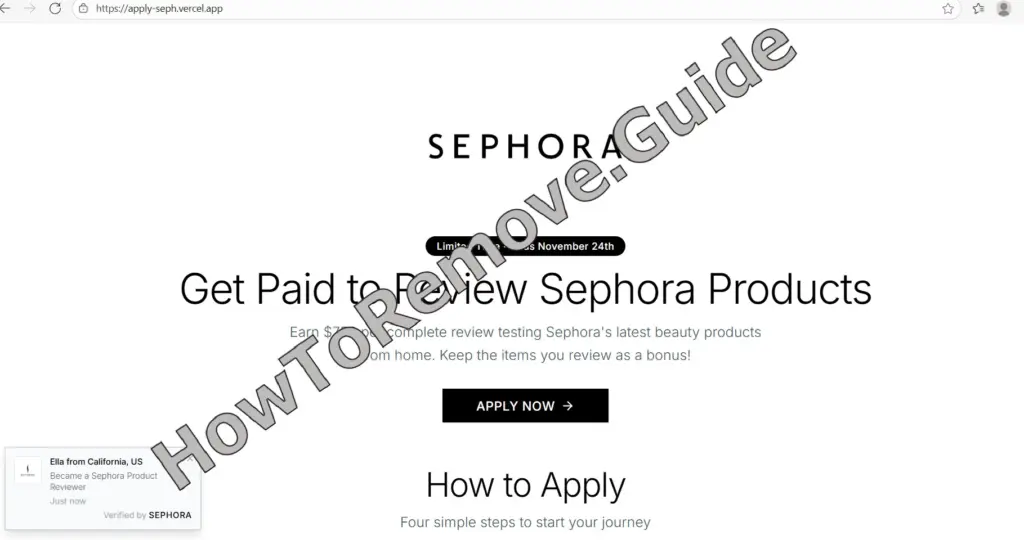
And that’s exactly the point. The scammers, similar to TikWatcher, want you excited, not thinking. They want you focused on seven hundred and fifty dollars per complete review and the idea of boxes of beauty products showing up at your door. Nobody is supposed to pause and ask, “Wait, why would any company pay that much per review?” because once you ask that question, the whole thing starts to crumble. Even ten dollars per review would be generous at scale, so seven hundred and fifty dollars is not just unrealistic, it’s screaming that something isn’t right.
When you hit that Apply Now button, the real funnel begins. You might start on applyseph.com, then get bounced to apply-seph.vercell.app, then on again to a site like rewarduplevel.com, and finally land on uplevelrewards.com or tiktok.com. To someone who doesn’t watch this stuff for a living, it just feels like the page is loading or updating. To someone who has seen this pattern over and over, it looks exactly like a classic survey scam chain dressed up in beauty-review clothing.
Once you reach uplevelrewards.com, the story shifts slightly but the core promise stays the same. Now you’re told that you can qualify for a seven hundred and fifty dollar Sephora gift card or credit if you complete some “simple deals” or offers. It sounds like easy money: sign up for a few things, click through some pages, maybe answer a couple of questions, and then enjoy your huge reward. Except that is not how it plays out for most people.
If you scroll all the way down to the very bottom of the uplevelrewards site and actually open the terms and conditions, you’ll see a phrase that explains why this whole thing exists: “marketing partners”. This is the part almost nobody reads, but it’s where the real business model is hiding. You hand over your first name, last name, email address, phone number, and whatever else they ask for, and that information can be shared with dozens or even hundreds of companies. Those companies can then start hitting you with calls, texts, and marketing emails, all because you thought you were signing up to review makeup.
As far as the big brand at the center of the promise goes, it isn’t involved at all. The name and logo are just bait. This isn’t a secret official reviewer program, and there’s no direct path from any of these sites to a real job testing beauty products. People who dig into this setup find that applyseph.com is a newly created domain with unclear ownership, vague or missing contact details, and content that raises all kinds of trust issues. On top of that, the site uses tools like Google Tag Manager to drop and update tracking tags, which is great for whoever is running the funnel and terrible for your privacy.
What to Do If You’ve Fallen for the Scam
Now, what happens to the average person who doesn’t know any of this and just wants a fun side hustle? They follow the steps. They click Apply Now, they fill out forms, they maybe even complete a long list of offers and surveys because the site keeps telling them they are “almost there”. They see dashboards and progress bars and numbers going up. They might even be told they’ve “qualified” for the big reward. But when it comes to actually getting the seven hundred and fifty dollars or the gift card, the story shifts again.
Some people report that they never receive anything at all, even after doing everything they were told. Others get pushed into more apps and more programs that promise other rewards, keeping them stuck in a loop of sign-ups and data grabbing. Their inbox fills up, their phone starts buzzing with unknown numbers and promotional texts, and the only thing that has clearly increased is the amount of spam they receive. In other words, the so-called opportunity is a machine for harvesting personal information, not a path to easy cash.
If you’ve already gone down this road, you might be wondering if you’re doomed. No, you’re probably not doomed, but you do need to be realistic about what happened. Your information may already be circulating through a network of marketing partners connected to sites like uplevelrewards.com and companies tied to survey-style schemes. You can’t easily pull it back once it’s out there, but you can at least be prepared for the fallout: more spam, more calls, more pitches that look a lot like the one that pulled you in the first time.
Recognizing Warning Signs of the ApplySeph Scam
This is why it’s so important to slow down the next time a breathless ad tells you that you can earn life-changing money for almost no work. Ask yourself a couple of basic questions. Does the payoff make even remote sense? Is the brand supposedly behind it actually talking about this program on its own official site? Do you see freshly registered domains, strange redirect chains, and vague mentions of “partners” or “marketing” buried in the small print? These are not little details. They’re the red flags that people only notice after they’ve already been burned.
From a distance, the ApplySeph setup looks polished enough to pass a casual glance test. There’s the beauty branding, the big numbers, the talk of early access and side hustles and flexible hours. But if you dig even a little bit, you find the same pattern that has been used in survey-driven scams for years: unrealistic rewards, endless hoops to jump through, and a business model that runs on collecting and selling data rather than paying out what was promised.
Final Words
So the next time you see an ad dangling seven hundred and fifty dollars in front of you for something as simple as a product review, remember this. Real opportunities do not have to hide behind new domains, confusing redirect chains, and walls of legal language about marketing partners. They also don’t need to shout “limited time” every other line to push you into rushing. Take a breath, close the tab if something feels off, and keep your personal information out of funnels that see you as the product, not the customer.
