

SnapRizz is a newly emerged scam site that promises its potential victims access to private Snapchat information that no outside tool could ever legitimately reveal.
People go to it expecting shortcuts to someone’s location, conversations, or hidden photo folders, and that is how they get caught up in a system designed to collect and steal their data and compromise their own virtual privacy.
SnapRizz and other sites like it, including Streakvade and VadeTroid, rely on emotional triggers – curiosity, jealousy, suspicion – to disguise the fact that they have no connection to Snapchat’s internal systems.
Once the visitor enters a username, SnapRizz launches a paper-thin (but still semi-convincing) performance involving fake messages and animated progress bars that are designed to look like real technical activity. It’s supposed to look reassuring and imitate Snapchat’s aesthetics so the visitor doesn’t suspect harmful activity.
But as I said, it’s all an act intended to keep you occupied long enough for the scam to begin extracting value. That value could be your browsing data, or any credentials you may be asked to enter. Or worse yet, the site may ask you to download some sketchy app that’s actually malware.
In any case, interacting with anything on SnapRizz is bad, and if you’ve already engaged with the site’s contents, you need to take measures to secure all your accounts and your device. Read the rest of this post to find out more about the ways to protect yourself.
Understanding the SnapRizz.com Scam
SnapRizz.com functions as a deceptive platform disguised as a Snapchat-monitoring tool. Its operators build the experience around ideas that sound technologically feasible to someone unfamiliar with the way Snapchat protects data. They promise access to private chats, “My Eyes Only” folders, and location histories, yet none of those can be accessed externally without credentials.
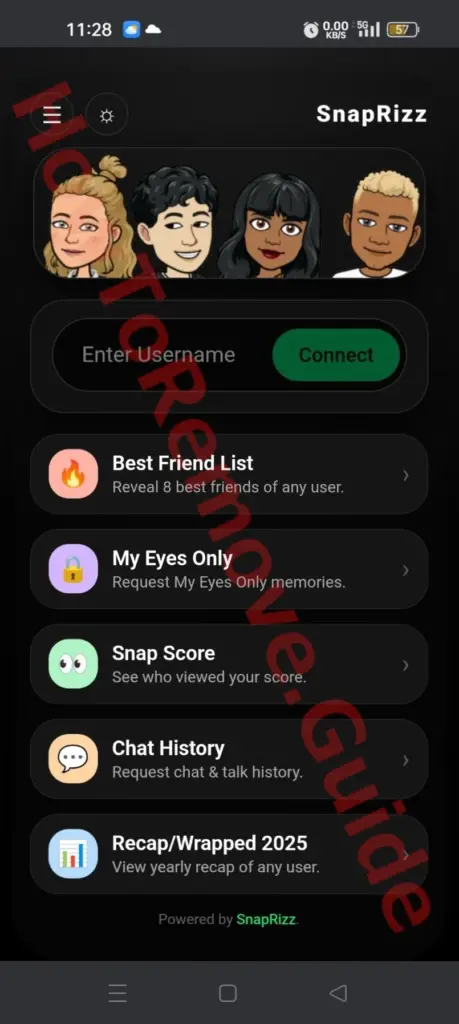
The scam’s structure is remarkably consistent. Once the visitor types in a username, a scripted sequence begins, showing phrases that mimic system-level activity. The thing is…those lines are not connected to any real network or server; they exist to deepen the illusion that the site is performing a complicated retrieval process. By the time the sequence ends, the visitor has usually invested enough attention to be receptive to whatever comes next.
I mean, that next step always involves “verification” demands. These are not security checks; they are revenue tactics such as app downloads, surveys, data collection forms, or subscription links. None unlocks anything except additional requests.
What to Do If You’ve Fallen for the SnapRizz Scam
Responding quickly is essential because the scam’s effects can reach beyond the moment you leave the site. Start by closing SnapRizz entirely and wiping its traces from your browser. Clearing cookies, cached files, and browsing history removes scripts that might continue tracking your activity. Next, uninstall any apps the site convinced you to download; these may display intrusive ads, collect data, or introduce security risks.
After removing those items, run a full device scan using security software that can detect malware, adware, or hidden processes. Allow the tool to quarantine anything suspicious. Once your device is clean, examine your mobile bill and account statements carefully. Unauthorized charges often hide under names that appear unrelated, so look for anything you do not recognize. Contact your carrier immediately if you find premium SMS services or recurring charges you never approved.
Finish by updating passwords on major accounts and enabling two-factor authentication. These steps limit damage if your information was captured earlier in the process.
How the SnapRizz Scam Tricks You
The scam thrives because it mirrors common expectations about what a “hacking” tool might look like. Fake progress bars, scrolling text, and technical jargon feel convincing enough that many visitors assume the site must be doing something real. Meanwhile, the emotional pull – wanting answers or reassurance – makes the visitor less likely to question the setup.
Once the staged sequence finishes, SnapRizz shifts into the monetization phase. Every survey, download, or subscription is designed to generate income for the operators. Each step is framed as the final requirement before data appears, yet the promised information never materializes. Instead, the user gets redirected into more tasks and more empty promises, creating an endless cycle meant to drain attention, data, and sometimes money.
These tactics succeed because they mimic patterns found in legitimate apps, but none of those real tools ask for unrelated offers in exchange for access. That contrast is often the clearest indication that something is wrong.
Recognizing Warning Signs of the SnapRizz Scam
Early recognition prevents deeper involvement. Watch for any site claiming it can access private Snapchat information without login credentials; such access simply isn’t possible. A second red flag appears when the site presents fast-moving animations intended to look like server communication. Legitimate services do not fabricate progress bars as entertainment.
Another concern arises when the site requires unrelated actions before displaying results. Surveys, app downloads, and subscription offers have nothing to do with verifying identity or accessing data. They are mechanisms for profit, not security. These signals combine into a pattern: a bold promise, a flashy imitation of technical work, and a set of tasks that benefit the operators while offering nothing in return. Paying attention to that pattern makes it easier to exit before any damage occurs.
Conclusion
No matter how convincing SnapRizz appears, the service cannot deliver the private Snapchat information it advertises. The operation relies on fabricated interfaces, emotional pressure, and continuous attempts to extract data or money from the visitor. Recognizing the impossibility of the promised features is the most effective defense. If you encounter similar sites, leaving immediately and avoiding any interaction protects your privacy and your device. Staying alert to these tactics also helps you guide others away from the same risks, reducing the reach of scams built on manufactured urgency and illusion.
