

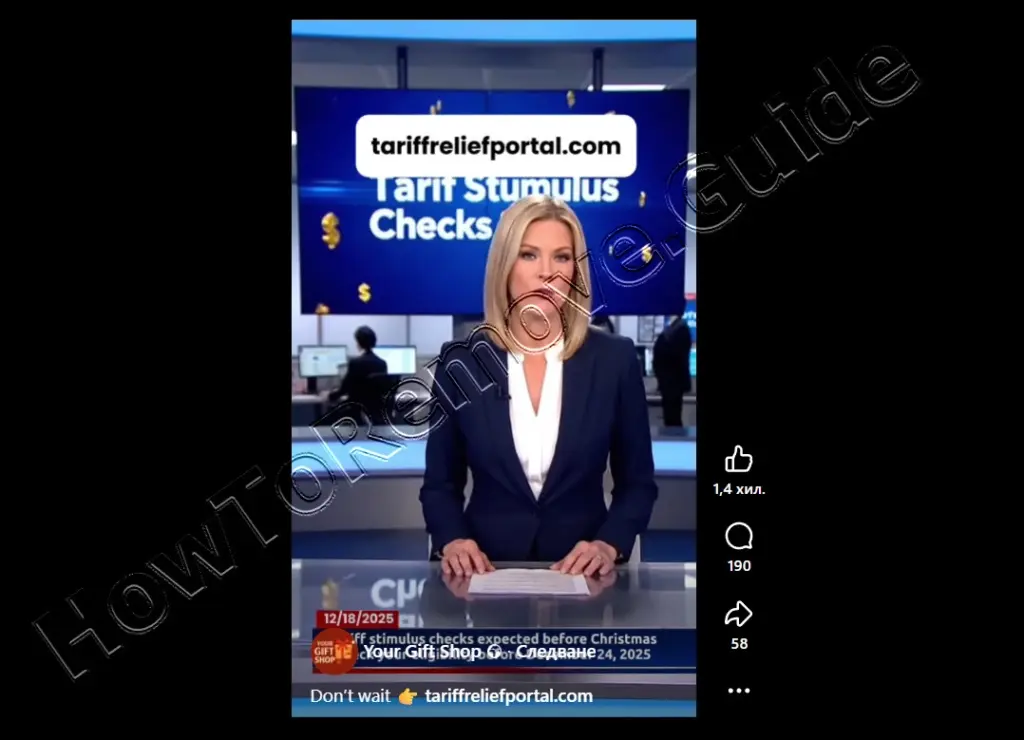
So picture this, you land on a clean benefits page that feels official and there is a friendly green button that says “Check My Eligibility” and your brain wants to treat it like a normal public service step. That is the moment TariffReliefPortal.com is built for. As of late 2025 TariffReliefPortal.com has been promoted in social media posts, especially on Facebook, with urgent prompts to “check your status” before “delays build fast,” and the whole setup is designed to catch you while you are moving fast and hoping for good news.
Here is what it promises, “find out if you qualify for $2,000 in tariff assistance” in “2 minutes.” On a landing page like (Ibuhrtenaksk.myfunnelish.com) It flashes social proof like “Anthony R. from Ohio started the 2-minute eligibility check,” it pressures you with a countdown timer such as “Application closes in 02:59:45,” and it nudges you with “Apply now.” Time out, those are not proof of an active government program, those are conversion tools. The goal is not to help you get $2,000, the goal is to get your click and then your information before you stop and ask who is behind this and why you should trust it.
Scams of TariffReliefPortal.com‘s type are known to steal personal data and passwords. Install SpyHunter Pro to scan for risks, remove any dangerous trackers, and enable real-time protection.

Try Free For 7 Days*
Buy now15% OFF if you buy straight without trial.
 OFFER
OFFERUnderstanding the TariffReliefPortal.com Scam
Zoom out and you see the template, TariffReliefPortal.com sits inside a wave of “benefit portal” sites, similar to VadeTroid and StreakVade, that swap themes depending on what people are searching for, one month it is “unclaimed money,” another month it is “stimulus eligibility,” then it becomes “tariff assistance,” “tariff dividend,” or “tariff relief.” The theme changes, the strategy stays the same. The red flags listed in the text are blunt: it is not a .gov site, there is no clear agency name tied to a real federal department, and there are no real customer support details you can verify. It also says the site has been associated with claims about 2025 tax changes and senior-specific relief that have not been verified by official government sources. And to make it even more uncomfortable, some users reported their antivirus software immediately quarantined viruses or flagged the site as a threat when they tried to use it.
How the TariffReliefPortal.com Scam Works, Step by Step
Now let’s walk the funnel, step one is the hook headline, “Find out if you qualify for $2,000,” and the $2,000 number is clean and memorable. Step two is the trust layer, “2-minute eligibility check,” because two minutes feels low effort and low risk and people tell themselves “I will just see what it says.” Step three is the pressure layer, the countdown timer, and the text notes the timer is often not a real deadline, it can reset or be tied to your session. Step four is the social proof layer, that live looking activity bar, and the text explains these “live updates” are usually automated scripts that rotate names and locations, so “Anthony R. from Ohio” is not evidence anyone got paid, it is a nudge meant to make you feel safe because other people are “doing it.”
After you click “Check My Eligibility” you enter data capture, and it usually starts light. You may be asked for ZIP code, age range, employment status, household size, and income bracket, which makes the process feel official while building a profile valuable to marketers. Even if you stop early, the text warns tracking scripts may still collect device type, browser fingerprinting signals, and IP location. Then comes the engineered result, “You are eligible,” because the point is continuation, not a truthful screening. If they tell you “not eligible” the funnel ends, so the result is designed to keep you moving.
Then comes the real ask, your email and phone number, often framed as needing to “send your results” or “confirm eligibility.” The moment you submit that contact info you can be added to lead lists, marketing databases, SMS campaigns, and robocall pipelines. And the text is clear that this can escalate, first your ZIP code, then your email, then your phone number, then “verification” details, then “confirm your identity” fields, then a redirect (Ibuhrtenaksk.myfunnelish[.]com) to a form that looks more official. After that, many portals send you somewhere else, because this is where the money gets made.
Now the redirect stage is where the money gets made. You may land on survey pages, credit score offers, insurance quote forms, subscription trials, finance lead forms, or “rewards” signups, and the text explains the site earns affiliate payouts when users click through, submit a form, start a free trial, provide contact details again, or agree to marketing terms. Even if you do not buy anything, your participation can still generate revenue. And then the aftermath hits, a sharp increase in spam emails, more robocalls, text messages claiming you have been approved, and follow up scams that try to take the next step. The text specifically warns about fake agents offering “help,” and messages pushing links to “verify your identity,” because once they know your ZIP code and that you were hunting for tariff relief, they can tailor the pitch to you.
What to Do If You’ve Fallen for the TariffReliefPortal.com Scam
If you already clicked around or entered information, do not spiral, do the practical steps. Stop interacting with the website and any redirects, close the tab, do not go back “to see what happened,” delete any bookmark, and avoid clicking the link again. Write down what you entered, ZIP code, email, phone number, address, or anything more sensitive, because you need an inventory. Change passwords for accounts linked to the email you used, secure that email account first, then important accounts that use that email like banking, payment apps, and shopping accounts, and use a new strong password that you have not used elsewhere. Turn on 2-factor authentication on your email, bank, and major accounts.
Watch for phishing emails and texts that look official, do not click links, do not open attachments, and if a message claims you have been “approved” for $2,000 treat it as suspicious until proven otherwise. Block and report suspicious calls, do not engage, confirm nothing, provide no details, and use call screening if your phone has it. Check your browser and device for unwanted permissions, and if you allowed notifications turn them off because push notifications can flood you with fake alerts.
If you shared sensitive information like full name, address, or birthdate, consider placing a credit freeze, because the text describes it as a strong protective step that prevents new credit accounts from being opened in your name. Monitor your financial accounts even if you did not submit banking details, check bank and card activity regularly for a few weeks, and set up transaction alerts if your bank offers them.
Then report it and warn others. The text recommends reporting through official consumer fraud reporting channels and your state consumer protection office, and also reporting the site through your browser’s phishing and unsafe site tools, and it points to the Federal Trade Commission for fraud reports. For legitimate information about federal benefits, taxes, or relief, use official sources instead of third-party “eligibility checkers,” the text points to IRS.gov for tax related updates and refund status and USA.gov/benefits for authentic information on government financial assistance. Spot portal scams in seconds.
Real programs explain eligibility rules and documentation they do not promise approval and they do not hide who runs the page so when those pieces are missing exit.
Useful Resources for Scam Reporting and Prevention (By Country)
Even when funds move quickly, rapid reporting can still be useful – exchanges and stablecoin issuers sometimes act when law enforcement provides clear documentation. Use the directory below to file complaints and attach your evidence bundle to any related case numbers or platform reports.
Open this to report the scam in your country
| Country / Agency | URL | Category / Use-case | Phone/Email |
| Australia – Crime Stoppers | https://www.crimestoppers.com.au | Anonymous tips about crime | 1800 333 000 |
| Australia – National Anti-Scam Center (Scamwatch) | https://www.scamwatch.gov.au/report-a-scam | General scams; phishing; texts/emails | |
| Australia – Police Assistance Line (non-emergency) | https://www.police.gov.au | Local police report | 131 444 |
| Australia – ReportCyber (ACSC) | https://www.cyber.gov.au/report | Cybercrime (hacks, fraud, extortion) | |
| Canada – Canadian Anti-Fraud Center (CAFC) | https://www.antifraudcentre-centreantifraude.ca/report-signalez-eng.htm | General scams incl. phone/text/email | |
| France – DGCCRF (SignalConso) | https://signal.conso.gouv.fr | Consumer scams/deceptive practices | |
| France – PHAROS – Internet-Signalement | https://www.internet-signalement.gouv.fr | Online content & cybercrime reports | |
| Germany – Bundeskriminalamt / Local Police | https://www.polizei.de/Polizei/DE/Home/home_node.html | Report online fraud | |
| Germany – Weißer Ring – Victim Support | https://weisser-ring.de | Victim support | 116 006 |
| India – DoT Helpline (Sanchar Saathi) | https://sancharsaathi.gov.in | Fraudulent telecom/SIM related | 155260 |
| India – National Consumer Helpline | https://consumerhelpline.gov.in | Consumer scams | 1800-11-4000 / 1915 |
| India – National Cyber Crime Reporting Portal | https://cybercrime.gov.in | Cybercrime incl. online fraud | 1930 |
| Japan – Consumer Affairs Agency (CAA) | https://www.caa.go.jp/policies/policy/consumer_policy/caution/cybercrime/ | Consumer scams | |
| Japan – National Police Agency – Cybercrime | https://www.npa.go.jp/bureau/cyber/ | Cybercrime reporting | |
| Mexico – Guardia Nacional (National Guard) | https://www.gob.mx/gn | Cybercrime reporting | |
| Mexico – Instituto Federal de Telecomunicaciones (IFT) | https://www.ift.org.mx | Telecom/online services scams | |
| Mexico – PROFECO | https://www.gob.mx/profeco | Consumer fraud & ecommerce | |
| Netherlands – AFM – Report investment fraud | https://www.afm.nl/en/consumenten/themas/beleggen/misleiding-misbruik | Investment/crypto | |
| Netherlands – Fraudehelpdesk | https://www.fraudehelpdesk.nl/melden | General scams (incl. phishing/SMS) | 088-7867372 |
| Netherlands – Politie – Meldpunt Internetoplichting | https://www.politie.nl/themas/internetoplichting.html | Online shopping fraud | |
| New Zealand – CERT NZ | https://www.cert.govt.nz/individuals/report-an-issue/ | Phishing, identity scams | |
| New Zealand – Department of Internal Affairs – Spam | https://www.dia.govt.nz/Spam-Contact-Us | Email/SMS spam | [email protected] |
| New Zealand – IDCARE | https://www.idcare.org | Victim support (identity compromise) | 0800 121 068 |
| New Zealand – Netsafe – Report | https://www.netsafe.org.nz/report/ | Online harms & scams | |
| New Zealand – New Zealand Police (non-emergency) | https://www.police.govt.nz/use-105 | Report fraud/online crime | 105 |
| Nigeria – Economic & Financial Crimes Commission (EFCC) | https://www.efcc.gov.ng | Financial scams incl. crypto/investment | [email protected] |
| Nigeria – Nigeria Police Special Fraud Unit (SFU) | https://www.specialfraudunit.org.ng | Serious fraud | Voice/SMS: 0708 227 6895; WhatsApp: 0812 760 9914 |
| Poland – CERT Polska (CERT.PL) | https://cert.pl/en/report/ | Cyber incidents & phishing | |
| Poland – Dyzurnet.pl | https://dyzurnet.pl | Illegal online content (esp. child protection) | |
| Poland – Polish Police (Policja) | https://www.policja.pl | Report scams to police | |
| Singapore – Anti-Scam Centre / Anti-Scam Helpline | https://www.scamalert.sg | General scams; texts; calls | 1800-722-6688 |
| Singapore – Monetary Authority of Singapore (MAS) | https://www.mas.gov.sg/investor-alert-list | Investment/crypto checks | |
| Singapore – Singapore Police Force | https://www.police.gov.sg/iwitness | Police report (cybercrime) | |
| South Africa – Cybersecurity Hub (CSIRT) | https://www.cybersecurityhub.gov.za | Cyber incidents incl. scams | |
| South Africa – South African Fraud Prevention Service (SAFPS) | https://www.safps.org.za | Identity fraud support | 011-867-2234 |
| South Africa – South African Police Service (SAPS) | https://www.saps.gov.za | Police report (cybercrime unit) | |
| South Korea – Korea Communications Commission (KCC) | https://www.kcc.go.kr | Telecom-related fraud | |
| South Korea – Korea Internet & Security Agency (KISA) | https://www.kisa.or.kr | Phishing, online harms | |
| South Korea – Korean National Police Agency – Cyber Bureau | https://ecrm.cyber.go.kr | Cybercrime reporting | |
| Spain – INCIBE – Oficina de Seguridad del Internauta (OSI) | https://www.osi.es/es/reporte | Cybersecurity & online fraud | |
| Spain – Policía Nacional / Guardia Civil | https://www.policia.es | Report scams to police | |
| Sweden – Crime Victim Authority (Brottsoffermyndigheten) | https://www.brottsoffermyndigheten.se | Victim support & compensation | 090–70 82 00 |
| Sweden – Polisen (Swedish Police) | https://polisen.se | Report fraud/cybercrime | 114 14 (non-emergency); 112 (emergency) |
| Sweden – Swedish Consumer Agency (Konsumentverket) | https://www.konsumentverket.se | Unfair business practices | |
| United Arab Emirates – Abu Dhabi Police – Aman Service | https://www.adpolice.gov.ae | Cybercrime tips/reporting | SMS 2828; 800 2626 |
| United Arab Emirates – Dubai Police – eCrime | https://www.dubaipolice.gov.ae | Cybercrime reporting | 04 606 1600 |
| United Arab Emirates – Ministry of Interior – Cyber Crime Dept. | https://www.moi.gov.ae | Cybercrime incl. online scams | |
| United Arab Emirates – Telecommunications Regulatory Authority (TRA) / TDRA | https://www.tra.gov.ae | Telecom-related scams/phishing | |
| United Kingdom – Action Fraud (NFIB) | https://www.actionfraud.police.uk | General scams & cybercrime (non-emergency) | 0300 123 2040 |
| United Kingdom – Citizens Advice Consumer Service | https://www.citizensadvice.org.uk/consumer/get-more-help/if-you-need-more-help-about-a-consumer-issue/ | Consumer problems & scam guidance | 0808 223 1133 |
| United Kingdom – Financial Conduct Authority (FCA) | https://www.fca.org.uk/consumers/report-scam-us | Investment/crypto & financial services | |
| United Kingdom – National Cyber Security Centre (NCSC) | https://www.ncsc.gov.uk/collection/phishing-scams | Phishing emails & suspicious websites | |
| United Kingdom – Stop Scams UK ‘159’ | https://stopscamsuk.org.uk/159 | Banking APP fraud (direct to your bank) | 159 |
| United States – AARP Fraud Watch Network Helpline | https://www.aarp.org/money/scams-fraud/ | Victim support | 833-372-8311 |
| United States – Better Business Bureau – Scam Tracker | https://www.bbb.org/scamtracker | Business/marketplace scams | |
| United States – FBI Internet Crime Complaint Center (IC3) | https://www.ic3.gov | Internet crime incl. investment/crypto | |
| United States – Federal Trade Commission – ReportFraud | https://reportfraud.ftc.gov | General scams, phishing, texts/emails | 1-877-382-4357 |
| United States – National Center for Disaster Fraud | https://www.justice.gov/disaster-fraud | Disaster-related scams | (866) 720-5721 |
| United States – SEC Tips & Complaints | https://www.sec.gov/tcr | Investment & securities/crypto-asset offerings |
