

Eventually, Zalupix introduces the real objective: a required payment to “verify,” “unlock,” or “transfer” winnings. The moment real funds are sent, communication slows or stops entirely. No license details, verifiable company data, or accountability exist behind the interface; Zalupix is a staged illusion built to harvest deposits before vanishing and reappearing under names.
Zalupix is a textbook example of how modern crypto scams use spectacle to replace substance. Short videos, viral posts, and AI-crafted endorsements push the idea that a famous billionaire-backed casino is handing out free money to anyone quick enough to register.
If you already clicked around Zalupix, Kasewin.at, or Vasewin.at, connected a wallet, or sent crypto, treat this as an active security hazard. Take immediate steps to disconnect and secure your accounts by using the guidance below.
Scams of Zalupix.com‘s type are known to steal personal data and passwords. Install SpyHunter Pro to scan for risks, remove any dangerous trackers, and enable real-time protection.

Try Free For 7 Days*
Buy now15% OFF if you buy straight without trial.
 OFFER
OFFERIMPORTANT – START HERE!
If you already interacted with Zalupix, treat it like a live incident. Move fast and assume anything you typed, shared, or approved could be reused later. Work from the assumption that exposed details can be replayed against you.
- Change passwords for your email and exchange accounts immediately; enable authenticator-based 2FA.
- If a seed phrase/private key was entered anywhere, move any remaining funds to a brand-new wallet.
- Do not send extra “verification,” “tax,” or “release” payments.
- Preserve evidence: screenshots, chats, emails, wallet addresses, transaction hashes, and dates.
- If you uploaded ID documents, begin identity monitoring and consider a credit freeze where available.
How to Spot a Fake Crypto Casino
Several warning signs line up with the typical fake-crypto-casino pattern, and together they look more like a designed pressure loop than a random “support problem.” When you look at the markers as a set, Zalupix reads less like a buggy service and more like a process built to keep extracting payments.
Pressure to pay before withdrawing
A primary red flag with Zalupix is being told you must send additional money to access a withdrawal, commonly described as fees, deposits, taxes, or an “upgrade.”
Licensing you can verify
Look for licensing you can confirm away from the website, using official regulator databases instead of badges, logos, or screenshots presented on the page.
Suspiciously easy early wins
A common tell is “too easy” early success, where new accounts win big quickly to create confidence and urgency.
Irreversibility used as pressure
Crypto transfers can be difficult to reverse, so the safest point to stop is before sending a second deposit.
Staged trust signals
Often, the platform’s trust cues feel staged – loud chats, questionable testimonials, and activity popups that read like a script.
Domain-age checks
Do basic background checks before depositing anywhere: review domain age, ownership signals, and whether the operator shows a consistent, verifiable track record.


How the Deception Funnel Usually Plays Out
It helps to view the mechanics as a sequence, because Zalupix often follows a repeatable script: it turns one confusing moment (“why can’t I withdraw?”) into a chain of checkpoints. Once you can name the checkpoint you’re stuck at, it’s easier to stop instead of complying with the next demand.
With Zalupix, the obstacle often becomes a staircase: you pay once, then a new requirement appears, and the cycle continues until you’re ignored, locked out, or redirected. That pattern matters because it turns hope into a simple choice – stop funding the process and focus on securing accounts and preserving evidence.
Promo hooks and referral codes
A short ad, promo code, or viral clip points you toward Zalupix with an offer that sounds wildly out of proportion to reality.

Casino look and bonus hype
Next, the site builds momentum with smooth animations, polished visuals, and constant cues that other people are “winning” right now.

Padded balances, then the lock
Then, the house “lets” you win – especially early – so your brain starts treating the displayed balance as real and reachable.
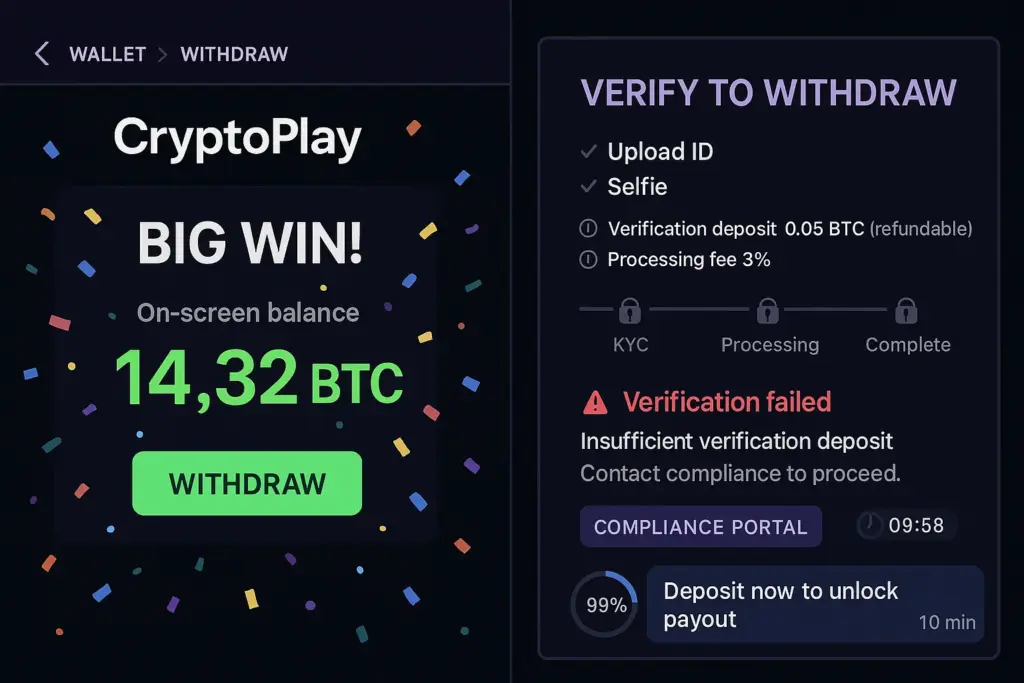
Fee gates and ID harvesting
After that, you try to withdraw and hit a sudden barrier: identity checks, account “flagging,” or a requirement you must satisfy immediately.

Delays, rebrands, and “recovery” bait
At the end, the barrier turns into a staircase: you pay once, a new reason appears, and the cycle repeats until you’re ignored, locked out, or redirected. After the initial loss, you may also receive “recovery” messages that claim they can get funds back for a fee or by “verifying” more information.
Staying safe from crypto casino scams like Elbeaston
Staying safe financially and digitally gets much easier once you follow a few fixed rules that remove the scammer’s main pressure points: urgency, isolation, and “just one more step.” When you recognize how Zalupix depends on rushed choices and repeat transfers, you can replace the emotional swing with a simple routine: verify, pause, and refuse additional payments.
Confirm licensing in official databases
When checking legitimacy, start by verifying whether Zalupix has licensing you can confirm outside the website itself, using official regulator databases rather than badges or screenshots.
Review domain age and history
Do quick background checks before depositing anywhere: domain age, ownership signals, and whether the operator has a consistent track record.
Refuse withdrawal fees and “unlock” deposits
Refuse any demand that you must send extra crypto to “unlock” a payout; real services don’t gate withdrawals behind new payments.
Stick to venues with recourse
When something feels off, stop early; the cheapest lesson is the one you pay for with skepticism, not a second deposit.
Reduce wallet exposure
Use strong account hygiene by default – unique passwords, authenticator 2FA, and separation between email, exchanges, and gambling accounts.
Verify “provably fair” claims
Don’t treat on-screen numbers as money until you can confirm them independently.
Collect proof and report quickly
Keep evidence: screenshots, chats, emails, wallet addresses, transaction hashes, and dates.
Build a slow-down habit
The cure is boring in the best way: rules you follow even when you feel rushed or excited.
Useful Resources for Scam Reporting and Prevention (By Country)
Documentation gives you leverage, even when the final outcome is uncertain. Build a clean timeline: when you first found Zalupix, when you registered, when you deposited, and when the withdrawal trouble began. Keep screenshots of prompts, wallet addresses, the messages you received, and the transaction hashes so your report isn’t dependent on memory.
Click here to report the scam in your country
| Country / Agency | URL | Category / Use-case | Phone/Email |
| Australia – Crime Stoppers | https://www.crimestoppers.com.au | Anonymous tips about crime | 1800 333 000 |
| Australia – National Anti-Scam Center (Scamwatch) | https://www.scamwatch.gov.au/report-a-scam | General scams; phishing; texts/emails | |
| Australia – Police Assistance Line (non-emergency) | https://www.police.gov.au | Local police report | 131 444 |
| Australia – ReportCyber (ACSC) | https://www.cyber.gov.au/report | Cybercrime (hacks, fraud, extortion) | |
| Canada – Canadian Anti-Fraud Center (CAFC) | https://www.antifraudcentre-centreantifraude.ca/report-signalez-eng.htm | General scams incl. phone/text/email | |
| France – DGCCRF (SignalConso) | https://signal.conso.gouv.fr | Consumer scams/deceptive practices | |
| France – PHAROS – Internet-Signalement | https://www.internet-signalement.gouv.fr | Online content & cybercrime reports | |
| Germany – Bundeskriminalamt / Local Police | https://www.polizei.de/Polizei/DE/Home/home_node.html | Report online fraud | |
| Germany – Weißer Ring – Victim Support | https://weisser-ring.de | Victim support | 116 006 |
| India – DoT Helpline (Sanchar Saathi) | https://sancharsaathi.gov.in | Fraudulent telecom/SIM related | 155260 |
| India – National Consumer Helpline | https://consumerhelpline.gov.in | Consumer scams | 1800-11-4000 / 1915 |
| India – National Cyber Crime Reporting Portal | https://cybercrime.gov.in | Cybercrime incl. online fraud | 1930 |
| Japan – Consumer Affairs Agency (CAA) | https://www.caa.go.jp/policies/policy/consumer_policy/caution/cybercrime/ | Consumer scams | |
| Japan – National Police Agency – Cybercrime | https://www.npa.go.jp/bureau/cyber/ | Cybercrime reporting | |
| Mexico – Guardia Nacional (National Guard) | https://www.gob.mx/gn | Cybercrime reporting | |
| Mexico – Instituto Federal de Telecomunicaciones (IFT) | https://www.ift.org.mx | Telecom/online services scams | |
| Mexico – PROFECO | https://www.gob.mx/profeco | Consumer fraud & ecommerce | |
| Netherlands – AFM – Report investment fraud | https://www.afm.nl/en/consumenten/themas/beleggen/misleiding-misbruik | Investment/crypto | |
| Netherlands – Fraudehelpdesk | https://www.fraudehelpdesk.nl/melden | General scams (incl. phishing/SMS) | 088-7867372 |
| Netherlands – Politie – Meldpunt Internetoplichting | https://www.politie.nl/themas/internetoplichting.html | Online shopping fraud | |
| New Zealand – CERT NZ | https://www.cert.govt.nz/individuals/report-an-issue/ | Phishing, identity scams | |
| New Zealand – Department of Internal Affairs – Spam | https://www.dia.govt.nz/Spam-Contact-Us | Email/SMS spam | [email protected] |
| New Zealand – IDCARE | https://www.idcare.org | Victim support (identity compromise) | 0800 121 068 |
| New Zealand – Netsafe – Report | https://www.netsafe.org.nz/report/ | Online harms & scams | |
| New Zealand – New Zealand Police (non-emergency) | https://www.police.govt.nz/use-105 | Report fraud/online crime | 105 |
| Nigeria – Economic & Financial Crimes Commission (EFCC) | https://www.efcc.gov.ng | Financial scams incl. crypto/investment | [email protected] |
| Nigeria – Nigeria Police Special Fraud Unit (SFU) | https://www.specialfraudunit.org.ng | Serious fraud | Voice/SMS: 0708 227 6895; WhatsApp: 0812 760 9914 |
| Poland – CERT Polska (CERT.PL) | https://cert.pl/en/report/ | Cyber incidents & phishing | |
| Poland – Dyzurnet.pl | https://dyzurnet.pl | Illegal online content (esp. child protection) | |
| Poland – Polish Police (Policja) | https://www.policja.pl | Report scams to police | |
| Singapore – Anti-Scam Centre / Anti-Scam Helpline | https://www.scamalert.sg | General scams; texts; calls | 1800-722-6688 |
| Singapore – Monetary Authority of Singapore (MAS) | https://www.mas.gov.sg/investor-alert-list | Investment/crypto checks | |
| Singapore – Singapore Police Force | https://www.police.gov.sg/iwitness | Police report (cybercrime) | |
| South Africa – Cybersecurity Hub (CSIRT) | https://www.cybersecurityhub.gov.za | Cyber incidents incl. scams | |
| South Africa – South African Fraud Prevention Service (SAFPS) | https://www.safps.org.za | Identity fraud support | 011-867-2234 |
| South Africa – South African Police Service (SAPS) | https://www.saps.gov.za | Police report (cybercrime unit) | |
| South Korea – Korea Communications Commission (KCC) | https://www.kcc.go.kr | Telecom-related fraud | |
| South Korea – Korea Internet & Security Agency (KISA) | https://www.kisa.or.kr | Phishing, online harms | |
| South Korea – Korean National Police Agency – Cyber Bureau | https://ecrm.cyber.go.kr | Cybercrime reporting | |
| Spain – INCIBE – Oficina de Seguridad del Internauta (OSI) | https://www.osi.es/es/reporte | Cybersecurity & online fraud | |
| Spain – Policía Nacional / Guardia Civil | https://www.policia.es | Report scams to police | |
| Sweden – Crime Victim Authority (Brottsoffermyndigheten) | https://www.brottsoffermyndigheten.se | Victim support & compensation | 090–70 82 00 |
| Sweden – Polisen (Swedish Police) | https://polisen.se | Report fraud/cybercrime | 114 14 (non-emergency); 112 (emergency) |
| Sweden – Swedish Consumer Agency (Konsumentverket) | https://www.konsumentverket.se | Unfair business practices | |
| United Arab Emirates – Abu Dhabi Police – Aman Service | https://www.adpolice.gov.ae | Cybercrime tips/reporting | SMS 2828; 800 2626 |
| United Arab Emirates – Dubai Police – eCrime | https://www.dubaipolice.gov.ae | Cybercrime reporting | 04 606 1600 |
| United Arab Emirates – Ministry of Interior – Cyber Crime Dept. | https://www.moi.gov.ae | Cybercrime incl. online scams | |
| United Arab Emirates – Telecommunications Regulatory Authority (TRA) / TDRA | https://www.tra.gov.ae | Telecom-related scams/phishing | |
| United Kingdom – Action Fraud (NFIB) | https://www.actionfraud.police.uk | General scams & cybercrime (non-emergency) | 0300 123 2040 |
| United Kingdom – Citizens Advice Consumer Service | https://www.citizensadvice.org.uk/consumer/get-more-help/if-you-need-more-help-about-a-consumer-issue/ | Consumer problems & scam guidance | 0808 223 1133 |
| United Kingdom – Financial Conduct Authority (FCA) | https://www.fca.org.uk/consumers/report-scam-us | Investment/crypto & financial services | |
| United Kingdom – National Cyber Security Centre (NCSC) | https://www.ncsc.gov.uk/collection/phishing-scams | Phishing emails & suspicious websites | |
| United Kingdom – Stop Scams UK ‘159’ | https://stopscamsuk.org.uk/159 | Banking APP fraud (direct to your bank) | 159 |
| United States – AARP Fraud Watch Network Helpline | https://www.aarp.org/money/scams-fraud/ | Victim support | 833-372-8311 |
| United States – Better Business Bureau – Scam Tracker | https://www.bbb.org/scamtracker | Business/marketplace scams | |
| United States – FBI Internet Crime Complaint Center (IC3) | https://www.ic3.gov | Internet crime incl. investment/crypto | |
| United States – Federal Trade Commission – ReportFraud | https://reportfraud.ftc.gov | General scams, phishing, texts/emails | 1-877-382-4357 |
| United States – National Center for Disaster Fraud | https://www.justice.gov/disaster-fraud | Disaster-related scams | (866) 720-5721 |
| United States – SEC Tips & Complaints | https://www.sec.gov/tcr | Investment & securities/crypto-asset offerings |
The antidote is also boring, and that’s useful: rules that don’t negotiate with emotion, especially when pressure is high.
Never send money to receive money.
