

When an email announces a wedding, birthday, or work party, your brain wants to jump straight to “RSVP.” That’s exactly why invitation-themed attacks work: they borrow the warm glow of celebration to smuggle in phishing.
Criminals have been sending messages that mimic Punchbowl invitations, then steering people to pages that quietly push dangerous downloads or harvest passwords. The goal can be quick account takeover, longer-term identity abuse, or simply turning your computer into someone else’s remote toy.
Scams like Punchbowl Invitation Scam are known to steal personal data and passwords. Install SpyHunter Pro to scan for risks, remove dangerous trackers, and enable real-time protection.
 OFFER
OFFER*Source of claim SH can remove it. Trial w/Credit card; image is for illustration; full terms.
Punchbowl itself is a real service used for digital invites and greeting cards, so the branding feels normal at a glance. That normality is the camouflage; attackers lean on familiar logos and polite party language to get one careless click.
I mean… a “secret invite” in your inbox can feel personal even when it’s automated. In the sections below, I’ll break down what this scam looks like, how to confirm a legitimate Punchbowl message, and what to do immediately if you interacted with a fake.
What is the Punchbowl Invitation Scam?
The Punchbowl Invitation Scam is an impersonation attack that arrives as an event invite and tries to lure you into opening a link or “viewing details.” Instead of taking you to Punchbowl, it routes you to a lookalike page on a different domain that the attacker controls.
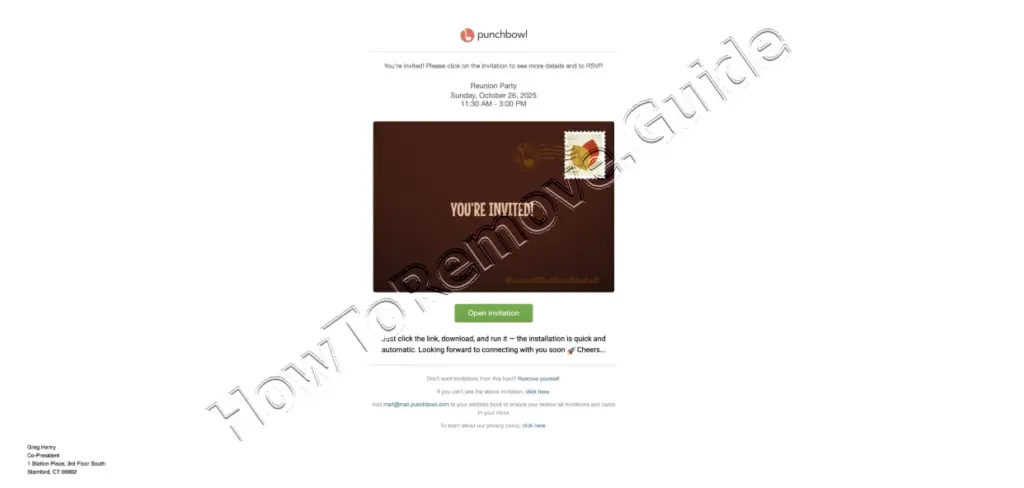
From there, two common outcomes appear. One path pushes a Windows installer file (often an .msi) that can set up remote-access software. Another path shows a “sign in to view” screen that steals your email credentials, then pretends something went wrong.
Is Punchbowl Invitation Legit?
Punchbowl invitations can be completely legitimate, but the verification step is on you. Real invitations sent by the platform arrive from [[email protected]](mailto:[email protected]), and real invitation links begin with the punchbowl.com domain. Legitimate messages also avoid attachments altogether.
The thing is… scammers exploit how most email apps show a friendly display name while hiding the actual sender. On a phone, tap the sender name to reveal the full address, then press-and-hold the RSVP button to preview the destination link before you open anything.
If anything feels off, verify outside the email. Open a fresh tab and type “punchbowl.com” yourself, then check whether the invitation exists there. In the U.S., legitimate Punchbowl texts come from short code 90403, which helps when SMS invites look suspicious.
What to Do If You’ve Fallen for the Punchbowl Invitation Scam
If you clicked an invite link, treat it like a possible exposure until you prove otherwise. Close the tab, avoid re-opening it, and think about what actually happened: did you just view a page, did something download, or did you type a password into a login screen?
The thing is… your next steps should match the risk. A simple click that led nowhere is different from running a downloaded installer, and both are different from giving away your email password. Move fast, but don’t flail; you’re trying to cut off access and preserve evidence.
Before you start “fixing” things, take a breath and work through a short, practical checklist in order. Doing this in sequence matters because attackers often aim for your email account first, then use it to reset other passwords and spread more invites.
* If a file downloaded, disconnect from Wi-Fi or unplug Ethernet, then delete the file from your Downloads folder and empty your Recycle Bin/Trash.
* Run a full antivirus scan with SpyHunter 5 (a reputable security software on Windows and macOS), and restart afterward so quarantined items can’t keep running.
* If you entered a password, change your email account password first, then change any other site where you reused that password.
* Turn on two-factor authentication for your email (Authenticator app or security key if possible), and save backup codes somewhere offline.
* Check account security pages for “recent sign-ins,” new recovery emails/phones, and unknown app access; remove anything you don’t recognize.
* Report the message by forwarding it to [[email protected]](mailto:[email protected]), then send it to [[email protected]](mailto:[email protected]); if money or identity data was involved, file a complaint at the FBI’s IC3 portal.
After the urgent steps, look for quiet damage. Review your email filters and forwarding rules on a desktop browser, because attackers sometimes hide future alerts by shunting messages into archives. Keep an eye on “password reset” emails you didn’t request for the next week.
How the Punchbowl Invitation Scam Tricks You
These campaigns win by blending social engineering with tiny technical nudges. The email may “come from” a friend, include an RSVP deadline, and present a clean invite design so your attention stays on the party theme instead of the web address, even when the domain looks bizarre.
You see… once you click, the scam often tries to keep you moving without thinking. Some landing pages start a download automatically, and others gate the “details” behind a fake CAPTCHA or a familiar-looking Google/Microsoft/Yahoo sign-in choice.
Here’s the twist: the page doesn’t need to accept your password to profit from it. Many credential thieves deliberately show an error so you’ll try a second email address or another password, handing them multiple working combinations in a single session.
Recognizing Warning Signs of the Punchbowl Invitation Scam
Fake Punchbowl invitations usually arrive out of nowhere and try to hurry you along with a single “view” button. A weirdly specific instruction – like “open this on a computer for the best results” – is a red flag, because legitimate invites rarely care what device you use.
Quickest reality check: sender identity. Expand message details and read the full address, not the display name. In Gmail, click the three dots then “Show original”; in Outlook, use “File > Properties.” A real invite should come from @punchbowl.com, not a random mailbox.
Then interrogate the link itself. On desktop, hover over the RSVP button; on mobile, press and hold to preview the destination. Watch for look-alike spellings, extra words, shorteners, or foreign endings like .ru/.de. If the address bar doesn’t show the exact punchbowl.com site after opening, back out.
Pay attention to what the webpage asks you to do. If you hit a CAPTCHA and immediately get pushed into a Google/Microsoft login screen before you can even read the event, assume it’s credential fishing. Any invite that starts a download (.msi, .zip, .exe) is also a hard stop.
Finally, check for “silent” clues after interacting. Sudden inbox chaos – messages auto-archiving, new forwarding, or rules you never made – can signal account tampering. Open your mail settings and review Filters/Rules one by one, and inspect your downloads folder for newly saved installers.
Useful Resources for Scam Reporting and Prevention (By Country)
Click here to report the scam in your country
| Country / Agency | URL | Category / Use-case | Phone/Email |
| Australia – Crime Stoppers | https://www.crimestoppers.com.au | Anonymous tips about crime | 1800 333 000 |
| Australia – National Anti-Scam Center (Scamwatch) | https://www.scamwatch.gov.au/report-a-scam | General scams; phishing; texts/emails | |
| Australia – Police Assistance Line (non-emergency) | https://www.police.gov.au | Local police report | 131 444 |
| Australia – ReportCyber (ACSC) | https://www.cyber.gov.au/report | Cybercrime (hacks, fraud, extortion) | |
| Canada – Canadian Anti-Fraud Center (CAFC) | https://www.antifraudcentre-centreantifraude.ca/report-signalez-eng.htm | General scams incl. phone/text/email | |
| France – DGCCRF (SignalConso) | https://signal.conso.gouv.fr | Consumer scams/deceptive practices | |
| France – PHAROS – Internet-Signalement | https://www.internet-signalement.gouv.fr | Online content & cybercrime reports | |
| Germany – Bundeskriminalamt / Local Police | https://www.polizei.de/Polizei/DE/Home/home_node.html | Report online fraud | |
| Germany – Weißer Ring – Victim Support | https://weisser-ring.de | Victim support | 116 006 |
| India – DoT Helpline (Sanchar Saathi) | https://sancharsaathi.gov.in | Fraudulent telecom/SIM related | 155260 |
| India – National Consumer Helpline | https://consumerhelpline.gov.in | Consumer scams | 1800-11-4000 / 1915 |
| India – National Cyber Crime Reporting Portal | https://cybercrime.gov.in | Cybercrime incl. online fraud | 1930 |
| Japan – Consumer Affairs Agency (CAA) | https://www.caa.go.jp/policies/policy/consumer_policy/caution/cybercrime/ | Consumer scams | |
| Japan – National Police Agency – Cybercrime | https://www.npa.go.jp/bureau/cyber/ | Cybercrime reporting | |
| Mexico – Guardia Nacional (National Guard) | https://www.gob.mx/gn | Cybercrime reporting | |
| Mexico – Instituto Federal de Telecomunicaciones (IFT) | https://www.ift.org.mx | Telecom/online services scams | |
| Mexico – PROFECO | https://www.gob.mx/profeco | Consumer fraud & ecommerce | |
| Netherlands – AFM – Report investment fraud | https://www.afm.nl/en/consumenten/themas/beleggen/misleiding-misbruik | Investment/crypto | |
| Netherlands – Fraudehelpdesk | https://www.fraudehelpdesk.nl/melden | General scams (incl. phishing/SMS) | 088-7867372 |
| Netherlands – Politie – Meldpunt Internetoplichting | https://www.politie.nl/themas/internetoplichting.html | Online shopping fraud | |
| New Zealand – CERT NZ | https://www.cert.govt.nz/individuals/report-an-issue/ | Phishing, identity scams | |
| New Zealand – Department of Internal Affairs – Spam | https://www.dia.govt.nz/Spam-Contact-Us | Email/SMS spam | [email protected] |
| New Zealand – IDCARE | https://www.idcare.org | Victim support (identity compromise) | 0800 121 068 |
| New Zealand – Netsafe – Report | https://www.netsafe.org.nz/report/ | Online harms & scams | |
| New Zealand – New Zealand Police (non-emergency) | https://www.police.govt.nz/use-105 | Report fraud/online crime | 105 |
| Nigeria – Economic & Financial Crimes Commission (EFCC) | https://www.efcc.gov.ng | Financial scams incl. crypto/investment | [email protected] |
| Nigeria – Nigeria Police Special Fraud Unit (SFU) | https://www.specialfraudunit.org.ng | Serious fraud | Voice/SMS: 0708 227 6895; WhatsApp: 0812 760 9914 |
| Poland – CERT Polska (CERT.PL) | https://cert.pl/en/report/ | Cyber incidents & phishing | |
| Poland – Dyzurnet.pl | https://dyzurnet.pl | Illegal online content (esp. child protection) | |
| Poland – Polish Police (Policja) | https://www.policja.pl | Report scams to police | |
| Singapore – Anti-Scam Centre / Anti-Scam Helpline | https://www.scamalert.sg | General scams; texts; calls | 1800-722-6688 |
| Singapore – Monetary Authority of Singapore (MAS) | https://www.mas.gov.sg/investor-alert-list | Investment/crypto checks | |
| Singapore – Singapore Police Force | https://www.police.gov.sg/iwitness | Police report (cybercrime) | |
| South Africa – Cybersecurity Hub (CSIRT) | https://www.cybersecurityhub.gov.za | Cyber incidents incl. scams | |
| South Africa – South African Fraud Prevention Service (SAFPS) | https://www.safps.org.za | Identity fraud support | 011-867-2234 |
| South Africa – South African Police Service (SAPS) | https://www.saps.gov.za | Police report (cybercrime unit) | |
| South Korea – Korea Communications Commission (KCC) | https://www.kcc.go.kr | Telecom-related fraud | |
| South Korea – Korea Internet & Security Agency (KISA) | https://www.kisa.or.kr | Phishing, online harms | |
| South Korea – Korean National Police Agency – Cyber Bureau | https://ecrm.cyber.go.kr | Cybercrime reporting | |
| Spain – INCIBE – Oficina de Seguridad del Internauta (OSI) | https://www.osi.es/es/reporte | Cybersecurity & online fraud | |
| Spain – Policía Nacional / Guardia Civil | https://www.policia.es | Report scams to police | |
| Sweden – Crime Victim Authority (Brottsoffermyndigheten) | https://www.brottsoffermyndigheten.se | Victim support & compensation | 090–70 82 00 |
| Sweden – Polisen (Swedish Police) | https://polisen.se | Report fraud/cybercrime | 114 14 (non-emergency); 112 (emergency) |
| Sweden – Swedish Consumer Agency (Konsumentverket) | https://www.konsumentverket.se | Unfair business practices | |
| United Arab Emirates – Abu Dhabi Police – Aman Service | https://www.adpolice.gov.ae | Cybercrime tips/reporting | SMS 2828; 800 2626 |
| United Arab Emirates – Dubai Police – eCrime | https://www.dubaipolice.gov.ae | Cybercrime reporting | 04 606 1600 |
| United Arab Emirates – Ministry of Interior – Cyber Crime Dept. | https://www.moi.gov.ae | Cybercrime incl. online scams | |
| United Arab Emirates – Telecommunications Regulatory Authority (TRA) / TDRA | https://www.tra.gov.ae | Telecom-related scams/phishing | |
| United Kingdom – Action Fraud (NFIB) | https://www.actionfraud.police.uk | General scams & cybercrime (non-emergency) | 0300 123 2040 |
| United Kingdom – Citizens Advice Consumer Service | https://www.citizensadvice.org.uk/consumer/get-more-help/if-you-need-more-help-about-a-consumer-issue/ | Consumer problems & scam guidance | 0808 223 1133 |
| United Kingdom – Financial Conduct Authority (FCA) | https://www.fca.org.uk/consumers/report-scam-us | Investment/crypto & financial services | |
| United Kingdom – National Cyber Security Centre (NCSC) | https://www.ncsc.gov.uk/collection/phishing-scams | Phishing emails & suspicious websites | |
| United Kingdom – Stop Scams UK ‘159’ | https://stopscamsuk.org.uk/159 | Banking APP fraud (direct to your bank) | 159 |
| United States – AARP Fraud Watch Network Helpline | https://www.aarp.org/money/scams-fraud/ | Victim support | 833-372-8311 |
| United States – Better Business Bureau – Scam Tracker | https://www.bbb.org/scamtracker | Business/marketplace scams | |
| United States – FBI Internet Crime Complaint Center (IC3) | https://www.ic3.gov | Internet crime incl. investment/crypto | |
| United States – Federal Trade Commission – ReportFraud | https://reportfraud.ftc.gov | General scams, phishing, texts/emails | 1-877-382-4357 |
| United States – National Center for Disaster Fraud | https://www.justice.gov/disaster-fraud | Disaster-related scams | (866) 720-5721 |
| United States – SEC Tips & Complaints | https://www.sec.gov/tcr | Investment & securities/crypto-asset offerings |
Conclusion
Punchbowl isn’t the villain here; the brand is the costume. The safest habit is boring but effective: confirm the sender, confirm the domain, and refuse any invitation that tries to make you download software or type credentials just to read details.
I mean… celebrations should cost you time and cake, not your accounts. When something feels slightly “off,” slow down, verify through an independent channel, and report the message so providers can block the infrastructure and protect the next wave of potential guests.
