

Fake gift card pages rarely announce themselves as traps. They borrow a familiar brand, promise a reward that feels believable, and present a short set of steps that seem harmless. That is why pages like Lemongifted.com can catch people who would normally ignore obvious scams.
Lemongifted.com, similar to Producthauls.com and Membercost.com, presents itself as a path to a $500 Lululemon gift card or a similar reward tied to a supposed reviewer program. The pitch is simple: click a button, enter basic details, complete a few offers, and expect the reward to follow.
Scams of Lemongifted.com‘s type are known to steal personal data and passwords. Install SpyHunter Pro to scan for risks, remove any dangerous trackers, and enable real-time protection.

Try Free For 7 Days*
Buy now15% OFF if you buy straight without trial.
 OFFER
OFFERYou see, the persuasive force comes from how ordinary the process looks. A checklist, a bold button, and a small FAQ can make the page feel procedural instead of suspicious, even when the promise is generous and the conditions are vague.
The thing is… a polished page can still exist mainly to push visitors into third-party offers, collect contact details, or steer them toward subscriptions that benefit someone other than the person chasing the reward.
What is Lemongifted.com?
Lemongifted.com is a landing page built around a branded reward claim. At the time of writing, it advertises a $500 gift card, tells visitors to enter email and basic information, and says the reward depends on completing several “recommended deals” after pressing Start Now.
The page also describes those deals as tasks such as app downloads or surveys, and it says users may need to complete between two and five of them to unlock the full value. That places the reward behind third-party actions rather than direct redemption.
A closer look makes the setup more revealing. The main call-to-action does not stay on a Lululemon domain; it routes the click to a different web address, such as ta5dy.edgeoffers[.]com, which suggests the page is functioning as a traffic funnel rather than as an official store or account portal.
You see, the structure matters more than the branding. When a site offers a major branded reward but sends users into outside offers, what you are dealing with is usually a conversion funnel designed to monetize clicks, sign-ups, and completions before any reward reaches the visitor.
Is Lemongifted.com Legit?
A legitimate promotion normally explains who runs it, how the reward is funded, what the rules are, and how eligibility is verified. Lemongifted.com does not offer much visible reassurance on those points from the landing page itself, even though it asks users to trust the promise quickly.
Official Lululemon pages describe gift cards through the brand’s own shopping system and reference its own support resources. Lululemon also has official pages for creator and affiliate relationships, but that is not the same as an outside page promising a gift card after unrelated offer completions.
I mean, legitimacy is not just about whether a page loads without errors. When a branded reward is tied to off-site deals, unclear tracking, and a moving completion threshold, the setup stops looking like a normal promotion and starts looking like a monetized detour.
The wording about finishing two to five deals is especially troubling because it creates elastic requirements. If one task fails to register, or if the platform claims it is still pending, the user can be nudged into more actions without ever reaching a clean finish line.
My assessment is that Lemongifted.com should not be treated as a trustworthy reward page. Even if some users eventually receive something, the design gives the operator an incentive to maximize offer completions first and leave the reward uncertain, delayed, or disputed.
Is Lemongifted.com safe?
Safety is broader than the question of whether a page installs malware. A site can be unsafe because it collects personal information too early, channels visitors toward billing traps, or normalizes redirects that make it harder to see who is really receiving your data.
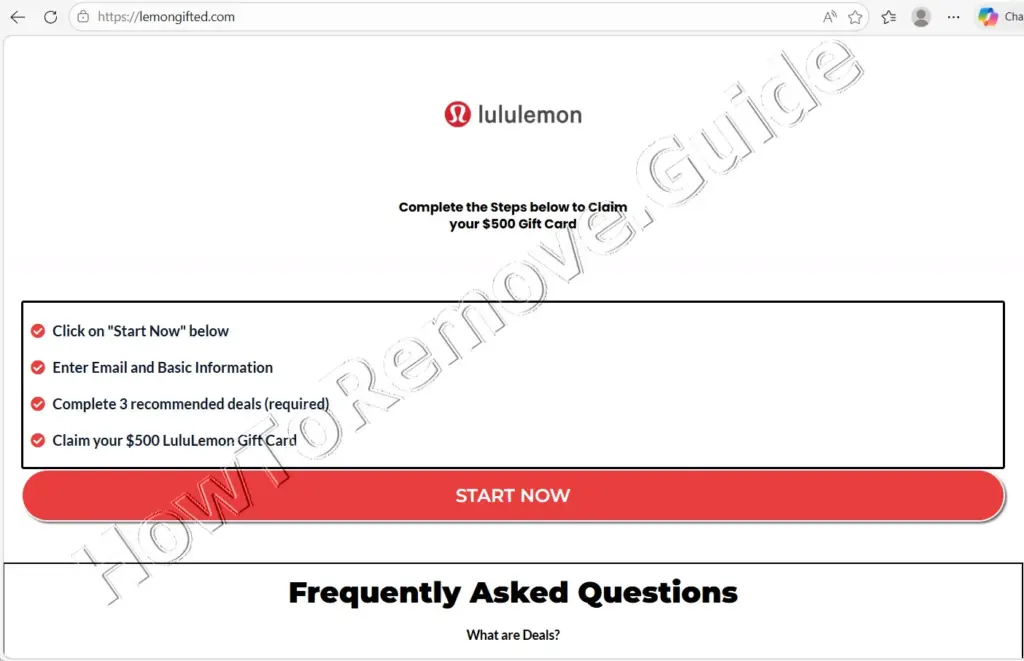
Lemongifted.com asks for email and basic information near the start of the flow, before any visitor has solid proof that the reward is genuine. That creates exposure, because contact details gathered during questionable promotions can feed spam, telemarketing, and follow-up scam attempts.
The next layer of risk comes from the deals themselves. The FTC warns that free trials and auto-renewal offers can become recurring charges if the terms are buried or cancellation is difficult, which fits the kind of offer walls commonly attached to reward funnels.
The thing is… a person does not need to type card details directly into Lemongifted.com to face financial risk. Once the funnel pushes them into outside offers, the danger can shift to subscription sign-ups, sample deals with fees, or forms that collect enough data for future targeting.
I mean, a clean design is not a security credential. Minimal pages are easy to build, and a sparse layout can reduce suspicion while still guiding people into something they should avoid.
What to Do If You’ve Fallen for the Lemongifted.com Scam
The first step is to stop interacting with the page and save evidence before you forget the details. Take screenshots of the offer, the domain name, any confirmation pages, and any emails or texts connected to it, because those records help later.
Next, search your inbox for signs that you joined trials or memberships without fully noticing it. Use terms like “welcome,” “trial,” “subscription,” “invoice,” “receipt,” and “membership,” then make a simple list showing the merchant name, sign-up date, payment method, and cancellation deadline for each offer.
If you entered payment information anywhere in the process, go directly to each merchant’s billing page and cancel immediately. Save confirmation emails and screenshots, then review your bank or card statement for small charges, delayed renewals, or unfamiliar descriptors that could appear days later.
If suspicious charges show up, contact your card issuer or bank without delay using the number on the back of the card or the secure message center in your banking app. Explain that the charge is disputed, ask what documents they need, and request a replacement card if necessary.
Your email account deserves special attention because it can become the control room for other takeovers. Change the password if it was reused anywhere, turn on two-factor authentication, and then update any other accounts that shared the same password, especially shopping, banking, and primary social accounts.
Be ready for a second wave of messages after the original visit. Scam funnels often trigger follow-up emails or texts claiming that your reward is pending, that one more step is required, or that you must verify details, and those messages are often more dangerous than the first page.
Useful Resources for Scam Reporting and Prevention (By Country)
Click here to report the scam in your country
| Country / Agency | URL | Category / Use-case | Phone/Email |
| Australia – Crime Stoppers | https://www.crimestoppers.com.au | Anonymous tips about crime | 1800 333 000 |
| Australia – National Anti-Scam Center (Scamwatch) | https://www.scamwatch.gov.au/report-a-scam | General scams; phishing; texts/emails | |
| Australia – Police Assistance Line (non-emergency) | https://www.police.gov.au | Local police report | 131 444 |
| Australia – ReportCyber (ACSC) | https://www.cyber.gov.au/report | Cybercrime (hacks, fraud, extortion) | |
| Canada – Canadian Anti-Fraud Center (CAFC) | https://www.antifraudcentre-centreantifraude.ca/report-signalez-eng.htm | General scams incl. phone/text/email | |
| France – DGCCRF (SignalConso) | https://signal.conso.gouv.fr | Consumer scams/deceptive practices | |
| France – PHAROS – Internet-Signalement | https://www.internet-signalement.gouv.fr | Online content & cybercrime reports | |
| Germany – Bundeskriminalamt / Local Police | https://www.polizei.de/Polizei/DE/Home/home_node.html | Report online fraud | |
| Germany – Weißer Ring – Victim Support | https://weisser-ring.de | Victim support | 116 006 |
| India – DoT Helpline (Sanchar Saathi) | https://sancharsaathi.gov.in | Fraudulent telecom/SIM related | 155260 |
| India – National Consumer Helpline | https://consumerhelpline.gov.in | Consumer scams | 1800-11-4000 / 1915 |
| India – National Cyber Crime Reporting Portal | https://cybercrime.gov.in | Cybercrime incl. online fraud | 1930 |
| Japan – Consumer Affairs Agency (CAA) | https://www.caa.go.jp/policies/policy/consumer_policy/caution/cybercrime/ | Consumer scams | |
| Japan – National Police Agency – Cybercrime | https://www.npa.go.jp/bureau/cyber/ | Cybercrime reporting | |
| Mexico – Guardia Nacional (National Guard) | https://www.gob.mx/gn | Cybercrime reporting | |
| Mexico – Instituto Federal de Telecomunicaciones (IFT) | https://www.ift.org.mx | Telecom/online services scams | |
| Mexico – PROFECO | https://www.gob.mx/profeco | Consumer fraud & ecommerce | |
| Netherlands – AFM – Report investment fraud | https://www.afm.nl/en/consumenten/themas/beleggen/misleiding-misbruik | Investment/crypto | |
| Netherlands – Fraudehelpdesk | https://www.fraudehelpdesk.nl/melden | General scams (incl. phishing/SMS) | 088-7867372 |
| Netherlands – Politie – Meldpunt Internetoplichting | https://www.politie.nl/themas/internetoplichting.html | Online shopping fraud | |
| New Zealand – CERT NZ | https://www.cert.govt.nz/individuals/report-an-issue/ | Phishing, identity scams | |
| New Zealand – Department of Internal Affairs – Spam | https://www.dia.govt.nz/Spam-Contact-Us | Email/SMS spam | [email protected] |
| New Zealand – IDCARE | https://www.idcare.org | Victim support (identity compromise) | 0800 121 068 |
| New Zealand – Netsafe – Report | https://www.netsafe.org.nz/report/ | Online harms & scams | |
| New Zealand – New Zealand Police (non-emergency) | https://www.police.govt.nz/use-105 | Report fraud/online crime | 105 |
| Nigeria – Economic & Financial Crimes Commission (EFCC) | https://www.efcc.gov.ng | Financial scams incl. crypto/investment | [email protected] |
| Nigeria – Nigeria Police Special Fraud Unit (SFU) | https://www.specialfraudunit.org.ng | Serious fraud | Voice/SMS: 0708 227 6895; WhatsApp: 0812 760 9914 |
| Poland – CERT Polska (CERT.PL) | https://cert.pl/en/report/ | Cyber incidents & phishing | |
| Poland – Dyzurnet.pl | https://dyzurnet.pl | Illegal online content (esp. child protection) | |
| Poland – Polish Police (Policja) | https://www.policja.pl | Report scams to police | |
| Singapore – Anti-Scam Centre / Anti-Scam Helpline | https://www.scamalert.sg | General scams; texts; calls | 1800-722-6688 |
| Singapore – Monetary Authority of Singapore (MAS) | https://www.mas.gov.sg/investor-alert-list | Investment/crypto checks | |
| Singapore – Singapore Police Force | https://www.police.gov.sg/iwitness | Police report (cybercrime) | |
| South Africa – Cybersecurity Hub (CSIRT) | https://www.cybersecurityhub.gov.za | Cyber incidents incl. scams | |
| South Africa – South African Fraud Prevention Service (SAFPS) | https://www.safps.org.za | Identity fraud support | 011-867-2234 |
| South Africa – South African Police Service (SAPS) | https://www.saps.gov.za | Police report (cybercrime unit) | |
| South Korea – Korea Communications Commission (KCC) | https://www.kcc.go.kr | Telecom-related fraud | |
| South Korea – Korea Internet & Security Agency (KISA) | https://www.kisa.or.kr | Phishing, online harms | |
| South Korea – Korean National Police Agency – Cyber Bureau | https://ecrm.cyber.go.kr | Cybercrime reporting | |
| Spain – INCIBE – Oficina de Seguridad del Internauta (OSI) | https://www.osi.es/es/reporte | Cybersecurity & online fraud | |
| Spain – Policía Nacional / Guardia Civil | https://www.policia.es | Report scams to police | |
| Sweden – Crime Victim Authority (Brottsoffermyndigheten) | https://www.brottsoffermyndigheten.se | Victim support & compensation | 090–70 82 00 |
| Sweden – Polisen (Swedish Police) | https://polisen.se | Report fraud/cybercrime | 114 14 (non-emergency); 112 (emergency) |
| Sweden – Swedish Consumer Agency (Konsumentverket) | https://www.konsumentverket.se | Unfair business practices | |
| United Arab Emirates – Abu Dhabi Police – Aman Service | https://www.adpolice.gov.ae | Cybercrime tips/reporting | SMS 2828; 800 2626 |
| United Arab Emirates – Dubai Police – eCrime | https://www.dubaipolice.gov.ae | Cybercrime reporting | 04 606 1600 |
| United Arab Emirates – Ministry of Interior – Cyber Crime Dept. | https://www.moi.gov.ae | Cybercrime incl. online scams | |
| United Arab Emirates – Telecommunications Regulatory Authority (TRA) / TDRA | https://www.tra.gov.ae | Telecom-related scams/phishing | |
| United Kingdom – Action Fraud (NFIB) | https://www.actionfraud.police.uk | General scams & cybercrime (non-emergency) | 0300 123 2040 |
| United Kingdom – Citizens Advice Consumer Service | https://www.citizensadvice.org.uk/consumer/get-more-help/if-you-need-more-help-about-a-consumer-issue/ | Consumer problems & scam guidance | 0808 223 1133 |
| United Kingdom – Financial Conduct Authority (FCA) | https://www.fca.org.uk/consumers/report-scam-us | Investment/crypto & financial services | |
| United Kingdom – National Cyber Security Centre (NCSC) | https://www.ncsc.gov.uk/collection/phishing-scams | Phishing emails & suspicious websites | |
| United Kingdom – Stop Scams UK ‘159’ | https://stopscamsuk.org.uk/159 | Banking APP fraud (direct to your bank) | 159 |
| United States – AARP Fraud Watch Network Helpline | https://www.aarp.org/money/scams-fraud/ | Victim support | 833-372-8311 |
| United States – Better Business Bureau – Scam Tracker | https://www.bbb.org/scamtracker | Business/marketplace scams | |
| United States – FBI Internet Crime Complaint Center (IC3) | https://www.ic3.gov | Internet crime incl. investment/crypto | |
| United States – Federal Trade Commission – ReportFraud | https://reportfraud.ftc.gov | General scams, phishing, texts/emails | 1-877-382-4357 |
| United States – National Center for Disaster Fraud | https://www.justice.gov/disaster-fraud | Disaster-related scams | (866) 720-5721 |
| United States – SEC Tips & Complaints | https://www.sec.gov/tcr | Investment & securities/crypto-asset offerings |
Conclusion
Lemongifted.com is best understood as a reward funnel, not as a straightforward brand promotion. Its promise is simple, but the path to the reward depends on outside deals, ambiguous tracking, and a redirect structure that gives users far less certainty than the polished page suggests.
That does not make every visitor doomed, but it does mean the risk-reward balance is poor. The likely outcomes are wasted time, extra spam, confusing subscriptions, and disputes over whether you did enough, while the supposed prize stays just far enough away to keep the process going.
The safest rule is brutally simple: when a site promises a big brand gift card but locks it behind unrelated offers, walk away and verify promotions through the brand’s own website or app instead. That habit will swat down a surprising amount of digital nonsense before it bites.
