

Giveaway Boat is a very simple, low-effort type of scam, yet it can still fool inexperienced users, especially younger ones, who are looking to get some free Robux for their Roblox accounts.
The site uses the same visual grammar as the actual Roblox site (without being associated with it whatsoever), which lures people, making them think this is a real, legit operation. Giveaway Boat flashes polished artwork, invented counters, and bold promises that are tailored for impatient Roblox players who lack enough experience to spot such scams.
The whole goal of sites like this is to look believable long enough to trap you into their endless cycle of completing mindless tasks that, supposedly, will eventually earn you Robux.
Scams like Giveaway Boat are known to steal personal data and passwords. Install SpyHunter Pro to scan for risks, remove dangerous trackers, and enable real-time protection.
 OFFER
OFFER*Source of claim SH can remove it. Trial w/Credit card; image is for illustration; full terms.
Needless to say, neither Giveaway Boat nor any of its other variants like Apkguide or Tipplow will ever give you anything of value. They just want to waste your time, farm your clicks, and, possibly, collect your personal data.
To protect yourself from Giveaway Boat, read the warning signs and safety advice below before interacting any further.
IMPORTANT! READ BEFORE PROCEEDING!
If you have already interacted with Giveaway Boat, entered a username, approved prompts, or downloaded anything after visiting it, treat the situation as a security problem rather than a failed giveaway. The checklist below covers the first moves you should make to lock down exposed accounts, payment methods, browser settings, and devices.
- Change your passwords on Roblox/email/any reused accounts and enable 2-step verification. Log out of all other sessions.
- Contact your bank immediately and freeze/replace your card, dispute any unexpected charges, and block the merchant. Then cancel any “trial” subscriptions and enable real-time alerts.
- Run a full system scan with a reliable security tool and remove anything flagged. We recommend SpyHunter 5 for this action.
- Revoke suspicious OAuth permissions (Discord, Google, etc.), remove unfamiliar extensions, and clear sketchy site notifications.
- Screenshot any odd activity, contact Roblox Support, and report the scam where you found it.
How We Know Giveaway Boat is a Scam
Pages built like this follow such a familiar pattern that these clues are enough to show Giveaway Boat is CERTAINLY a scam. One strange detail could be luck, but the full cluster below points to manipulation, data harvesting, and affiliate abuse rather than any authentic Roblox promotion:
The prize claim is unrealistically huge
A supposed giveaway that hands out massive amounts of currency to random visitors makes no business sense. Scam pages inflate the number on purpose because a ridiculous reward is more likely to overpower caution, especially for younger players who are focused on the fantasy of what that balance could buy.
The page performs a fake status show
Animated loading bars, spinning wheels, confetti bursts, and “account found” notices are there to manufacture certainty. They are not connected to Roblox systems. They simply create momentum so the visitor feels progress is happening and becomes more willing to finish whatever task appears next.
It sends you through ad-heavy detours
Legitimate reward programs do not bounce people across survey walls, notification prompts, download pages, and affiliate offers. That maze is a revenue machine. Every extra redirect can expose the visitor to more tracking, more pressure, and sometimes more dangerous files.
No accountable operator is visible
These sites often hide behind vague contact pages, empty legal text, or policies that do not match the information being requested. When a page wants usernames, clicks, installs, or payment-linked sign-ups but cannot identify a real business behind the request, that absence matters.
The hype surrounding it is manufactured
Spam comments saying it “worked instantly,” chat messages pushing shortened links, and copied testimonials are common props in this scam category. Social proof is easy to fake. When the main support for a page comes from anonymous strangers repeating the same lines, trust should drop, not rise.
Disposable domains are part of the pattern
A newly registered site does not prove fraud by itself, yet fresh domains often appear in these campaigns because operators burn one name and move to another. Looking up registration details through who.is can help you spot short-lived infrastructure that fits the rest of the warning signs.
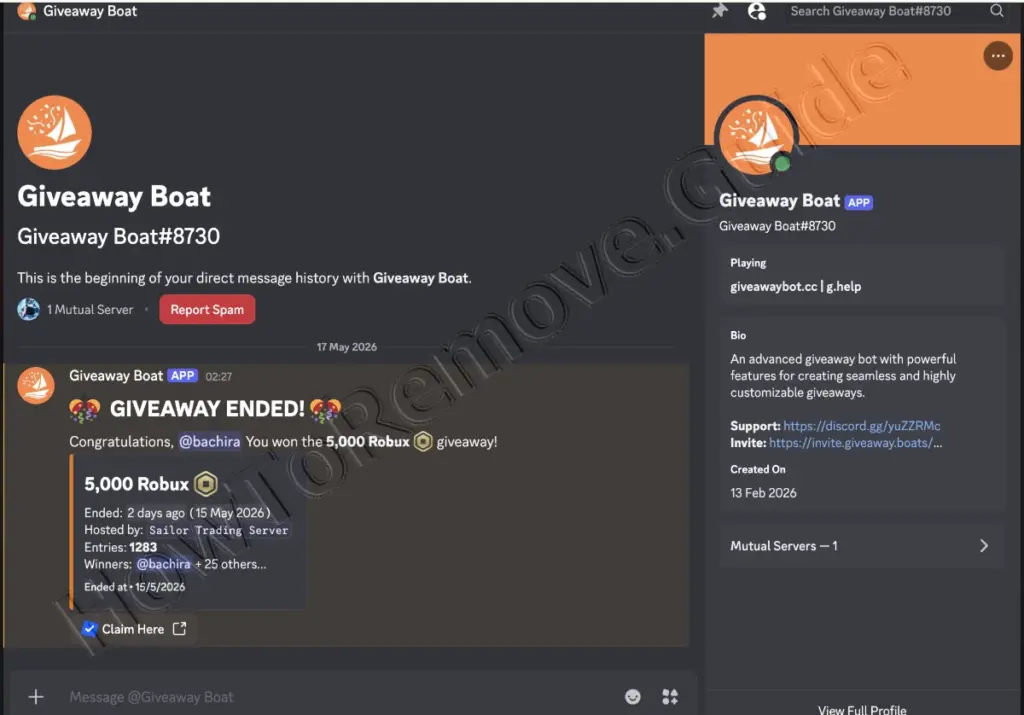

How the Giveaway Boat Scam Deception Funnel Works
To avoid getting dragged deeper into the trap, it helps to understand the sequence the operators rely on. This type of page is not random. It is usually arranged as a staged path that grabs attention, creates false confidence, pushes the visitor into profit-generating tasks, and then exits without delivering anything promised:
Traffic bait reaches players first
The first contact often happens away from the site itself. A flashy video comment, chat message, social post, or search result teases free Robux and funnels the click toward Giveaway Boat before the target has time to question why a real reward would be promoted in such a sketchy way.

The landing page stages credibility
Once opened, the page tries to look close enough to a familiar gaming brand to lower suspicion. It may ask for a Roblox username, display fake inventory checks, or show a made-up support badge so the visitor feels the request is connected to a real platform workflow.

A scripted payout scene builds trust
After the visitor picks an amount, the site usually pretends to process the request. Counters move, status text updates, and a final message claims the balance is almost ready. That artificial buildup is there to make the next barrier feel reasonable instead of suspicious.

Off-site tasks become the money maker
The so-called final step is where the operators cash in. They push surveys, app installs, browser notifications, trial offers, or link sharing because each action can generate affiliate income, harvest personal data, or expose the device to unsafe downloads and persistent advertising.

The reward is always postponed
When tasks are finished, the page usually claims something went wrong, requests one more action, or simply loops the visitor back into the same offers. No Robux appears because delivery was never part of the plan. The intended outcome is wasted time, collected data, and sometimes extra charges or a compromised device.
Staying safe from Robux-site traps like Giveaway Boat
The good news is that a handful of habits can cut off most of the risk before it starts. You do not need to memorize every scam brand. You only need a routine that treats surprise rewards, off-site checks, downloads, and urgent countdowns as reasons to pause, verify, and step back rather than press forward:
Stick to platform-owned announcements
When free items or currency are real, Roblox communicates them through its own channels, not through random pages dropped into comments or direct messages. If the offer is not traceable to an official source you already trust, assume the page is bait and close it.
Refuse “human checks” off-site
Surveys, installs, trial subscriptions, and notification prompts are not security checks. They are the business model. The moment a supposed reward page sends you somewhere else to complete monetized actions, stop. Continuing only gives the operators value while expanding your exposure.
Reduce redirects with browser protection
A solid content blocker, updated browser, and basic security filtering will not solve every problem, but they can reduce malvertising, intrusive pop-ups, and forced jumps to lookalike pages. That makes it harder for scam funnels to keep escalating once an accidental click happens.
Strengthen your key accounts
Use unique passwords for Roblox, email, and chat platforms, and turn on two-step verification wherever possible. Email matters especially because it is often the recovery path for everything else. If one password is reused across services, a small mistake on one page can spread much farther.
Use parent tools for younger players
Kids and teens are frequent targets because the scam is built around speed and excitement. Account PINs, stricter privacy settings, supervised contacts, and a simple rule about asking an adult before claiming any outside reward can interrupt the scam before data or money is exposed.
Build a pause before you tap
Scam pages count on impulse. A short pause is powerful. Check the address, ask who is benefiting, and look for signs of pressure such as timers or giant payout claims. Taking even half a minute to inspect the situation is often enough to break the spell the page is trying to create.
Review connected apps regularly
Every unnecessary app connection is another place where access can linger after a bad decision. Periodically remove old sign-ins, unused extensions, and unfamiliar permissions from accounts like Google, Discord, Apple, or Microsoft so a scam interaction has fewer paths to exploit later.
Never install files for prizes
A page that asks for an APK, browser extension, configuration profile, or desktop installer in exchange for Robux is not giving you a bonus. It is asking you to lower your defenses. Treat that request as a hard stop and scan the device if anything was already downloaded.
Useful Resources for Scam Reporting and Prevention (By Country)
The reference table below lists agencies and reporting channels that can be used to flag pages like XXX. Submitting reports helps payment providers, hosting services, ad networks, consumer watchdogs, and cybercrime teams see repeat abuse faster, which can limit how long one of these schemes stays active.
Open the country-by-country reporting list
| Country / Agency | URL | Category / Use-case | Phone/Email |
| Australia – Crime Stoppers | https://www.crimestoppers.com.au | Anonymous tips about crime | 1800 333 000 |
| Australia – National Anti-Scam Center (Scamwatch) | https://www.scamwatch.gov.au/report-a-scam | General scams; phishing; texts/emails | |
| Australia – Police Assistance Line (non-emergency) | https://www.police.gov.au | Local police report | 131 444 |
| Australia – ReportCyber (ACSC) | https://www.cyber.gov.au/report | Cybercrime (hacks, fraud, extortion) | |
| Canada – Canadian Anti-Fraud Center (CAFC) | https://www.antifraudcentre-centreantifraude.ca/report-signalez-eng.htm | General scams incl. phone/text/email | |
| France – DGCCRF (SignalConso) | https://signal.conso.gouv.fr | Consumer scams/deceptive practices | |
| France – PHAROS – Internet-Signalement | https://www.internet-signalement.gouv.fr | Online content & cybercrime reports | |
| Germany – Bundeskriminalamt / Local Police | https://www.polizei.de/Polizei/DE/Home/home_node.html | Report online fraud | |
| Germany – Weißer Ring – Victim Support | https://weisser-ring.de | Victim support | 116 006 |
| India – DoT Helpline (Sanchar Saathi) | https://sancharsaathi.gov.in | Fraudulent telecom/SIM related | 155260 |
| India – National Consumer Helpline | https://consumerhelpline.gov.in | Consumer scams | 1800-11-4000 / 1915 |
| India – National Cyber Crime Reporting Portal | https://cybercrime.gov.in | Cybercrime incl. online fraud | 1930 |
| Japan – Consumer Affairs Agency (CAA) | https://www.caa.go.jp/policies/policy/consumer_policy/caution/cybercrime/ | Consumer scams | |
| Japan – National Police Agency – Cybercrime | https://www.npa.go.jp/bureau/cyber/ | Cybercrime reporting | |
| Mexico – Guardia Nacional (National Guard) | https://www.gob.mx/gn | Cybercrime reporting | |
| Mexico – Instituto Federal de Telecomunicaciones (IFT) | https://www.ift.org.mx | Telecom/online services scams | |
| Mexico – PROFECO | https://www.gob.mx/profeco | Consumer fraud & ecommerce | |
| Netherlands – AFM – Report investment fraud | https://www.afm.nl/en/consumenten/themas/beleggen/misleiding-misbruik | Investment/crypto | |
| Netherlands – Fraudehelpdesk | https://www.fraudehelpdesk.nl/melden | General scams (incl. phishing/SMS) | 088-7867372 |
| Netherlands – Politie – Meldpunt Internetoplichting | https://www.politie.nl/themas/internetoplichting.html | Online shopping fraud | |
| New Zealand – CERT NZ | https://www.cert.govt.nz/individuals/report-an-issue/ | Phishing, identity scams | |
| New Zealand – Department of Internal Affairs – Spam | https://www.dia.govt.nz/Spam-Contact-Us | Email/SMS spam | [email protected] |
| New Zealand – IDCARE | https://www.idcare.org | Victim support (identity compromise) | 0800 121 068 |
| New Zealand – Netsafe – Report | https://www.netsafe.org.nz/report/ | Online harms & scams | |
| New Zealand – New Zealand Police (non-emergency) | https://www.police.govt.nz/use-105 | Report fraud/online crime | 105 |
| Nigeria – Economic & Financial Crimes Commission (EFCC) | https://www.efcc.gov.ng | Financial scams incl. crypto/investment | [email protected] |
| Nigeria – Nigeria Police Special Fraud Unit (SFU) | https://www.specialfraudunit.org.ng | Serious fraud | Voice/SMS: 0708 227 6895; WhatsApp: 0812 760 9914 |
| Poland – CERT Polska (CERT.PL) | https://cert.pl/en/report/ | Cyber incidents & phishing | |
| Poland – Dyzurnet.pl | https://dyzurnet.pl | Illegal online content (esp. child protection) | |
| Poland – Polish Police (Policja) | https://www.policja.pl | Report scams to police | |
| Singapore – Anti-Scam Centre / Anti-Scam Helpline | https://www.scamalert.sg | General scams; texts; calls | 1800-722-6688 |
| Singapore – Monetary Authority of Singapore (MAS) | https://www.mas.gov.sg/investor-alert-list | Investment/crypto checks | |
| Singapore – Singapore Police Force | https://www.police.gov.sg/iwitness | Police report (cybercrime) | |
| South Africa – Cybersecurity Hub (CSIRT) | https://www.cybersecurityhub.gov.za | Cyber incidents incl. scams | |
| South Africa – South African Fraud Prevention Service (SAFPS) | https://www.safps.org.za | Identity fraud support | 011-867-2234 |
| South Africa – South African Police Service (SAPS) | https://www.saps.gov.za | Police report (cybercrime unit) | |
| South Korea – Korea Communications Commission (KCC) | https://www.kcc.go.kr | Telecom-related fraud | |
| South Korea – Korea Internet & Security Agency (KISA) | https://www.kisa.or.kr | Phishing, online harms | |
| South Korea – Korean National Police Agency – Cyber Bureau | https://ecrm.cyber.go.kr | Cybercrime reporting | |
| Spain – INCIBE – Oficina de Seguridad del Internauta (OSI) | https://www.osi.es/es/reporte | Cybersecurity & online fraud | |
| Spain – Policía Nacional / Guardia Civil | https://www.policia.es | Report scams to police | |
| Sweden – Crime Victim Authority (Brottsoffermyndigheten) | https://www.brottsoffermyndigheten.se | Victim support & compensation | 090–70 82 00 |
| Sweden – Polisen (Swedish Police) | https://polisen.se | Report fraud/cybercrime | 114 14 (non-emergency); 112 (emergency) |
| Sweden – Swedish Consumer Agency (Konsumentverket) | https://www.konsumentverket.se | Unfair business practices | |
| United Arab Emirates – Abu Dhabi Police – Aman Service | https://www.adpolice.gov.ae | Cybercrime tips/reporting | SMS 2828; 800 2626 |
| United Arab Emirates – Dubai Police – eCrime | https://www.dubaipolice.gov.ae | Cybercrime reporting | 04 606 1600 |
| United Arab Emirates – Ministry of Interior – Cyber Crime Dept. | https://www.moi.gov.ae | Cybercrime incl. online scams | |
| United Arab Emirates – Telecommunications Regulatory Authority (TRA) / TDRA | https://www.tra.gov.ae | Telecom-related scams/phishing | |
| United Kingdom – Action Fraud (NFIB) | https://www.actionfraud.police.uk | General scams & cybercrime (non-emergency) | 0300 123 2040 |
| United Kingdom – Citizens Advice Consumer Service | https://www.citizensadvice.org.uk/consumer/get-more-help/if-you-need-more-help-about-a-consumer-issue/ | Consumer problems & scam guidance | 0808 223 1133 |
| United Kingdom – Financial Conduct Authority (FCA) | https://www.fca.org.uk/consumers/report-scam-us | Investment/crypto & financial services | |
| United Kingdom – National Cyber Security Centre (NCSC) | https://www.ncsc.gov.uk/collection/phishing-scams | Phishing emails & suspicious websites | |
| United Kingdom – Stop Scams UK ‘159’ | https://stopscamsuk.org.uk/159 | Banking APP fraud (direct to your bank) | 159 |
| United States – AARP Fraud Watch Network Helpline | https://www.aarp.org/money/scams-fraud/ | Victim support | 833-372-8311 |
| United States – Better Business Bureau – Scam Tracker | https://www.bbb.org/scamtracker | Business/marketplace scams | |
| United States – FBI Internet Crime Complaint Center (IC3) | https://www.ic3.gov | Internet crime incl. investment/crypto | |
| United States – Federal Trade Commission – ReportFraud | https://reportfraud.ftc.gov | General scams, phishing, texts/emails | 1-877-382-4357 |
| United States – National Center for Disaster Fraud | https://www.justice.gov/disaster-fraud | Disaster-related scams | (866) 720-5721 |
| United States – SEC Tips & Complaints | https://www.sec.gov/tcr | Investment & securities/crypto-asset offerings |
