

Did you get an email saying a friend, former coworker, client, or professional contact wants you to endorse them on GainRep? If you were not already talking to that person about recommendations, and suddenly this platform appears asking you to click a button, sign in, or connect your Google, Microsoft, or LinkedIn account, do not roll with it.
The whole hook works because the name in the message is familiar. It feels like a real person is asking for a tiny favor. But according to the reports around GainRep, that tiny favor can turn into a contact list mess where your own network starts getting endorsement requests that look like they came from you.
Now the scary part is not just one weird email. It is the chain reaction. Someone receives a “Quick endorsement request,” clicks because the sender seems real, goes through the endorsement or sign-in process, and then suddenly other people are receiving emails in that person’s name. Some users say they never clearly approved that. Others say the page made sharing contacts feel like part of finishing the review. So before you click, slow down.
Scams of GainRep Endorsment‘s type are known to steal personal data and passwords. Install SpyHunter Pro to scan for risks, remove any dangerous trackers, and enable real-time protection.

Try Free For 7 Days*
Buy now15% OFF if you buy straight without trial.
 OFFER
OFFERWhat is the GainRep Endorsement Scam
GainRep presents itself as a professional reputation and peer endorsement platform. On the surface, that sounds harmless. Who would not want a few nice recommendations from people they have worked with? But here is where the problem begins. Users have described the service as something that pulls them into a loop of contact harvesting and automated invitations, and once that loop starts it can make a normal person look like they are spamming everyone they know.
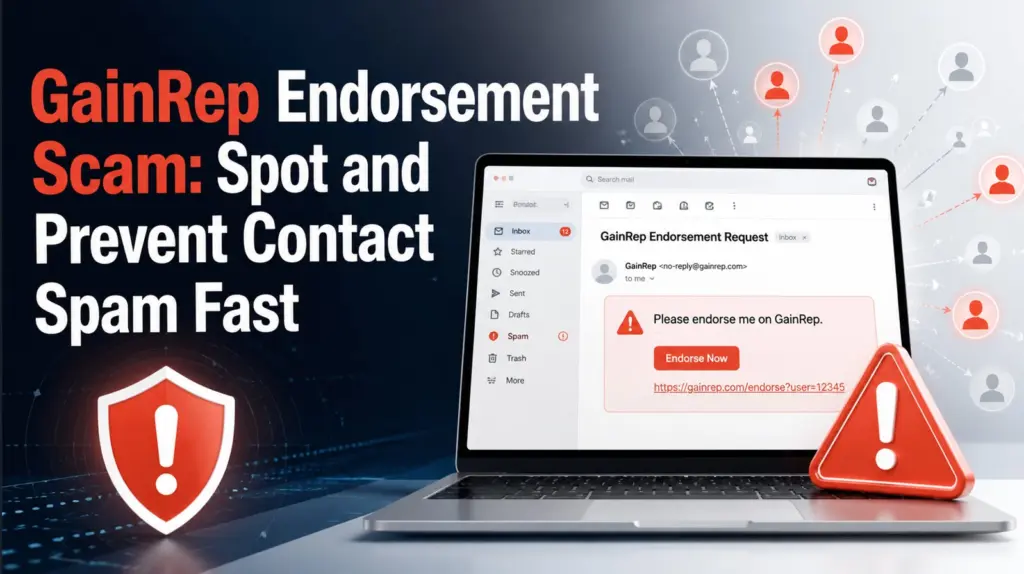
One user said they received an email to endorse a friend, completed the endorsement, and then, all of a sudden, everybody was getting emails from them asking for endorsements. Another person described being stuck in a spam email loop after receiving multiple “Quick endorsement requests” over months, with the requests increasing to a weekly frequency in March 2026. That is important because repeated emails can wear people down. You might ignore the first one. You might ignore the second. But after enough reminders, especially from someone you semi-regularly speak to, you may click just to make it stop.
GainRep’s response says signing up alone does not automatically send invitations. The company says users must provide explicit consent, check a box that says, “I confirm and authorize Gainrep to send invitations to my contacts on my behalf,” and then click the button to continue. They also say future invitations can be stopped from the My Network page. That is their explanation.
But the complaints are about the gap between what users thought they were doing and what happened afterward. One person pointed to the footer text, “You’re receiving this because [Name] entered your email,” and said they never manually entered anyone’s email. That matters because it makes the email sound deliberate when the user says it was not.
What to Do If You’ve Interacted With GainRep Scam
If you clicked the link, signed in, or connected an account, do not sit there hoping it will sort itself out. First, revoke access. If you used Google, go into your Google Account settings, open Security, find third-party apps with account access, locate GainRep, and remove it. If you used Microsoft or LinkedIn, go to the connected apps or permissions area and remove GainRep there too. The point is simple: cut off the permission pathway.
Next, if you can still access GainRep, check the My Network page. GainRep itself says this is where future invitations can be stopped, so look for anything related to contacts, pending invitations, or outgoing requests and shut it down. Now, do not treat that as a replacement for revoking access. Think of it as a second lock on the same door.
Then warn your contacts if messages already went out. A quick note saying you did not intentionally send GainRep endorsement requests can save someone else from clicking because they trust your name. And if you see card charges labeled “GAINREP” or “GAINREP SUBSCRIPTION,” especially amounts in the reported range of $29.99 to $49.99, contact your bank or card issuer and dispute anything you did not authorize.
How the GainRep Scam Tricks You
The trick is familiarity. You are not getting a random message from a stranger promising impossible money. You are getting what looks like a professional request from someone you know. That lowers your guard, and that is exactly why this works.
The process usually begins with an endorsement request, a professional recommendation request, or a request to connect. Then comes the sign-in step. Reports mention Google, Microsoft, and LinkedIn sign-in, and the big warning sign is any request to access or manage your contacts. If all you are trying to do is endorse one person, why does the platform need your whole address book? It does not feel right because it is not a normal requirement for a simple recommendation.
Now remember, giving contact access is not the same as typing in one email address. Users report that after access was granted, the service used their contact list to send invitations more widely. That is how the chain keeps moving. Your name gets used to reach your contacts, their names may get used to reach their contacts, and suddenly the platform spreads through trust instead of through ordinary advertising.
Recognizing Warning Signs of a GainRep Email
The first red flag is surprise. If you were not expecting an endorsement request, treat it carefully. The second red flag is repetition. Multiple “Quick endorsement requests,” especially over weeks or months, are not normal personal follow-ups. They look automated.
Another red flag is the permission screen. If you see wording like “Manage your contacts,” stop. Do not click Allow just because the page feels official. Also watch for the reported red-orange branding and handshake icon. Those details do not prove anything by themselves, but they can help you recognize the pattern if the email lands in your inbox.
And watch the wording. If an email claims you are receiving it because someone entered your email, verify that outside the platform. Text the person. Call them. Message them somewhere else. In one reported case, the supposed sender said they were not personally sending the requests and did not know how to stop them.
Useful Resources for Scam Reporting and Prevention (By Country)
Open the country-by-country reporting list
| Country / Agency | URL | Category / Use-case | Phone/Email |
| Australia – Crime Stoppers | https://www.crimestoppers.com.au | Anonymous tips about crime | 1800 333 000 |
| Australia – National Anti-Scam Center (Scamwatch) | https://www.scamwatch.gov.au/report-a-scam | General scams; phishing; texts/emails | |
| Australia – Police Assistance Line (non-emergency) | https://www.police.gov.au | Local police report | 131 444 |
| Australia – ReportCyber (ACSC) | https://www.cyber.gov.au/report | Cybercrime (hacks, fraud, extortion) | |
| Canada – Canadian Anti-Fraud Center (CAFC) | https://www.antifraudcentre-centreantifraude.ca/report-signalez-eng.htm | General scams incl. phone/text/email | |
| France – DGCCRF (SignalConso) | https://signal.conso.gouv.fr | Consumer scams/deceptive practices | |
| France – PHAROS – Internet-Signalement | https://www.internet-signalement.gouv.fr | Online content & cybercrime reports | |
| Germany – Bundeskriminalamt / Local Police | https://www.polizei.de/Polizei/DE/Home/home_node.html | Report online fraud | |
| Germany – Weißer Ring – Victim Support | https://weisser-ring.de | Victim support | 116 006 |
| India – DoT Helpline (Sanchar Saathi) | https://sancharsaathi.gov.in | Fraudulent telecom/SIM related | 155260 |
| India – National Consumer Helpline | https://consumerhelpline.gov.in | Consumer scams | 1800-11-4000 / 1915 |
| India – National Cyber Crime Reporting Portal | https://cybercrime.gov.in | Cybercrime incl. online fraud | 1930 |
| Japan – Consumer Affairs Agency (CAA) | https://www.caa.go.jp/policies/policy/consumer_policy/caution/cybercrime/ | Consumer scams | |
| Japan – National Police Agency – Cybercrime | https://www.npa.go.jp/bureau/cyber/ | Cybercrime reporting | |
| Mexico – Guardia Nacional (National Guard) | https://www.gob.mx/gn | Cybercrime reporting | |
| Mexico – Instituto Federal de Telecomunicaciones (IFT) | https://www.ift.org.mx | Telecom/online services scams | |
| Mexico – PROFECO | https://www.gob.mx/profeco | Consumer fraud & ecommerce | |
| Netherlands – AFM – Report investment fraud | https://www.afm.nl/en/consumenten/themas/beleggen/misleiding-misbruik | Investment/crypto | |
| Netherlands – Fraudehelpdesk | https://www.fraudehelpdesk.nl/melden | General scams (incl. phishing/SMS) | 088-7867372 |
| Netherlands – Politie – Meldpunt Internetoplichting | https://www.politie.nl/themas/internetoplichting.html | Online shopping fraud | |
| New Zealand – CERT NZ | https://www.cert.govt.nz/individuals/report-an-issue/ | Phishing, identity scams | |
| New Zealand – Department of Internal Affairs – Spam | https://www.dia.govt.nz/Spam-Contact-Us | Email/SMS spam | [email protected] |
| New Zealand – IDCARE | https://www.idcare.org | Victim support (identity compromise) | 0800 121 068 |
| New Zealand – Netsafe – Report | https://www.netsafe.org.nz/report/ | Online harms & scams | |
| New Zealand – New Zealand Police (non-emergency) | https://www.police.govt.nz/use-105 | Report fraud/online crime | 105 |
| Nigeria – Economic & Financial Crimes Commission (EFCC) | https://www.efcc.gov.ng | Financial scams incl. crypto/investment | [email protected] |
| Nigeria – Nigeria Police Special Fraud Unit (SFU) | https://www.specialfraudunit.org.ng | Serious fraud | Voice/SMS: 0708 227 6895; WhatsApp: 0812 760 9914 |
| Poland – CERT Polska (CERT.PL) | https://cert.pl/en/report/ | Cyber incidents & phishing | |
| Poland – Dyzurnet.pl | https://dyzurnet.pl | Illegal online content (esp. child protection) | |
| Poland – Polish Police (Policja) | https://www.policja.pl | Report scams to police | |
| Singapore – Anti-Scam Centre / Anti-Scam Helpline | https://www.scamalert.sg | General scams; texts; calls | 1800-722-6688 |
| Singapore – Monetary Authority of Singapore (MAS) | https://www.mas.gov.sg/investor-alert-list | Investment/crypto checks | |
| Singapore – Singapore Police Force | https://www.police.gov.sg/iwitness | Police report (cybercrime) | |
| South Africa – Cybersecurity Hub (CSIRT) | https://www.cybersecurityhub.gov.za | Cyber incidents incl. scams | |
| South Africa – South African Fraud Prevention Service (SAFPS) | https://www.safps.org.za | Identity fraud support | 011-867-2234 |
| South Africa – South African Police Service (SAPS) | https://www.saps.gov.za | Police report (cybercrime unit) | |
| South Korea – Korea Communications Commission (KCC) | https://www.kcc.go.kr | Telecom-related fraud | |
| South Korea – Korea Internet & Security Agency (KISA) | https://www.kisa.or.kr | Phishing, online harms | |
| South Korea – Korean National Police Agency – Cyber Bureau | https://ecrm.cyber.go.kr | Cybercrime reporting | |
| Spain – INCIBE – Oficina de Seguridad del Internauta (OSI) | https://www.osi.es/es/reporte | Cybersecurity & online fraud | |
| Spain – Policía Nacional / Guardia Civil | https://www.policia.es | Report scams to police | |
| Sweden – Crime Victim Authority (Brottsoffermyndigheten) | https://www.brottsoffermyndigheten.se | Victim support & compensation | 090–70 82 00 |
| Sweden – Polisen (Swedish Police) | https://polisen.se | Report fraud/cybercrime | 114 14 (non-emergency); 112 (emergency) |
| Sweden – Swedish Consumer Agency (Konsumentverket) | https://www.konsumentverket.se | Unfair business practices | |
| United Arab Emirates – Abu Dhabi Police – Aman Service | https://www.adpolice.gov.ae | Cybercrime tips/reporting | SMS 2828; 800 2626 |
| United Arab Emirates – Dubai Police – eCrime | https://www.dubaipolice.gov.ae | Cybercrime reporting | 04 606 1600 |
| United Arab Emirates – Ministry of Interior – Cyber Crime Dept. | https://www.moi.gov.ae | Cybercrime incl. online scams | |
| United Arab Emirates – Telecommunications Regulatory Authority (TRA) / TDRA | https://www.tra.gov.ae | Telecom-related scams/phishing | |
| United Kingdom – Action Fraud (NFIB) | https://www.actionfraud.police.uk | General scams & cybercrime (non-emergency) | 0300 123 2040 |
| United Kingdom – Citizens Advice Consumer Service | https://www.citizensadvice.org.uk/consumer/get-more-help/if-you-need-more-help-about-a-consumer-issue/ | Consumer problems & scam guidance | 0808 223 1133 |
| United Kingdom – Financial Conduct Authority (FCA) | https://www.fca.org.uk/consumers/report-scam-us | Investment/crypto & financial services | |
| United Kingdom – National Cyber Security Centre (NCSC) | https://www.ncsc.gov.uk/collection/phishing-scams | Phishing emails & suspicious websites | |
| United Kingdom – Stop Scams UK ‘159’ | https://stopscamsuk.org.uk/159 | Banking APP fraud (direct to your bank) | 159 |
| United States – AARP Fraud Watch Network Helpline | https://www.aarp.org/money/scams-fraud/ | Victim support | 833-372-8311 |
| United States – Better Business Bureau – Scam Tracker | https://www.bbb.org/scamtracker | Business/marketplace scams | |
| United States – FBI Internet Crime Complaint Center (IC3) | https://www.ic3.gov | Internet crime incl. investment/crypto | |
| United States – Federal Trade Commission – ReportFraud | https://reportfraud.ftc.gov | General scams, phishing, texts/emails | 1-877-382-4357 |
| United States – National Center for Disaster Fraud | https://www.justice.gov/disaster-fraud | Disaster-related scams | (866) 720-5721 |
| United States – SEC Tips & Complaints | https://www.sec.gov/tcr | Investment & securities/crypto-asset offerings |
How to Handle a GainRep Endorsement Request
If a GainRep email shows up, the safest move is boring: do not click, do not sign in, do not connect contacts, and do not grant permissions. Use your email provider’s spam or phishing report tools instead. If you do not trust the message, avoid the internal unsubscribe link too, because the source material warns it may confirm your email is active.
GainRep may describe itself as a tool for building reputation, but the reported experience is the opposite: unwanted invitations, confused contacts, and damage to trust. Before giving any platform access to your contacts, ask yourself one question. Would I be comfortable with this service emailing everyone I know? If the answer is no, close the page.
