

The Andrew Tate Virus Scam is a social-media hijacking campaign where compromised accounts suddenly promote a fake crypto casino or giveaway. Victims often notice strange posts or messages using Andrew Tate branding, exaggerated luxury language, and hooks such as “$2,500 bonus,” “promo code: LAUNCH,” or “Escape Slavery.”
In many reported cases, the visible spam is only the symptom. The real danger is an info-stealer, similar to VectorGatewa.exe, infection that may have collected passwords, cookies, and other browser data, letting criminals reopen logged-in accounts without needing the victim’s current password.
Scams of Andrew Tate‘s type are known to steal personal data and passwords. Install SpyHunter Pro to scan for risks, remove any dangerous trackers, and enable real-time protection.

Try Free For 7 Days*
Buy now15% OFF if you buy straight without trial.
 OFFER
OFFERThat is why people can lose access to Discord, Instagram, LinkedIn, Steam, shopping accounts, or freelance profiles even when two-factor authentication was enabled. The scam may send links to friends, mute replies, trigger account restrictions, attempt purchases, or use the victim’s identity to trick more people.
If this happened after opening a suspicious file, cracked program, cheat tool, or unexpected “game” like Wezowin, Goufax or Zaewex, from a friend, the device should be checked, not just the accounts.
IMPORTANT! READ BEFORE PROCEEDING!
If you deposited crypto, shared documents, connected a wallet, or installed anything after visiting Andrew Tate, treat the incident as an active account-security problem, not just as a failed gambling withdrawal.
Begin by isolating the device and using SpyHunter 5 or another trusted security scanner to check for unwanted software before logging back into wallets, exchanges, or email.
Fastest Removal Option: Use SpyHunter 5
- 1.1Click here to download and install the anti-malware tool on your PC.
- 1.2
 Start SpyHunter 5, click the Buy button and choose between starting your 7-days free trial or directly purchasing the tool.
If you choose to buy SpyHunter 5 now, you can use our discount code, “HTRG15“, for 15% off.
- 1.3
 Once you activate SpyHunter, click Start Scan Now, select the Full Scan option, and let the tool do its job.
 - 1.4
 Once the scan completes (it could take a while, so have patience), you’ll see all malware and other undesirables listed.
Click Next to review the detections and then click Next again to delete all rogue items.
Once the device has been checked, move quickly through the account and identity protections below:
- Reset passwords and enable 2FA on your email, crypto exchanges, and wallets; terminate other active sessions.
- Notify any exchanges and services touched by the funds; provide TxIDs and ask that accounts/addresses be flagged per policy.
- Migrate assets to fresh wallets with new seed phrases and revoke any existing token approvals on connected chains.
- If you uploaded ID documents, place credit/fraud alerts where available and monitor for identity-theft signals.
- Assemble an evidence bundle – wallet addresses, TxIDs, site URLs, chats, and screenshots – and file reports with police/IC3 and any involved platforms.
How We Know Andrew Tate Message is a Scam
Several signs point in the same direction: Andrew Tate behaves like a withdrawal-fee operation wrapped in a casino theme. None of the warning signs alone has to prove intent, but the combination of bonus pressure, unverifiable claims, crypto-only funding, and sudden payout barriers is the classic fake-casino profile.
Payout requests become payment requests
A legitimate withdrawal should reduce friction, not create a new invoice. When a platform asks for a tax, clearance charge, AML fee, verification deposit, or similar payment before releasing funds, the demand is a strong sign the displayed balance is bait.
Ownership and licensing cannot be verified
Scam casinos often copy licensing badges, registration numbers, seals, or support language without a record in official databases. If the company name, domain, and license details do not independently line up, the page is performing legitimacy rather than proving it.
Winning feels too easy too early
Fake platforms commonly let new users see rapid gains or lucky streaks because excitement weakens skepticism. The apparent profit encourages larger deposits and makes the user more willing to pay a fee to save what looks like a valuable balance.
Crypto payments remove recovery leverage
By steering users toward coin transfers, the operator avoids card disputes, bank recalls, and many normal consumer-protection routes. Once the transaction is confirmed on-chain, the victim has very little practical leverage over the receiver.
Trust signals are staged, not verifiable
Live counters, chat snippets, glowing comments, and copied testimonials can make the site feel busy. The problem is that none of those signals can be checked against an independent source, and many clone sites reuse the same social-proof theater.
The domain footprint looks disposable
Short domain history, privacy-masked registration, missing company records, and repeated lookalike designs all suggest churn. A quick public lookup through who.is, web archives, and outside reviews can reveal whether the casino has any real history.


How the Andrew Tate Scam Deception Funnel Works
Knowing the sequence matters because the fraud relies on momentum. Each stage is designed to make the next request feel small compared with the fake balance already shown on the screen, which is why slowing down before paying any withdrawal-related charge is so important.
The usual path is simple: an ad or code creates curiosity, the site displays easy profit, the withdrawal page introduces new conditions, support reframes each delay as routine, and the victim is pushed to send more crypto or documents until they stop cooperating.
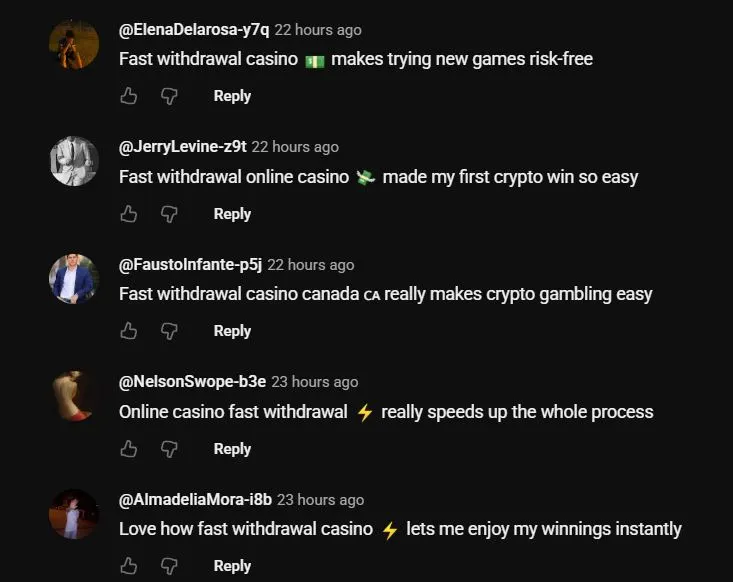
Promo hooks and influencer codes
A user is usually pulled in by a bonus code, a short video, a comment thread, or a direct message that presents the offer as time-sensitive and already used by others. That borrowed excitement is meant to replace independent research.
Casino skin and bonus theater
After the click, the page borrows the look of a real gambling site: bright game tiles, crypto balances, “fair play” language, and bonus dashboards. The polish matters because it convinces visitors they are testing a product instead of entering a controlled funnel.

Inflated balances, then the gate
The account may show quick profits, bonus credit, or a balance that grows with very little effort. Only when the user tries to move that balance out does the system reveal the gate: verification payments, extra deposits, or new account-tier demands.
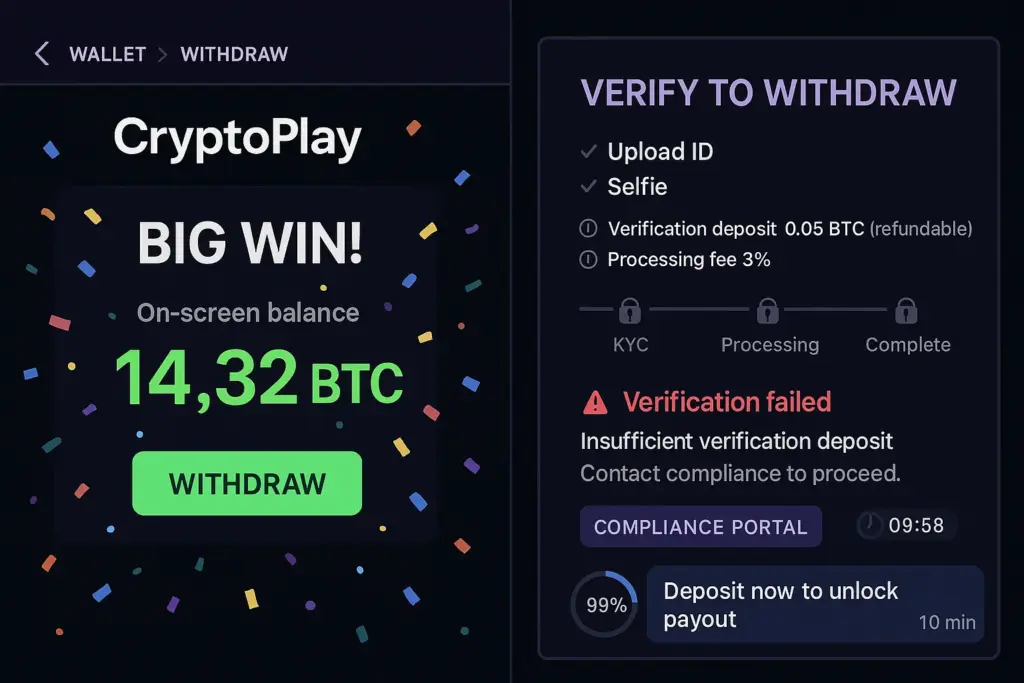
Fee-gates and KYC harvest
Every new excuse protects the same objective. A tax request, VIP upgrade, AML review, or KYC upload keeps the user engaged while extracting more value, either as additional crypto or as identity material that can be abused later.

Stalling, rebrands, and “recovery” bait
When resistance grows, support becomes slow, vague, or sympathetic without solving the problem. The site may disappear or reopen under another name, while separate “recovery” contacts may appear and ask for yet another up-front payment.
Staying safe from crypto casino scams like Andrew Tate
Good prevention starts before the wallet is ever connected. The habits below help turn a tempting offer into a checklist: verify the operator, test the claims outside the site, protect wallet access, and refuse any request that makes you pay in order to be paid.
Verify license status in official registers
Look up the operator in the regulator’s own database, not through logos pasted on the casino page. Search by company name, domain, and license number; a mismatch or missing listing should be treated as a stop sign.
Check domain age and history
Check when the domain was registered, whether ownership is hidden, and whether archive snapshots show a stable business history. Scam networks often rotate fresh domains that look nearly identical to previous versions.
Reject withdrawal fees and “unlock” deposits
Any demand for a “temporary” deposit, tax, activation fee, or clearance payment before withdrawal should end the interaction. Paying usually creates the next excuse rather than releasing the displayed funds.
Prefer venues with recourse
Choose services with clear legal identity, accountable payment channels, written dispute processes, and reputation outside their own website. A casino that accepts only crypto and offers no practical escalation path leaves you exposed.
Limit wallet exposure
Keep gambling, trading, and savings wallets separate. Use a low-balance wallet for testing, avoid connecting primary wallets to unknown sites, enable 2FA, and revoke token approvals that are no longer needed.
Validate “provably fair” claims
Real fairness systems allow independent verification of bets, seeds, hashes, and results. If the explanation is vague, hidden behind marketing language, or impossible to reproduce, assume the claim is there to persuade rather than prove.
Document and report rapidly
Save transaction hashes, wallet addresses, screenshots, emails, chat logs, and the exact URLs involved. Reports are stronger when they include evidence that exchanges, banks, cybercrime units, or consumer-protection agencies can actually review.
Build a deliberate slow-down reflex
Build a delay into every decision that involves a bonus, a withdrawal fee, or a document upload. Waiting ten minutes to verify the domain, license, and reviews can prevent months of identity cleanup.
Useful Resources for Scam Reporting and Prevention (By Country)
If money or documents were already sent, reporting still has value. Exchanges, stablecoin issuers, banks, and law-enforcement units need organized evidence before they can flag accounts or connect your case to a wider investigation. Use the directory below and keep copies of every submission.
Click here to report the scam in your country
| Country / Agency | URL | Category / Use-case | Phone/Email |
| Australia – Crime Stoppers | https://www.crimestoppers.com.au | Anonymous tips about crime | 1800 333 000 |
| Australia – National Anti-Scam Center (Scamwatch) | https://www.scamwatch.gov.au/report-a-scam | General scams; phishing; texts/emails | |
| Australia – Police Assistance Line (non-emergency) | https://www.police.gov.au | Local police report | 131 444 |
| Australia – ReportCyber (ACSC) | https://www.cyber.gov.au/report | Cybercrime (hacks, fraud, extortion) | |
| Canada – Canadian Anti-Fraud Center (CAFC) | https://www.antifraudcentre-centreantifraude.ca/report-signalez-eng.htm | General scams incl. phone/text/email | |
| France – DGCCRF (SignalConso) | https://signal.conso.gouv.fr | Consumer scams/deceptive practices | |
| France – PHAROS – Internet-Signalement | https://www.internet-signalement.gouv.fr | Online content & cybercrime reports | |
| Germany – Bundeskriminalamt / Local Police | https://www.polizei.de/Polizei/DE/Home/home_node.html | Report online fraud | |
| Germany – Weißer Ring – Victim Support | https://weisser-ring.de | Victim support | 116 006 |
| India – DoT Helpline (Sanchar Saathi) | https://sancharsaathi.gov.in | Fraudulent telecom/SIM related | 155260 |
| India – National Consumer Helpline | https://consumerhelpline.gov.in | Consumer scams | 1800-11-4000 / 1915 |
| India – National Cyber Crime Reporting Portal | https://cybercrime.gov.in | Cybercrime incl. online fraud | 1930 |
| Japan – Consumer Affairs Agency (CAA) | https://www.caa.go.jp/policies/policy/consumer_policy/caution/cybercrime/ | Consumer scams | |
| Japan – National Police Agency – Cybercrime | https://www.npa.go.jp/bureau/cyber/ | Cybercrime reporting | |
| Mexico – Guardia Nacional (National Guard) | https://www.gob.mx/gn | Cybercrime reporting | |
| Mexico – Instituto Federal de Telecomunicaciones (IFT) | https://www.ift.org.mx | Telecom/online services scams | |
| Mexico – PROFECO | https://www.gob.mx/profeco | Consumer fraud & ecommerce | |
| Netherlands – AFM – Report investment fraud | https://www.afm.nl/en/consumenten/themas/beleggen/misleiding-misbruik | Investment/crypto | |
| Netherlands – Fraudehelpdesk | https://www.fraudehelpdesk.nl/melden | General scams (incl. phishing/SMS) | 088-7867372 |
| Netherlands – Politie – Meldpunt Internetoplichting | https://www.politie.nl/themas/internetoplichting.html | Online shopping fraud | |
| New Zealand – CERT NZ | https://www.cert.govt.nz/individuals/report-an-issue/ | Phishing, identity scams | |
| New Zealand – Department of Internal Affairs – Spam | https://www.dia.govt.nz/Spam-Contact-Us | Email/SMS spam | [email protected] |
| New Zealand – IDCARE | https://www.idcare.org | Victim support (identity compromise) | 0800 121 068 |
| New Zealand – Netsafe – Report | https://www.netsafe.org.nz/report/ | Online harms & scams | |
| New Zealand – New Zealand Police (non-emergency) | https://www.police.govt.nz/use-105 | Report fraud/online crime | 105 |
| Nigeria – Economic & Financial Crimes Commission (EFCC) | https://www.efcc.gov.ng | Financial scams incl. crypto/investment | [email protected] |
| Nigeria – Nigeria Police Special Fraud Unit (SFU) | https://www.specialfraudunit.org.ng | Serious fraud | Voice/SMS: 0708 227 6895; WhatsApp: 0812 760 9914 |
| Poland – CERT Polska (CERT.PL) | https://cert.pl/en/report/ | Cyber incidents & phishing | |
| Poland – Dyzurnet.pl | https://dyzurnet.pl | Illegal online content (esp. child protection) | |
| Poland – Polish Police (Policja) | https://www.policja.pl | Report scams to police | |
| Singapore – Anti-Scam Centre / Anti-Scam Helpline | https://www.scamalert.sg | General scams; texts; calls | 1800-722-6688 |
| Singapore – Monetary Authority of Singapore (MAS) | https://www.mas.gov.sg/investor-alert-list | Investment/crypto checks | |
| Singapore – Singapore Police Force | https://www.police.gov.sg/iwitness | Police report (cybercrime) | |
| South Africa – Cybersecurity Hub (CSIRT) | https://www.cybersecurityhub.gov.za | Cyber incidents incl. scams | |
| South Africa – South African Fraud Prevention Service (SAFPS) | https://www.safps.org.za | Identity fraud support | 011-867-2234 |
| South Africa – South African Police Service (SAPS) | https://www.saps.gov.za | Police report (cybercrime unit) | |
| South Korea – Korea Communications Commission (KCC) | https://www.kcc.go.kr | Telecom-related fraud | |
| South Korea – Korea Internet & Security Agency (KISA) | https://www.kisa.or.kr | Phishing, online harms | |
| South Korea – Korean National Police Agency – Cyber Bureau | https://ecrm.cyber.go.kr | Cybercrime reporting | |
| Spain – INCIBE – Oficina de Seguridad del Internauta (OSI) | https://www.osi.es/es/reporte | Cybersecurity & online fraud | |
| Spain – Policía Nacional / Guardia Civil | https://www.policia.es | Report scams to police | |
| Sweden – Crime Victim Authority (Brottsoffermyndigheten) | https://www.brottsoffermyndigheten.se | Victim support & compensation | 090–70 82 00 |
| Sweden – Polisen (Swedish Police) | https://polisen.se | Report fraud/cybercrime | 114 14 (non-emergency); 112 (emergency) |
| Sweden – Swedish Consumer Agency (Konsumentverket) | https://www.konsumentverket.se | Unfair business practices | |
| United Arab Emirates – Abu Dhabi Police – Aman Service | https://www.adpolice.gov.ae | Cybercrime tips/reporting | SMS 2828; 800 2626 |
| United Arab Emirates – Dubai Police – eCrime | https://www.dubaipolice.gov.ae | Cybercrime reporting | 04 606 1600 |
| United Arab Emirates – Ministry of Interior – Cyber Crime Dept. | https://www.moi.gov.ae | Cybercrime incl. online scams | |
| United Arab Emirates – Telecommunications Regulatory Authority (TRA) / TDRA | https://www.tra.gov.ae | Telecom-related scams/phishing | |
| United Kingdom – Action Fraud (NFIB) | https://www.actionfraud.police.uk | General scams & cybercrime (non-emergency) | 0300 123 2040 |
| United Kingdom – Citizens Advice Consumer Service | https://www.citizensadvice.org.uk/consumer/get-more-help/if-you-need-more-help-about-a-consumer-issue/ | Consumer problems & scam guidance | 0808 223 1133 |
| United Kingdom – Financial Conduct Authority (FCA) | https://www.fca.org.uk/consumers/report-scam-us | Investment/crypto & financial services | |
| United Kingdom – National Cyber Security Centre (NCSC) | https://www.ncsc.gov.uk/collection/phishing-scams | Phishing emails & suspicious websites | |
| United Kingdom – Stop Scams UK ‘159’ | https://stopscamsuk.org.uk/159 | Banking APP fraud (direct to your bank) | 159 |
| United States – AARP Fraud Watch Network Helpline | https://www.aarp.org/money/scams-fraud/ | Victim support | 833-372-8311 |
| United States – Better Business Bureau – Scam Tracker | https://www.bbb.org/scamtracker | Business/marketplace scams | |
| United States – FBI Internet Crime Complaint Center (IC3) | https://www.ic3.gov | Internet crime incl. investment/crypto | |
| United States – Federal Trade Commission – ReportFraud | https://reportfraud.ftc.gov | General scams, phishing, texts/emails | 1-877-382-4357 |
| United States – National Center for Disaster Fraud | https://www.justice.gov/disaster-fraud | Disaster-related scams | (866) 720-5721 |
| United States – SEC Tips & Complaints | https://www.sec.gov/tcr | Investment & securities/crypto-asset offerings |
The safest reading of Andrew Tate is that the balance, bonus, and withdrawal process are designed to keep users paying rather than cashing out. Secure the device, lock down accounts, move remaining funds to clean wallets, document everything, and refuse any recovery offer that asks for money up front.
