

Cofixplay.com comes in looking like a simple crypto gaming site, right, you sign up, grab a bonus, play a few familiar casino games, and supposedly cash out. But this is where you need to slow down, because that polished page and those big reward numbers can be theater.
The balance you see may not be real money at all. It may just be bait sitting on a screen. Users are often encouraged to believe they have won or unlocked crypto, but trouble begins when they try to cash out or confirm the account.
A major warning sign, similar to Fearwin and Kasowin, is any demand for an extra deposit before withdrawals are allowed. This payment may be described as verification, activation, wallet validation, or a transfer fee, but the result is usually the same: more money leaves the victim’s wallet.
Scams of Cofixplay.com‘s type are known to steal personal data and passwords. Install SpyHunter Pro to scan for risks, remove any dangerous trackers, and enable real-time protection.

Try Free For 7 Days*
Buy now15% OFF if you buy straight without trial.
 OFFER
OFFERCofixplay should be treated as a withdrawal trap, not a safe gaming platform. This article explains the red flags, the risks, and the safer steps to take if you already registered, shared details, or sent cryptocurrency.
IMPORTANT! READ BEFORE PROCEEDING!
If Cofixplay has touched your wallet, accounts, identity documents, or device, handle the situation like a broader security event. Do not focus only on the lost transfer, especially if you clicked downloads, approved wallet prompts, or reused login details.
A clean device matters before any recovery or account-hardening work. At this stage, we recommend running SpyHunter 5 to look for malicious or unwanted items that could interfere with securing email, exchange, and wallet access.
Fastest Removal Option: Use SpyHunter 5
- 1.1Click here to download and install the anti-malware tool on your PC.
- 1.2
 Start SpyHunter 5, click the Buy button and choose between starting your 7-days free trial or directly purchasing the tool.
If you choose to buy SpyHunter 5 now, you can use our discount code, “HTRG15“, for 15% off.
- 1.3
 Once you activate SpyHunter, click Start Scan Now, select the Full Scan option, and let the tool do its job.
 - 1.4
 Once the scan completes (it could take a while, so have patience), you’ll see all malware and other undesirables listed.
Click Next to review the detections and then click Next again to delete all rogue items.
After scanning, apply these additional safeguards without delay:
- Reset passwords and enable 2FA on your email, crypto exchanges, and wallets; terminate other active sessions.
- Notify any exchanges and services touched by the funds; provide TxIDs and ask that accounts/addresses be flagged per policy.
- Migrate assets to fresh wallets with new seed phrases and revoke any existing token approvals on connected chains.
- If you uploaded ID documents, place credit/fraud alerts where available and monitor for identity-theft signals.
- Assemble an evidence bundle – wallet addresses, TxIDs, site URLs, chats, and screenshots – and file reports with police/IC3 and any involved platforms.
How We Know Cofixplay is a Scam
The evidence against Cofixplay is found in how the site behaves when trust becomes expensive. Real gambling platforms clarify rules and identity checks before money moves; fee-gate scams wait until the user feels invested, then attach new costs to withdrawal.
The offer is designed to bypass caution
Huge welcome balances and easy promo codes are not neutral marketing when they come from an unknown crypto site. They push users to skip verification because the reward appears too valuable to miss.
The withdrawal page changes the deal
A platform that accepted deposits without friction may suddenly require payments, documents, or upgrades to release funds. That timing is a major warning because the user’s leverage is weakest after the money is already inside.
The license presentation lacks substance
Scam sites may display seals, numbers, or jurisdiction names that look official. Those details matter only if they can be matched to a real regulator entry and a company legally tied to the same domain.
The winnings encourage sunk-cost thinking
A rapidly increasing balance makes people think in terms of rescue rather than risk. The bigger the displayed payout, the easier it becomes for the scammer to justify “just one more” payment.
Payment irreversibility is part of the design
Direct crypto transfers suit the scam because they are fast and final. When a site avoids ordinary payment protections while demanding separate transfers to release funds, caution should override excitement.
The domain may be built for a short lifespan
Many fake casino brands rely on quick launches and quick replacements. A search through who.is can reveal recent registration, hidden ownership, or patterns that conflict with the site’s confidence claims.


How the Cofixplay Scam Deception Funnel Works
The deception is easier to resist when viewed as a sequence. The site does not need to fool everyone forever; it only needs to keep one user moving from curiosity to deposit to withdrawal panic before doubt takes over.
The common sequence is promotion, registration, fake confidence, blocked cashout, repeated payment requests, and abandonment. After that, another scam may appear in the form of a recovery expert offering to retrieve the funds for an advance fee.
A social hook starts the momentum
The victim may first see a code in a comment, a video, a private message, or an ad. The invitation often implies insider access, which encourages action before basic checks are done.

The platform simulates legitimacy
The website may include games, menus, terms, wallet pages, and automated support replies. Those pieces can be copied or staged, so they should never replace independent verification.

The win screen creates attachment
A fake balance is powerful because it feels like something already owned. Once the victim accepts that idea, the scammer can frame every fee as the path to reclaiming it.
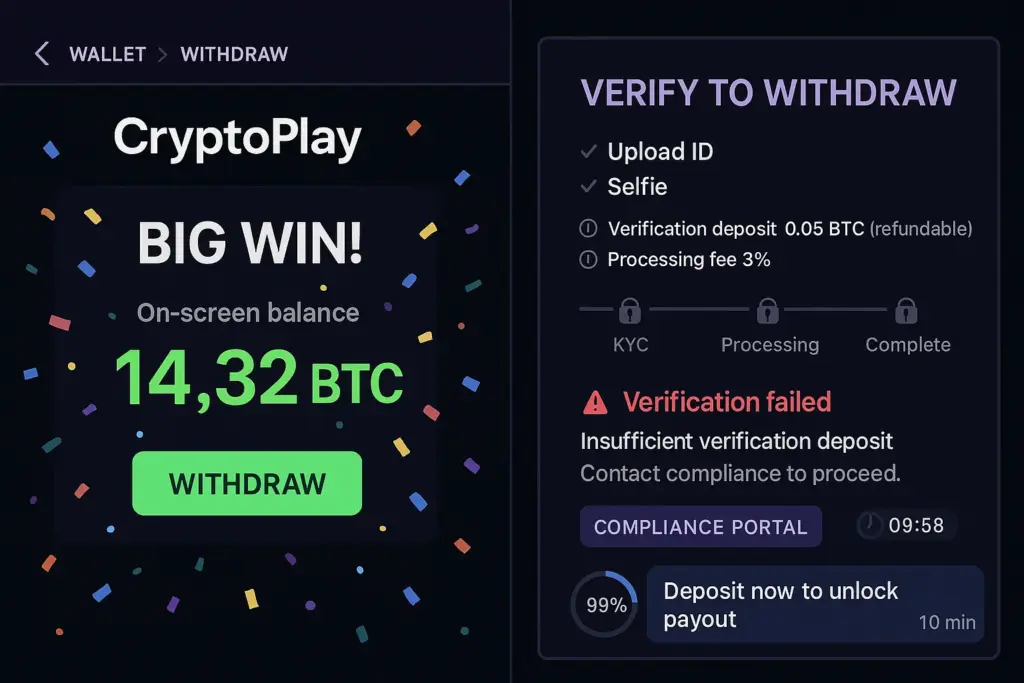
The cashout block extracts more value
Taxes, verification deposits, liquidity checks, VIP upgrades, and wallet activation fees are different labels for the same request. They ask the user to risk real crypto for an unproven payout.

The final phase removes accountability
Support can delay, blame compliance, or stop responding. If complaints pile up, the operators can abandon the domain and redirect new victims to another site using similar language and design.
Staying safe from crypto casino scams like Cofixplay
A good prevention routine is plain and repetitive. Verify first, deposit later. That means checking the company, license, domain age, withdrawal terms, payment methods, and independent reputation before interacting with any casino that asks for crypto.
Verify the regulator entry directly
Use the regulator’s official search tool and compare exact details. If the website cannot be tied to a licensed entity through independent records, the safest answer is not to use it.
Study the domain timeline
Check when the site was registered, whether ownership is hidden, and whether older copies exist. A casino handling funds should not look like it appeared solely for a current promotion.
Do not fund a locked payout
Paying to unlock money is the central trap. Once a site asks for a separate transfer before withdrawal, stop communicating as a customer and start preserving evidence as a victim or target.
Favor accountability over bonus size
Choose platforms that provide verifiable licensing, known payment providers, dispute procedures, and real company contacts. A smaller, checkable offer is safer than a giant balance on an anonymous page.
Keep risky wallets disposable
Use separate wallets for experiments, keep only minimal funds in them, avoid saving seed phrases digitally, and revoke token approvals when finished. Isolation limits how far one bad interaction can spread.
Require proof for fairness claims
Technical terms should be supported by public verification steps. If the site says games are fair but gives no usable method to check outcomes, the claim does not protect you.
Collect records before confronting support
Before asking questions that may trigger account closure, capture screenshots, transaction hashes, wallet addresses, messages, and account pages. Save the domain exactly as visited, including subdomains and paths.
Train yourself to pause under pressure
Urgency is a tool, not a reason. Any demand that must be paid immediately should trigger slower verification, not faster compliance.
Useful Resources for Scam Reporting and Prevention (By Country)
Damage reports are strongest when they include specific technical and financial evidence. Send transaction IDs, wallet addresses, screenshots, and message logs to the relevant agencies and platforms so the case can be connected to other reports.
Check reporting options for your location
| Country / Agency | URL | Category / Use-case | Phone/Email |
| Australia – Crime Stoppers | https://www.crimestoppers.com.au | Anonymous tips about crime | 1800 333 000 |
| Australia – National Anti-Scam Center (Scamwatch) | https://www.scamwatch.gov.au/report-a-scam | General scams; phishing; texts/emails | |
| Australia – Police Assistance Line (non-emergency) | https://www.police.gov.au | Local police report | 131 444 |
| Australia – ReportCyber (ACSC) | https://www.cyber.gov.au/report | Cybercrime (hacks, fraud, extortion) | |
| Canada – Canadian Anti-Fraud Center (CAFC) | https://www.antifraudcentre-centreantifraude.ca/report-signalez-eng.htm | General scams incl. phone/text/email | |
| France – DGCCRF (SignalConso) | https://signal.conso.gouv.fr | Consumer scams/deceptive practices | |
| France – PHAROS – Internet-Signalement | https://www.internet-signalement.gouv.fr | Online content & cybercrime reports | |
| Germany – Bundeskriminalamt / Local Police | https://www.polizei.de/Polizei/DE/Home/home_node.html | Report online fraud | |
| Germany – Weißer Ring – Victim Support | https://weisser-ring.de | Victim support | 116 006 |
| India – DoT Helpline (Sanchar Saathi) | https://sancharsaathi.gov.in | Fraudulent telecom/SIM related | 155260 |
| India – National Consumer Helpline | https://consumerhelpline.gov.in | Consumer scams | 1800-11-4000 / 1915 |
| India – National Cyber Crime Reporting Portal | https://cybercrime.gov.in | Cybercrime incl. online fraud | 1930 |
| Japan – Consumer Affairs Agency (CAA) | https://www.caa.go.jp/policies/policy/consumer_policy/caution/cybercrime/ | Consumer scams | |
| Japan – National Police Agency – Cybercrime | https://www.npa.go.jp/bureau/cyber/ | Cybercrime reporting | |
| Mexico – Guardia Nacional (National Guard) | https://www.gob.mx/gn | Cybercrime reporting | |
| Mexico – Instituto Federal de Telecomunicaciones (IFT) | https://www.ift.org.mx | Telecom/online services scams | |
| Mexico – PROFECO | https://www.gob.mx/profeco | Consumer fraud & ecommerce | |
| Netherlands – AFM – Report investment fraud | https://www.afm.nl/en/consumenten/themas/beleggen/misleiding-misbruik | Investment/crypto | |
| Netherlands – Fraudehelpdesk | https://www.fraudehelpdesk.nl/melden | General scams (incl. phishing/SMS) | 088-7867372 |
| Netherlands – Politie – Meldpunt Internetoplichting | https://www.politie.nl/themas/internetoplichting.html | Online shopping fraud | |
| New Zealand – CERT NZ | https://www.cert.govt.nz/individuals/report-an-issue/ | Phishing, identity scams | |
| New Zealand – Department of Internal Affairs – Spam | https://www.dia.govt.nz/Spam-Contact-Us | Email/SMS spam | [email protected] |
| New Zealand – IDCARE | https://www.idcare.org | Victim support (identity compromise) | 0800 121 068 |
| New Zealand – Netsafe – Report | https://www.netsafe.org.nz/report/ | Online harms & scams | |
| New Zealand – New Zealand Police (non-emergency) | https://www.police.govt.nz/use-105 | Report fraud/online crime | 105 |
| Nigeria – Economic & Financial Crimes Commission (EFCC) | https://www.efcc.gov.ng | Financial scams incl. crypto/investment | [email protected] |
| Nigeria – Nigeria Police Special Fraud Unit (SFU) | https://www.specialfraudunit.org.ng | Serious fraud | Voice/SMS: 0708 227 6895; WhatsApp: 0812 760 9914 |
| Poland – CERT Polska (CERT.PL) | https://cert.pl/en/report/ | Cyber incidents & phishing | |
| Poland – Dyzurnet.pl | https://dyzurnet.pl | Illegal online content (esp. child protection) | |
| Poland – Polish Police (Policja) | https://www.policja.pl | Report scams to police | |
| Singapore – Anti-Scam Centre / Anti-Scam Helpline | https://www.scamalert.sg | General scams; texts; calls | 1800-722-6688 |
| Singapore – Monetary Authority of Singapore (MAS) | https://www.mas.gov.sg/investor-alert-list | Investment/crypto checks | |
| Singapore – Singapore Police Force | https://www.police.gov.sg/iwitness | Police report (cybercrime) | |
| South Africa – Cybersecurity Hub (CSIRT) | https://www.cybersecurityhub.gov.za | Cyber incidents incl. scams | |
| South Africa – South African Fraud Prevention Service (SAFPS) | https://www.safps.org.za | Identity fraud support | 011-867-2234 |
| South Africa – South African Police Service (SAPS) | https://www.saps.gov.za | Police report (cybercrime unit) | |
| South Korea – Korea Communications Commission (KCC) | https://www.kcc.go.kr | Telecom-related fraud | |
| South Korea – Korea Internet & Security Agency (KISA) | https://www.kisa.or.kr | Phishing, online harms | |
| South Korea – Korean National Police Agency – Cyber Bureau | https://ecrm.cyber.go.kr | Cybercrime reporting | |
| Spain – INCIBE – Oficina de Seguridad del Internauta (OSI) | https://www.osi.es/es/reporte | Cybersecurity & online fraud | |
| Spain – Policía Nacional / Guardia Civil | https://www.policia.es | Report scams to police | |
| Sweden – Crime Victim Authority (Brottsoffermyndigheten) | https://www.brottsoffermyndigheten.se | Victim support & compensation | 090–70 82 00 |
| Sweden – Polisen (Swedish Police) | https://polisen.se | Report fraud/cybercrime | 114 14 (non-emergency); 112 (emergency) |
| Sweden – Swedish Consumer Agency (Konsumentverket) | https://www.konsumentverket.se | Unfair business practices | |
| United Arab Emirates – Abu Dhabi Police – Aman Service | https://www.adpolice.gov.ae | Cybercrime tips/reporting | SMS 2828; 800 2626 |
| United Arab Emirates – Dubai Police – eCrime | https://www.dubaipolice.gov.ae | Cybercrime reporting | 04 606 1600 |
| United Arab Emirates – Ministry of Interior – Cyber Crime Dept. | https://www.moi.gov.ae | Cybercrime incl. online scams | |
| United Arab Emirates – Telecommunications Regulatory Authority (TRA) / TDRA | https://www.tra.gov.ae | Telecom-related scams/phishing | |
| United Kingdom – Action Fraud (NFIB) | https://www.actionfraud.police.uk | General scams & cybercrime (non-emergency) | 0300 123 2040 |
| United Kingdom – Citizens Advice Consumer Service | https://www.citizensadvice.org.uk/consumer/get-more-help/if-you-need-more-help-about-a-consumer-issue/ | Consumer problems & scam guidance | 0808 223 1133 |
| United Kingdom – Financial Conduct Authority (FCA) | https://www.fca.org.uk/consumers/report-scam-us | Investment/crypto & financial services | |
| United Kingdom – National Cyber Security Centre (NCSC) | https://www.ncsc.gov.uk/collection/phishing-scams | Phishing emails & suspicious websites | |
| United Kingdom – Stop Scams UK ‘159’ | https://stopscamsuk.org.uk/159 | Banking APP fraud (direct to your bank) | 159 |
| United States – AARP Fraud Watch Network Helpline | https://www.aarp.org/money/scams-fraud/ | Victim support | 833-372-8311 |
| United States – Better Business Bureau – Scam Tracker | https://www.bbb.org/scamtracker | Business/marketplace scams | |
| United States – FBI Internet Crime Complaint Center (IC3) | https://www.ic3.gov | Internet crime incl. investment/crypto | |
| United States – Federal Trade Commission – ReportFraud | https://reportfraud.ftc.gov | General scams, phishing, texts/emails | 1-877-382-4357 |
| United States – National Center for Disaster Fraud | https://www.justice.gov/disaster-fraud | Disaster-related scams | (866) 720-5721 |
| United States – SEC Tips & Complaints | https://www.sec.gov/tcr | Investment & securities/crypto-asset offerings |
Cofixplay should not receive another payment, document, or wallet approval unless independent evidence proves it legitimate. The practical response is to secure what remains, document what happened, and use verification habits before engaging with similar offers.
