

Crypto gambling is risky before any scam enters the room. With Jezowin.com, the sharper problem is the way the site seems to turn the game into a payment trap.
The bonus offered by sites like Jezowin, Bcjili.com, or Zorevex is the bait. It lets the balance on the screen start feeling less like promo credit and more like money you are close to taking out. That is the dangerous part, because the site only has to keep the balance believable until the next payment feels like the last small step before a payout.
Scams of Jezowin.com‘s type are known to steal personal data and passwords. Install SpyHunter Pro to scan for risks, remove any dangerous trackers, and enable real-time protection.

Try Free For 7 Days*
Buy now15% OFF if you buy straight without trial.
 OFFER
OFFERI treat that deposit request as the moment the casino stops pretending. They may call it verification or some harmless account requirement, but the real money moves in one direction. Once it is paid, the withdrawal can stay stuck while support fades or the rules change again.
A polished casino page does not make Jezowin safe. Learn the red flags before a fake screen balance becomes an actual loss of money or identity.
IMPORTANT! READ BEFORE PROCEEDING!
If you sent crypto to Jezowin, connected a wallet, shared exchange credentials, uploaded ID, or downloaded anything from its funnel, act as though the exposure is ongoing, especially if the site now claims another payment will reverse the problem.
Move to a trusted device, run a full SpyHunter 5 scan, and lock down email, exchanges, wallets, and recovery accounts before engaging further.
Protect Your System and Privacy Using SpyHunter 5
- 1.1Click here to download and install SpyHunter on your PC.
- 1.2Start SpyHunter 5, click the Buy button and choose between starting your 7-days free trial or directly purchasing the tool.
If you choose to buy SpyHunter 5 now, you can use our discount code, “HTRG15“, for 15% off.
- 1.3
 Once you activate SpyHunter, click Start Scan Now, select the Full Scan option, and let the tool do its job.
 - 1.4
 Once the scan completes (it could take a while, so have patience), you’ll see all undesirables listed as well as any system vulnerabilities that may endanger your privacy.
Click Next to review the detections and then click Next again to delete all rogue items.
After the scan, use these steps to limit additional loss and preserve evidence:
- Reset passwords and enable 2FA on your email, crypto exchanges, and wallets; terminate other active sessions.
- Notify any exchanges and services touched by the funds; provide TxIDs and ask that accounts/addresses be flagged per policy.
- Migrate assets to fresh wallets with new seed phrases and revoke any existing token approvals on connected chains.
- If you uploaded ID documents, place credit/fraud alerts where available and monitor for identity-theft signals.
- Assemble an evidence bundle – wallet addresses, TxIDs, site URLs, chats, and screenshots – and file reports with police/IC3 and any involved platforms.
How We Know Jezowin is a Scam
The payment architecture tells a clear story. Jezowin steers users toward transfers that are hard to reverse, then invents withdrawal conditions that require more of the same. Combined with unverifiable licensing and staged activity, that is a strong indicator of a crypto casino trap.
Deposits move one way
Wallet transfers are easy for scammers to request and difficult for victims to claw back. A site that relies on that alone while offering weak ownership details is asking for trust it has not earned.
Withdrawal fees are externalized
A real balance should not require sending new funds to unlock it. Processing charges, refundable verification deposits, and wallet activation fees are common advance-fee disguises.
The account balance is not proof
Numbers on a dashboard can be edited by the operator. Large early wins matter only if withdrawals are real, documented, and not conditional on more payments.
Licensing claims lack a trail
Scam casinos can paste badges and legal text faster than users can verify them. If the exact domain and operator do not appear in a regulator register, the claim should be ignored.
Social proof cannot be audited
Pop-ups, comments, and testimonial snippets may be scripted. They are designed to replace due diligence with the feeling that many people already trust the site.
Registration details look temporary
New domains, hidden owners, and recycled layouts point to disposable infrastructure. A quick record check via who.is can reveal whether the site has existed long enough to earn credibility.
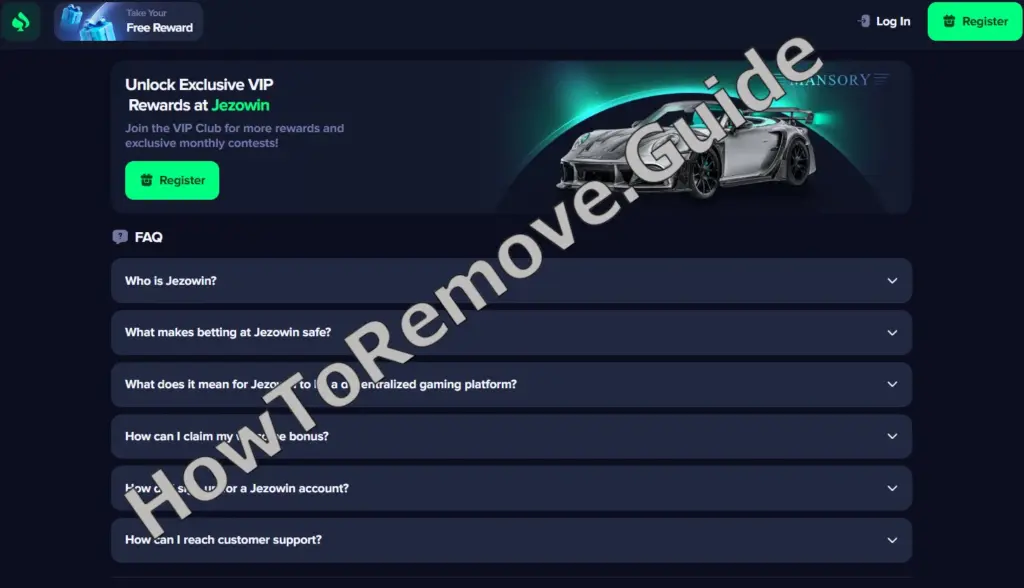

How the Jezowin Scam Deception Funnel Works
The process is built around irreversible transfer behavior. Jezowin first makes crypto feel like the easiest way to access a reward, then uses the lack of payment recourse to keep asking for more.
The user is usually drawn in by a bonus, shown a convincing casino interface, given staged balance growth, blocked at withdrawal, and then pressured through fees, KYC, support delays, and possible recovery bait.
Promo hooks and influencer codes
An ad, comment, or message presents a promo code as a special shortcut. The user focuses on the reward and may overlook the absence of a known operator or credible licensing trail.
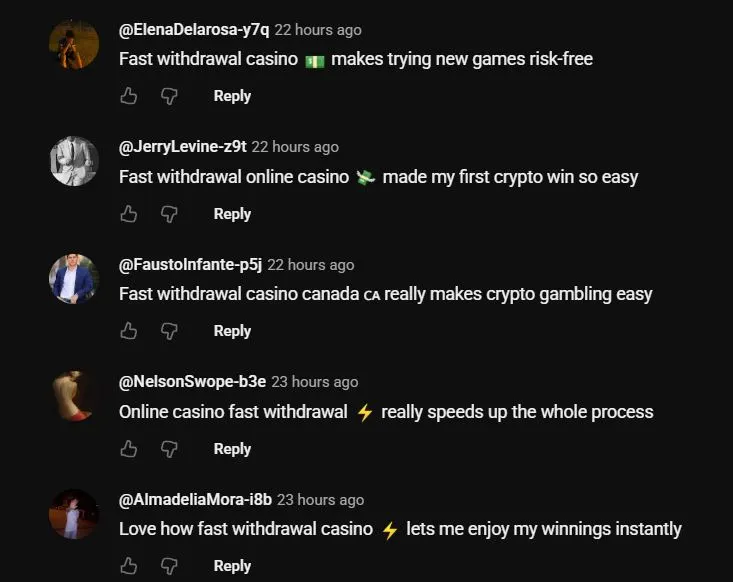
Casino skin and bonus theater
The site then looks polished enough to reduce suspicion. Games, wallet balances, and fairness language imitate familiar gambling platforms without providing the same accountability.

Inflated balances, then the gate
After a few interactions, the balance can appear profitable. That is the emotional pivot: the victim begins to treat an operator-controlled number as money already earned.
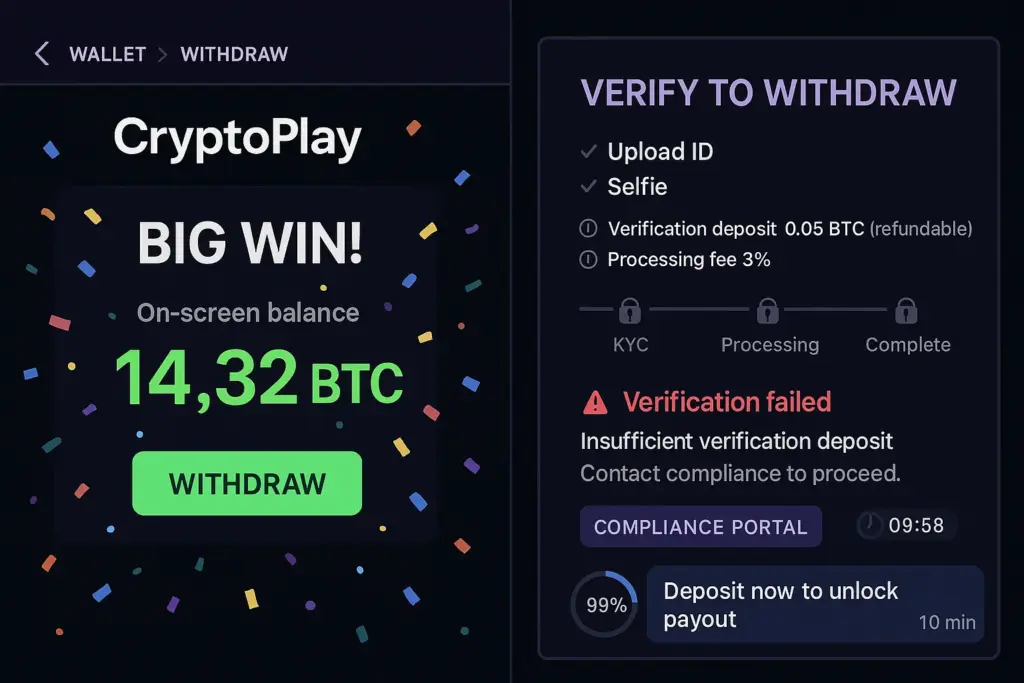
Fee-gates and KYC harvest
Withdrawal requests trigger external payment demands. The site may call them network fees, verification deposits, tax clearances, or wallet syncing, but each one sends more crypto away from the victim.

Stalling, rebrands, and “recovery” bait
Support maintains the illusion until resistance grows. Then delays, repeated instructions, threats of account closure, domain changes, or fake recovery offers can replace the earlier friendly tone.
Staying safe from crypto casino scams like Jezowin
Reducing crypto-casino risk means adding your own friction. Never let a wallet transfer happen before you verify operator identity, license status, domain history, payout rules, and independent complaints.
Verify license status in official registers
Start with official licensing databases. Match the legal entity, license number, domain, and jurisdiction; screenshots and footer badges are not enough.
Check domain age and history
Review public domain records and archive history. A recent, privacy-hidden registration with no credible past is a poor foundation for irreversible payments.
Reject withdrawal fees and “unlock” deposits
Treat every unlock deposit as a refusal point. If the site cannot release funds without a new transfer, the displayed balance should be considered fake.
Prefer venues with recourse
Use services that preserve recourse. Licensed operators, normal payment rails, and documented support channels are safer than anonymous crypto-only pages.
Limit wallet exposure
Keep exposure minimal. Use separate wallets for risky interactions, protect seed phrases, enable two-factor authentication, and remove approvals connected to unfamiliar sites.
Validate “provably fair” claims
Verify more than game randomness. A fair-looking game means little if the platform can block cash-out; payout mechanics and licensing matter just as much.
Document and report rapidly
Record blockchain evidence carefully. Transaction hashes, destination addresses, timestamps, screenshots, and chat logs can help exchanges or investigators identify related activity.
Build a deliberate slow-down reflex
Pause before acting on big numbers. A large on-screen balance is exactly what the scam uses to make another irreversible payment feel sensible.
Useful Resources for Scam Reporting and Prevention (By Country)
Because crypto moves quickly, evidence quality matters. Provide exact wallet addresses, TxIDs, screenshots, messages, and domain data to exchanges, cybercrime portals, and any service that touched the funds.
Click here to report the scam in your country
| Country / Agency | URL | Category / Use-case | Phone/Email |
| Australia – Crime Stoppers | https://www.crimestoppers.com.au | Anonymous tips about crime | 1800 333 000 |
| Australia – National Anti-Scam Center (Scamwatch) | https://www.scamwatch.gov.au/report-a-scam | General scams; phishing; texts/emails | |
| Australia – Police Assistance Line (non-emergency) | https://www.police.gov.au | Local police report | 131 444 |
| Australia – ReportCyber (ACSC) | https://www.cyber.gov.au/report | Cybercrime (hacks, fraud, extortion) | |
| Canada – Canadian Anti-Fraud Center (CAFC) | https://www.antifraudcentre-centreantifraude.ca/report-signalez-eng.htm | General scams incl. phone/text/email | |
| France – DGCCRF (SignalConso) | https://signal.conso.gouv.fr | Consumer scams/deceptive practices | |
| France – PHAROS – Internet-Signalement | https://www.internet-signalement.gouv.fr | Online content & cybercrime reports | |
| Germany – Bundeskriminalamt / Local Police | https://www.polizei.de/Polizei/DE/Home/home_node.html | Report online fraud | |
| Germany – Weißer Ring – Victim Support | https://weisser-ring.de | Victim support | 116 006 |
| India – DoT Helpline (Sanchar Saathi) | https://sancharsaathi.gov.in | Fraudulent telecom/SIM related | 155260 |
| India – National Consumer Helpline | https://consumerhelpline.gov.in | Consumer scams | 1800-11-4000 / 1915 |
| India – National Cyber Crime Reporting Portal | https://cybercrime.gov.in | Cybercrime incl. online fraud | 1930 |
| Japan – Consumer Affairs Agency (CAA) | https://www.caa.go.jp/policies/policy/consumer_policy/caution/cybercrime/ | Consumer scams | |
| Japan – National Police Agency – Cybercrime | https://www.npa.go.jp/bureau/cyber/ | Cybercrime reporting | |
| Mexico – Guardia Nacional (National Guard) | https://www.gob.mx/gn | Cybercrime reporting | |
| Mexico – Instituto Federal de Telecomunicaciones (IFT) | https://www.ift.org.mx | Telecom/online services scams | |
| Mexico – PROFECO | https://www.gob.mx/profeco | Consumer fraud & ecommerce | |
| Netherlands – AFM – Report investment fraud | https://www.afm.nl/en/consumenten/themas/beleggen/misleiding-misbruik | Investment/crypto | |
| Netherlands – Fraudehelpdesk | https://www.fraudehelpdesk.nl/melden | General scams (incl. phishing/SMS) | 088-7867372 |
| Netherlands – Politie – Meldpunt Internetoplichting | https://www.politie.nl/themas/internetoplichting.html | Online shopping fraud | |
| New Zealand – CERT NZ | https://www.cert.govt.nz/individuals/report-an-issue/ | Phishing, identity scams | |
| New Zealand – Department of Internal Affairs – Spam | https://www.dia.govt.nz/Spam-Contact-Us | Email/SMS spam | [email protected] |
| New Zealand – IDCARE | https://www.idcare.org | Victim support (identity compromise) | 0800 121 068 |
| New Zealand – Netsafe – Report | https://www.netsafe.org.nz/report/ | Online harms & scams | |
| New Zealand – New Zealand Police (non-emergency) | https://www.police.govt.nz/use-105 | Report fraud/online crime | 105 |
| Nigeria – Economic & Financial Crimes Commission (EFCC) | https://www.efcc.gov.ng | Financial scams incl. crypto/investment | [email protected] |
| Nigeria – Nigeria Police Special Fraud Unit (SFU) | https://www.specialfraudunit.org.ng | Serious fraud | Voice/SMS: 0708 227 6895; WhatsApp: 0812 760 9914 |
| Poland – CERT Polska (CERT.PL) | https://cert.pl/en/report/ | Cyber incidents & phishing | |
| Poland – Dyzurnet.pl | https://dyzurnet.pl | Illegal online content (esp. child protection) | |
| Poland – Polish Police (Policja) | https://www.policja.pl | Report scams to police | |
| Singapore – Anti-Scam Centre / Anti-Scam Helpline | https://www.scamalert.sg | General scams; texts; calls | 1800-722-6688 |
| Singapore – Monetary Authority of Singapore (MAS) | https://www.mas.gov.sg/investor-alert-list | Investment/crypto checks | |
| Singapore – Singapore Police Force | https://www.police.gov.sg/iwitness | Police report (cybercrime) | |
| South Africa – Cybersecurity Hub (CSIRT) | https://www.cybersecurityhub.gov.za | Cyber incidents incl. scams | |
| South Africa – South African Fraud Prevention Service (SAFPS) | https://www.safps.org.za | Identity fraud support | 011-867-2234 |
| South Africa – South African Police Service (SAPS) | https://www.saps.gov.za | Police report (cybercrime unit) | |
| South Korea – Korea Communications Commission (KCC) | https://www.kcc.go.kr | Telecom-related fraud | |
| South Korea – Korea Internet & Security Agency (KISA) | https://www.kisa.or.kr | Phishing, online harms | |
| South Korea – Korean National Police Agency – Cyber Bureau | https://ecrm.cyber.go.kr | Cybercrime reporting | |
| Spain – INCIBE – Oficina de Seguridad del Internauta (OSI) | https://www.osi.es/es/reporte | Cybersecurity & online fraud | |
| Spain – Policía Nacional / Guardia Civil | https://www.policia.es | Report scams to police | |
| Sweden – Crime Victim Authority (Brottsoffermyndigheten) | https://www.brottsoffermyndigheten.se | Victim support & compensation | 090–70 82 00 |
| Sweden – Polisen (Swedish Police) | https://polisen.se | Report fraud/cybercrime | 114 14 (non-emergency); 112 (emergency) |
| Sweden – Swedish Consumer Agency (Konsumentverket) | https://www.konsumentverket.se | Unfair business practices | |
| United Arab Emirates – Abu Dhabi Police – Aman Service | https://www.adpolice.gov.ae | Cybercrime tips/reporting | SMS 2828; 800 2626 |
| United Arab Emirates – Dubai Police – eCrime | https://www.dubaipolice.gov.ae | Cybercrime reporting | 04 606 1600 |
| United Arab Emirates – Ministry of Interior – Cyber Crime Dept. | https://www.moi.gov.ae | Cybercrime incl. online scams | |
| United Arab Emirates – Telecommunications Regulatory Authority (TRA) / TDRA | https://www.tra.gov.ae | Telecom-related scams/phishing | |
| United Kingdom – Action Fraud (NFIB) | https://www.actionfraud.police.uk | General scams & cybercrime (non-emergency) | 0300 123 2040 |
| United Kingdom – Citizens Advice Consumer Service | https://www.citizensadvice.org.uk/consumer/get-more-help/if-you-need-more-help-about-a-consumer-issue/ | Consumer problems & scam guidance | 0808 223 1133 |
| United Kingdom – Financial Conduct Authority (FCA) | https://www.fca.org.uk/consumers/report-scam-us | Investment/crypto & financial services | |
| United Kingdom – National Cyber Security Centre (NCSC) | https://www.ncsc.gov.uk/collection/phishing-scams | Phishing emails & suspicious websites | |
| United Kingdom – Stop Scams UK ‘159’ | https://stopscamsuk.org.uk/159 | Banking APP fraud (direct to your bank) | 159 |
| United States – AARP Fraud Watch Network Helpline | https://www.aarp.org/money/scams-fraud/ | Victim support | 833-372-8311 |
| United States – Better Business Bureau – Scam Tracker | https://www.bbb.org/scamtracker | Business/marketplace scams | |
| United States – FBI Internet Crime Complaint Center (IC3) | https://www.ic3.gov | Internet crime incl. investment/crypto | |
| United States – Federal Trade Commission – ReportFraud | https://reportfraud.ftc.gov | General scams, phishing, texts/emails | 1-877-382-4357 |
| United States – National Center for Disaster Fraud | https://www.justice.gov/disaster-fraud | Disaster-related scams | (866) 720-5721 |
| United States – SEC Tips & Complaints | https://www.sec.gov/tcr | Investment & securities/crypto-asset offerings |
The priority is to protect what remains. Stop sending funds, separate wallets, secure accounts, and treat Jezowin as an extraction page rather than a broken casino. Do not let crypto finality push you into more risk; one irreversible transfer is a reason to slow down, not to double down. Keep your timeline, screenshots, and wallet records together so each future report is consistent and easy to follow. Save local copies, note dates, and preserve wallet addresses exactly as shown so platform reports do not lose crucial context. If you share the case with a bank, exchange, or police portal, use the same chronological summary each time; consistency helps reviewers connect the domain, wallet, and support script. For crypto-only losses, verify destination addresses carefully before reporting and avoid sending tiny test payments after the fact, since further transfers only give the operators more money. Also compare the deposit address against any exchange warning notes you receive later, because reused wallets can connect separate reports and may help platforms recognize a broader payment cluster.
