

Fexowin.com has the shape of a crypto casino, but I do not give that shape much credit. In fact, it is a clone and literally the same as Vuahox.com and numerous others. Just follow the page to our Vuahox article and you will literally see absolutely everything is the same besides the name.
The bonus and easy play are there to make the balance on the screen feel real before you have done anything meaningful. That number is the bait. It makes the withdrawal feel close enough that the next request can pass as a normal step instead of a money grab.
The trouble usually shows up when someone tries to cash out. Suddenly the account has to be “cleared” before the winnings can move, and the site can dress that up as verification or as some routine transfer step. Once that payment goes in, the withdrawal still does not arrive. The request just keeps moving away, sometimes behind another fee and sometimes behind silence. The casino surface matters less than the ask underneath: the platform appears built to collect deposits while keeping the promised money out of reach.
Scams of Fexowin.com‘s type are known to steal personal data and passwords. Install SpyHunter Pro to scan for risks, remove any dangerous trackers, and enable real-time protection.

Try Free For 7 Days*
Buy now15% OFF if you buy straight without trial.
 OFFER
OFFERThe social proof around Fexowin.com belongs to the same setup. Fake winner screenshots and borrowed-looking testimonials make the place feel less lonely, especially to someone new to this kind of trap. Public-figure-style promos add another layer of borrowed trust. That can be enough to turn suspicion into one more payment. I would treat a site like Fexowin.com,as a high-risk scam setup, not a casino with awkward withdrawal rules.

IMPORTANT! READ BEFORE PROCEEDING!
Any deposit, wallet connection, document upload, or software download involving Fexowin.com should be treated as a possible account compromise. Stop communicating with the site and do not send another “release,” “tax,” or “verification” payment. Secure the email address linked to the account, review wallet permissions, preserve transaction records, and alert the exchange that sent the funds. If identification was shared, begin identity-protection steps as well.
For a Windows device that opened a file or installer promoted by the site, run a complete SpyHunter 5 scan and review every detection before signing back into financial accounts.
Protect Your System and Privacy Using SpyHunter 5
- 1.1Click here to download and install SpyHunter on your PC.
- 1.2Start SpyHunter 5, click the Buy button and choose between starting your 7-days free trial or directly purchasing the tool.
If you choose to buy SpyHunter 5 now, you can use our discount code, “HTRG15“, for 15% off.
- 1.3
 Once you activate SpyHunter, click Start Scan Now, select the Full Scan option, and let the tool do its job.
 - 1.4
 Once the scan completes (it could take a while, so have patience), you’ll see all undesirables listed as well as any system vulnerabilities that may endanger your privacy.
Click Next to review the detections and then click Next again to delete all rogue items.
Once the device has been checked, complete these containment steps without returning to the scam page:
- Reset passwords and enable 2FA on your email, crypto exchanges, and wallets; terminate other active sessions.
- Notify any exchanges and services touched by the funds; provide TxIDs and ask that accounts/addresses be flagged per policy.
- Migrate assets to fresh wallets with new seed phrases and revoke any existing token approvals on connected chains.
- If you uploaded ID documents, place credit/fraud alerts where available and monitor for identity-theft signals.
- Assemble an evidence bundle – wallet addresses, TxIDs, site URLs, chats, and screenshots – and file reports with police/IC3 and any involved platforms.
How We Know Fexowin.com is a Scam
Several indicators point in the same direction. None proves fraud alone, but together they show a platform built to receive deposits while making successful withdrawals increasingly unlikely.
Withdrawal terms appear after the request
New fees, minimum deposits, or upgrades appear only when payment is requested. Genuine withdrawal conditions are published before play, not invented after a balance grows.
Licensing claims do not withstand checking
A badge proves nothing unless the named operator and exact domain appear in the regulator’s database. Scam pages often copy credentials from unrelated businesses.
Winning is used as persuasion
Frequent jackpots and fast-growing balances encourage larger deposits. Because the operator controls the interface, those figures do not prove transferable funds exist.
Payments travel in one direction
Deposits arrive instantly, while withdrawals trigger delays and extra conditions. Irreversible cryptocurrency transfers make that imbalance especially dangerous.
Public confidence is manufactured
Reviews, payout screenshots, activity popups, and influencer promotions can be staged. Repeated wording and unverifiable profiles suggest coordination rather than popularity.
The web identity is disposable
Hidden ownership, recent registration, and clones with matching layouts suggest a replaceable operation. A lookup through who.is can reveal timing and privacy masking, which should be weighed with the other evidence.

How the Fexowin.com Scam Deception Funnel Works
Recognizing the sequence removes much of its power. Each stage deepens commitment before the victim learns the displayed balance cannot be collected, so pausing early can prevent later losses.
The pattern moves from attention and trust to artificial profit, blocked withdrawal, repeated payment demands, and finally disappearance or a second scam.
Promo hooks and influencer codes
A short video, sponsored post, direct message, or referral code presents a dramatic winner and a time-limited bonus. The promotion leans on urgency and social proof so the visitor arrives excited rather than skeptical.

Casino skin and bonus theater
After signup, the page imitates a functioning casino with familiar games, live-looking counters, chat widgets, and a generous promotional balance. Smooth animation substitutes for evidence about ownership, licensing, or genuine payment reserves.

Inflated balances, then the gate
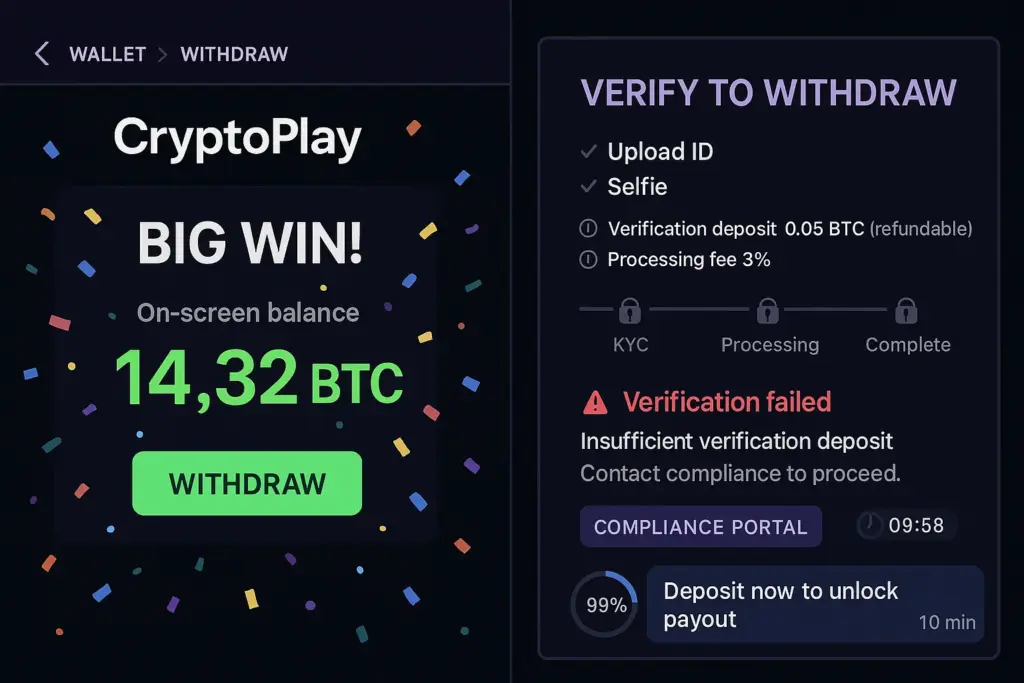
Small wagers produce conspicuous success, and the account total rises fast enough to create emotional ownership. Once the victim regards the balance as “their money,” depositing more can feel like protecting profit instead of risking new funds.
Fee-gates and KYC harvest
A withdrawal request activates the extraction phase. Support may ask for identity documents, a wallet verification transfer, anti-money-laundering collateral, tax, or VIP status, while promising that each new payment is the last obstacle.

Stalling, rebrands, and “recovery” bait
When questions become persistent, support answers with delays, scripted reassurance, or account restrictions. The site may then vanish or change domains, and people posing as investigators or recovery specialists may contact the victim and demand another advance fee.
Staying safe from crypto casino scams like Fexowin.com
Protection starts before registration. Verify the operator independently, limit what an unfamiliar site can access, and decide that no displayed balance justifies an unexpected release payment. This routine reduces financial and identity exposure.
Verify license status in official registers
Begin with the regulator, not the casino footer. Search the legal company and exact domain in the official register, then confirm the license covers online gambling where you live.
Check domain age and history
Review domain age, archived pages, ownership history, and reports of matching clones. A young site is not automatically fraudulent, but secrecy combined with aggressive promotion warrants caution.
Reject withdrawal fees and “unlock” deposits
Never send cryptocurrency to unlock a withdrawal. Taxes, compliance deposits, liquidity checks, and upgrades are common pretexts for turning one loss into several.
Prefer venues with recourse
Prefer services that identify a real company, publish enforceable terms, provide complaints procedures, and offer payment methods with dispute options. Anonymous crypto-only operations leave little recourse.
Limit wallet exposure
Use a separate low-value wallet and never enter a seed phrase on a website. After disconnecting, revoke unnecessary token approvals and protect exchange and email accounts with unique passwords and two-factor authentication.
Validate “provably fair” claims
Treat “provably fair” as advertising unless each result can be independently checked. Mentioning hashes or seeds proves nothing when the site controls every displayed value.
Document and report rapidly
Save URLs, wallet addresses, transaction identifiers, chats, emails, and screenshots immediately. Report to the sending exchange, relevant stablecoin issuer, local police, and national cybercrime channel.
Build a deliberate slow-down reflex
Create a mandatory pause before sending funds. Search beyond affiliate pages, read withdrawal conditions fully, and leave whenever urgency is used to discourage verification.
Useful Resources for Scam Reporting and Prevention (By Country)
Reporting cannot guarantee repayment, especially after cryptocurrency has moved through several addresses, but it can still create useful leads. Exchanges may flag destination accounts, stablecoin issuers may respond to lawful requests, hosting providers can investigate abuse, and authorities can connect separate complaints to the same infrastructure. Use the country directory below, include transaction identifiers and timestamps, and submit copies rather than surrendering original evidence. Ignore anyone who privately promises guaranteed recovery or asks for a retainer in cryptocurrency; victims are frequently targeted again by people claiming special access to investigators or blockchain tracing teams.
Click here to report the scam in your country
| Country / Agency | URL | Category / Use-case | Phone/Email |
| Australia – Crime Stoppers | https://www.crimestoppers.com.au | Anonymous tips about crime | 1800 333 000 |
| Australia – National Anti-Scam Center (Scamwatch) | https://www.scamwatch.gov.au/report-a-scam | General scams; phishing; texts/emails | |
| Australia – Police Assistance Line (non-emergency) | https://www.police.gov.au | Local police report | 131 444 |
| Australia – ReportCyber (ACSC) | https://www.cyber.gov.au/report | Cybercrime (hacks, fraud, extortion) | |
| Canada – Canadian Anti-Fraud Center (CAFC) | https://www.antifraudcentre-centreantifraude.ca/report-signalez-eng.htm | General scams incl. phone/text/email | |
| France – DGCCRF (SignalConso) | https://signal.conso.gouv.fr | Consumer scams/deceptive practices | |
| France – PHAROS – Internet-Signalement | https://www.internet-signalement.gouv.fr | Online content & cybercrime reports | |
| Germany – Bundeskriminalamt / Local Police | https://www.polizei.de/Polizei/DE/Home/home_node.html | Report online fraud | |
| Germany – Weißer Ring – Victim Support | https://weisser-ring.de | Victim support | 116 006 |
| India – DoT Helpline (Sanchar Saathi) | https://sancharsaathi.gov.in | Fraudulent telecom/SIM related | 155260 |
| India – National Consumer Helpline | https://consumerhelpline.gov.in | Consumer scams | 1800-11-4000 / 1915 |
| India – National Cyber Crime Reporting Portal | https://cybercrime.gov.in | Cybercrime incl. online fraud | 1930 |
| Japan – Consumer Affairs Agency (CAA) | https://www.caa.go.jp/policies/policy/consumer_policy/caution/cybercrime/ | Consumer scams | |
| Japan – National Police Agency – Cybercrime | https://www.npa.go.jp/bureau/cyber/ | Cybercrime reporting | |
| Mexico – Guardia Nacional (National Guard) | https://www.gob.mx/gn | Cybercrime reporting | |
| Mexico – Instituto Federal de Telecomunicaciones (IFT) | https://www.ift.org.mx | Telecom/online services scams | |
| Mexico – PROFECO | https://www.gob.mx/profeco | Consumer fraud & ecommerce | |
| Netherlands – AFM – Report investment fraud | https://www.afm.nl/en/consumenten/themas/beleggen/misleiding-misbruik | Investment/crypto | |
| Netherlands – Fraudehelpdesk | https://www.fraudehelpdesk.nl/melden | General scams (incl. phishing/SMS) | 088-7867372 |
| Netherlands – Politie – Meldpunt Internetoplichting | https://www.politie.nl/themas/internetoplichting.html | Online shopping fraud | |
| New Zealand – CERT NZ | https://www.cert.govt.nz/individuals/report-an-issue/ | Phishing, identity scams | |
| New Zealand – Department of Internal Affairs – Spam | https://www.dia.govt.nz/Spam-Contact-Us | Email/SMS spam | [email protected] |
| New Zealand – IDCARE | https://www.idcare.org | Victim support (identity compromise) | 0800 121 068 |
| New Zealand – Netsafe – Report | https://www.netsafe.org.nz/report/ | Online harms & scams | |
| New Zealand – New Zealand Police (non-emergency) | https://www.police.govt.nz/use-105 | Report fraud/online crime | 105 |
| Nigeria – Economic & Financial Crimes Commission (EFCC) | https://www.efcc.gov.ng | Financial scams incl. crypto/investment | [email protected] |
| Nigeria – Nigeria Police Special Fraud Unit (SFU) | https://www.specialfraudunit.org.ng | Serious fraud | Voice/SMS: 0708 227 6895; WhatsApp: 0812 760 9914 |
| Poland – CERT Polska (CERT.PL) | https://cert.pl/en/report/ | Cyber incidents & phishing | |
| Poland – Dyzurnet.pl | https://dyzurnet.pl | Illegal online content (esp. child protection) | |
| Poland – Polish Police (Policja) | https://www.policja.pl | Report scams to police | |
| Singapore – Anti-Scam Centre / Anti-Scam Helpline | https://www.scamalert.sg | General scams; texts; calls | 1800-722-6688 |
| Singapore – Monetary Authority of Singapore (MAS) | https://www.mas.gov.sg/investor-alert-list | Investment/crypto checks | |
| Singapore – Singapore Police Force | https://www.police.gov.sg/iwitness | Police report (cybercrime) | |
| South Africa – Cybersecurity Hub (CSIRT) | https://www.cybersecurityhub.gov.za | Cyber incidents incl. scams | |
| South Africa – South African Fraud Prevention Service (SAFPS) | https://www.safps.org.za | Identity fraud support | 011-867-2234 |
| South Africa – South African Police Service (SAPS) | https://www.saps.gov.za | Police report (cybercrime unit) | |
| South Korea – Korea Communications Commission (KCC) | https://www.kcc.go.kr | Telecom-related fraud | |
| South Korea – Korea Internet & Security Agency (KISA) | https://www.kisa.or.kr | Phishing, online harms | |
| South Korea – Korean National Police Agency – Cyber Bureau | https://ecrm.cyber.go.kr | Cybercrime reporting | |
| Spain – INCIBE – Oficina de Seguridad del Internauta (OSI) | https://www.osi.es/es/reporte | Cybersecurity & online fraud | |
| Spain – Policía Nacional / Guardia Civil | https://www.policia.es | Report scams to police | |
| Sweden – Crime Victim Authority (Brottsoffermyndigheten) | https://www.brottsoffermyndigheten.se | Victim support & compensation | 090–70 82 00 |
| Sweden – Polisen (Swedish Police) | https://polisen.se | Report fraud/cybercrime | 114 14 (non-emergency); 112 (emergency) |
| Sweden – Swedish Consumer Agency (Konsumentverket) | https://www.konsumentverket.se | Unfair business practices | |
| United Arab Emirates – Abu Dhabi Police – Aman Service | https://www.adpolice.gov.ae | Cybercrime tips/reporting | SMS 2828; 800 2626 |
| United Arab Emirates – Dubai Police – eCrime | https://www.dubaipolice.gov.ae | Cybercrime reporting | 04 606 1600 |
| United Arab Emirates – Ministry of Interior – Cyber Crime Dept. | https://www.moi.gov.ae | Cybercrime incl. online scams | |
| United Arab Emirates – Telecommunications Regulatory Authority (TRA) / TDRA | https://www.tra.gov.ae | Telecom-related scams/phishing | |
| United Kingdom – Action Fraud (NFIB) | https://www.actionfraud.police.uk | General scams & cybercrime (non-emergency) | 0300 123 2040 |
| United Kingdom – Citizens Advice Consumer Service | https://www.citizensadvice.org.uk/consumer/get-more-help/if-you-need-more-help-about-a-consumer-issue/ | Consumer problems & scam guidance | 0808 223 1133 |
| United Kingdom – Financial Conduct Authority (FCA) | https://www.fca.org.uk/consumers/report-scam-us | Investment/crypto & financial services | |
| United Kingdom – National Cyber Security Centre (NCSC) | https://www.ncsc.gov.uk/collection/phishing-scams | Phishing emails & suspicious websites | |
| United Kingdom – Stop Scams UK ‘159’ | https://stopscamsuk.org.uk/159 | Banking APP fraud (direct to your bank) | 159 |
| United States – AARP Fraud Watch Network Helpline | https://www.aarp.org/money/scams-fraud/ | Victim support | 833-372-8311 |
| United States – Better Business Bureau – Scam Tracker | https://www.bbb.org/scamtracker | Business/marketplace scams | |
| United States – FBI Internet Crime Complaint Center (IC3) | https://www.ic3.gov | Internet crime incl. investment/crypto | |
| United States – Federal Trade Commission – ReportFraud | https://reportfraud.ftc.gov | General scams, phishing, texts/emails | 1-877-382-4357 |
| United States – National Center for Disaster Fraud | https://www.justice.gov/disaster-fraud | Disaster-related scams | (866) 720-5721 |
| United States – SEC Tips & Complaints | https://www.sec.gov/tcr | Investment & securities/crypto-asset offerings |
The central lesson is simple: the balance shown by Fexowin.com has no value until a legitimate withdrawal reaches a wallet you control. Do not pay to receive money, do not hand over identity documents to an unverified operator, and do not let urgency replace independent checking. If exposure has already occurred, focus first on securing accounts, moving remaining assets, preserving evidence, and reporting the incident. Recovery may be uncertain, but rapid containment can prevent the original loss from expanding into account theft, identity fraud, or a follow-up recovery scam.