

So imagine you are going about your day and your phone lights up with a bank message saying money was withdrawn and you freeze because you did not swipe a card, type a PIN, share an OTP, or approve anything. Okay, time out, because this is the part that makes the AePS scam so unsettling. If the withdrawal says it happened through Aadhaar based banking, or AePS, then the usual “but I never shared my OTP” comfort does not help, because in this system the biometric check can be the key.
AePS was built to make banking easier where branch access is limited. But scammers love useful systems when they can twist them, and here they try to turn Aadhaar numbers, personal details, fingerprints, face checks, and fake agents into ways to pull money out before the victim notices.
Scams of AePS Scam‘s type are known to steal personal data and passwords. Install SpyHunter Pro to scan for risks, remove any dangerous trackers, and enable real-time protection.

Try Free For 7 Days*
Buy now15% OFF if you buy straight without trial.
 OFFER
OFFERUnderstanding the AePS Scam
AePS stands for Aadhaar Enabled Payment System, and the simple version is that it lets someone do basic banking transactions using Aadhaar authentication. In a normal setup, the person proves who they are with biometric verification, like a fingerprint or face check, and that is supposed to replace things like a card, signature, PIN, or OTP.
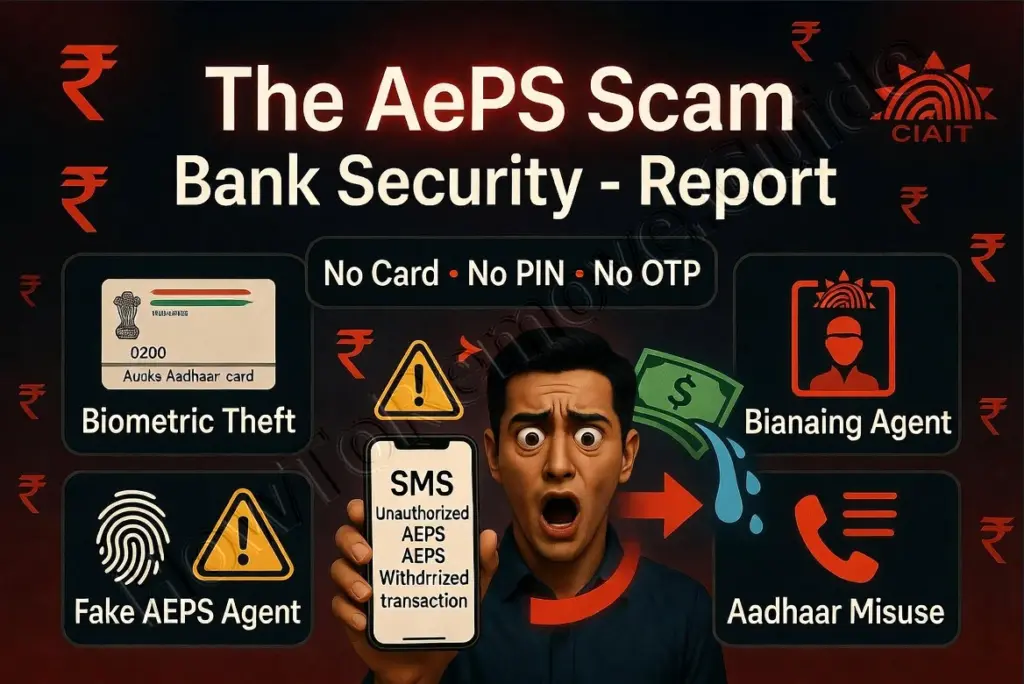
Now notice this. If biometric authentication is the password, then anyone who tricks you into unsafe biometric use, misuses your Aadhaar details, or works through a shady service point may be after your bank account. That does not mean AePS itself is fake. It means criminals are abusing the trust around it.
They may get Aadhaar numbers from leaks, careless document sharing, phishing messages, fake customer support calls, or forms that look official. Then they may pretend to be a banking agent, government helper, service provider, or customer care person. Sometimes there may be a fake kiosk or unauthorized agent involved. In newer versions, public photos and videos can create risk when face verification enters the process. The point is to stop treating Aadhaar requests as harmless.
What to Do If You’ve Fallen for the AePS Scam
If you see a withdrawal you did not make, do not sit there hoping it is a bank glitch. Move fast. Call your bank using the official number not some number that arrived in a message. Tell them there is an unauthorized AePS withdrawal and ask them to secure the account and block further debits.
Then call the National Cybercrime Helpline at 1930 and file a complaint on the National Cybercrime Reporting Portal. Also lock your Aadhaar biometrics through UIDAI, either through the official portal or mAadhaar app. If biometric access stays open, the same weakness may be abused again.
Keep every piece of evidence. Bank SMS alerts, statement screenshots, transaction references, complaint numbers, suspicious calls, links, names, locations, anything. File an FIR at your local police station if the bank or authorities ask for it, because when money is already gone, documentation becomes your friend.
How the AePS Scam Tricks You
Here is where the scam gets nasty. It does not always ask you to click a payment link or read out a code. Sometimes the victim never knowingly speaks to the scammer at all. Other times, the scammer builds a normal-looking reason for Aadhaar verification, and because it sounds like banking or government work, people lower their guard.
One version is impersonation. Someone claims they are helping with a banking issue, benefit update, subsidy, account verification, SIM matter, or service correction. They sound confident, they use official words, and they act like this is routine. That is the trap. The moment someone unknown starts asking for Aadhaar details, bank information, fingerprint use, or video verification, you should assume something is off until you prove otherwise.
Another version is phishing. You get a text, call, or link that looks like it came from a trusted organization, but it is really there to collect details or push you toward a fake process. And now there is the issue of video and face misuse. If someone pressures you into a video call for “verification,” especially from an unofficial number, do not treat that as harmless. Your face is identity data.
Recognizing Warning Signs of the AePS Scam
The first red flag is simple. Someone you did not contact first is asking for Aadhaar information, bank details, biometric use, or face verification. Real organizations should not need you to hand over sensitive information through a random phone call, unverified link, or private chat.
The next red flag is urgency. Scammers love making everything sound like it has to happen now. Your account will be blocked, your benefit will stop, your KYC will fail, your money will be frozen. Maybe. Or maybe they just do not want you to hang up and check with the real bank.
Be careful with unknown kiosks, temporary counters, or people offering Aadhaar banking help without clear authorization. Also watch your account. The biggest warning sign may be the one that comes after the damage: an unexpected withdrawal alert. Small deductions matter too, because fraudsters may test first.
How to Handle Suspicious Aadhaar or AePS Requests
If someone asks for Aadhaar verification, do not respond on reflex. Do not click the link. Do not share the number. Do not send the document. Do not put your finger on a scanner just because someone says it is required. Pause first.
Go through official channels. Open your bank app yourself, call the official helpline, visit a known branch, or use a trusted government website. Never use the number inside the suspicious message as proof, because scammers can write any number they want.
When you must share Aadhaar, use safer options where available, like a UIDAI Virtual ID instead of the permanent number. Avoid giving photocopies casually. If you use a biometric scanner at an authorized location, stay aware and clean the scanner afterward if needed. More importantly, only use biometric authentication with people and places you can verify.
Reporting AePS Fraud
Report it in layers. Bank first, because they control the account. Cybercrime helpline next, because speed can matter. Online complaint after that, because you need an official record. Police report if required, because banks often want paperwork before they review liability or reversal requests.
When you report, include the withdrawal date, time, amount, account, transaction reference, messages, screenshots, and anything connected to the person, kiosk, link, or call. Do not edit the evidence to make it look cleaner. Keep it as it is.
Useful Resources for Scam Reporting and Prevention (By Country)
Find the right reporting channel below
| Country / Agency | URL | Category / Use-case | Phone/Email |
| Australia – Crime Stoppers | https://www.crimestoppers.com.au | Anonymous tips about crime | 1800 333 000 |
| Australia – National Anti-Scam Center (Scamwatch) | https://www.scamwatch.gov.au/report-a-scam | General scams; phishing; texts/emails | |
| Australia – Police Assistance Line (non-emergency) | https://www.police.gov.au | Local police report | 131 444 |
| Australia – ReportCyber (ACSC) | https://www.cyber.gov.au/report | Cybercrime (hacks, fraud, extortion) | |
| Canada – Canadian Anti-Fraud Center (CAFC) | https://www.antifraudcentre-centreantifraude.ca/report-signalez-eng.htm | General scams incl. phone/text/email | |
| France – DGCCRF (SignalConso) | https://signal.conso.gouv.fr | Consumer scams/deceptive practices | |
| France – PHAROS – Internet-Signalement | https://www.internet-signalement.gouv.fr | Online content & cybercrime reports | |
| Germany – Bundeskriminalamt / Local Police | https://www.polizei.de/Polizei/DE/Home/home_node.html | Report online fraud | |
| Germany – Weißer Ring – Victim Support | https://weisser-ring.de | Victim support | 116 006 |
| India – DoT Helpline (Sanchar Saathi) | https://sancharsaathi.gov.in | Fraudulent telecom/SIM related | 155260 |
| India – National Consumer Helpline | https://consumerhelpline.gov.in | Consumer scams | 1800-11-4000 / 1915 |
| India – National Cyber Crime Reporting Portal | https://cybercrime.gov.in | Cybercrime incl. online fraud | 1930 |
| Japan – Consumer Affairs Agency (CAA) | https://www.caa.go.jp/policies/policy/consumer_policy/caution/cybercrime/ | Consumer scams | |
| Japan – National Police Agency – Cybercrime | https://www.npa.go.jp/bureau/cyber/ | Cybercrime reporting | |
| Mexico – Guardia Nacional (National Guard) | https://www.gob.mx/gn | Cybercrime reporting | |
| Mexico – Instituto Federal de Telecomunicaciones (IFT) | https://www.ift.org.mx | Telecom/online services scams | |
| Mexico – PROFECO | https://www.gob.mx/profeco | Consumer fraud & ecommerce | |
| Netherlands – AFM – Report investment fraud | https://www.afm.nl/en/consumenten/themas/beleggen/misleiding-misbruik | Investment/crypto | |
| Netherlands – Fraudehelpdesk | https://www.fraudehelpdesk.nl/melden | General scams (incl. phishing/SMS) | 088-7867372 |
| Netherlands – Politie – Meldpunt Internetoplichting | https://www.politie.nl/themas/internetoplichting.html | Online shopping fraud | |
| New Zealand – CERT NZ | https://www.cert.govt.nz/individuals/report-an-issue/ | Phishing, identity scams | |
| New Zealand – Department of Internal Affairs – Spam | https://www.dia.govt.nz/Spam-Contact-Us | Email/SMS spam | [email protected] |
| New Zealand – IDCARE | https://www.idcare.org | Victim support (identity compromise) | 0800 121 068 |
| New Zealand – Netsafe – Report | https://www.netsafe.org.nz/report/ | Online harms & scams | |
| New Zealand – New Zealand Police (non-emergency) | https://www.police.govt.nz/use-105 | Report fraud/online crime | 105 |
| Nigeria – Economic & Financial Crimes Commission (EFCC) | https://www.efcc.gov.ng | Financial scams incl. crypto/investment | [email protected] |
| Nigeria – Nigeria Police Special Fraud Unit (SFU) | https://www.specialfraudunit.org.ng | Serious fraud | Voice/SMS: 0708 227 6895; WhatsApp: 0812 760 9914 |
| Poland – CERT Polska (CERT.PL) | https://cert.pl/en/report/ | Cyber incidents & phishing | |
| Poland – Dyzurnet.pl | https://dyzurnet.pl | Illegal online content (esp. child protection) | |
| Poland – Polish Police (Policja) | https://www.policja.pl | Report scams to police | |
| Singapore – Anti-Scam Centre / Anti-Scam Helpline | https://www.scamalert.sg | General scams; texts; calls | 1800-722-6688 |
| Singapore – Monetary Authority of Singapore (MAS) | https://www.mas.gov.sg/investor-alert-list | Investment/crypto checks | |
| Singapore – Singapore Police Force | https://www.police.gov.sg/iwitness | Police report (cybercrime) | |
| South Africa – Cybersecurity Hub (CSIRT) | https://www.cybersecurityhub.gov.za | Cyber incidents incl. scams | |
| South Africa – South African Fraud Prevention Service (SAFPS) | https://www.safps.org.za | Identity fraud support | 011-867-2234 |
| South Africa – South African Police Service (SAPS) | https://www.saps.gov.za | Police report (cybercrime unit) | |
| South Korea – Korea Communications Commission (KCC) | https://www.kcc.go.kr | Telecom-related fraud | |
| South Korea – Korea Internet & Security Agency (KISA) | https://www.kisa.or.kr | Phishing, online harms | |
| South Korea – Korean National Police Agency – Cyber Bureau | https://ecrm.cyber.go.kr | Cybercrime reporting | |
| Spain – INCIBE – Oficina de Seguridad del Internauta (OSI) | https://www.osi.es/es/reporte | Cybersecurity & online fraud | |
| Spain – Policía Nacional / Guardia Civil | https://www.policia.es | Report scams to police | |
| Sweden – Crime Victim Authority (Brottsoffermyndigheten) | https://www.brottsoffermyndigheten.se | Victim support & compensation | 090–70 82 00 |
| Sweden – Polisen (Swedish Police) | https://polisen.se | Report fraud/cybercrime | 114 14 (non-emergency); 112 (emergency) |
| Sweden – Swedish Consumer Agency (Konsumentverket) | https://www.konsumentverket.se | Unfair business practices | |
| United Arab Emirates – Abu Dhabi Police – Aman Service | https://www.adpolice.gov.ae | Cybercrime tips/reporting | SMS 2828; 800 2626 |
| United Arab Emirates – Dubai Police – eCrime | https://www.dubaipolice.gov.ae | Cybercrime reporting | 04 606 1600 |
| United Arab Emirates – Ministry of Interior – Cyber Crime Dept. | https://www.moi.gov.ae | Cybercrime incl. online scams | |
| United Arab Emirates – Telecommunications Regulatory Authority (TRA) / TDRA | https://www.tra.gov.ae | Telecom-related scams/phishing | |
| United Kingdom – Action Fraud (NFIB) | https://www.actionfraud.police.uk | General scams & cybercrime (non-emergency) | 0300 123 2040 |
| United Kingdom – Citizens Advice Consumer Service | https://www.citizensadvice.org.uk/consumer/get-more-help/if-you-need-more-help-about-a-consumer-issue/ | Consumer problems & scam guidance | 0808 223 1133 |
| United Kingdom – Financial Conduct Authority (FCA) | https://www.fca.org.uk/consumers/report-scam-us | Investment/crypto & financial services | |
| United Kingdom – National Cyber Security Centre (NCSC) | https://www.ncsc.gov.uk/collection/phishing-scams | Phishing emails & suspicious websites | |
| United Kingdom – Stop Scams UK ‘159’ | https://stopscamsuk.org.uk/159 | Banking APP fraud (direct to your bank) | 159 |
| United States – AARP Fraud Watch Network Helpline | https://www.aarp.org/money/scams-fraud/ | Victim support | 833-372-8311 |
| United States – Better Business Bureau – Scam Tracker | https://www.bbb.org/scamtracker | Business/marketplace scams | |
| United States – FBI Internet Crime Complaint Center (IC3) | https://www.ic3.gov | Internet crime incl. investment/crypto | |
| United States – Federal Trade Commission – ReportFraud | https://reportfraud.ftc.gov | General scams, phishing, texts/emails | 1-877-382-4357 |
| United States – National Center for Disaster Fraud | https://www.justice.gov/disaster-fraud | Disaster-related scams | (866) 720-5721 |
| United States – SEC Tips & Complaints | https://www.sec.gov/tcr | Investment & securities/crypto-asset offerings |
Strengthening Your AePS and Aadhaar Security
The biggest practical step is locking your Aadhaar biometrics through UIDAI when unused. Think of it like closing the door instead of leaving it open just because nobody suspicious is nearby.
Turn on SMS alerts. Check statements. Treat tiny unknown debits seriously. And stop sharing Aadhaar like it is just another ID number. It is connected to real services and, in the wrong hands, real money.
AePS fraud is scary because it skips the usual signs people expect from online scams. But that does not mean you are helpless. Lock what you can lock, verify what you can verify, question anyone who rushes you, and report fast when something looks wrong.
