

Beasttrials.com wants you to think it is just another big-name crypto casino, and on the surface I get why some people might buy that. The site throws a lot at you right away: bonus offers, giant numbers, polished branding, all the stuff meant to make you feel like this is already trusted and already safe.
Now here is the problem. A slick homepage is not proof of anything, and that is one of the easiest traps to fall into with sites like this. Once you slow down and look past the sales pitch, you start seeing the usual issues: grand claims about fairness and licensing, vague ownership, and very little that actually proves who is running the operation.
That combination is a huge red flag, especially in crypto scams. The whole point is to get you moving before you start asking basic questions.
And if someone does sign up, the risk is not only losing money. You could also end up handing over wallet access or personal information to people you cannot verify.
Scams of Beasttrials.com‘s type are known to steal personal data and passwords. Install SpyHunter Pro to scan for risks, remove any dangerous trackers, and enable real-time protection.

Try Free For 7 Days*
Buy now15% OFF if you buy straight without trial.
 OFFER
OFFERAnd if someone does sign up, the risk is not only losing money. You could also end up handing over wallet access or personal information to people you cannot verify.
In plain language, anyone who cares about money, identity, and device security should avoid this site and other sites like Asoxplay.com and Bazowin781. The material below explains the warning signs, the usual sequence of the fraud, and the practical steps that reduce damage if contact with Beasttrials.com has already happened.
IMPORTANT! READ BEFORE PROCEEDING!
If you already interacted with Beasttrials.com, treat the situation as active fraud rather than a customer-service dispute. Stop sending funds, isolate anything the site touched, and preserve proof before pages vanish. The most useful first moves are the ones that cut off access, secure the accounts you still control, and document what happened while details are fresh:
- Reset passwords for email and exchanges, then turn on 2FA everywhere you can.
- Disconnect any wallet from the site and revoke permissions, then move remaining funds to a fresh wallet with a new seed.
- If you ever shared a seed phrase or private key, assume that wallet is compromised and migrate immediately from a clean device.
- If you shared ID documents, place a fraud alert or credit freeze and monitor for identity misuse.
- File a report and save proof before the domain disappears, including screenshots, chats, wallet addresses, and transaction hashes.
How We Know Beasttrials.com is a Scam
When several signals point in the same direction, the safest conclusion is the obvious one. Here the pattern matches the usual fake-casino formula: simulated winnings, blocked withdrawals, and repeated pressure to send more crypto long after a normal service would have processed or rejected a payout cleanly.
Withdrawals turn into surprise payment hurdles
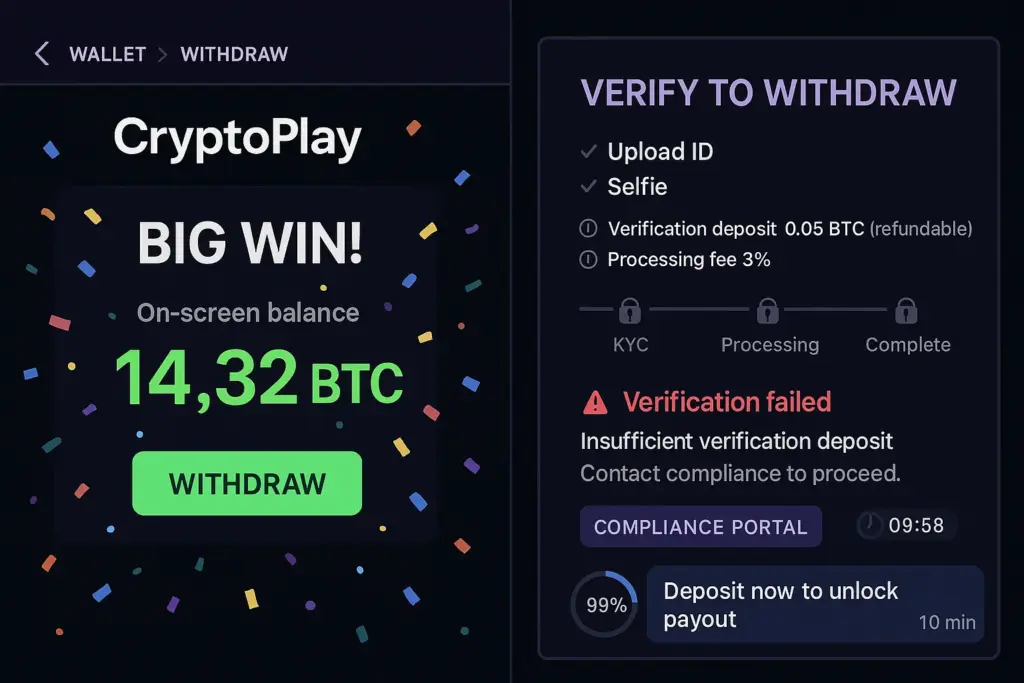
The clearest sign appears at cash-out time, when a visible balance suddenly becomes unavailable unless you pay a handling charge, verification deposit, tax advance, or account upgrade.
Bonuses are used as emotional bait
Huge credits, promo codes, and exaggerated welcome gifts are not generosity here; they are a low-cost way to create attachment to money that was never real.
Short-lived domains fit the clone pattern
Many sites in this category appear on recently registered addresses, disappear after complaints, and re-emerge under a different name with the same layout, wording, and promises.
Activity on the page can be manufactured
Busy chat windows, jackpot pop-ups, and live-player counters can be scripted to simulate demand and reduce hesitation, even when there is no meaningful community behind the screen.
Support keeps circling back to payment
Instead of resolving a blocked withdrawal, the operators tend to recycle scripted replies and introduce one more transfer, one more document request, or one more deadline.
Independent proof is hard to find
Social posts that praise Beasttrials.com often trace back to throwaway accounts, copied videos, or unverifiable endorsements, which is very different from a regulated brand with a visible reputation to protect.
Basic ownership checks raise more questions
A quick look at registration history, company identity, and licensing claims often reveals missing specifics or information that cannot be confirmed through trustworthy outside sources, and lookup tools can help expose churn.


How the Beasttrials.com Scam Deception Funnel Works
Learning the usual progression matters because it turns a confusing experience into something recognizable. Once you can name the stages, you are less likely to mistake manipulation for bad luck or to keep cooperating while hoping the next step will finally release the balance on screen.
The sequence is also useful when you report the incident. What feels personal and chaotic to a victim often turns out to be a recycled script running on a new domain, with the same emotional triggers and the same last-minute demands.
Promo hooks and influencer codes
Most victims first meet Beasttrials.com through a code, clip, direct message, or planted comment promising an easy bonus. The lure is not sophistication; it is timing. The pitch lands when curiosity, boredom, or recent gambling content makes the invitation feel worth a quick look.

Casino skin and bonus theater
Once you land, the site imitates a normal betting platform with polished menus, familiar games, and a simple sign-up flow. That ordinary feel is strategic, because people scrutinize less when the interface resembles something they already trust.

Inflated balances, then the gate
Soon after that, the account balance starts looking unusually lucky. Early spins or bets seem to go your way, which creates the impression that the bonus was genuine and that a withdrawal might actually work.
Fee-gates and KYC harvest
Trouble begins the moment you request a payout. The fake winnings become a lever for extracting more value: identity documents, extra deposits, wallet confirmations, clearance fees, or premium-status payments that supposedly release the funds.

Stalling, rebrands, and “recovery” bait
After each payment or upload, another obstacle appears. By then sunk-cost thinking does much of the work, and some victims keep complying until the site stops replying, the address changes, or a second-wave recovery scam reaches out.
Staying safe from crypto casino scams like Beasttrials.com
Reducing risk over time is mostly about habits that still work when you are tired, distracted, or tempted by a dramatic promise. The goal is to shrink the blast radius of mistakes, slow down impulsive decisions, and make suspicious patterns easier to spot before money moves.
Verify license status in official registers
Check whether the claimed operator exists in a real public register and whether the license number, company name, and jurisdiction all point to the same business. A logo in the footer means very little by itself.
Check domain age and history
Before depositing anything, look up when the domain was created, whether ownership details are hidden, and whether the site has a history of recent changes. Fresh domains deserve maximum suspicion in this scam niche.
Reject withdrawal fees and “unlock” deposits
Adopt a non-negotiable rule: no legitimate platform should need a separate payment to release your own balance. The moment a site asks for that, step away instead of negotiating.
Prefer venues with recourse
Reduce the blast radius of bad decisions by using a separate email address and a low-value wallet for unfamiliar services. Segmentation will not stop every scam, but it prevents one mistake from spreading everywhere.
Limit wallet exposure
Disconnect wallets you no longer use with a site, review permissions often, and never approve transactions you do not fully understand. Scam pages benefit when people sign first and inspect later.
Validate “provably fair” claims
Treat grand claims about fairness, celebrity involvement, or exclusive bonus codes as unverified until they are confirmed somewhere official. Reposts, clipped videos, and comment threads are cheap to fake.
Document and report rapidly
Save screenshots, transaction hashes, wallet addresses, usernames, support replies, and the full domain name as soon as suspicion appears. Reports are more useful when they include specific, time-stamped evidence.
Build a deliberate slow-down reflex
Create a pause between impulse and action. A few minutes spent verifying a domain, reading complaints, or asking someone detached from the pitch can save far more than any supposed jackpot could.
Useful Resources for Scam Reporting and Prevention (By Country)
Gather the record while the site is still reachable: visible balances, payment demands, chat history, wallet addresses, confirmation emails, and every transaction hash. Then alert any exchange or wallet provider involved, because speed can matter for flagging suspicious destinations and securing connected accounts.
Click here to report the scam in your country
| Country / Agency | URL | Category / Use-case | Phone/Email |
| Australia – Crime Stoppers | https://www.crimestoppers.com.au | Anonymous tips about crime | 1800 333 000 |
| Australia – National Anti-Scam Center (Scamwatch) | https://www.scamwatch.gov.au/report-a-scam | General scams; phishing; texts/emails | |
| Australia – Police Assistance Line (non-emergency) | https://www.police.gov.au | Local police report | 131 444 |
| Australia – ReportCyber (ACSC) | https://www.cyber.gov.au/report | Cybercrime (hacks, fraud, extortion) | |
| Canada – Canadian Anti-Fraud Center (CAFC) | https://www.antifraudcentre-centreantifraude.ca/report-signalez-eng.htm | General scams incl. phone/text/email | |
| France – DGCCRF (SignalConso) | https://signal.conso.gouv.fr | Consumer scams/deceptive practices | |
| France – PHAROS – Internet-Signalement | https://www.internet-signalement.gouv.fr | Online content & cybercrime reports | |
| Germany – Bundeskriminalamt / Local Police | https://www.polizei.de/Polizei/DE/Home/home_node.html | Report online fraud | |
| Germany – Weißer Ring – Victim Support | https://weisser-ring.de | Victim support | 116 006 |
| India – DoT Helpline (Sanchar Saathi) | https://sancharsaathi.gov.in | Fraudulent telecom/SIM related | 155260 |
| India – National Consumer Helpline | https://consumerhelpline.gov.in | Consumer scams | 1800-11-4000 / 1915 |
| India – National Cyber Crime Reporting Portal | https://cybercrime.gov.in | Cybercrime incl. online fraud | 1930 |
| Japan – Consumer Affairs Agency (CAA) | https://www.caa.go.jp/policies/policy/consumer_policy/caution/cybercrime/ | Consumer scams | |
| Japan – National Police Agency – Cybercrime | https://www.npa.go.jp/bureau/cyber/ | Cybercrime reporting | |
| Mexico – Guardia Nacional (National Guard) | https://www.gob.mx/gn | Cybercrime reporting | |
| Mexico – Instituto Federal de Telecomunicaciones (IFT) | https://www.ift.org.mx | Telecom/online services scams | |
| Mexico – PROFECO | https://www.gob.mx/profeco | Consumer fraud & ecommerce | |
| Netherlands – AFM – Report investment fraud | https://www.afm.nl/en/consumenten/themas/beleggen/misleiding-misbruik | Investment/crypto | |
| Netherlands – Fraudehelpdesk | https://www.fraudehelpdesk.nl/melden | General scams (incl. phishing/SMS) | 088-7867372 |
| Netherlands – Politie – Meldpunt Internetoplichting | https://www.politie.nl/themas/internetoplichting.html | Online shopping fraud | |
| New Zealand – CERT NZ | https://www.cert.govt.nz/individuals/report-an-issue/ | Phishing, identity scams | |
| New Zealand – Department of Internal Affairs – Spam | https://www.dia.govt.nz/Spam-Contact-Us | Email/SMS spam | [email protected] |
| New Zealand – IDCARE | https://www.idcare.org | Victim support (identity compromise) | 0800 121 068 |
| New Zealand – Netsafe – Report | https://www.netsafe.org.nz/report/ | Online harms & scams | |
| New Zealand – New Zealand Police (non-emergency) | https://www.police.govt.nz/use-105 | Report fraud/online crime | 105 |
| Nigeria – Economic & Financial Crimes Commission (EFCC) | https://www.efcc.gov.ng | Financial scams incl. crypto/investment | [email protected] |
| Nigeria – Nigeria Police Special Fraud Unit (SFU) | https://www.specialfraudunit.org.ng | Serious fraud | Voice/SMS: 0708 227 6895; WhatsApp: 0812 760 9914 |
| Poland – CERT Polska (CERT.PL) | https://cert.pl/en/report/ | Cyber incidents & phishing | |
| Poland – Dyzurnet.pl | https://dyzurnet.pl | Illegal online content (esp. child protection) | |
| Poland – Polish Police (Policja) | https://www.policja.pl | Report scams to police | |
| Singapore – Anti-Scam Centre / Anti-Scam Helpline | https://www.scamalert.sg | General scams; texts; calls | 1800-722-6688 |
| Singapore – Monetary Authority of Singapore (MAS) | https://www.mas.gov.sg/investor-alert-list | Investment/crypto checks | |
| Singapore – Singapore Police Force | https://www.police.gov.sg/iwitness | Police report (cybercrime) | |
| South Africa – Cybersecurity Hub (CSIRT) | https://www.cybersecurityhub.gov.za | Cyber incidents incl. scams | |
| South Africa – South African Fraud Prevention Service (SAFPS) | https://www.safps.org.za | Identity fraud support | 011-867-2234 |
| South Africa – South African Police Service (SAPS) | https://www.saps.gov.za | Police report (cybercrime unit) | |
| South Korea – Korea Communications Commission (KCC) | https://www.kcc.go.kr | Telecom-related fraud | |
| South Korea – Korea Internet & Security Agency (KISA) | https://www.kisa.or.kr | Phishing, online harms | |
| South Korea – Korean National Police Agency – Cyber Bureau | https://ecrm.cyber.go.kr | Cybercrime reporting | |
| Spain – INCIBE – Oficina de Seguridad del Internauta (OSI) | https://www.osi.es/es/reporte | Cybersecurity & online fraud | |
| Spain – Policía Nacional / Guardia Civil | https://www.policia.es | Report scams to police | |
| Sweden – Crime Victim Authority (Brottsoffermyndigheten) | https://www.brottsoffermyndigheten.se | Victim support & compensation | 090–70 82 00 |
| Sweden – Polisen (Swedish Police) | https://polisen.se | Report fraud/cybercrime | 114 14 (non-emergency); 112 (emergency) |
| Sweden – Swedish Consumer Agency (Konsumentverket) | https://www.konsumentverket.se | Unfair business practices | |
| United Arab Emirates – Abu Dhabi Police – Aman Service | https://www.adpolice.gov.ae | Cybercrime tips/reporting | SMS 2828; 800 2626 |
| United Arab Emirates – Dubai Police – eCrime | https://www.dubaipolice.gov.ae | Cybercrime reporting | 04 606 1600 |
| United Arab Emirates – Ministry of Interior – Cyber Crime Dept. | https://www.moi.gov.ae | Cybercrime incl. online scams | |
| United Arab Emirates – Telecommunications Regulatory Authority (TRA) / TDRA | https://www.tra.gov.ae | Telecom-related scams/phishing | |
| United Kingdom – Action Fraud (NFIB) | https://www.actionfraud.police.uk | General scams & cybercrime (non-emergency) | 0300 123 2040 |
| United Kingdom – Citizens Advice Consumer Service | https://www.citizensadvice.org.uk/consumer/get-more-help/if-you-need-more-help-about-a-consumer-issue/ | Consumer problems & scam guidance | 0808 223 1133 |
| United Kingdom – Financial Conduct Authority (FCA) | https://www.fca.org.uk/consumers/report-scam-us | Investment/crypto & financial services | |
| United Kingdom – National Cyber Security Centre (NCSC) | https://www.ncsc.gov.uk/collection/phishing-scams | Phishing emails & suspicious websites | |
| United Kingdom – Stop Scams UK ‘159’ | https://stopscamsuk.org.uk/159 | Banking APP fraud (direct to your bank) | 159 |
| United States – AARP Fraud Watch Network Helpline | https://www.aarp.org/money/scams-fraud/ | Victim support | 833-372-8311 |
| United States – Better Business Bureau – Scam Tracker | https://www.bbb.org/scamtracker | Business/marketplace scams | |
| United States – FBI Internet Crime Complaint Center (IC3) | https://www.ic3.gov | Internet crime incl. investment/crypto | |
| United States – Federal Trade Commission – ReportFraud | https://reportfraud.ftc.gov | General scams, phishing, texts/emails | 1-877-382-4357 |
| United States – National Center for Disaster Fraud | https://www.justice.gov/disaster-fraud | Disaster-related scams | (866) 720-5721 |
| United States – SEC Tips & Complaints | https://www.sec.gov/tcr | Investment & securities/crypto-asset offerings |
The hardest part for many victims is accepting that the displayed balance was bait from the start. Protect what remains, report the incident, and be especially wary of anyone who now promises guaranteed recovery for an upfront fee.
