

Did you recently encounter a pitch from Bitnest – appearing on Bitnest.me or Bitnest.finance – promising a slick “circulation yield” on USDT plus referral bonuses through a unilevel team? Resist the urge to treat tidy daily percentages as a sign of safety. The concrete details tied to this operation depict an MLM-style crypto Ponzi that hides its operators, recycles a collapsed predecessor called Yunus Loop, spreads across multiple interchangeable domains, and scrubs criticism in its public Telegram. Before anyone locks funds into “contracts,” it’s worth walking through the specifics that actually define what Bitnest is and how it behaves.
If a message or promoter pushed you toward Bitnest and highlighted short-term “contracts” with fixed returns, pause. The pitch centers on guaranteed yields and “team” earnings, yet the documented pattern shows undisclosed ownership, a multi-domain setup, and payouts that depend on new participants. The available material also notes that Bitnest’s communications have been edited to remove references to “Yunus Loop,” and that negative posts in its public Telegram are deleted while users who raise inconvenient questions are banned. Those are operational facts, not vibes.
Scams of BitNest‘s type are known to steal personal data and passwords. Install SpyHunter Pro to scan for risks, remove any dangerous trackers, and enable real-time protection.

Try Free For 7 Days*
Buy now15% OFF if you buy straight without trial.
 OFFER
OFFERUnderstanding the Bitnest Scheme
Bitnest markets a so-called “circulation yield protocol” on the Binance Smart Chain, framed as continuous returns on USDT with extra income via referrals. The offers are explicit: 0.4% for a 1-day contract, 4% for 7 days, 9.5% for 7 days, and 24% for 28 days. The same twenty-four percent also appears as “%24 monthly profits.” Structurally, Bitnest runs as MLM (multi-level marketing), using a unilevel team with referral bonuses that financially reward recruitment. Critically, there are no disclosed owners or executives – no names, no faces, no verifiable operators – despite the grand claims. That ownership secrecy is not a small cosmetic issue; it is one of the most concrete red flags attached to the project.
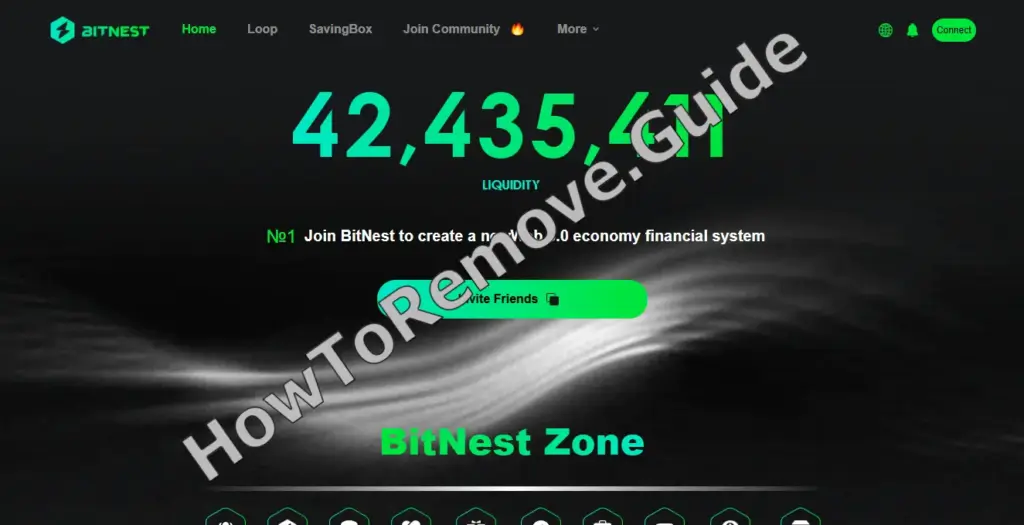
The web footprint adds more detail. Bitnest does not operate from a single canonical site. It’s described as running across eight domains, a setup that allows quick switching if a domain is flagged or taken down. Two specific domains are named: Bitnest.me and Bitnest.finance. As for audience, traffic data cited for August 2025 reports ~115,000 visits to the main site, with the bulk of visitors coming from Italy, Germany, the United States, the Netherlands, and Ukraine. That pattern reads less like organic global adoption and more like targeted recruitment in specific geographies.
The historical linkage is even more pointed. Research in the provided material identifies Bitnest as a reboot of Yunus Loop, an MLM crypto Ponzi that launched in late 2022 and collapsed in early 2024. In a telling detail, Bitnest’s own Telegram posts were edited to erase “Yunus Loop” mentions. Technical breadcrumbs also appear: reviewers found Chinese language strings in Bitnest’s website code, interpreted as ties to Chinese operators, with a historical note that many crypto Ponzis with such ties have been run from outside China, “usually from places like Singapore.” Whether or not one agrees with the inference, the Chinese text in the code is a concrete, observed data point.
What to Do If You’ve Fallen for the Scam
The clearest firsthand account in the material is simple. A participant deposited a small test amount and received a payment. Rather than scaling up, they investigated. They cite DEHEK – an online source cataloging Ponzi schemes – as providing a Bitnest investigation that describes 24% monthly as a number funded by new entrants, not by any sustainable activity. Seeking transparency, the participant then asked Bitnest’s public Telegram about any relationship to Yunus Loop. The message was deleted immediately, and they were removed from the group. From the user’s perspective, this meant negative reviews and complaints were being deleted, while promoters earning commissions continued posting positives. The outcome is specific and verifiable: question asked, message deleted, user banned.
Two additional resources are called out by observers. A site named bitnest-truth.com is described as presenting evidence that the Bitnest developers are the same as those behind Yunus Loop, including May 2024 and October 2023 episodes. A Dune Analytics page – dune.com/bitsandbytes/bitnest – is cited for charting Bitnest’s on-chain, ponzi-style money flows using Bitnest’s own contracts. These references are scheme-specific and concrete; they are not generic warnings, but named repositories of documentation.
How the Bitnest Scheme Tricks You
The techniques described are consistent across the material:
- Ownership secrecy. There are no disclosed names or executives – no real people publically accountable for the operation.
- Domain redundancy. Bitnest is said to operate across eight domains, including Bitnest.me and Bitnest.finance, allowing quick shifts when scrutiny increases.
- High, fixed returns. The exact numbers – 0.4% (1 day), 4% (7 days), 9.5% (7 days), 24% (28 days), and 24% monthly – are not floating targets; they are the pitch.
- MLM unilevel referrals. The team structure and referral bonuses monetize recruitment, not verifiable external activity.
- Messaging edits and moderation. Telegram posts were edited to remove “Yunus Loop,” and questions about it resulted in deletions and bans.
Recognizing Warning Signs of the Bitnest Scheme
The red flags in the record are specific:
- No disclosed owners or executives.
- Eight-domain footprint, including Bitnest.me and Bitnest.finance.
- Guaranteed yields with short timeframes, up to 24% in 28 days and 24% monthly.
- Unilevel referral structure paying recruitment.
- Claimed operation “since 2022” contrasted with a domain registered last year.
- Edits to Telegram posts to remove “Yunus Loop,” plus deletions and bans for those who ask about it.
- Chinese language found in site code, with historical notes about operations from outside China, “usually from places like Singapore.”
- Traffic concentration: Italy, Germany, the U.S., the Netherlands, Ukraine, with ~115,000 visits in August 2025.
- Direct lineage to a failed scheme: Yunus Loop (late 2022 launch, early 2024 collapse).
How to Handle Bitnest Communications
The moderation behavior is itself an indicator. In Bitnest’s public Telegram, a user who asked about Yunus Loop reports that their message was removed and they were banned. Separately, Bitnest’s own posts were edited to strip prior Yunus Loop mentions. Those actions do not supply counter-evidence; they erase context. Public comments tied to the same corpus warn prospective participants in unambiguous language and characterize 24% monthly as an obvious scam claim. The picture that emerges is not one of open engagement but one of curated promotion and aggressive pruning of dissent.
Reporting and Documentation
The material repeatedly references concrete, named sources:
- DEHEK, described as an online catalog of Ponzi schemes, includes a Bitnest investigation and the framing that new deposits fund withdrawals.
- bitnest-truth.com, described as documenting evidence that Bitnest’s developers are the same as those behind Yunus Loop, with May 2024 and October 2023 called out.
- dune.com/bitsandbytes/bitnest, a Dune Analytics page that documents money flows via Bitnest’s own contracts, reflecting a Ponzi-style pattern.
These are not generic advisories; they are project-specific dossiers that map actors, flows, and timelines.
Bottom Line
Bring the strands together and the mechanism is not ambiguous. The platforms – Bitnest.me and Bitnest.finance – anchor a multi-domain footprint. The numbers – 0.4% (1 day), 4% and 9.5% (7 days), 24% (28 days), 24% monthly – are the inducement. The methods – MLM unilevel referrals, undisclosed owners, eight domains, edited posts, bans – are the delivery system. The lineage – a reboot of Yunus Loop (late 2022 launch, early 2024 collapse) – supplies the pattern. The code clue (Chinese strings), the country-specific traffic (Italy, Germany, the U.S., the Netherlands, Ukraine), and the Telegram moderation complete the picture. Participants have reported deposits and early payments, but the described structure pays older users from newer users, and when recruitment slows, collapse follows. On the record available, the prudent course is to stay away from Bitnest, and to treat the named resources – DEHEK, bitnest-truth.com, and dune.com/bitsandbytes/bitnest – as the places where the scheme’s own data points and past connections are already compiled.
