

Okay, so if you landed here because Coawox promised you some easy crypto casino win, time out, because this is exactly where people need to slow down. A site can look clean, have games that feel familiar, and throw around big bonus numbers, but none of that proves there is real money waiting for you.
Now here’s the part that matters. The scam usually doesn’t feel obvious at the start. You sign up, maybe use a promo code, and suddenly your account shows a balance that makes it seem like you’re one step away from cashing out. But remember, those are just numbers on a screen.
The real catch often shows up when you try to withdraw. That’s when you may be told to pay an activation deposit, a verification fee, or some other made-up charge before the money can be released. And if you send crypto, getting it back is extremely unlikely.
So if you gave Coawox details, clicked suspicious links, or installed anything connected to it, check your device right away. If the cleanup feels confusing, SpyHunter 5 can help find and remove unwanted programs.
Scams of Coawox.com‘s type are known to steal personal data and passwords. Install SpyHunter Pro to scan for risks, remove any dangerous trackers, and enable real-time protection.

Try Free For 7 Days*
Buy now15% OFF if you buy straight without trial.
 OFFER
OFFERIMPORTANT! READ BEFORE PROCEEDING!
Anyone who deposited, uploaded documents, connected a wallet, clicked through a support link, or downloaded a file tied to Coawox should assume the exposure may extend beyond the casino account, especially if the browser or device also stores financial logins.
Begin with device hygiene before touching wallets or exchanges; we strongly recommend using SpyHunter 5 to scan the computer and remove suspicious components that may have arrived through ads, downloads, or support instructions.
Fastest Removal Option: Use SpyHunter 5
- 1.1Click here to download and install the anti-malware tool on your PC.
- 1.2
 Start SpyHunter 5, click the Buy button and choose between starting your 7-days free trial or directly purchasing the tool.
If you choose to buy SpyHunter 5 now, you can use our discount code, “HTRG15“, for 15% off.
- 1.3
 Once you activate SpyHunter, click Start Scan Now, select the Full Scan option, and let the tool do its job.
 - 1.4
 Once the scan completes (it could take a while, so have patience), you’ll see all malware and other undesirables listed.
Click Next to review the detections and then click Next again to delete all rogue items.
After the SpyHunter scan, work through the additional wallet, password, exchange, and evidence steps listed below:
- Reset passwords and enable 2FA on your email, crypto exchanges, and wallets; terminate other active sessions.
- Notify any exchanges and services touched by the funds; provide TxIDs and ask that accounts/addresses be flagged per policy.
- Migrate assets to fresh wallets with new seed phrases and revoke any existing token approvals on connected chains.
- If you uploaded ID documents, place credit/fraud alerts where available and monitor for identity-theft signals.
- Assemble an evidence bundle – wallet addresses, TxIDs, site URLs, chats, and screenshots – and file reports with police/IC3 and any involved platforms.
How We Know Coawox.com is a Scam
The signs around Coawox.com line up with a familiar crypto-casino fraud model. The site does not need to hack anything to cause losses; it only needs to make fake winnings feel real enough that users keep paying to retrieve them.
Withdrawal turns into negotiation
A legitimate casino should have clear cash-out rules before you deposit. Here, the obstacles appear after the balance looks valuable: release fees, clearance payments, tax deposits, or account reviews that require more money first.
Regulator proof is missing or decorative
Scam pages often display official-looking badges that lead nowhere useful. If the license number, company name, jurisdiction, and domain cannot be verified through an official register, the display is not evidence.
Bonuses are used as bait
Large sign-up credits and sudden wins create the illusion that the user has something to lose. That feeling can overpower caution and make a small extra payment seem rational.
Crypto payments isolate the victim
Blockchain transfers are fast and hard to reverse, which suits the scammer. A platform that avoids cards, banks, and transparent payment processors removes many of the routes victims normally use to dispute a loss.
Community noise is easy to fake
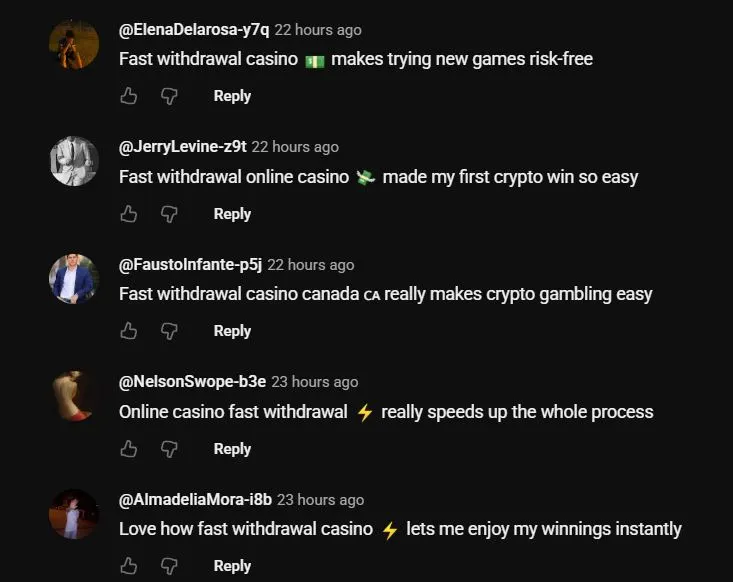
Screenshots of winners, comments full of praise, live notifications, and influencer-like posts can all be manufactured. The volume of praise matters less than whether independent sources confirm the platform’s identity and payouts.
Clone behavior points to churn
Fraudulent brands often move through disposable domains and copied layouts. Checking registration age and ownership through who.is can quickly show whether the casino has a stable public record or a throwaway presence.


How the Coawox Scam Deception Funnel Works
Understanding the sequence removes much of the pressure. The scam does not usually ask for the largest payment first; it builds belief gradually, then uses the displayed balance to justify one demand after another.
The path often starts with a social post or referral, moves to a polished-looking casino page, produces flattering account numbers, blocks withdrawal, and then uses support scripts to request money, documents, or both.
Promo hooks and influencer codes
The lure may arrive as a TikTok-style clip, a comment under crypto content, a direct message, or a shared “exclusive” code. The wording suggests that only quick users will benefit, which is meant to shorten the verification window.
Casino skin and bonus theater
After clicking through, the user sees familiar gambling design: bonus panels, games that respond smoothly, crypto wallets, and fairness claims. The design reduces suspicion by making the page feel like dozens of real sites the user has seen before.

Inflated balances, then the gate
Early activity is shaped to feel successful. Whether through a bonus balance or apparent game wins, the account begins to look valuable, and that perceived value becomes the hook used during withdrawal.
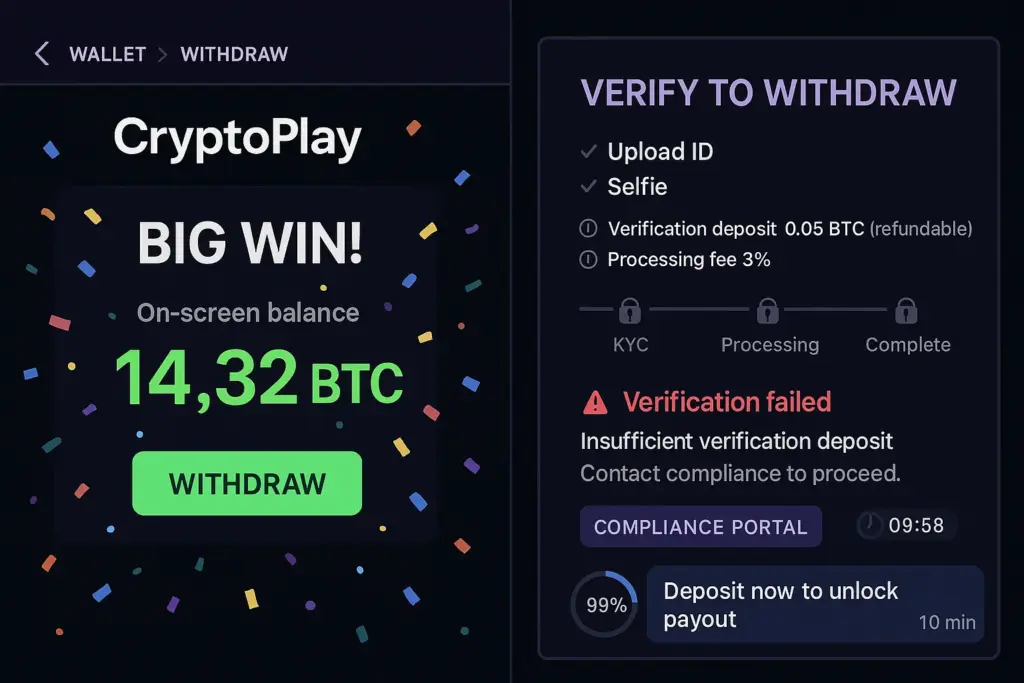
Fee-gates and KYC harvest
The withdrawal screen then introduces barriers with serious names: identity review, AML clearance, tax settlement, VIP threshold, or wallet validation. Each barrier asks the user to sacrifice either more crypto or more personal data.

Stalling, rebrands, and “recovery” bait
If payment slows down, support may switch from helpful to evasive. Eventually messages can stop, the domain can change, and new contacts may appear claiming they can recover the lost balance for another fee.
Staying safe from crypto casino scams like Coawox
Prevention works best when it is routine. Before using any crypto casino, require proof that exists outside the website: regulator records, long-term domain history, realistic terms, and payment methods with some recourse.
Verify license status in official registers
Use the regulator’s own search tools, not badges shown on the casino page. Search every name the site gives you and confirm that the licensed entity actually matches the domain being used.
Check domain age and history
Check whether the domain is new, privacy-shielded, recently changed, or absent from older web archives. A serious gambling business should not look like it appeared yesterday.
Reject withdrawal fees and “unlock” deposits
Refuse any instruction that says you must deposit money to withdraw money. Processing fees, tax deposits, unlock payments, and collateral demands are core signals of an advance-fee trap.
Prefer venues with recourse
A safer venue will identify who operates it, explain complaint procedures, publish stable terms, and support normal financial channels. A nameless crypto-only site shifts nearly all risk onto the user.
Limit wallet exposure
Separate gambling experiments from your main holdings. Use isolated wallets, keep balances low, enable two-factor authentication, and revoke permissions after any interaction with an unfamiliar site.
Validate “provably fair” claims
Do not accept “provably fair” as a slogan. Verification requires public details you can inspect yourself, such as seeds, hashes, bet records, and independent audits that match the games being offered.
Document and report rapidly
Collect evidence while the site is still online. Save screenshots of the balance, payment requests, wallet addresses, chat logs, emails, domains, and any social posts that led you there.
Build a deliberate slow-down reflex
Build a habit of leaving the page before deciding. Scam funnels rely on momentum; a pause gives you time to search, compare, and notice whether the offer only makes sense inside the scam’s own story.
Useful Resources for Scam Reporting and Prevention (By Country)
Even when crypto cannot be reversed, reports can add pressure. Exchanges, wallet providers, stablecoin issuers, hosts, and cybercrime teams are more likely to act when victims submit transaction IDs and organized documentation.
Click here to report the scam in your country
| Country / Agency | URL | Category / Use-case | Phone/Email |
| Australia – Crime Stoppers | https://www.crimestoppers.com.au | Anonymous tips about crime | 1800 333 000 |
| Australia – National Anti-Scam Center (Scamwatch) | https://www.scamwatch.gov.au/report-a-scam | General scams; phishing; texts/emails | |
| Australia – Police Assistance Line (non-emergency) | https://www.police.gov.au | Local police report | 131 444 |
| Australia – ReportCyber (ACSC) | https://www.cyber.gov.au/report | Cybercrime (hacks, fraud, extortion) | |
| Canada – Canadian Anti-Fraud Center (CAFC) | https://www.antifraudcentre-centreantifraude.ca/report-signalez-eng.htm | General scams incl. phone/text/email | |
| France – DGCCRF (SignalConso) | https://signal.conso.gouv.fr | Consumer scams/deceptive practices | |
| France – PHAROS – Internet-Signalement | https://www.internet-signalement.gouv.fr | Online content & cybercrime reports | |
| Germany – Bundeskriminalamt / Local Police | https://www.polizei.de/Polizei/DE/Home/home_node.html | Report online fraud | |
| Germany – Weißer Ring – Victim Support | https://weisser-ring.de | Victim support | 116 006 |
| India – DoT Helpline (Sanchar Saathi) | https://sancharsaathi.gov.in | Fraudulent telecom/SIM related | 155260 |
| India – National Consumer Helpline | https://consumerhelpline.gov.in | Consumer scams | 1800-11-4000 / 1915 |
| India – National Cyber Crime Reporting Portal | https://cybercrime.gov.in | Cybercrime incl. online fraud | 1930 |
| Japan – Consumer Affairs Agency (CAA) | https://www.caa.go.jp/policies/policy/consumer_policy/caution/cybercrime/ | Consumer scams | |
| Japan – National Police Agency – Cybercrime | https://www.npa.go.jp/bureau/cyber/ | Cybercrime reporting | |
| Mexico – Guardia Nacional (National Guard) | https://www.gob.mx/gn | Cybercrime reporting | |
| Mexico – Instituto Federal de Telecomunicaciones (IFT) | https://www.ift.org.mx | Telecom/online services scams | |
| Mexico – PROFECO | https://www.gob.mx/profeco | Consumer fraud & ecommerce | |
| Netherlands – AFM – Report investment fraud | https://www.afm.nl/en/consumenten/themas/beleggen/misleiding-misbruik | Investment/crypto | |
| Netherlands – Fraudehelpdesk | https://www.fraudehelpdesk.nl/melden | General scams (incl. phishing/SMS) | 088-7867372 |
| Netherlands – Politie – Meldpunt Internetoplichting | https://www.politie.nl/themas/internetoplichting.html | Online shopping fraud | |
| New Zealand – CERT NZ | https://www.cert.govt.nz/individuals/report-an-issue/ | Phishing, identity scams | |
| New Zealand – Department of Internal Affairs – Spam | https://www.dia.govt.nz/Spam-Contact-Us | Email/SMS spam | [email protected] |
| New Zealand – IDCARE | https://www.idcare.org | Victim support (identity compromise) | 0800 121 068 |
| New Zealand – Netsafe – Report | https://www.netsafe.org.nz/report/ | Online harms & scams | |
| New Zealand – New Zealand Police (non-emergency) | https://www.police.govt.nz/use-105 | Report fraud/online crime | 105 |
| Nigeria – Economic & Financial Crimes Commission (EFCC) | https://www.efcc.gov.ng | Financial scams incl. crypto/investment | [email protected] |
| Nigeria – Nigeria Police Special Fraud Unit (SFU) | https://www.specialfraudunit.org.ng | Serious fraud | Voice/SMS: 0708 227 6895; WhatsApp: 0812 760 9914 |
| Poland – CERT Polska (CERT.PL) | https://cert.pl/en/report/ | Cyber incidents & phishing | |
| Poland – Dyzurnet.pl | https://dyzurnet.pl | Illegal online content (esp. child protection) | |
| Poland – Polish Police (Policja) | https://www.policja.pl | Report scams to police | |
| Singapore – Anti-Scam Centre / Anti-Scam Helpline | https://www.scamalert.sg | General scams; texts; calls | 1800-722-6688 |
| Singapore – Monetary Authority of Singapore (MAS) | https://www.mas.gov.sg/investor-alert-list | Investment/crypto checks | |
| Singapore – Singapore Police Force | https://www.police.gov.sg/iwitness | Police report (cybercrime) | |
| South Africa – Cybersecurity Hub (CSIRT) | https://www.cybersecurityhub.gov.za | Cyber incidents incl. scams | |
| South Africa – South African Fraud Prevention Service (SAFPS) | https://www.safps.org.za | Identity fraud support | 011-867-2234 |
| South Africa – South African Police Service (SAPS) | https://www.saps.gov.za | Police report (cybercrime unit) | |
| South Korea – Korea Communications Commission (KCC) | https://www.kcc.go.kr | Telecom-related fraud | |
| South Korea – Korea Internet & Security Agency (KISA) | https://www.kisa.or.kr | Phishing, online harms | |
| South Korea – Korean National Police Agency – Cyber Bureau | https://ecrm.cyber.go.kr | Cybercrime reporting | |
| Spain – INCIBE – Oficina de Seguridad del Internauta (OSI) | https://www.osi.es/es/reporte | Cybersecurity & online fraud | |
| Spain – Policía Nacional / Guardia Civil | https://www.policia.es | Report scams to police | |
| Sweden – Crime Victim Authority (Brottsoffermyndigheten) | https://www.brottsoffermyndigheten.se | Victim support & compensation | 090–70 82 00 |
| Sweden – Polisen (Swedish Police) | https://polisen.se | Report fraud/cybercrime | 114 14 (non-emergency); 112 (emergency) |
| Sweden – Swedish Consumer Agency (Konsumentverket) | https://www.konsumentverket.se | Unfair business practices | |
| United Arab Emirates – Abu Dhabi Police – Aman Service | https://www.adpolice.gov.ae | Cybercrime tips/reporting | SMS 2828; 800 2626 |
| United Arab Emirates – Dubai Police – eCrime | https://www.dubaipolice.gov.ae | Cybercrime reporting | 04 606 1600 |
| United Arab Emirates – Ministry of Interior – Cyber Crime Dept. | https://www.moi.gov.ae | Cybercrime incl. online scams | |
| United Arab Emirates – Telecommunications Regulatory Authority (TRA) / TDRA | https://www.tra.gov.ae | Telecom-related scams/phishing | |
| United Kingdom – Action Fraud (NFIB) | https://www.actionfraud.police.uk | General scams & cybercrime (non-emergency) | 0300 123 2040 |
| United Kingdom – Citizens Advice Consumer Service | https://www.citizensadvice.org.uk/consumer/get-more-help/if-you-need-more-help-about-a-consumer-issue/ | Consumer problems & scam guidance | 0808 223 1133 |
| United Kingdom – Financial Conduct Authority (FCA) | https://www.fca.org.uk/consumers/report-scam-us | Investment/crypto & financial services | |
| United Kingdom – National Cyber Security Centre (NCSC) | https://www.ncsc.gov.uk/collection/phishing-scams | Phishing emails & suspicious websites | |
| United Kingdom – Stop Scams UK ‘159’ | https://stopscamsuk.org.uk/159 | Banking APP fraud (direct to your bank) | 159 |
| United States – AARP Fraud Watch Network Helpline | https://www.aarp.org/money/scams-fraud/ | Victim support | 833-372-8311 |
| United States – Better Business Bureau – Scam Tracker | https://www.bbb.org/scamtracker | Business/marketplace scams | |
| United States – FBI Internet Crime Complaint Center (IC3) | https://www.ic3.gov | Internet crime incl. investment/crypto | |
| United States – Federal Trade Commission – ReportFraud | https://reportfraud.ftc.gov | General scams, phishing, texts/emails | 1-877-382-4357 |
| United States – National Center for Disaster Fraud | https://www.justice.gov/disaster-fraud | Disaster-related scams | (866) 720-5721 |
| United States – SEC Tips & Complaints | https://www.sec.gov/tcr | Investment & securities/crypto-asset offerings |
Treat Coawox as a warning about process, not just a single website. If a platform invents fees at cash-out, hides ownership, and pushes you to act fast, step away, protect your accounts, and document everything before more value is exposed.