

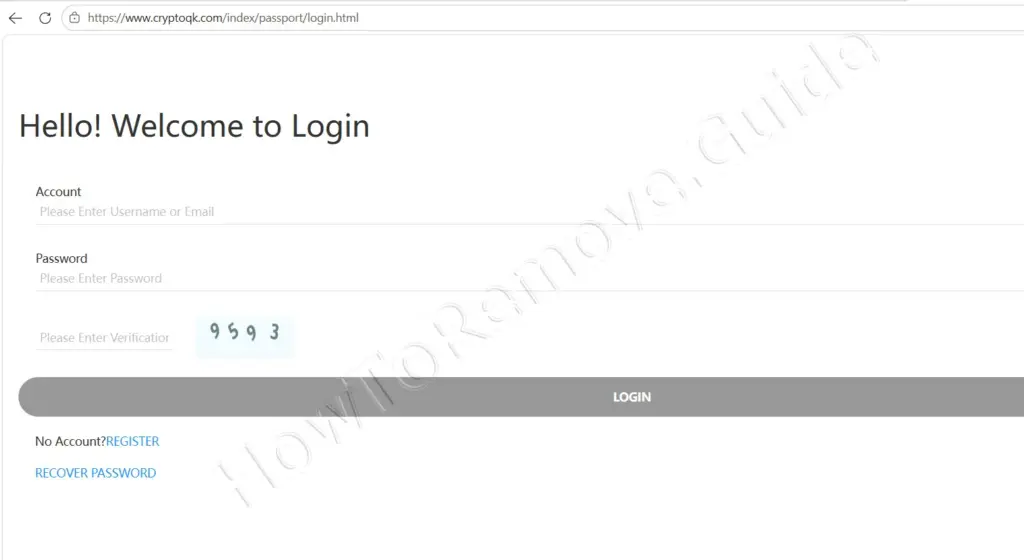
If Cryptoqk has just landed in front of you as a crypto exchange, I would not start by testing the signup flow or trying the promo code. I would start with the way the whole thing is asking to be believed before it has earned any of that trust.
The site may look like a functioning exchange, but the shape is the familiar clone-scam shape: a ready-made crypto front end built around a balance that seems to appear too easily. The promotion language is there to make the risk feel smaller than it is. The important part comes when you ask for your money back. That is where the fake account stops acting like an account and turns into a payment trap.
Scams of Cryptoqk.com‘s type are known to steal personal data and passwords. Install SpyHunter Pro to scan for risks, remove any dangerous trackers, and enable real-time protection.

Try Free For 7 Days*
Buy now15% OFF if you buy straight without trial.
 OFFER
OFFERThey may call the next charge verification. Or they may dress it up as some kind of activation or transfer fee. The label is less important than the ask: real money has to go in before imaginary money can supposedly come out.
Once that happens, Cryptoqk can vanish or return under a new domain with the same costume (we’ve seen the exact same thing with other scam sites like Yzzq919.cc and Betabinary). The platform is just one copy of a template that keeps working because new visitors keep meeting it for the first time.
IMPORTANT! READ BEFORE PROCEEDING!
If you entered details, connected a wallet, sent crypto, or installed anything after visiting Cryptoqk, assume the exposure may extend beyond the first payment, especially if a download, browser extension, remote-support request, or wallet connection was involved.
For device safety, the first step we strongly recommend is using SpyHunter 5 to scan for unwanted software, risky extensions, and other items that could keep accounts exposed.
Fastest Removal Option: Use SpyHunter 5
- 1.1Click here to download and install the anti-malware tool on your PC.
- 1.2
 Start SpyHunter 5, click the Buy button and choose between starting your 7-days free trial or directly purchasing the tool.
If you choose to buy SpyHunter 5 now, you can use our discount code, “HTRG15“, for 15% off.
- 1.3
 Once you activate SpyHunter, click Start Scan Now, select the Full Scan option, and let the tool do its job.
 - 1.4
 Once the scan completes (it could take a while, so have patience), you’ll see all malware and other undesirables listed.
Click Next to review the detections and then click Next again to delete all rogue items.
After SpyHunter 5, it is also strongly recommended that you lock down the accounts and wallets connected to the incident, because fake exchange scams often lead to password theft, wallet-permission abuse, follow-up phishing, and recovery-fraud attempts.
- Move remaining assets to a fresh, clean wallet and revoke any suspicious token approvals linked to the scam touchpoint.
- Change passwords and enable app-based 2FA on email, exchanges, and chat accounts; review active sessions and delete unused API keys.
- Preserve evidence: screenshots, URLs, videos or ads, wallet addresses, TXIDs, and chat logs – keep everything for official reports.
- Notify the sending platform (your exchange or service) with TXIDs and the destination address so they can flag or freeze if possible.
- Report promptly to your national cybercrime unit (e.g., IC3 in the US, Action Fraud in the UK) and to the platform where you saw the promotion.
How We Know Cryptoqk is a Scam
Several independent warning signs line up around Cryptoqk. None of them requires guessing about hidden code or secret trading records; they are visible in the way the site recruits users, invents balances, blocks withdrawals, and avoids verifiable accountability.
Instant balance illusion
A code or sign-up flow that produces a large crypto balance is not a reward. It is a bait number placed inside the interface to make the next deposit feel like a minor step toward a much bigger payout.
Withdrawal held hostage
The moment a platform demands a separate payment before releasing funds, the relationship has shifted from investing to advance-fee fraud. A legitimate service can show transparent fees without forcing a fresh crypto transfer first.
Social proof without proof
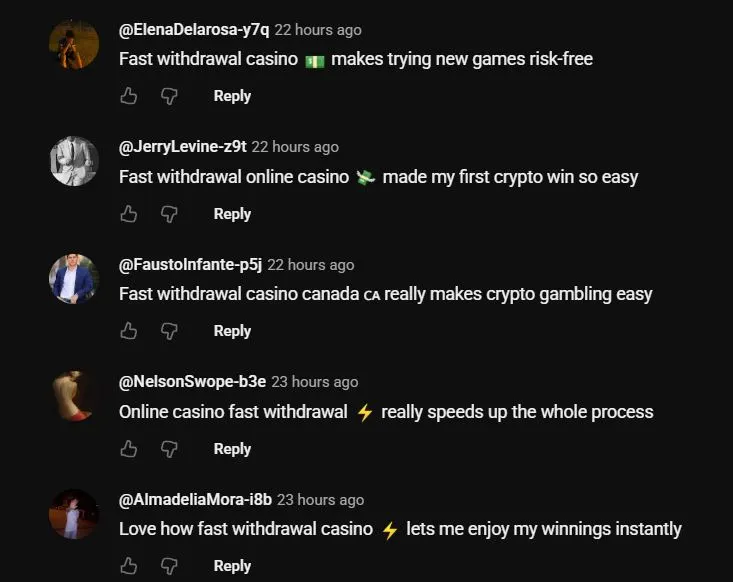
Celebrity clips, influencer shoutouts, and enthusiastic comment threads can be fabricated or recycled. Scammers use borrowed authority because it shortens the time victims spend checking whether the platform is real.
Numbers that cannot be verified
Real crypto movement leaves records that can be checked. If the supposed payout has no transaction hash, no confirmed network activity, and only a dashboard entry, the balance is just website text.
Decorative compliance claims
Fraud sites often paste seals, license wording, and security badges without giving a regulator record that matches. A claim that cannot be independently verified is marketing, not authorization.
Template behavior
Clone operations reuse the same funnel under fresh names. When complaints rise, one domain can disappear while another launches with nearly identical pages, scripts, and payment demands.
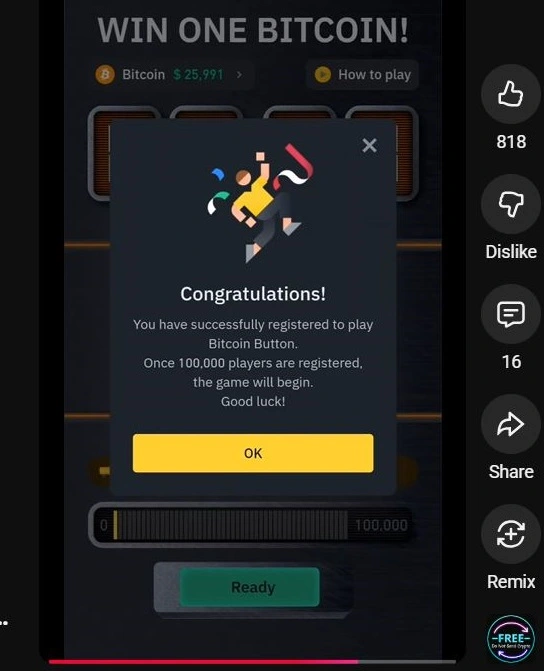
How the Cryptoqk Scam Deception Funnel Works
The scam works because every stage narrows the victim’s focus. It first creates curiosity, then shows easy profit, then frames payment as a final technical requirement. Seeing that sequence clearly makes the pressure easier to resist.
A common run looks like this: a viral promotion sends the user to Cryptoqk, registration feels harmless, a fake balance appears, withdrawal fails, support asks for a deposit, and new excuses appear until the victim stops paying or the site vanishes.
Promo hooks and influencer codes
The first hook is usually convenience plus urgency: a bonus, celebrity-themed code, or private invitation that appears to be expiring soon. Seeded comments make the offer look popular before the user has checked anything.
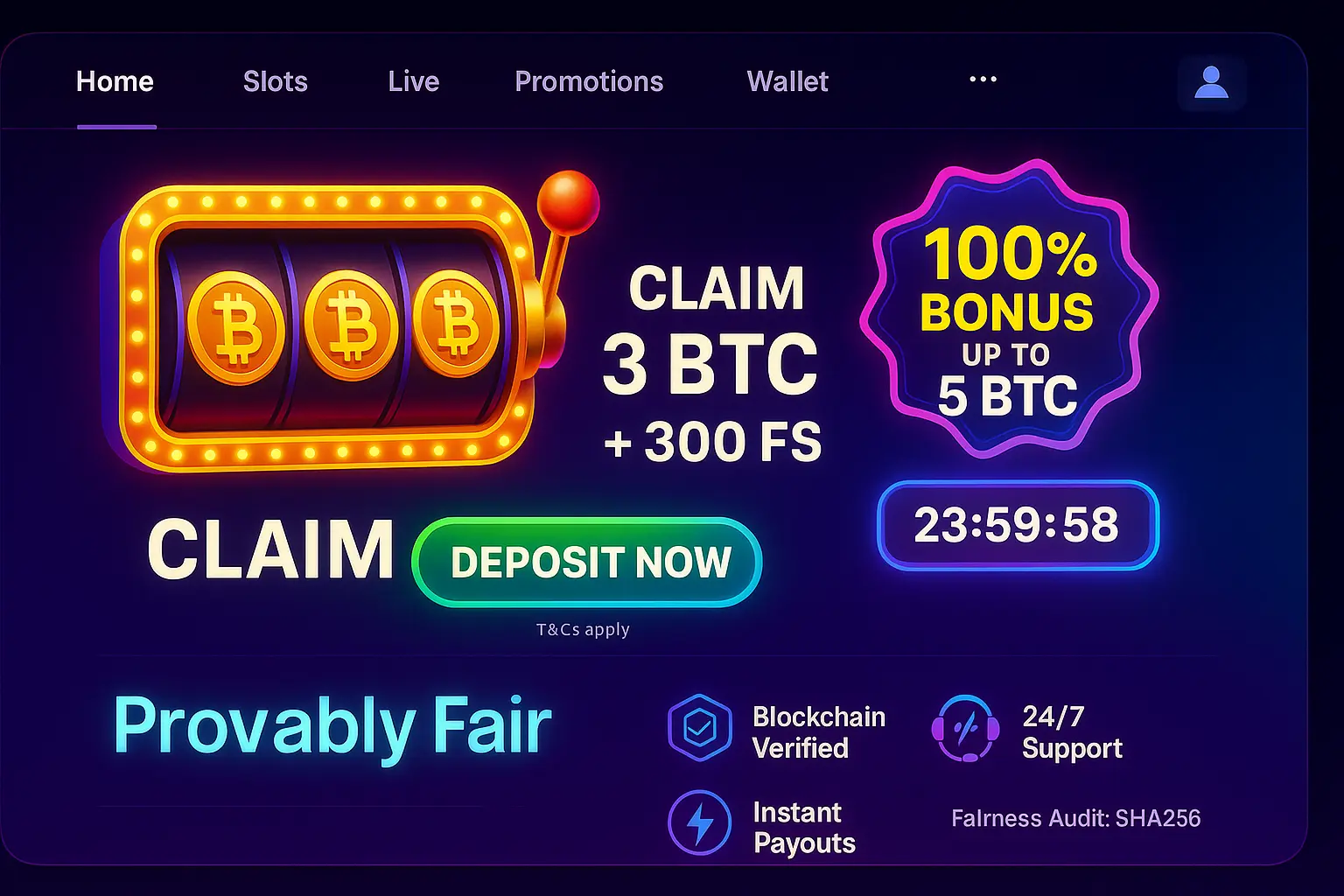
Casino skin and bonus theater
The landing page imitates a financial product with charts, menus, account panels, and security language. Those visuals are meant to calm suspicion even though the platform may have no real exchange connection behind it.
Inflated balances, then the gate
After sign-up, the interface may show profit instantly. That artificial success lowers caution, and the first withdrawal attempt becomes the moment when the fake gate is introduced.
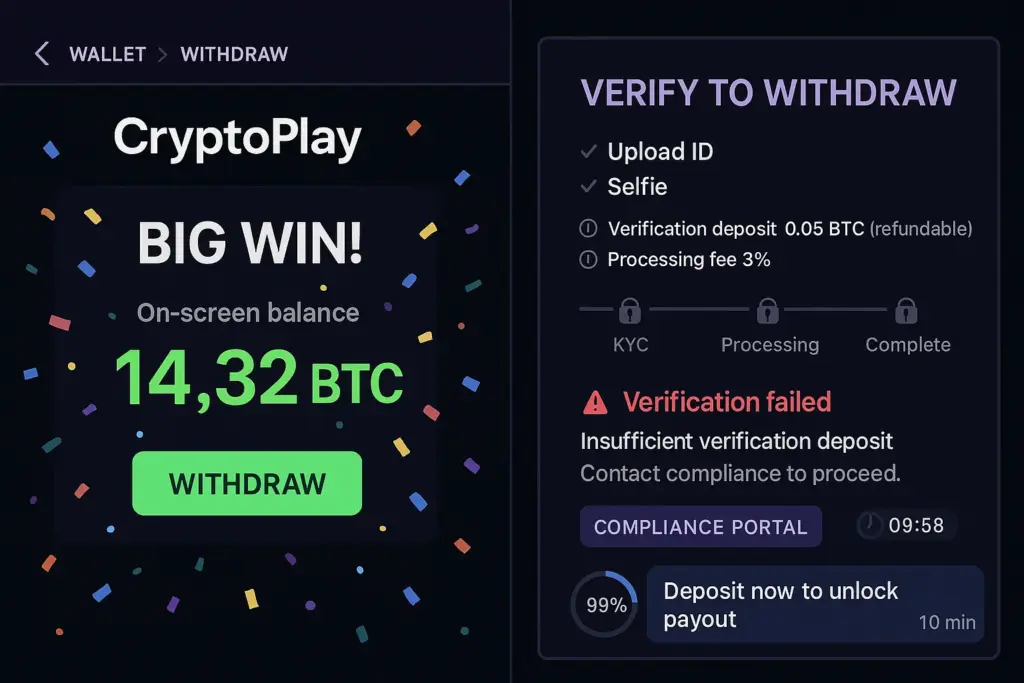
Fee-gates and KYC harvest
The gate then multiplies. Verification, taxes, AML review, VIP status, or wallet limits are used as reasons for another payment, while any documents uploaded may create separate identity-risk problems.

Stalling, rebrands, and “recovery” bait
When the victim hesitates, support may sound patient and official while adding deadlines or new conditions. Later the operators may disappear, then another account may contact the victim offering paid recovery.
Staying safe from crypto scams like Cryptoqk
Good protection comes from slowing the process down and separating proof from presentation. Use the habits below to protect wallets, accounts, identity documents, and decision-making before a site like Cryptoqk can turn curiosity into loss.
Never pay to withdraw
No credible exchange requires a separate unlock payment to release a displayed balance. Treat activation fees, tax prepayments, withdrawal deposits, and limit-removal charges as stop signs.
Verify endorsements at the source
Check any endorsement through the person’s official website, verified social channels, or reputable reporting. A video embedded in an ad or reposted by strangers should not carry financial trust.
Navigate with your own bookmarks
Use saved links for exchanges and wallet tools rather than ads, search results, or message links. This simple habit cuts off many clone domains before they ever load.
Check regulator registers & warnings
Look up licensing claims directly in official databases and warning pages. Matching names, domains, and registration details matter; vague badge graphics do not.
Segregate risk with burner wallets
Keep long-term funds away from experimental sites. A low-balance wallet used only for testing limits the damage if a page is malicious or later proves dishonest.
Harden accounts with 2FA & hygiene
Change passwords after any interaction, enable app-based two-factor authentication, remove unknown sessions, and delete unused API keys from exchanges and email accounts.
Revoke approvals & migrate
A wallet connection can leave approvals behind. Review permissions with trusted tools, revoke anything unnecessary, and move remaining assets to a clean address if exposure is suspected.
Protect identity & slow down
Identity data deserves the same urgency as coins. If documents were submitted, watch for account-opening attempts, consider a credit freeze where available, and be skeptical of follow-up calls.
Where to report Cryptoqk-style crypto scams (by country)
Reports are most useful when evidence is preserved early. Save screenshots, wallet addresses, transaction IDs, chats, emails, and ad links, then notify the sending exchange, the ad platform, and the appropriate cybercrime authority.
Click here to report the scam in your country
| Country / Agency | URL | Category / Use-case | Phone/Email |
| Australia – Crime Stoppers | https://www.crimestoppers.com.au | Anonymous tips about crime | 1800 333 000 |
| Australia – National Anti-Scam Center (Scamwatch) | https://www.scamwatch.gov.au/report-a-scam | General scams; phishing; texts/emails | |
| Australia – Police Assistance Line (non-emergency) | https://www.police.gov.au | Local police report | 131 444 |
| Australia – ReportCyber (ACSC) | https://www.cyber.gov.au/report | Cybercrime (hacks, fraud, extortion) | |
| Canada – Canadian Anti-Fraud Center (CAFC) | https://www.antifraudcentre-centreantifraude.ca/report-signalez-eng.htm | General scams incl. phone/text/email | |
| France – DGCCRF (SignalConso) | https://signal.conso.gouv.fr | Consumer scams/deceptive practices | |
| France – PHAROS – Internet-Signalement | https://www.internet-signalement.gouv.fr | Online content & cybercrime reports | |
| Germany – Bundeskriminalamt / Local Police | https://www.polizei.de/Polizei/DE/Home/home_node.html | Report online fraud | |
| Germany – Weißer Ring – Victim Support | https://weisser-ring.de | Victim support | 116 006 |
| India – DoT Helpline (Sanchar Saathi) | https://sancharsaathi.gov.in | Fraudulent telecom/SIM related | 155260 |
| India – National Consumer Helpline | https://consumerhelpline.gov.in | Consumer scams | 1800-11-4000 / 1915 |
| India – National Cyber Crime Reporting Portal | https://cybercrime.gov.in | Cybercrime incl. online fraud | 1930 |
| Japan – Consumer Affairs Agency (CAA) | https://www.caa.go.jp/policies/policy/consumer_policy/caution/cybercrime/ | Consumer scams | |
| Japan – National Police Agency – Cybercrime | https://www.npa.go.jp/bureau/cyber/ | Cybercrime reporting | |
| Mexico – Guardia Nacional (National Guard) | https://www.gob.mx/gn | Cybercrime reporting | |
| Mexico – Instituto Federal de Telecomunicaciones (IFT) | https://www.ift.org.mx | Telecom/online services scams | |
| Mexico – PROFECO | https://www.gob.mx/profeco | Consumer fraud & ecommerce | |
| Netherlands – AFM – Report investment fraud | https://www.afm.nl/en/consumenten/themas/beleggen/misleiding-misbruik | Investment/crypto | |
| Netherlands – Fraudehelpdesk | https://www.fraudehelpdesk.nl/melden | General scams (incl. phishing/SMS) | 088-7867372 |
| Netherlands – Politie – Meldpunt Internetoplichting | https://www.politie.nl/themas/internetoplichting.html | Online shopping fraud | |
| New Zealand – CERT NZ | https://www.cert.govt.nz/individuals/report-an-issue/ | Phishing, identity scams | |
| New Zealand – Department of Internal Affairs – Spam | https://www.dia.govt.nz/Spam-Contact-Us | Email/SMS spam | [email protected] |
| New Zealand – IDCARE | https://www.idcare.org | Victim support (identity compromise) | 0800 121 068 |
| New Zealand – Netsafe – Report | https://www.netsafe.org.nz/report/ | Online harms & scams | |
| New Zealand – New Zealand Police (non-emergency) | https://www.police.govt.nz/use-105 | Report fraud/online crime | 105 |
| Nigeria – Economic & Financial Crimes Commission (EFCC) | https://www.efcc.gov.ng | Financial scams incl. crypto/investment | [email protected] |
| Nigeria – Nigeria Police Special Fraud Unit (SFU) | https://www.specialfraudunit.org.ng | Serious fraud | Voice/SMS: 0708 227 6895; WhatsApp: 0812 760 9914 |
| Poland – CERT Polska (CERT.PL) | https://cert.pl/en/report/ | Cyber incidents & phishing | |
| Poland – Dyzurnet.pl | https://dyzurnet.pl | Illegal online content (esp. child protection) | |
| Poland – Polish Police (Policja) | https://www.policja.pl | Report scams to police | |
| Singapore – Anti-Scam Centre / Anti-Scam Helpline | https://www.scamalert.sg | General scams; texts; calls | 1800-722-6688 |
| Singapore – Monetary Authority of Singapore (MAS) | https://www.mas.gov.sg/investor-alert-list | Investment/crypto checks | |
| Singapore – Singapore Police Force | https://www.police.gov.sg/iwitness | Police report (cybercrime) | |
| South Africa – Cybersecurity Hub (CSIRT) | https://www.cybersecurityhub.gov.za | Cyber incidents incl. scams | |
| South Africa – South African Fraud Prevention Service (SAFPS) | https://www.safps.org.za | Identity fraud support | 011-867-2234 |
| South Africa – South African Police Service (SAPS) | https://www.saps.gov.za | Police report (cybercrime unit) | |
| South Korea – Korea Communications Commission (KCC) | https://www.kcc.go.kr | Telecom-related fraud | |
| South Korea – Korea Internet & Security Agency (KISA) | https://www.kisa.or.kr | Phishing, online harms | |
| South Korea – Korean National Police Agency – Cyber Bureau | https://ecrm.cyber.go.kr | Cybercrime reporting | |
| Spain – INCIBE – Oficina de Seguridad del Internauta (OSI) | https://www.osi.es/es/reporte | Cybersecurity & online fraud | |
| Spain – Policía Nacional / Guardia Civil | https://www.policia.es | Report scams to police | |
| Sweden – Crime Victim Authority (Brottsoffermyndigheten) | https://www.brottsoffermyndigheten.se | Victim support & compensation | 090–70 82 00 |
| Sweden – Polisen (Swedish Police) | https://polisen.se | Report fraud/cybercrime | 114 14 (non-emergency); 112 (emergency) |
| Sweden – Swedish Consumer Agency (Konsumentverket) | https://www.konsumentverket.se | Unfair business practices | |
| United Arab Emirates – Abu Dhabi Police – Aman Service | https://www.adpolice.gov.ae | Cybercrime tips/reporting | SMS 2828; 800 2626 |
| United Arab Emirates – Dubai Police – eCrime | https://www.dubaipolice.gov.ae | Cybercrime reporting | 04 606 1600 |
| United Arab Emirates – Ministry of Interior – Cyber Crime Dept. | https://www.moi.gov.ae | Cybercrime incl. online scams | |
| United Arab Emirates – Telecommunications Regulatory Authority (TRA) / TDRA | https://www.tra.gov.ae | Telecom-related scams/phishing | |
| United Kingdom – Action Fraud (NFIB) | https://www.actionfraud.police.uk | General scams & cybercrime (non-emergency) | 0300 123 2040 |
| United Kingdom – Citizens Advice Consumer Service | https://www.citizensadvice.org.uk/consumer/get-more-help/if-you-need-more-help-about-a-consumer-issue/ | Consumer problems & scam guidance | 0808 223 1133 |
| United Kingdom – Financial Conduct Authority (FCA) | https://www.fca.org.uk/consumers/report-scam-us | Investment/crypto & financial services | |
| United Kingdom – National Cyber Security Centre (NCSC) | https://www.ncsc.gov.uk/collection/phishing-scams | Phishing emails & suspicious websites | |
| United Kingdom – Stop Scams UK ‘159’ | https://stopscamsuk.org.uk/159 | Banking APP fraud (direct to your bank) | 159 |
| United States – AARP Fraud Watch Network Helpline | https://www.aarp.org/money/scams-fraud/ | Victim support | 833-372-8311 |
| United States – Better Business Bureau – Scam Tracker | https://www.bbb.org/scamtracker | Business/marketplace scams | |
| United States – FBI Internet Crime Complaint Center (IC3) | https://www.ic3.gov | Internet crime incl. investment/crypto | |
| United States – Federal Trade Commission – ReportFraud | https://reportfraud.ftc.gov | General scams, phishing, texts/emails | 1-877-382-4357 |
| United States – National Center for Disaster Fraud | https://www.justice.gov/disaster-fraud | Disaster-related scams | (866) 720-5721 |
| United States – SEC Tips & Complaints | https://www.sec.gov/tcr | Investment & securities/crypto-asset offerings |
