

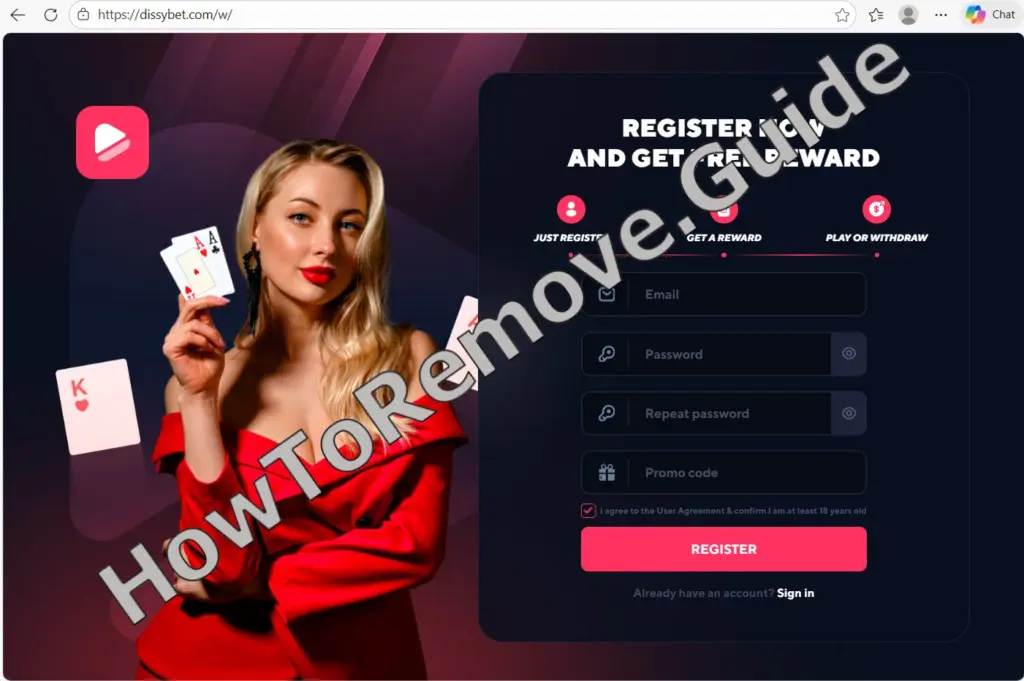
If a shiny online crypto gambling platform called Dissybet.com promises to hand you “free” credit the moment you register, and assures you there’s zero risk for your own funds if you try some of its games, I warn you NOT TO engage with this site. It’s a scam!
This site runs an identical scheme to Cenatsino.com, Cusewin.cc, and other similar fake platforms we’ve covered many times on our site. Its tactics are painfully familiar, yet they still prove effective when applied against inexperienced users. Here’s the gist of this scam:
As we said, the site grants you a hefty starting bonus for free, then you spin a few games, and the balance climbs. But that’s all an absolute lie. Dissybet.com isn’t built to reward luck but to manufacture “winnings” until you’re emotionally invested.
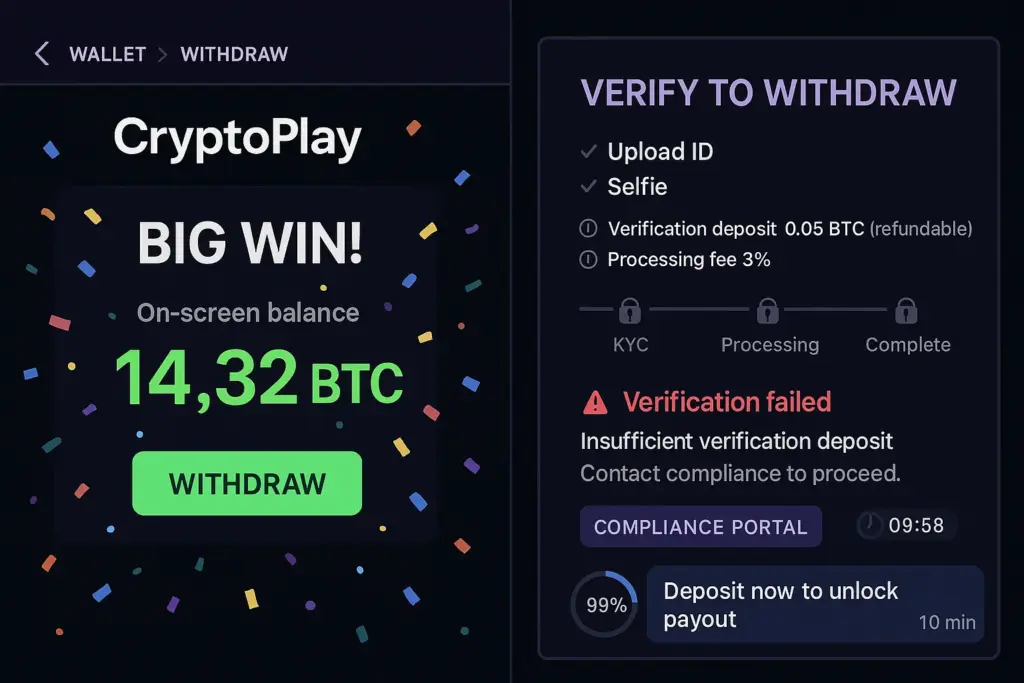
When you finally (and inevitably) try to withdraw, the scam asks you to pay an “activation,” “verification,” or “transfer” deposit first. Whatever the made-up premise, you must always send some money before you can cash out, and it is that money that the scammers are after.
The amount is always “small compared to your winnings,” and that comparison is the con. The deposit isn’t a fee; it’s the theft. After you pay, withdrawals stall, support ghosts you (if there ever was one to begin with), and new “requirements” appear to squeeze one more payment.
The bigger problem here is that, if the scammers managed to trick you and get you to deposit actual money, they may have also gained access to sensitive info such as your banking account details. Therefore, damage control should be a first priority in such situations. To learn exactly what to do, I strongly advise you to read the rest of this post.
Scams of Dissybet.com‘s type are known to steal personal data and passwords. Install SpyHunter Pro to scan for risks, remove any dangerous trackers, and enable real-time protection.

Try Free For 7 Days*
Buy now15% OFF if you buy straight without trial.
 OFFER
OFFERIMPORTANT! READ BEFORE PROCEEDING!
If you have already interacted with Dissybet.com, cut the line now – no more messages, no more “fees,” no screen-sharing, and no remote access – and pivot to containment mode. Secure accounts, isolate funds into clean wallets, and preserve every scrap of evidence for reports. Here are five emergency steps we strongly recommend you take right now:
- Change credentials and turn on 2FA for email, exchanges, and wallets; sign out other sessions and revoke unknown devices.
- Alert any exchanges or services involved and share wallet addresses/TxIDs; request internal flags on accounts and destination addresses where possible.
- Move remaining assets to new wallets created from fresh seed phrases, and remove token approvals from any chains you connected during the scam.
- If you sent ID documents, set fraud alerts/credit monitoring where available and watch for new-account or SIM-swap warning signs.
- Build an evidence packet – URLs, chat logs, screenshots, wallet addresses, TxIDs, and timestamps – and submit it to police/IC3 and any platforms that touched the funds.
How We Know Dissybet.com is a Scam
Ignore the neon and the “bonus” confetti: the diagnostic red flags for fake crypto casinos stack up fast here. The markers below are the reliable tells of a fee-to-withdraw trap, with identity collection bolted on for extra profit.
Surprise withdrawal charges
Withdrawals suddenly require “admin,” “network,” “tax,” or “verification” payments first. Real platforms don’t invoice you up front to hand you your own balance.
Counterfeit licensing
Regulator logos and license numbers are displayed like stickers, but they don’t validate in the relevant registers – performance legitimacy, not the real thing.
Inflated early “wins”
Initial results are engineered to feel generous so you deposit more; the “luck” is a screen effect, not a fair system paying out.
Crypto-only rails
Keeping everything in crypto strips away chargebacks and dispute pathways; the irreversibility is a feature for the scammer, not a convenience for you.
Synthetic social proof
Popups, “recent winners,” botty reviews, and referral codes mimic community momentum while avoiding anything independently verifiable.
Fresh, privacy-masked domains
Short-lived domains with hidden ownership and obvious “clone family” behavior are a classic hallmark; public lookups like who.is often make the churn visible.

How the Dissybet.com Scam Deception Funnel Works
Knowing the sequence matters because the whole con is modular and predictable. Once you can name the steps, you stop negotiating with the script and start cutting off the leverage points.
The pipeline is simple: attract with bonuses, inflate “success,” block cash-outs with fees and KYC, then delay until you quit – followed by a rebrand and, sometimes, a second-wave “recovery” pitch.
Promo hooks and influencer codes
Seeded comments, shiny “bonus” codes, and pushy DMs are used to accelerate trust and urgency, especially for first-time deposits.

Casino skin and bonus theater
A polished lobby and big-number “bonuses” create instant legitimacy, while vague “provably fair” language hand-waves away accountability.

Inflated balances, then the gate
Early “wins” inflate the dashboard, then the first withdrawal attempt triggers a KYC wall plus an “unlock” payment dressed up as a required fee.
Fee-gates and KYC harvest
Every new obstacle comes with a new invoice – VIP tiers, AML reviews, “tax clearance” – while the same process quietly extracts both more crypto and high-value identity data.

Stalling, rebrands, and “recovery” bait
Support shifts from “helpful” to endlessly procedural, then the domain goes quiet and a replacement site appears. Not long after, a “fund recovery” pitch may show up to run the sequel scam.
Staying safe from crypto casino scams like Dissybet.com
Staying safe mostly means doing the boring checks before the dopamine hits. The habits below give you a repeatable filter for spotting paste-on “casinos” before you deposit – or before you hand over documents.
Verify license status in official registers
Ignore on-page “license badges.” Search real regulator databases by company name and domain; no match usually means no license.
Check domain age and history
Use WHOIS and archives to spot brand-new, privacy-masked domains and “same-site-different-name” patterns.
Reject withdrawal fees and “unlock” deposits
Any demand to “pay first to withdraw” is the scam core. Don’t negotiate with it; don’t send another cent.
Prefer venues with recourse
Look for verifiable licensing, transparent ownership, and real dispute channels; crypto-only “venues” are optimized for irreversible loss.
Limit wallet exposure
Segment funds, use fresh addresses, protect seed phrases offline, and revoke token approvals you don’t actively need.
Validate “provably fair” claims
If you can’t independently verify outcomes via transparent seeds/hashes and a reproducible method, assume the “math” is just marketing copy.
Document and report rapidly
Save TxIDs, addresses, timestamps, and all chats/screenshots. Report to authorities and platforms quickly – speed improves the odds of useful action.
Build a deliberate slow-down reflex
Make “pause and verify” automatic: check licensing and domain history first, then decide with your cortex – not your adrenaline.
Useful Resources for Scam Reporting and Prevention (By Country)
Even when crypto moves fast, reporting promptly can still matter – especially when exchanges, platforms, or stablecoin issuers can connect your documentation to existing cases. Use the directory below to file clean, evidence-backed reports.
Click here to report the scam in your country
| Country / Agency | URL | Category / Use-case | Phone/Email |
| Australia – Crime Stoppers | https://www.crimestoppers.com.au | Anonymous tips about crime | 1800 333 000 |
| Australia – National Anti-Scam Center (Scamwatch) | https://www.scamwatch.gov.au/report-a-scam | General scams; phishing; texts/emails | |
| Australia – Police Assistance Line (non-emergency) | https://www.police.gov.au | Local police report | 131 444 |
| Australia – ReportCyber (ACSC) | https://www.cyber.gov.au/report | Cybercrime (hacks, fraud, extortion) | |
| Canada – Canadian Anti-Fraud Center (CAFC) | https://www.antifraudcentre-centreantifraude.ca/report-signalez-eng.htm | General scams incl. phone/text/email | |
| France – DGCCRF (SignalConso) | https://signal.conso.gouv.fr | Consumer scams/deceptive practices | |
| France – PHAROS – Internet-Signalement | https://www.internet-signalement.gouv.fr | Online content & cybercrime reports | |
| Germany – Bundeskriminalamt / Local Police | https://www.polizei.de/Polizei/DE/Home/home_node.html | Report online fraud | |
| Germany – Weißer Ring – Victim Support | https://weisser-ring.de | Victim support | 116 006 |
| India – DoT Helpline (Sanchar Saathi) | https://sancharsaathi.gov.in | Fraudulent telecom/SIM related | 155260 |
| India – National Consumer Helpline | https://consumerhelpline.gov.in | Consumer scams | 1800-11-4000 / 1915 |
| India – National Cyber Crime Reporting Portal | https://cybercrime.gov.in | Cybercrime incl. online fraud | 1930 |
| Japan – Consumer Affairs Agency (CAA) | https://www.caa.go.jp/policies/policy/consumer_policy/caution/cybercrime/ | Consumer scams | |
| Japan – National Police Agency – Cybercrime | https://www.npa.go.jp/bureau/cyber/ | Cybercrime reporting | |
| Mexico – Guardia Nacional (National Guard) | https://www.gob.mx/gn | Cybercrime reporting | |
| Mexico – Instituto Federal de Telecomunicaciones (IFT) | https://www.ift.org.mx | Telecom/online services scams | |
| Mexico – PROFECO | https://www.gob.mx/profeco | Consumer fraud & ecommerce | |
| Netherlands – AFM – Report investment fraud | https://www.afm.nl/en/consumenten/themas/beleggen/misleiding-misbruik | Investment/crypto | |
| Netherlands – Fraudehelpdesk | https://www.fraudehelpdesk.nl/melden | General scams (incl. phishing/SMS) | 088-7867372 |
| Netherlands – Politie – Meldpunt Internetoplichting | https://www.politie.nl/themas/internetoplichting.html | Online shopping fraud | |
| New Zealand – CERT NZ | https://www.cert.govt.nz/individuals/report-an-issue/ | Phishing, identity scams | |
| New Zealand – Department of Internal Affairs – Spam | https://www.dia.govt.nz/Spam-Contact-Us | Email/SMS spam | [email protected] |
| New Zealand – IDCARE | https://www.idcare.org | Victim support (identity compromise) | 0800 121 068 |
| New Zealand – Netsafe – Report | https://www.netsafe.org.nz/report/ | Online harms & scams | |
| New Zealand – New Zealand Police (non-emergency) | https://www.police.govt.nz/use-105 | Report fraud/online crime | 105 |
| Nigeria – Economic & Financial Crimes Commission (EFCC) | https://www.efcc.gov.ng | Financial scams incl. crypto/investment | [email protected] |
| Nigeria – Nigeria Police Special Fraud Unit (SFU) | https://www.specialfraudunit.org.ng | Serious fraud | Voice/SMS: 0708 227 6895; WhatsApp: 0812 760 9914 |
| Poland – CERT Polska (CERT.PL) | https://cert.pl/en/report/ | Cyber incidents & phishing | |
| Poland – Dyzurnet.pl | https://dyzurnet.pl | Illegal online content (esp. child protection) | |
| Poland – Polish Police (Policja) | https://www.policja.pl | Report scams to police | |
| Singapore – Anti-Scam Centre / Anti-Scam Helpline | https://www.scamalert.sg | General scams; texts; calls | 1800-722-6688 |
| Singapore – Monetary Authority of Singapore (MAS) | https://www.mas.gov.sg/investor-alert-list | Investment/crypto checks | |
| Singapore – Singapore Police Force | https://www.police.gov.sg/iwitness | Police report (cybercrime) | |
| South Africa – Cybersecurity Hub (CSIRT) | https://www.cybersecurityhub.gov.za | Cyber incidents incl. scams | |
| South Africa – South African Fraud Prevention Service (SAFPS) | https://www.safps.org.za | Identity fraud support | 011-867-2234 |
| South Africa – South African Police Service (SAPS) | https://www.saps.gov.za | Police report (cybercrime unit) | |
| South Korea – Korea Communications Commission (KCC) | https://www.kcc.go.kr | Telecom-related fraud | |
| South Korea – Korea Internet & Security Agency (KISA) | https://www.kisa.or.kr | Phishing, online harms | |
| South Korea – Korean National Police Agency – Cyber Bureau | https://ecrm.cyber.go.kr | Cybercrime reporting | |
| Spain – INCIBE – Oficina de Seguridad del Internauta (OSI) | https://www.osi.es/es/reporte | Cybersecurity & online fraud | |
| Spain – Policía Nacional / Guardia Civil | https://www.policia.es | Report scams to police | |
| Sweden – Crime Victim Authority (Brottsoffermyndigheten) | https://www.brottsoffermyndigheten.se | Victim support & compensation | 090–70 82 00 |
| Sweden – Polisen (Swedish Police) | https://polisen.se | Report fraud/cybercrime | 114 14 (non-emergency); 112 (emergency) |
| Sweden – Swedish Consumer Agency (Konsumentverket) | https://www.konsumentverket.se | Unfair business practices | |
| United Arab Emirates – Abu Dhabi Police – Aman Service | https://www.adpolice.gov.ae | Cybercrime tips/reporting | SMS 2828; 800 2626 |
| United Arab Emirates – Dubai Police – eCrime | https://www.dubaipolice.gov.ae | Cybercrime reporting | 04 606 1600 |
| United Arab Emirates – Ministry of Interior – Cyber Crime Dept. | https://www.moi.gov.ae | Cybercrime incl. online scams | |
| United Arab Emirates – Telecommunications Regulatory Authority (TRA) / TDRA | https://www.tra.gov.ae | Telecom-related scams/phishing | |
| United Kingdom – Action Fraud (NFIB) | https://www.actionfraud.police.uk | General scams & cybercrime (non-emergency) | 0300 123 2040 |
| United Kingdom – Citizens Advice Consumer Service | https://www.citizensadvice.org.uk/consumer/get-more-help/if-you-need-more-help-about-a-consumer-issue/ | Consumer problems & scam guidance | 0808 223 1133 |
| United Kingdom – Financial Conduct Authority (FCA) | https://www.fca.org.uk/consumers/report-scam-us | Investment/crypto & financial services | |
| United Kingdom – National Cyber Security Centre (NCSC) | https://www.ncsc.gov.uk/collection/phishing-scams | Phishing emails & suspicious websites | |
| United Kingdom – Stop Scams UK ‘159’ | https://stopscamsuk.org.uk/159 | Banking APP fraud (direct to your bank) | 159 |
| United States – AARP Fraud Watch Network Helpline | https://www.aarp.org/money/scams-fraud/ | Victim support | 833-372-8311 |
| United States – Better Business Bureau – Scam Tracker | https://www.bbb.org/scamtracker | Business/marketplace scams | |
| United States – FBI Internet Crime Complaint Center (IC3) | https://www.ic3.gov | Internet crime incl. investment/crypto | |
| United States – Federal Trade Commission – ReportFraud | https://reportfraud.ftc.gov | General scams, phishing, texts/emails | 1-877-382-4357 |
| United States – National Center for Disaster Fraud | https://www.justice.gov/disaster-fraud | Disaster-related scams | (866) 720-5721 |
| United States – SEC Tips & Complaints | https://www.sec.gov/tcr | Investment & securities/crypto-asset offerings |
That’s the practical takeaway: recognize the pattern, shut down exposure quickly, and make verification your default before deposits or document uploads.
