

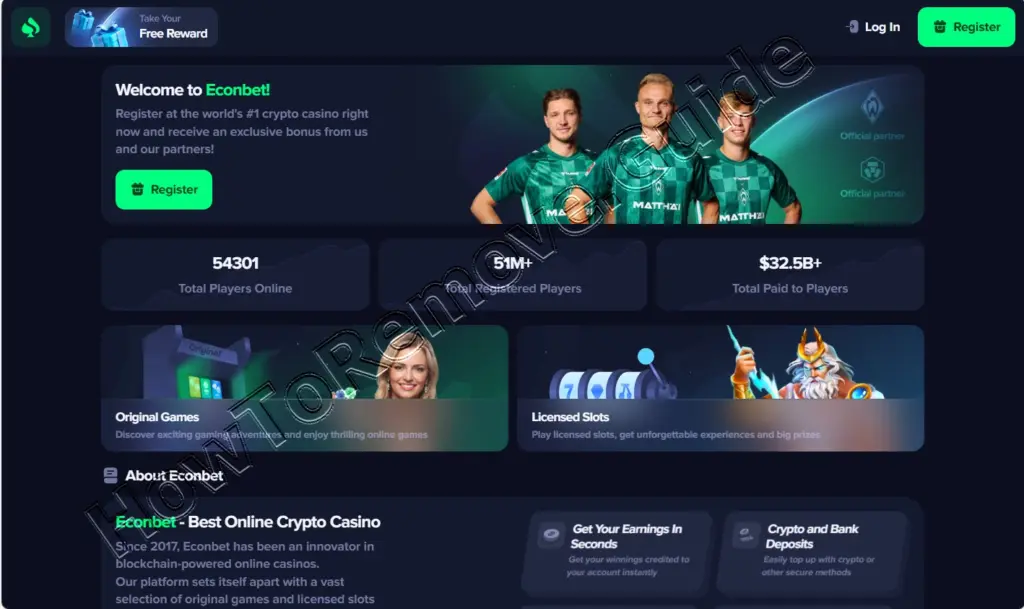
I’ve been digging into Econbet because it presents itself as a crypto casino where fairness is enforced by blockchain code. Yet econbet.com was created on February 14, 2026, registered via NICENIC, and its registration details are privacy-shielded in WHOIS – a mismatch worth noticing.
Another red flag is the marketing: posts advertise a $2,000 bonus tied to a BEAST promo code. In many withdrawal traps, the balance looks real until “support” demands extra fees. Paying those add-ons in crypto usually ends the story.
Scams of Econbet.com‘s type are known to steal personal data and passwords. Install SpyHunter Pro to scan for risks, remove any dangerous trackers, and enable real-time protection.

Try Free For 7 Days*
Buy now15% OFF if you buy straight without trial.
 OFFER
OFFERTo protect yourself, verify licensing the boring way. Scroll to the bottom of the site for a gambling license number and company name, then search both on the regulator’s public database (for example Malta, the UK, or Curaçao). No match means leave.
Also check the domain yourself with ICANN Lookup or any WHOIS tool. If you already sent funds, stop now, save screenshots, copy the transaction hash from a blockchain explorer, and contact your exchange fast to flag the address.
Handle any interaction with Econbet, Lewycon.cc, or Nonspace.top like a security incident, not a customer-support issue. The guidance below summarizes how these schemes operate, what to do to limit harm, and how to avoid getting pulled into the next clone.
IMPORTANT – READ THIS BEFORE YOU START!
If you have already interacted with Econbet, cut contact immediately – no more chats, no more “fees,” no screen-sharing – and switch to containment. Secure accounts, move remaining funds to clean wallets, and preserve evidence for reporting. Here are five emergency steps we strongly recommend taking right now:
- Reset passwords and enable 2FA on your email, crypto exchanges, and wallets after Econbet exposure; terminate other active sessions.
- Notify any exchanges and services touched by the funds; provide TxIDs and request that accounts/addresses be flagged per policy.
- Migrate assets to fresh wallets with new seed phrases and revoke any existing token approvals on connected chains.
- If you uploaded ID documents, place credit/fraud alerts where available and watch for identity-theft indicators.
- Assemble an evidence bundle – wallet addresses, TxIDs, site URLs, chats, and screenshots – and file reports with police/IC3 and any involved platforms.
How We Know Econbet Is a Scam
Ignore the glossy design for a moment: the same warning signs tied to fake crypto casinos show up here in clusters. Below are practical indicators that point to a fee-to-withdraw setup, with identity collection layered on top to squeeze more value from victims.
Unexpected withdrawal charges
“Processing,” “tax,” and “verification” payments appear right before release. Legitimate operators do not demand up-front fees just to access your own balance.
Fake licensing claims
Badges and license numbers are displayed on the page, but they don’t verify in official regulator registers – it’s legitimacy theater, not compliance.
Overstated early “wins”
Balances jump unrealistically fast to build confidence and nudge bigger deposits; the “generosity” exists only on-screen.
Crypto-only payment rails
No fiat rails or chargebacks means no meaningful recourse; that one-way design is deliberate.
Manufactured social proof
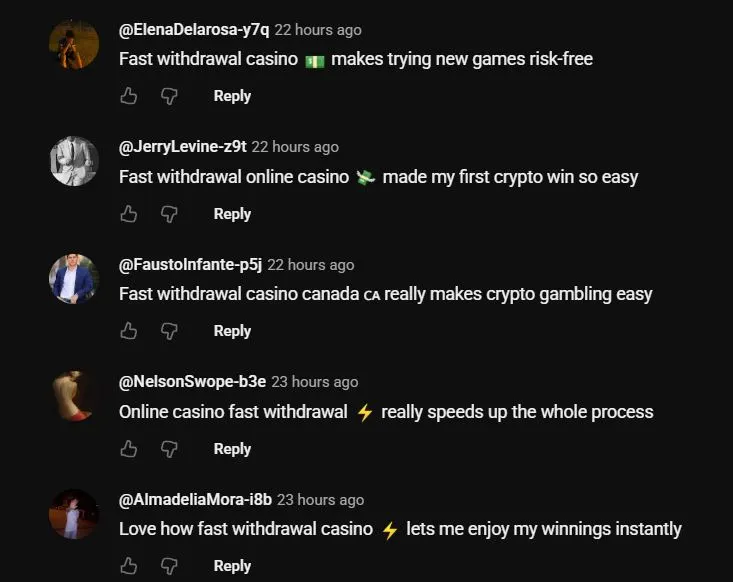
Popups, botted reviews, and promo codes simulate activity and trust while avoiding anything you can independently verify.
New, privacy-masked domains
Newly minted sites with hidden ownership and a trail of near-identical clones are a strong signal; public lookups like who.is make the churn easier to spot.

How the Econbet Scam Deception Funnel Typically Works
Understanding the sequence matters because it’s repetitive by design. Once you recognize the steps, you can anticipate the next prompt and cut it off early; each stage is tuned to convert deposits into fees and to collect identity data.
The order is consistent: hook with bonuses, inflate the on-screen balance, block withdrawals with fees and KYC, then stall and rebrand while “recovery” scammers look for a second pass.
Promo bait and influencer codes
Polished ads, seeded comments, and DMs push “limited” bonuses and staged testimonials to start the funnel and create urgency.
Casino look and bonus theater
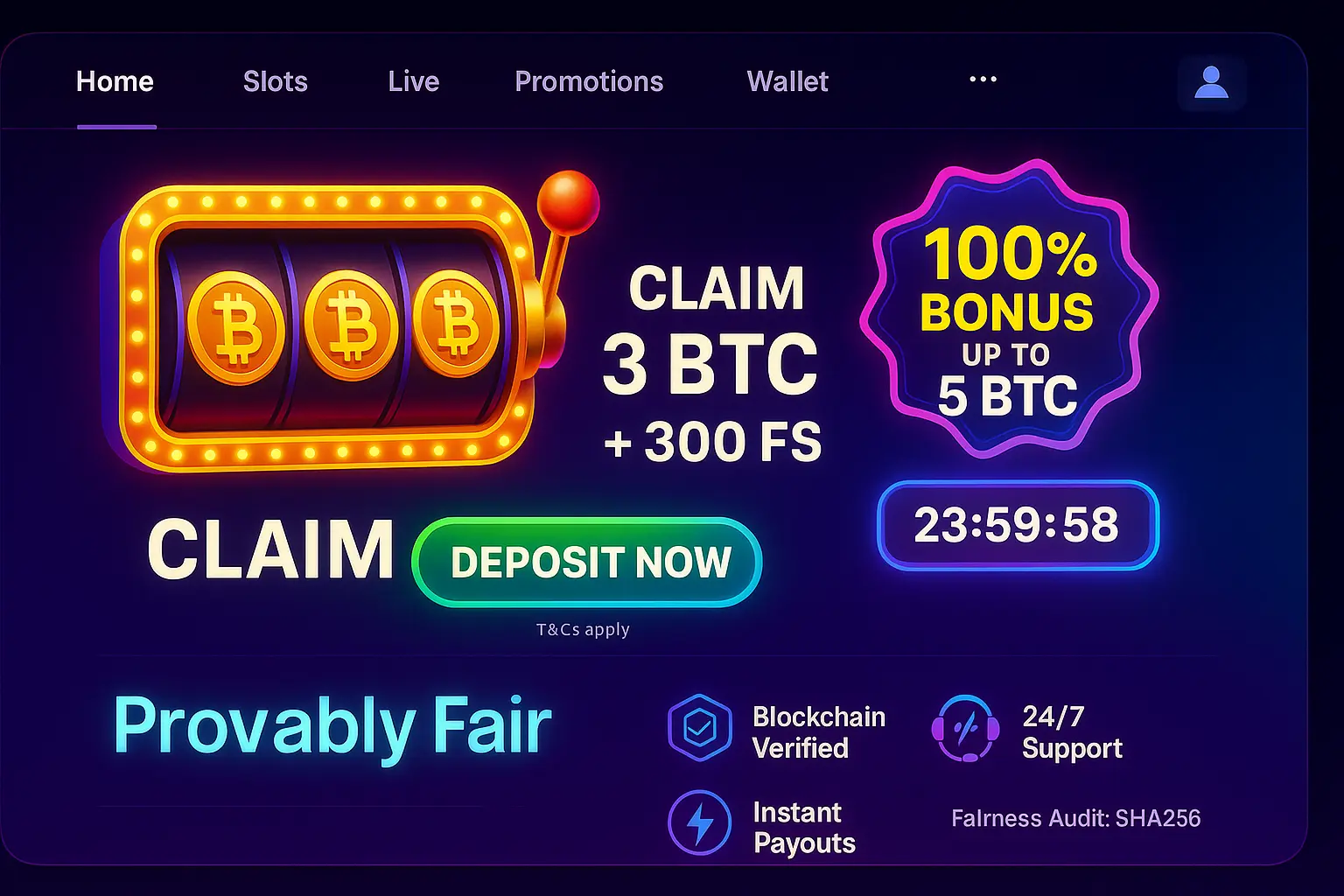
The landing page imitates a real casino, flashes oversized crypto bonuses, and repeats “provably fair” claims to create instant credibility.
Inflated balances, then the lock
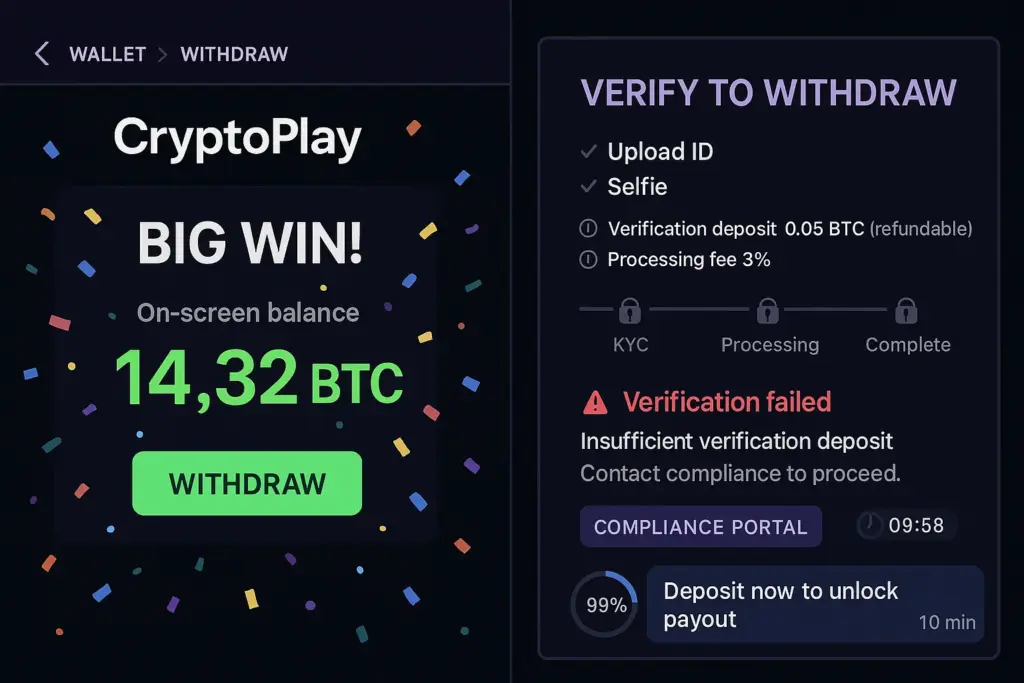
Early “wins” swell the displayed balance, then withdrawal attempts trigger KYC and a “verification deposit” or “processing fee” to continue.
Fee gates and KYC harvest
Each step adds a new excuse – VIP upgrades, AML checks, taxes – while extracting more crypto and collecting high-value identity documents.

Stalling, rebrands, and “recovery” pitches
Support scripts sound sympathetic while adding hurdles, then the site disappears and shifts to a new domain. Soon after, a “recovery agent” shows up to sell the same scam again.
Staying safe from crypto casino scams like Econbet
Staying safer long-term comes down to practicing the boring checks before you ever deposit. The habits below make your process repeatable, so you can separate real operators from copy-paste fronts that exist mainly to collect deposits and documents.
Confirm license status in official registers
Search regulator registers by company name and domain, not by on-page logos. No listing usually means the operator is unlicensed.
Review domain age and history
Use public WHOIS and web archives to catch newly registered, privacy-masked domains and repeated clone patterns across names.
Refuse withdrawal fees and “unlock” deposits
Legitimate platforms do not require up-front “processing,” “tax,” or “verification” payments to release your funds.
Choose venues with recourse
Favor operators with verifiable licensing, fiat rails, and clear dispute paths; crypto-only fronts maximize irreversibility.
Reduce wallet exposure
Use fresh addresses, enable 2FA everywhere, and routinely revoke token approvals you no longer need on connected chains.
Verify “provably fair” claims
If you can’t independently verify each bet with public seeds and hashes, treat the claim as marketing, not math.
Record evidence and report quickly
Keep TxIDs, chats, and screenshots. File with your national cybercrime unit and any exchanges touched; speed can increase your options.
Practice a deliberate slow-down habit
Discipline beats urgency: pause before depositing, verify licensing and domain history, and only then decide.
Useful Resources for Scam Reporting and Prevention (By Country)
Even when funds move fast, prompt reporting can still help – stablecoin issuers and exchanges sometimes act when authorities provide solid evidence. Use the directory below to file complaints and attach your documentation to any open investigations.
Click here to report the scam in your country
| Country / Agency | URL | Category / Use-case | Phone/Email |
| Australia – Crime Stoppers | https://www.crimestoppers.com.au | Anonymous tips about crime | 1800 333 000 |
| Australia – National Anti-Scam Center (Scamwatch) | https://www.scamwatch.gov.au/report-a-scam | General scams; phishing; texts/emails | |
| Australia – Police Assistance Line (non-emergency) | https://www.police.gov.au | Local police report | 131 444 |
| Australia – ReportCyber (ACSC) | https://www.cyber.gov.au/report | Cybercrime (hacks, fraud, extortion) | |
| Canada – Canadian Anti-Fraud Center (CAFC) | https://www.antifraudcentre-centreantifraude.ca/report-signalez-eng.htm | General scams incl. phone/text/email | |
| France – DGCCRF (SignalConso) | https://signal.conso.gouv.fr | Consumer scams/deceptive practices | |
| France – PHAROS – Internet-Signalement | https://www.internet-signalement.gouv.fr | Online content & cybercrime reports | |
| Germany – Bundeskriminalamt / Local Police | https://www.polizei.de/Polizei/DE/Home/home_node.html | Report online fraud | |
| Germany – Weißer Ring – Victim Support | https://weisser-ring.de | Victim support | 116 006 |
| India – DoT Helpline (Sanchar Saathi) | https://sancharsaathi.gov.in | Fraudulent telecom/SIM related | 155260 |
| India – National Consumer Helpline | https://consumerhelpline.gov.in | Consumer scams | 1800-11-4000 / 1915 |
| India – National Cyber Crime Reporting Portal | https://cybercrime.gov.in | Cybercrime incl. online fraud | 1930 |
| Japan – Consumer Affairs Agency (CAA) | https://www.caa.go.jp/policies/policy/consumer_policy/caution/cybercrime/ | Consumer scams | |
| Japan – National Police Agency – Cybercrime | https://www.npa.go.jp/bureau/cyber/ | Cybercrime reporting | |
| Mexico – Guardia Nacional (National Guard) | https://www.gob.mx/gn | Cybercrime reporting | |
| Mexico – Instituto Federal de Telecomunicaciones (IFT) | https://www.ift.org.mx | Telecom/online services scams | |
| Mexico – PROFECO | https://www.gob.mx/profeco | Consumer fraud & ecommerce | |
| Netherlands – AFM – Report investment fraud | https://www.afm.nl/en/consumenten/themas/beleggen/misleiding-misbruik | Investment/crypto | |
| Netherlands – Fraudehelpdesk | https://www.fraudehelpdesk.nl/melden | General scams (incl. phishing/SMS) | 088-7867372 |
| Netherlands – Politie – Meldpunt Internetoplichting | https://www.politie.nl/themas/internetoplichting.html | Online shopping fraud | |
| New Zealand – CERT NZ | https://www.cert.govt.nz/individuals/report-an-issue/ | Phishing, identity scams | |
| New Zealand – Department of Internal Affairs – Spam | https://www.dia.govt.nz/Spam-Contact-Us | Email/SMS spam | [email protected] |
| New Zealand – IDCARE | https://www.idcare.org | Victim support (identity compromise) | 0800 121 068 |
| New Zealand – Netsafe – Report | https://www.netsafe.org.nz/report/ | Online harms & scams | |
| New Zealand – New Zealand Police (non-emergency) | https://www.police.govt.nz/use-105 | Report fraud/online crime | 105 |
| Nigeria – Economic & Financial Crimes Commission (EFCC) | https://www.efcc.gov.ng | Financial scams incl. crypto/investment | [email protected] |
| Nigeria – Nigeria Police Special Fraud Unit (SFU) | https://www.specialfraudunit.org.ng | Serious fraud | Voice/SMS: 0708 227 6895; WhatsApp: 0812 760 9914 |
| Poland – CERT Polska (CERT.PL) | https://cert.pl/en/report/ | Cyber incidents & phishing | |
| Poland – Dyzurnet.pl | https://dyzurnet.pl | Illegal online content (esp. child protection) | |
| Poland – Polish Police (Policja) | https://www.policja.pl | Report scams to police | |
| Singapore – Anti-Scam Centre / Anti-Scam Helpline | https://www.scamalert.sg | General scams; texts; calls | 1800-722-6688 |
| Singapore – Monetary Authority of Singapore (MAS) | https://www.mas.gov.sg/investor-alert-list | Investment/crypto checks | |
| Singapore – Singapore Police Force | https://www.police.gov.sg/iwitness | Police report (cybercrime) | |
| South Africa – Cybersecurity Hub (CSIRT) | https://www.cybersecurityhub.gov.za | Cyber incidents incl. scams | |
| South Africa – South African Fraud Prevention Service (SAFPS) | https://www.safps.org.za | Identity fraud support | 011-867-2234 |
| South Africa – South African Police Service (SAPS) | https://www.saps.gov.za | Police report (cybercrime unit) | |
| South Korea – Korea Communications Commission (KCC) | https://www.kcc.go.kr | Telecom-related fraud | |
| South Korea – Korea Internet & Security Agency (KISA) | https://www.kisa.or.kr | Phishing, online harms | |
| South Korea – Korean National Police Agency – Cyber Bureau | https://ecrm.cyber.go.kr | Cybercrime reporting | |
| Spain – INCIBE – Oficina de Seguridad del Internauta (OSI) | https://www.osi.es/es/reporte | Cybersecurity & online fraud | |
| Spain – Policía Nacional / Guardia Civil | https://www.policia.es | Report scams to police | |
| Sweden – Crime Victim Authority (Brottsoffermyndigheten) | https://www.brottsoffermyndigheten.se | Victim support & compensation | 090–70 82 00 |
| Sweden – Polisen (Swedish Police) | https://polisen.se | Report fraud/cybercrime | 114 14 (non-emergency); 112 (emergency) |
| Sweden – Swedish Consumer Agency (Konsumentverket) | https://www.konsumentverket.se | Unfair business practices | |
| United Arab Emirates – Abu Dhabi Police – Aman Service | https://www.adpolice.gov.ae | Cybercrime tips/reporting | SMS 2828; 800 2626 |
| United Arab Emirates – Dubai Police – eCrime | https://www.dubaipolice.gov.ae | Cybercrime reporting | 04 606 1600 |
| United Arab Emirates – Ministry of Interior – Cyber Crime Dept. | https://www.moi.gov.ae | Cybercrime incl. online scams | |
| United Arab Emirates – Telecommunications Regulatory Authority (TRA) / TDRA | https://www.tra.gov.ae | Telecom-related scams/phishing | |
| United Kingdom – Action Fraud (NFIB) | https://www.actionfraud.police.uk | General scams & cybercrime (non-emergency) | 0300 123 2040 |
| United Kingdom – Citizens Advice Consumer Service | https://www.citizensadvice.org.uk/consumer/get-more-help/if-you-need-more-help-about-a-consumer-issue/ | Consumer problems & scam guidance | 0808 223 1133 |
| United Kingdom – Financial Conduct Authority (FCA) | https://www.fca.org.uk/consumers/report-scam-us | Investment/crypto & financial services | |
| United Kingdom – National Cyber Security Centre (NCSC) | https://www.ncsc.gov.uk/collection/phishing-scams | Phishing emails & suspicious websites | |
| United Kingdom – Stop Scams UK ‘159’ | https://stopscamsuk.org.uk/159 | Banking APP fraud (direct to your bank) | 159 |
| United States – AARP Fraud Watch Network Helpline | https://www.aarp.org/money/scams-fraud/ | Victim support | 833-372-8311 |
| United States – Better Business Bureau – Scam Tracker | https://www.bbb.org/scamtracker | Business/marketplace scams | |
| United States – FBI Internet Crime Complaint Center (IC3) | https://www.ic3.gov | Internet crime incl. investment/crypto | |
| United States – Federal Trade Commission – ReportFraud | https://reportfraud.ftc.gov | General scams, phishing, texts/emails | 1-877-382-4357 |
| United States – National Center for Disaster Fraud | https://www.justice.gov/disaster-fraud | Disaster-related scams | (866) 720-5721 |
| United States – SEC Tips & Complaints | https://www.sec.gov/tcr | Investment & securities/crypto-asset offerings |
That’s the full picture: learn the pattern, contain exposure quickly, and run checks you can verify before any deposit or document upload.
