

The first red flag in Elmunix that tells you this is a scam is how you came across it. It doesn’t spread through reputation or satisfied players but through social media algorithms. Short-form AI-slop videos on TikTok, recycled clips on YouTube, and flashy posts on X aggressively promote the platform as the next big crypto casino opportunity.
Some videos even appear to feature well-known entrepreneurs praising the site, but that’s just more AI trash. These endorsements are slopily stitched together with AI voice cloning, edited footage, and fabricated screenshots designed to manufacture trust that inexperienced users might fall for.
Scams of Elmunix.com‘s type are known to steal personal data and passwords. Install SpyHunter Pro to scan for risks, remove any dangerous trackers, and enable real-time protection.

Try Free For 7 Days*
Buy now15% OFF if you buy straight without trial.
 OFFER
OFFERThe core strategy of Elmunix and other sites like it (Dasewin.gl, Vasewin.at, etc.) is simple and highly disposable. A flashy virtual casino promises a massive signup bonus, and those who sign up and play a few spins immediately see impressive “winnings” displayed on their dashboards.
Then, once you want to actually claim that money, a withdrawal barrier appears, where you are required to send a deposit framed as verification or activation.
Obviously, those who send the requested real-life money lose that money forever and gain nothing in return, but the psychological lure of claiming thousands if you just deposit a couple of hundred is strong enough to make many people fall for the trap.
Treat any contact with Elmunix or closely named clones as a security incident. The guidance below summarizes how this scheme operates, how to limit damage, and how to avoid the next copycat.
IMPORTANT! READ BEFORE PROCEEDING!
If you’ve already dealt with Elmunix, end contact immediately – no more chats, no more “fees,” no screen-sharing – and move straight to containment. Secure accounts, shift funds to clean wallets, and preserve evidence for reporting. Here are five urgent actions we strongly recommend you take right now:
- Change passwords and turn on 2FA for your email, crypto exchanges, and wallets; sign out other active sessions.
- Alert any exchanges or services involved with the transfers; share TxIDs and request address/account flagging under their policy.
- Move assets to new wallets using fresh seed phrases, and revoke any existing token approvals on connected chains.
- If you submitted ID documents, place credit/fraud alerts where available and watch for signs of identity misuse.
- Collect an evidence bundle – wallet addresses, TxIDs, site URLs, chats, and screenshots – and file reports with police/IC3 and any involved platforms.
How We Spot Elmunix as a Scam
Ignore the polish for a minute: the same warning signs that define fake crypto casinos appear here in clusters. The points below are practical indicators that you’re looking at a fee-to-withdraw setup, often paired with document collection that only shows up once you attempt to cash out.
Unexpected withdrawal charges
“Processing,” “tax,” and “verification” payments are demanded before release. Real operators don’t make you prepay to access your own balance.
Fake licensing claims
Badges and license numbers are pasted on the site, but nothing matches official regulator registers – it’s legitimacy theater.
Overstated early “wins”
Balances jump unrealistically fast to build confidence and nudge bigger deposits; the generosity exists only inside the interface.
Crypto-only payment rails
No fiat rails and no chargebacks means limited recovery options; that one-way design is intentional.
Manufactured social proof
Popups, botted reviews, and influencer codes simulate momentum and credibility without offering anything you can verify.
New, privacy-masked domains
Fresh sites with hidden ownership plus a trail of near-identical clones are a strong indicator; public lookups such as who.is make the churn easier to spot.


How the Elmunix Scam Funnel Plays Out
Understanding the sequence matters because repetition is the giveaway. Once you can recognize the pattern, the next “required” payment or document request stops feeling mysterious and starts looking like a scripted move designed to convert deposits into fees and personal data.
The flow is deliberate: hook you with bonuses, inflate the on-screen balance, block withdrawals behind fees and KYC, then stall and rebrand while “recovery” scammers move in for a second pass.
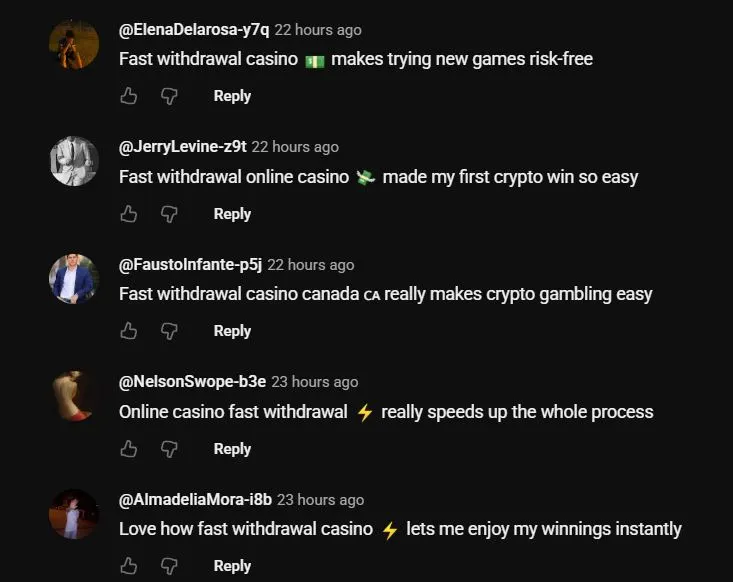
Promo bait and influencer codes
Polished ads, planted comments, and DMs push “limited” bonuses and staged testimonials to start the funnel and pressure quick decisions.
Casino facade and bonus theatrics
The landing page copies a real casino layout, blasts oversized crypto bonuses, and name-drops “provably fair” play to create instant legitimacy.

Padded balances, then the lock
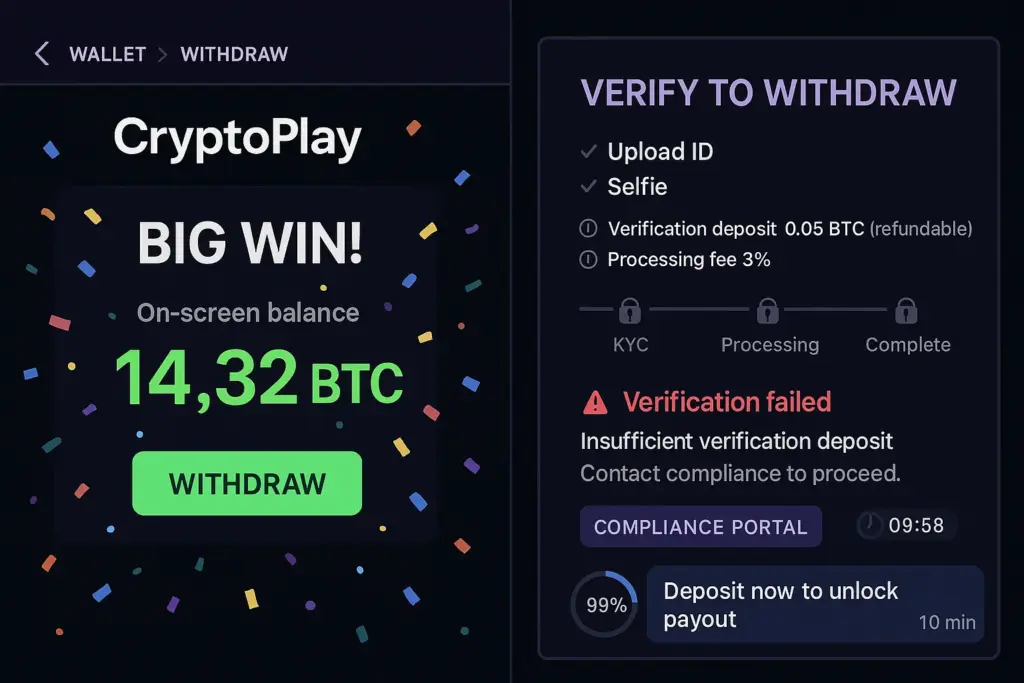
Early “wins” puff up the on-screen balance, then any withdrawal attempt triggers KYC plus a “verification deposit” or “processing fee” to continue.
Fee barriers and KYC harvesting
Every stage adds a new excuse – VIP tiers, AML checks, taxes – while extracting more crypto and requesting high-value identity documents.

Stalling, rebrands, and “recovery” lures
Support messages switch between empathy and new hurdles, then the site disappears and reappears under a different domain. Not long after, a “recovery agent” shows up to sell the follow-up scam.
Staying safe from crypto casino scams like Elmunix
Staying out of trouble is mostly about doing the boring checks before you send money. With Elmunix-style sites, the risk spikes once you deposit or upload documents, so the safest approach is to verify basics first and treat any pressure to “act fast” as a warning sign.
Confirm license status in official registers
Search regulator registers using the company name and domain, not on-page logos. If there is no listing, assume there is no valid license.
Review domain age and history
Use public WHOIS tools and web archives to identify newly created, privacy-masked domains and repeated clone naming patterns.
Refuse withdrawal fees and “unlock” deposits
Legitimate platforms do not demand up-front “processing,” “tax,” or “verification” payments to release your funds.
Choose venues with real recourse
Prefer operators with verifiable licensing, fiat rails, and clear dispute options; crypto-only fronts maximize irreversibility.
Reduce wallet exposure
Use fresh addresses, enable 2FA everywhere, and regularly revoke token approvals you no longer need on connected chains.
Verify “provably fair” claims independently
If you cannot verify each bet independently using public seeds and hashes, treat the claim as branding, not proof.
Preserve evidence and report quickly
Save TxIDs, chats, and screenshots. Report to your national cybercrime unit and any exchanges involved; acting fast can expand your options.
Train a slow-down habit
Resist urgency: pause before depositing, confirm licensing and domain history, and decide only after those checks.
Useful Resources for Scam Reporting and Prevention (By Country)
Even when crypto moves fast, reporting promptly can still matter – exchanges and stablecoin issuers sometimes respond when law enforcement provides solid documentation. Use the directory below to file complaints and attach the evidence you’ve collected to any ongoing investigations.
Open the reporting links for your country
| Country / Agency | URL | Category / Use-case | Phone/Email |
| Australia – Crime Stoppers | https://www.crimestoppers.com.au | Anonymous tips about crime | 1800 333 000 |
| Australia – National Anti-Scam Center (Scamwatch) | https://www.scamwatch.gov.au/report-a-scam | General scams; phishing; texts/emails | |
| Australia – Police Assistance Line (non-emergency) | https://www.police.gov.au | Local police report | 131 444 |
| Australia – ReportCyber (ACSC) | https://www.cyber.gov.au/report | Cybercrime (hacks, fraud, extortion) | |
| Canada – Canadian Anti-Fraud Center (CAFC) | https://www.antifraudcentre-centreantifraude.ca/report-signalez-eng.htm | General scams incl. phone/text/email | |
| France – DGCCRF (SignalConso) | https://signal.conso.gouv.fr | Consumer scams/deceptive practices | |
| France – PHAROS – Internet-Signalement | https://www.internet-signalement.gouv.fr | Online content & cybercrime reports | |
| Germany – Bundeskriminalamt / Local Police | https://www.polizei.de/Polizei/DE/Home/home_node.html | Report online fraud | |
| Germany – Weißer Ring – Victim Support | https://weisser-ring.de | Victim support | 116 006 |
| India – DoT Helpline (Sanchar Saathi) | https://sancharsaathi.gov.in | Fraudulent telecom/SIM related | 155260 |
| India – National Consumer Helpline | https://consumerhelpline.gov.in | Consumer scams | 1800-11-4000 / 1915 |
| India – National Cyber Crime Reporting Portal | https://cybercrime.gov.in | Cybercrime incl. online fraud | 1930 |
| Japan – Consumer Affairs Agency (CAA) | https://www.caa.go.jp/policies/policy/consumer_policy/caution/cybercrime/ | Consumer scams | |
| Japan – National Police Agency – Cybercrime | https://www.npa.go.jp/bureau/cyber/ | Cybercrime reporting | |
| Mexico – Guardia Nacional (National Guard) | https://www.gob.mx/gn | Cybercrime reporting | |
| Mexico – Instituto Federal de Telecomunicaciones (IFT) | https://www.ift.org.mx | Telecom/online services scams | |
| Mexico – PROFECO | https://www.gob.mx/profeco | Consumer fraud & ecommerce | |
| Netherlands – AFM – Report investment fraud | https://www.afm.nl/en/consumenten/themas/beleggen/misleiding-misbruik | Investment/crypto | |
| Netherlands – Fraudehelpdesk | https://www.fraudehelpdesk.nl/melden | General scams (incl. phishing/SMS) | 088-7867372 |
| Netherlands – Politie – Meldpunt Internetoplichting | https://www.politie.nl/themas/internetoplichting.html | Online shopping fraud | |
| New Zealand – CERT NZ | https://www.cert.govt.nz/individuals/report-an-issue/ | Phishing, identity scams | |
| New Zealand – Department of Internal Affairs – Spam | https://www.dia.govt.nz/Spam-Contact-Us | Email/SMS spam | [email protected] |
| New Zealand – IDCARE | https://www.idcare.org | Victim support (identity compromise) | 0800 121 068 |
| New Zealand – Netsafe – Report | https://www.netsafe.org.nz/report/ | Online harms & scams | |
| New Zealand – New Zealand Police (non-emergency) | https://www.police.govt.nz/use-105 | Report fraud/online crime | 105 |
| Nigeria – Economic & Financial Crimes Commission (EFCC) | https://www.efcc.gov.ng | Financial scams incl. crypto/investment | [email protected] |
| Nigeria – Nigeria Police Special Fraud Unit (SFU) | https://www.specialfraudunit.org.ng | Serious fraud | Voice/SMS: 0708 227 6895; WhatsApp: 0812 760 9914 |
| Poland – CERT Polska (CERT.PL) | https://cert.pl/en/report/ | Cyber incidents & phishing | |
| Poland – Dyzurnet.pl | https://dyzurnet.pl | Illegal online content (esp. child protection) | |
| Poland – Polish Police (Policja) | https://www.policja.pl | Report scams to police | |
| Singapore – Anti-Scam Centre / Anti-Scam Helpline | https://www.scamalert.sg | General scams; texts; calls | 1800-722-6688 |
| Singapore – Monetary Authority of Singapore (MAS) | https://www.mas.gov.sg/investor-alert-list | Investment/crypto checks | |
| Singapore – Singapore Police Force | https://www.police.gov.sg/iwitness | Police report (cybercrime) | |
| South Africa – Cybersecurity Hub (CSIRT) | https://www.cybersecurityhub.gov.za | Cyber incidents incl. scams | |
| South Africa – South African Fraud Prevention Service (SAFPS) | https://www.safps.org.za | Identity fraud support | 011-867-2234 |
| South Africa – South African Police Service (SAPS) | https://www.saps.gov.za | Police report (cybercrime unit) | |
| South Korea – Korea Communications Commission (KCC) | https://www.kcc.go.kr | Telecom-related fraud | |
| South Korea – Korea Internet & Security Agency (KISA) | https://www.kisa.or.kr | Phishing, online harms | |
| South Korea – Korean National Police Agency – Cyber Bureau | https://ecrm.cyber.go.kr | Cybercrime reporting | |
| Spain – INCIBE – Oficina de Seguridad del Internauta (OSI) | https://www.osi.es/es/reporte | Cybersecurity & online fraud | |
| Spain – Policía Nacional / Guardia Civil | https://www.policia.es | Report scams to police | |
| Sweden – Crime Victim Authority (Brottsoffermyndigheten) | https://www.brottsoffermyndigheten.se | Victim support & compensation | 090–70 82 00 |
| Sweden – Polisen (Swedish Police) | https://polisen.se | Report fraud/cybercrime | 114 14 (non-emergency); 112 (emergency) |
| Sweden – Swedish Consumer Agency (Konsumentverket) | https://www.konsumentverket.se | Unfair business practices | |
| United Arab Emirates – Abu Dhabi Police – Aman Service | https://www.adpolice.gov.ae | Cybercrime tips/reporting | SMS 2828; 800 2626 |
| United Arab Emirates – Dubai Police – eCrime | https://www.dubaipolice.gov.ae | Cybercrime reporting | 04 606 1600 |
| United Arab Emirates – Ministry of Interior – Cyber Crime Dept. | https://www.moi.gov.ae | Cybercrime incl. online scams | |
| United Arab Emirates – Telecommunications Regulatory Authority (TRA) / TDRA | https://www.tra.gov.ae | Telecom-related scams/phishing | |
| United Kingdom – Action Fraud (NFIB) | https://www.actionfraud.police.uk | General scams & cybercrime (non-emergency) | 0300 123 2040 |
| United Kingdom – Citizens Advice Consumer Service | https://www.citizensadvice.org.uk/consumer/get-more-help/if-you-need-more-help-about-a-consumer-issue/ | Consumer problems & scam guidance | 0808 223 1133 |
| United Kingdom – Financial Conduct Authority (FCA) | https://www.fca.org.uk/consumers/report-scam-us | Investment/crypto & financial services | |
| United Kingdom – National Cyber Security Centre (NCSC) | https://www.ncsc.gov.uk/collection/phishing-scams | Phishing emails & suspicious websites | |
| United Kingdom – Stop Scams UK \u2018159\u2019 | https://stopscamsuk.org.uk/159 | Banking APP fraud (direct to your bank) | 159 |
| United States – AARP Fraud Watch Network Helpline | https://www.aarp.org/money/scams-fraud/ | Victim support | 833-372-8311 |
| United States – Better Business Bureau \u2013 Scam Tracker | https://www.bbb.org/scamtracker | Business/marketplace scams | |
| United States – FBI Internet Crime Complaint Center (IC3) | https://www.ic3.gov | Internet crime incl. investment/crypto | |
| United States – Federal Trade Commission \u2013 ReportFraud | https://reportfraud.ftc.gov | General scams, phishing, texts/emails | 1-877-382-4357 |
| United States – National Center for Disaster Fraud | https://www.justice.gov/disaster-fraud | Disaster-related scams | (866) 720-5721 |
| United States – SEC Tips & Complaints | https://www.sec.gov/tcr | Investment & securities/crypto-asset offerings |
That’s the full picture: recognize the pattern, contain exposure quickly, and run checks you can verify before any deposit or document upload.
