

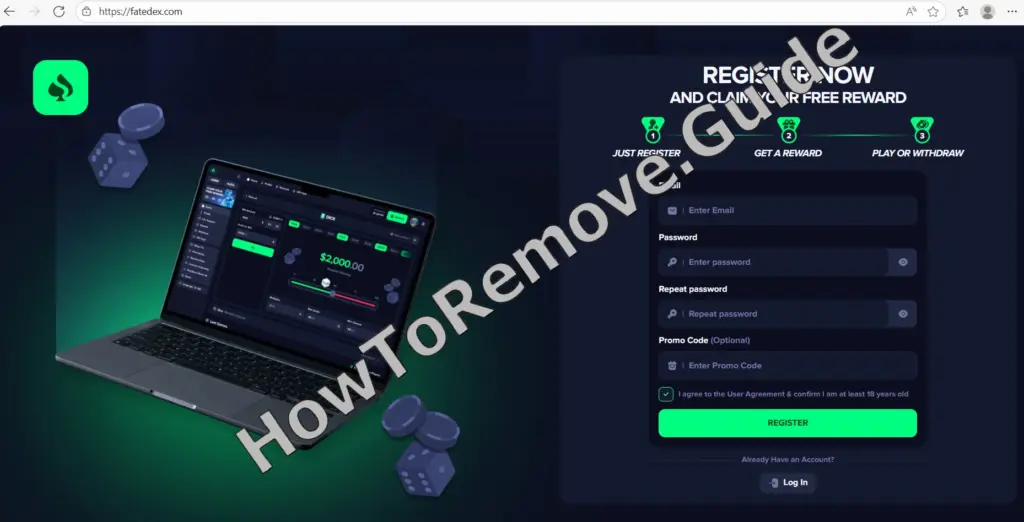
Fatedex sells itself as a slick, “#1 decentralized” crypto casino, where its main selling point is the free signup credits and the clips of famous billionaires cheering it on.
But that’s where you need to take a step back and think about it critically. When a site hands you money up front and leans on celebrity aura, the chances of it actually being a real thing and not just a scam are slim to none.
The surface looks legit: flashy reels, a two-page “white paper,” testimonials. But it takes the tiniest bit of digging to realize it’s all just a thin facade. There’s no real phone number or address, the domain is brand new, and the site’s policies are badly-written AI copies.
The scheme is simple, yet still effective against inexperienced users. You play, you “win,” your dashboard soars. Then withdrawals stall until you make a “verification” or “transfer” deposit, which is the gist of the scam. Pay it, and you’ve given the scammers some of your money that you’re never getting back.
Treat every interaction with a crypto casino site like Fatedex, Volnaluck, or Zh88.com as a live security issue. The guidance below focuses on cutting exposure fast, understanding the manipulation sequence, and installing habits that block the next iteration of the same playbook.
Scams of Fatedex.com‘s type are known to steal personal data and passwords. Install SpyHunter Pro to scan for risks, remove any dangerous trackers, and enable real-time protection.

Try Free For 7 Days*
Buy now15% OFF if you buy straight without trial.
 OFFER
OFFERIMPORTANT! READ BEFORE PROCEEDING!
If you have already interacted with Fatedex, assume compromise and move to containment now – no more chats, no screen-sharing, and no additional payments. Lock down credentials, rotate wallets, and collect evidence for authorities. Here are five emergency steps we strongly recommend you take right now:
- Reset passwords and enable 2FA (authenticator app) on email, exchanges, and wallets; sign out of all devices.
- Notify any exchanges and services touched and submit TXIDs so they can flag flows or accounts where policy allows.
- Migrate assets to fresh wallets generated with new seed phrases; treat prior addresses and approvals as exposed.
- If you uploaded ID documents, place credit/fraud alerts where supported and plan to reissue compromised IDs if advised by your authorities.
- Assemble an evidence bundle – full URLs, screenshots, chat transcripts, wallet addresses, and TXIDs – and file with police/cybercrime units and affected platforms.
How We Know Fatedex is a Scam
Strip away the styling and the tells pile up: outreach through Telegram/WhatsApp, AI-voiced promos, urgency-driven bonuses, and “one-time” paywalls at withdrawal. None of this aligns with transparent operators who publish verifiable audits and pay without up-front charges.
“Compliance” that costs you money
Pretexts such as “tax clearance,” “regional AML checks,” or “VIP activation” demand deposits before release – legitimate venues do not charge withdrawal unlock tolls.
No independent fairness proof
Claims of “provably fair” lack public seeds or third-party verification; credible platforms expose the math and allow external checks.
Pressure and scarcity cues
Countdown timers and limited “VIP codes” force fast decisions and reduce scrutiny – classic manipulation to bypass rational checks.
Authority theater
Borrowed legitimacy via fake endorsements, fabricated testimonials, and “manager” personas stand in for real licensing and dispute options.
ID harvesting risk
Withdrawal-only KYC requests scoop up passports and utility bills – perfect targets for identity fraud once you’ve been stalled or ghosted.

How the Fatedex Scam Deception Funnel Works
By mapping the stages, you can exit early. The scheme leans on intermittent rewards, urgency, and authority cues to make each next click feel reasonable, even as the overall pattern points away from real payouts and toward data and fund extraction.
The rhythm stays consistent: pull with viral promos, reinforce with streaky wins, erect a payable “compliance” wall, escalate with fresh labels, and pivot to silence or a new brand while impersonators pitch “fund recovery.”
⮟ Promo hooks and influencer codes
AI-voiced videos, cloned influencer handles, and Telegram pushes frame massive bonuses as expiring soon, corralling impulsive sign-ups.

⮟ Casino skin and bonus theater
The UI copies reputable brands, touting jumbo crypto credits and “fair play” without any verifiable certification or third-party RNG audits.

⮟ Inflated balances, then the gate
Intermittent jackpot-like surges leverage the house-money bias; the first withdrawal attempt triggers identity upload plus a “compliance” payment.
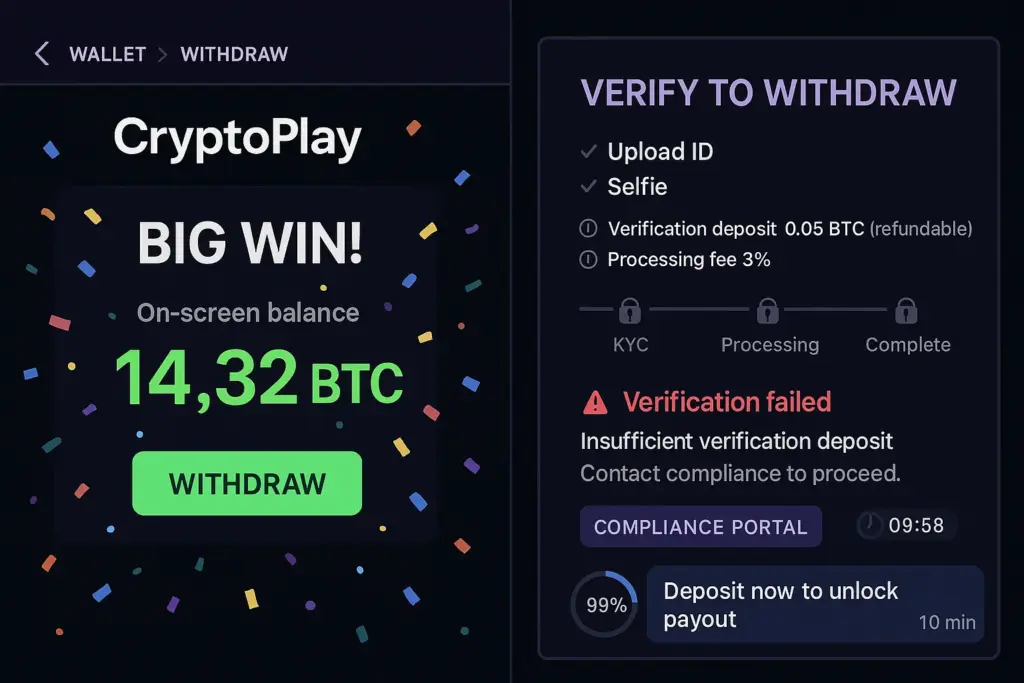
⮟ Fee-gates and KYC harvest
New labels appear – “regional upgrade,” “AML finalization,” “tax remittance” – each framed as a one-time barrier while more crypto and personal data are collected.

⮟ Stalling, rebrands, and “recovery” bait
Once you resist, tickets linger unanswered, the brand shifts, and soon third parties approach offering paid “recovery” – a common second-wave fraud.
Staying safe from scam casino traps like Fatedex
Hardening your routine beats reacting under pressure. These habits cut the oxygen from Fatedex-style funnels by slowing decisions, isolating risk, and insisting on proofs that real operators can readily provide.
⮟ Verify license status in official registers
Confirm the operator’s name and URL on regulator databases; a footer logo isn’t proof without a matching public record.
⮟ Check domain age and history
Use WHOIS and web archives to spot fresh registrations, privacy shields, and the same template appearing across new names.
⮟ Reject withdrawal fees and “unlock” deposits
Any site that makes you pay a “verification,” “tax,” or “processing” sum to cash out is signaling a trap – stop there.
⮟ Prefer venues with recourse
Choose operators with verifiable oversight and real dispute channels; crypto-only traps thrive on irreversible transfers.
⮟ Limit wallet exposure
Segment risk with burner emails and profiles, use strong unique credentials, and periodically revoke on-chain approvals you no longer need.
⮟ Validate “provably fair” claims
Insist on per-bet public seeds and third-party validation; unverifiable math is marketing, not fairness.
⮟ Document and report rapidly
Gather TXIDs, addresses, and chats; file with your national cyber unit and any impacted platforms to increase the chance of intervention.
⮟ Build a deliberate slow-down reflex
Pause at the bonus screen, verify licensing and audits, and require evidence of prior payouts before risking funds.
Useful Resources for Scam Reporting and Prevention (By Country)
Fast, well-documented reports can sometimes trigger freezes at intermediaries, even on irreversible networks. Use the directory below and include TXIDs, wallet addresses, dates, and any contact handles used by the scammers.
Click here to report the scam in your country
| Country / Agency | URL | Category / Use-case | Phone/Email |
| Australia – Crime Stoppers | https://www.crimestoppers.com.au | Anonymous tips about crime | 1800 333 000 |
| Australia – National Anti-Scam Center (Scamwatch) | https://www.scamwatch.gov.au/report-a-scam | General scams; phishing; texts/emails | |
| Australia – Police Assistance Line (non-emergency) | https://www.police.gov.au | Local police report | 131 444 |
| Australia – ReportCyber (ACSC) | https://www.cyber.gov.au/report | Cybercrime (hacks, fraud, extortion) | |
| Canada – Canadian Anti-Fraud Center (CAFC) | https://www.antifraudcentre-centreantifraude.ca/report-signalez-eng.htm | General scams incl. phone/text/email | |
| France – DGCCRF (SignalConso) | https://signal.conso.gouv.fr | Consumer scams/deceptive practices | |
| France – PHAROS – Internet-Signalement | https://www.internet-signalement.gouv.fr | Online content & cybercrime reports | |
| Germany – Bundeskriminalamt / Local Police | https://www.polizei.de/Polizei/DE/Home/home_node.html | Report online fraud | |
| Germany – Weißer Ring – Victim Support | https://weisser-ring.de | Victim support | 116 006 |
| India – DoT Helpline (Sanchar Saathi) | https://sancharsaathi.gov.in | Fraudulent telecom/SIM related | 155260 |
| India – National Consumer Helpline | https://consumerhelpline.gov.in | Consumer scams | 1800-11-4000 / 1915 |
| India – National Cyber Crime Reporting Portal | https://cybercrime.gov.in | Cybercrime incl. online fraud | 1930 |
| Japan – Consumer Affairs Agency (CAA) | https://www.caa.go.jp/policies/policy/consumer_policy/caution/cybercrime/ | Consumer scams | |
| Japan – National Police Agency – Cybercrime | https://www.npa.go.jp/bureau/cyber/ | Cybercrime reporting | |
| Mexico – Guardia Nacional (National Guard) | https://www.gob.mx/gn | Cybercrime reporting | |
| Mexico – Instituto Federal de Telecomunicaciones (IFT) | https://www.ift.org.mx | Telecom/online services scams | |
| Mexico – PROFECO | https://www.gob.mx/profeco | Consumer fraud & ecommerce | |
| Netherlands – AFM – Report investment fraud | https://www.afm.nl/en/consumenten/themas/beleggen/misleiding-misbruik | Investment/crypto | |
| Netherlands – Fraudehelpdesk | https://www.fraudehelpdesk.nl/melden | General scams (incl. phishing/SMS) | 088-7867372 |
| Netherlands – Politie – Meldpunt Internetoplichting | https://www.politie.nl/themas/internetoplichting.html | Online shopping fraud | |
| New Zealand – CERT NZ | https://www.cert.govt.nz/individuals/report-an-issue/ | Phishing, identity scams | |
| New Zealand – Department of Internal Affairs – Spam | https://www.dia.govt.nz/Spam-Contact-Us | Email/SMS spam | [email protected] |
| New Zealand – IDCARE | https://www.idcare.org | Victim support (identity compromise) | 0800 121 068 |
| New Zealand – Netsafe – Report | https://www.netsafe.org.nz/report/ | Online harms & scams | |
| New Zealand – New Zealand Police (non-emergency) | https://www.police.govt.nz/use-105 | Report fraud/online crime | 105 |
| Nigeria – Economic & Financial Crimes Commission (EFCC) | https://www.efcc.gov.ng | Financial scams incl. crypto/investment | [email protected] |
| Nigeria – Nigeria Police Special Fraud Unit (SFU) | https://www.specialfraudunit.org.ng | Serious fraud | Voice/SMS: 0708 227 6895; WhatsApp: 0812 760 9914 |
| Poland – CERT Polska (CERT.PL) | https://cert.pl/en/report/ | Cyber incidents & phishing | |
| Poland – Dyzurnet.pl | https://dyzurnet.pl | Illegal online content (esp. child protection) | |
| Poland – Polish Police (Policja) | https://www.policja.pl | Report scams to police | |
| Singapore – Anti-Scam Centre / Anti-Scam Helpline | https://www.scamalert.sg | General scams; texts; calls | 1800-722-6688 |
| Singapore – Monetary Authority of Singapore (MAS) | https://www.mas.gov.sg/investor-alert-list | Investment/crypto checks | |
| Singapore – Singapore Police Force | https://www.police.gov.sg/iwitness | Police report (cybercrime) | |
| South Africa – Cybersecurity Hub (CSIRT) | https://www.cybersecurityhub.gov.za | Cyber incidents incl. scams | |
| South Africa – South African Fraud Prevention Service (SAFPS) | https://www.safps.org.za | Identity fraud support | 011-867-2234 |
| South Africa – South African Police Service (SAPS) | https://www.saps.gov.za | Police report (cybercrime unit) | |
| South Korea – Korea Communications Commission (KCC) | https://www.kcc.go.kr | Telecom-related fraud | |
| South Korea – Korea Internet & Security Agency (KISA) | https://www.kisa.or.kr | Phishing, online harms | |
| South Korea – Korean National Police Agency – Cyber Bureau | https://ecrm.cyber.go.kr | Cybercrime reporting | |
| Spain – INCIBE – Oficina de Seguridad del Internauta (OSI) | https://www.osi.es/es/reporte | Cybersecurity & online fraud | |
| Spain – Policía Nacional / Guardia Civil | https://www.policia.es | Report scams to police | |
| Sweden – Crime Victim Authority (Brottsoffermyndigheten) | https://www.brottsoffermyndigheten.se | Victim support & compensation | 090–70 82 00 |
| Sweden – Polisen (Swedish Police) | https://polisen.se | Report fraud/cybercrime | 114 14 (non-emergency); 112 (emergency) |
| Sweden – Swedish Consumer Agency (Konsumentverket) | https://www.konsumentverket.se | Unfair business practices | |
| United Arab Emirates – Abu Dhabi Police – Aman Service | https://www.adpolice.gov.ae | Cybercrime tips/reporting | SMS 2828; 800 2626 |
| United Arab Emirates – Dubai Police – eCrime | https://www.dubaipolice.gov.ae | Cybercrime reporting | 04 606 1600 |
| United Arab Emirates – Ministry of Interior – Cyber Crime Dept. | https://www.moi.gov.ae | Cybercrime incl. online scams | |
| United Arab Emirates – Telecommunications Regulatory Authority (TRA) / TDRA | https://www.tra.gov.ae | Telecom-related scams/phishing | |
| United Kingdom – Action Fraud (NFIB) | https://www.actionfraud.police.uk | General scams & cybercrime (non-emergency) | 0300 123 2040 |
| United Kingdom – Citizens Advice Consumer Service | https://www.citizensadvice.org.uk/consumer/get-more-help/if-you-need-more-help-about-a-consumer-issue/ | Consumer problems & scam guidance | 0808 223 1133 |
| United Kingdom – Financial Conduct Authority (FCA) | https://www.fca.org.uk/consumers/report-scam-us | Investment/crypto & financial services | |
| United Kingdom – National Cyber Security Centre (NCSC) | https://www.ncsc.gov.uk/collection/phishing-scams | Phishing emails & suspicious websites | |
| United Kingdom – Stop Scams UK ‘159’ | https://stopscamsuk.org.uk/159 | Banking APP fraud (direct to your bank) | 159 |
| United States – AARP Fraud Watch Network Helpline | https://www.aarp.org/money/scams-fraud/ | Victim support | 833-372-8311 |
| United States – Better Business Bureau – Scam Tracker | https://www.bbb.org/scamtracker | Business/marketplace scams | |
| United States – FBI Internet Crime Complaint Center (IC3) | https://www.ic3.gov | Internet crime incl. investment/crypto | |
| United States – Federal Trade Commission – ReportFraud | https://reportfraud.ftc.gov | General scams, phishing, texts/emails | 1-877-382-4357 |
| United States – National Center for Disaster Fraud | https://www.justice.gov/disaster-fraud | Disaster-related scams | (866) 720-5721 |
| United States – SEC Tips & Complaints | https://www.sec.gov/tcr | Investment & securities/crypto-asset offerings |
In sum, Fatedex relies on urgency, authority, and intermittent wins to push you toward payable “compliance.” Break the sequence: refuse unlock fees, secure your accounts, preserve evidence, and demand verifiable oversight before risking funds anywhere.
