

To the inexperienced user, Ferospin can pass for a real crypto casino, but it’s 2026, and everyone should have at least some base level of awareness and idea of how to sniff out scam sites.
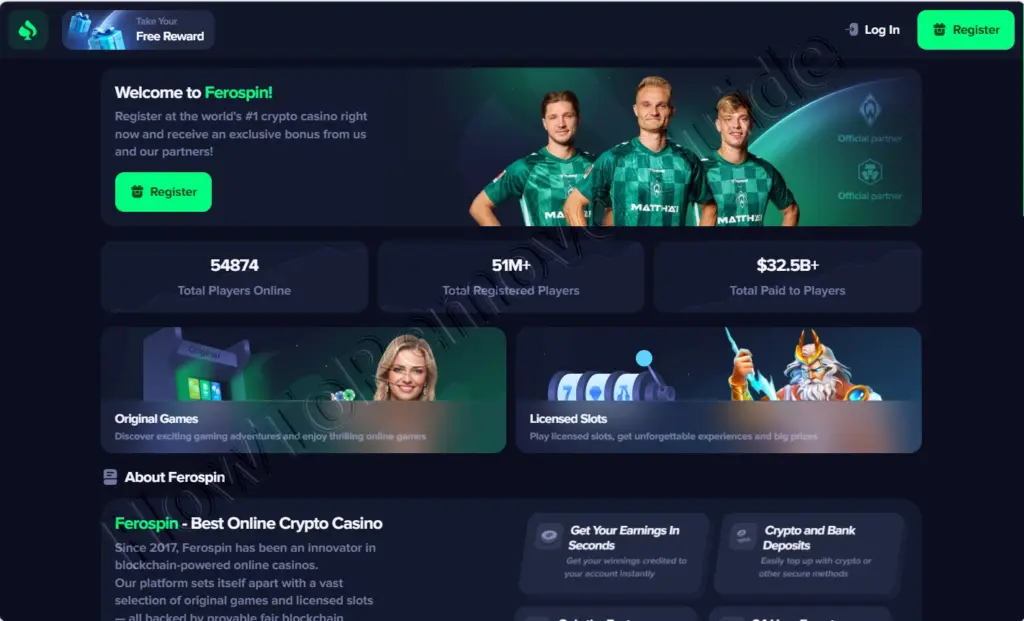
Yes, Ferospin.com is totally a scam and not even a very complex one. That shiny surface credibility is only a facade that hides a run-of-the-mill trap used by other similar scams like Drakelion.com and Ortexplay. Victims are drawn in by outsized bonuses, staged social proof, and easy early “wins” that make the balance on screen feel real long before any money is actually returned.
Scams of Ferospin.com‘s type are known to steal personal data and passwords. Install SpyHunter Pro to scan for risks, remove any dangerous trackers, and enable real-time protection.

Try Free For 7 Days*
Buy now15% OFF if you buy straight without trial.
 OFFER
OFFERBut you don’t need to even look that closely to spot that something’s off about this site: weak transparency, poor or unverifiable operator details, vague legal language, and no trustworthy way to confirm who is really running the platform. The site may still look slick, but appearance is not the same thing as legitimacy, licensing, or consumer protection.
But if you have already fallen for this scam, you must not waste any time and take immediate precautions to limit the damage. Any money you spent there is already lost, so you need to focus on damage control. Read the tips below to learn what needs to be done next.
IMPORTANT! READ BEFORE PROCEEDING!
If you already interacted with Ferospin, break contact now and focus on damage control instead of trying to unlock the displayed balance. These scams often escalate once a victim hesitates, adding new demands, new fees, or new document requests. Your priority is to protect what is still under your control and preserve proof before the site changes, stalls, or disappears:
- Change passwords for your email, exchange, and wallet-related accounts, then enable 2FA on every critical login.
- Move remaining crypto to a new wallet if you connected a wallet, signed approvals, or suspect the old one was exposed.
- Assume any shared seed phrase, private key, or recovery code is burned and rebuild from a clean device immediately.
- Treat uploaded ID documents as a fraud risk and monitor for identity misuse, alerts, or unfamiliar account activity.
- Save screenshots, wallet addresses, chats, transaction hashes, and fee demands so you can report the scam clearly later.
How We Know Ferospin is a Scam
The warning signs line up with a familiar crypto-casino fraud model: fake momentum, fake confidence, and a money gate that appears only when you try to take funds out. No single clue has to stand alone when the overall pattern points in the same direction from multiple angles.
Any pay-to-withdraw demand
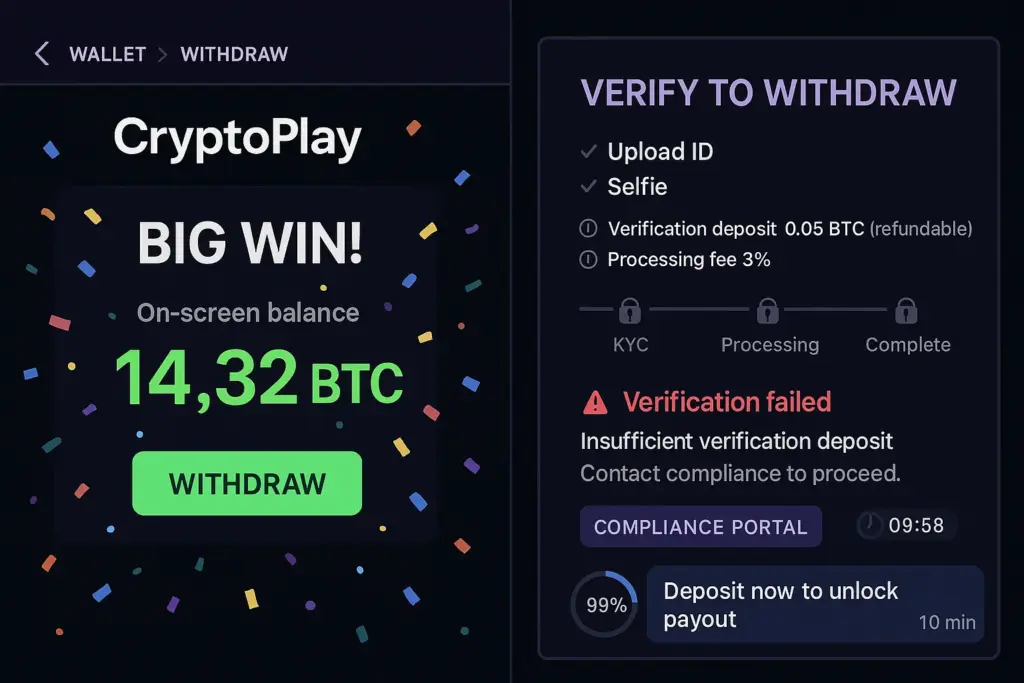
A real payout does not require you to send extra crypto first, yet scam platforms routinely invent a fee, tax, or verification transfer at the last moment.
Giant “free crypto” for entering a promo code
Huge sign-up credits are used as bait because they create the illusion that you already have something valuable to lose if you walk away.
brand-new domain / constantly rotating domains
Short-lived domains fit this scam family well because operators can burn one name, switch to another, and continue using the same template with minimal interruption.
fake reviews, staged chat, and inflated activity counters
Artificial buzz makes the site feel active and trusted, but manufactured comments and counters are cheap signals that do not prove real users or real payouts.
Support tends to be circular and fee-focused
Instead of solving the problem, support usually loops back to another condition, another document request, or one more payment presented as the final step.
Celebrity association you can’t verify independently
Questionable promotions on social media often lean on fake endorsements, edited clips, or reposted hype that collapses once you try to confirm it outside the ad itself.
From the start, check domain age and ownership history
Independent checks matter because a fresh domain with hidden ownership, weak corporate detail, and no trusted track record deserves immediate caution, and WHOIS tools can help you verify that.

How the Ferospin Scam Deception Funnel Works
Recognizing the sequence matters because the scam becomes less persuasive once you can see the script underneath it. What feels personal or confusing in the moment is usually a staged funnel designed to move you from curiosity to commitment, then from commitment to repeated loss.
Seeing the pattern early also helps you act faster if something goes wrong. Once you understand where the hook turns into extraction, it becomes easier to stop, document what happened, and avoid being pushed into one more transfer.
Promo hooks and influencer codes
The first contact often comes through a flashy ad, a comment thread, a reposted clip, or a supposed influencer code that makes Ferospin look newly popular and easy to trust.

Casino skin and bonus theater
After that, the site uses a clean interface, familiar games, and oversized bonus language to lower suspicion and make the whole experience feel routine rather than risky.

Inflated balances, then the gate
Once you start playing, the account often grows surprisingly fast, because the visible balance is meant to create trust and urgency before any genuine withdrawal is tested.
Fee-gates and KYC harvest
The moment you request a payout, the tone changes: suddenly there is a compliance issue, a verification payment, a tax, or an identity check that extracts more money or personal data.

Stalling, rebrands, and “recovery” bait
If you keep paying, the hurdles keep multiplying until the operator stops replying, shifts to a new domain, or leaves you open to a second scam promising recovery for another fee.
Staying safe from crypto casino scams like Ferospin
Safer habits matter more than spot judgments, because these sites are designed to catch people when they are excited, distracted, or afraid of missing out. A few consistent rules can block most of the manipulation before a deposit, wallet approval, or document upload ever happens.
Verify license status in official registers
Before trusting any gambling platform, confirm that the operator, the license, and the listed company details all match an official public register rather than a footer badge.
Check domain age and history
Fresh domains, hidden ownership, and a thin online history do not prove fraud on their own, but they are common features in this scam category and should raise the bar for trust.
Reject withdrawal fees and “unlock” deposits
Set one simple rule in advance: if a platform asks you to send money in order to receive money, the conversation ends there.
Prefer venues with recourse
Use separation as protection by keeping a dedicated email and a low-balance wallet for experiments, so one bad decision cannot expose your entire digital life.
Limit wallet exposure
Keep wallet permissions narrow, disconnect sites you do not need, and never approve unclear signing requests just because a page claims the next step is routine.
Validate “provably fair” claims
Verify promotions and reputation through independent sources, not reposted clips, glowing comments, or social accounts that exist mainly to create pressure and momentum.
Document and report rapidly
Preserve the evidence while it still exists, including transaction hashes, addresses, messages, balances, and fee prompts, then report the case through the right fraud or cybercrime channel.
Build a deliberate slow-down reflex
The strongest anti-scam habit is a pause: excitement and panic both make manipulation easier, while even a brief delay gives you time to verify, compare, and walk away.
Useful Resources for Scam Reporting and Prevention (By Country)
Begin with evidence collection while the site is still reachable. Save the domain, wallet addresses, fee messages, support replies, account balances, and transaction records, then contact the service you used to send funds as quickly as possible in case they can flag the destination or advise next steps.
Click here to report the scam in your country
| Country / Agency | URL | Category / Use-case | Phone/Email |
| Australia – Crime Stoppers | https://www.crimestoppers.com.au | Anonymous tips about crime | 1800 333 000 |
| Australia – National Anti-Scam Center (Scamwatch) | https://www.scamwatch.gov.au/report-a-scam | General scams; phishing; texts/emails | |
| Australia – Police Assistance Line (non-emergency) | https://www.police.gov.au | Local police report | 131 444 |
| Australia – ReportCyber (ACSC) | https://www.cyber.gov.au/report | Cybercrime (hacks, fraud, extortion) | |
| Canada – Canadian Anti-Fraud Center (CAFC) | https://www.antifraudcentre-centreantifraude.ca/report-signalez-eng.htm | General scams incl. phone/text/email | |
| France – DGCCRF (SignalConso) | https://signal.conso.gouv.fr | Consumer scams/deceptive practices | |
| France – PHAROS – Internet-Signalement | https://www.internet-signalement.gouv.fr | Online content & cybercrime reports | |
| Germany – Bundeskriminalamt / Local Police | https://www.polizei.de/Polizei/DE/Home/home_node.html | Report online fraud | |
| Germany – Weißer Ring – Victim Support | https://weisser-ring.de | Victim support | 116 006 |
| India – DoT Helpline (Sanchar Saathi) | https://sancharsaathi.gov.in | Fraudulent telecom/SIM related | 155260 |
| India – National Consumer Helpline | https://consumerhelpline.gov.in | Consumer scams | 1800-11-4000 / 1915 |
| India – National Cyber Crime Reporting Portal | https://cybercrime.gov.in | Cybercrime incl. online fraud | 1930 |
| Japan – Consumer Affairs Agency (CAA) | https://www.caa.go.jp/policies/policy/consumer_policy/caution/cybercrime/ | Consumer scams | |
| Japan – National Police Agency – Cybercrime | https://www.npa.go.jp/bureau/cyber/ | Cybercrime reporting | |
| Mexico – Guardia Nacional (National Guard) | https://www.gob.mx/gn | Cybercrime reporting | |
| Mexico – Instituto Federal de Telecomunicaciones (IFT) | https://www.ift.org.mx | Telecom/online services scams | |
| Mexico – PROFECO | https://www.gob.mx/profeco | Consumer fraud & ecommerce | |
| Netherlands – AFM – Report investment fraud | https://www.afm.nl/en/consumenten/themas/beleggen/misleiding-misbruik | Investment/crypto | |
| Netherlands – Fraudehelpdesk | https://www.fraudehelpdesk.nl/melden | General scams (incl. phishing/SMS) | 088-7867372 |
| Netherlands – Politie – Meldpunt Internetoplichting | https://www.politie.nl/themas/internetoplichting.html | Online shopping fraud | |
| New Zealand – CERT NZ | https://www.cert.govt.nz/individuals/report-an-issue/ | Phishing, identity scams | |
| New Zealand – Department of Internal Affairs – Spam | https://www.dia.govt.nz/Spam-Contact-Us | Email/SMS spam | [email protected] |
| New Zealand – IDCARE | https://www.idcare.org | Victim support (identity compromise) | 0800 121 068 |
| New Zealand – Netsafe – Report | https://www.netsafe.org.nz/report/ | Online harms & scams | |
| New Zealand – New Zealand Police (non-emergency) | https://www.police.govt.nz/use-105 | Report fraud/online crime | 105 |
| Nigeria – Economic & Financial Crimes Commission (EFCC) | https://www.efcc.gov.ng | Financial scams incl. crypto/investment | [email protected] |
| Nigeria – Nigeria Police Special Fraud Unit (SFU) | https://www.specialfraudunit.org.ng | Serious fraud | Voice/SMS: 0708 227 6895; WhatsApp: 0812 760 9914 |
| Poland – CERT Polska (CERT.PL) | https://cert.pl/en/report/ | Cyber incidents & phishing | |
| Poland – Dyzurnet.pl | https://dyzurnet.pl | Illegal online content (esp. child protection) | |
| Poland – Polish Police (Policja) | https://www.policja.pl | Report scams to police | |
| Singapore – Anti-Scam Centre / Anti-Scam Helpline | https://www.scamalert.sg | General scams; texts; calls | 1800-722-6688 |
| Singapore – Monetary Authority of Singapore (MAS) | https://www.mas.gov.sg/investor-alert-list | Investment/crypto checks | |
| Singapore – Singapore Police Force | https://www.police.gov.sg/iwitness | Police report (cybercrime) | |
| South Africa – Cybersecurity Hub (CSIRT) | https://www.cybersecurityhub.gov.za | Cyber incidents incl. scams | |
| South Africa – South African Fraud Prevention Service (SAFPS) | https://www.safps.org.za | Identity fraud support | 011-867-2234 |
| South Africa – South African Police Service (SAPS) | https://www.saps.gov.za | Police report (cybercrime unit) | |
| South Korea – Korea Communications Commission (KCC) | https://www.kcc.go.kr | Telecom-related fraud | |
| South Korea – Korea Internet & Security Agency (KISA) | https://www.kisa.or.kr | Phishing, online harms | |
| South Korea – Korean National Police Agency – Cyber Bureau | https://ecrm.cyber.go.kr | Cybercrime reporting | |
| Spain – INCIBE – Oficina de Seguridad del Internauta (OSI) | https://www.osi.es/es/reporte | Cybersecurity & online fraud | |
| Spain – Policía Nacional / Guardia Civil | https://www.policia.es | Report scams to police | |
| Sweden – Crime Victim Authority (Brottsoffermyndigheten) | https://www.brottsoffermyndigheten.se | Victim support & compensation | 090–70 82 00 |
| Sweden – Polisen (Swedish Police) | https://polisen.se | Report fraud/cybercrime | 114 14 (non-emergency); 112 (emergency) |
| Sweden – Swedish Consumer Agency (Konsumentverket) | https://www.konsumentverket.se | Unfair business practices | |
| United Arab Emirates – Abu Dhabi Police – Aman Service | https://www.adpolice.gov.ae | Cybercrime tips/reporting | SMS 2828; 800 2626 |
| United Arab Emirates – Dubai Police – eCrime | https://www.dubaipolice.gov.ae | Cybercrime reporting | 04 606 1600 |
| United Arab Emirates – Ministry of Interior – Cyber Crime Dept. | https://www.moi.gov.ae | Cybercrime incl. online scams | |
| United Arab Emirates – Telecommunications Regulatory Authority (TRA) / TDRA | https://www.tra.gov.ae | Telecom-related scams/phishing | |
| United Kingdom – Action Fraud (NFIB) | https://www.actionfraud.police.uk | General scams & cybercrime (non-emergency) | 0300 123 2040 |
| United Kingdom – Citizens Advice Consumer Service | https://www.citizensadvice.org.uk/consumer/get-more-help/if-you-need-more-help-about-a-consumer-issue/ | Consumer problems & scam guidance | 0808 223 1133 |
| United Kingdom – Financial Conduct Authority (FCA) | https://www.fca.org.uk/consumers/report-scam-us | Investment/crypto & financial services | |
| United Kingdom – National Cyber Security Centre (NCSC) | https://www.ncsc.gov.uk/collection/phishing-scams | Phishing emails & suspicious websites | |
| United Kingdom – Stop Scams UK ‘159’ | https://stopscamsuk.org.uk/159 | Banking APP fraud (direct to your bank) | 159 |
| United States – AARP Fraud Watch Network Helpline | https://www.aarp.org/money/scams-fraud/ | Victim support | 833-372-8311 |
| United States – Better Business Bureau – Scam Tracker | https://www.bbb.org/scamtracker | Business/marketplace scams | |
| United States – FBI Internet Crime Complaint Center (IC3) | https://www.ic3.gov | Internet crime incl. investment/crypto | |
| United States – Federal Trade Commission – ReportFraud | https://reportfraud.ftc.gov | General scams, phishing, texts/emails | 1-877-382-4357 |
| United States – National Center for Disaster Fraud | https://www.justice.gov/disaster-fraud | Disaster-related scams | (866) 720-5721 |
| United States – SEC Tips & Complaints | https://www.sec.gov/tcr | Investment & securities/crypto-asset offerings |
Keep in mind that irreversible payments are part of the pressure here, which is why trying to chase the loss emotionally often leads straight into the next trap.
