

Did you recently get a text saying “FLORIDA DMV ACTION ALERT” and warning that you need to pay now or face serious consequences? Maybe it mentions 3/22/2026. Maybe it threatens registration nullification, permanent record retention, a 30-day driving limitation, or a 35% penalty inflation. Stop there. That kind of pressure is exactly how this scam works.
Similar to Txdmv.org and Wisconsin DMV scams this is a phishing scam sent by text, also called smishing. The goal is to get you to click a link, land on a fake payment page, and hand over card details or other personal information. In some cases the amount is just $6.99. A small payment feels easier to accept when the message warns that something much worse will happen if you do not act now.
Scams of Florida DMV‘s type are known to steal personal data and passwords. Install SpyHunter Pro to scan for risks, remove any dangerous trackers, and enable real-time protection.

Try Free For 7 Days*
Buy now15% OFF if you buy straight without trial.
 OFFER
OFFERUnderstanding the Florida DMV Text Scam
The setup is simple. The scammers pretend to be the Florida DMV or Florida Highway Safety and Motor Vehicles, also known as FLHSMV. Then they claim you owe money for a toll, ticket, or citation. After that they pile on threats. Pay now or lose driving privileges. Pay now or your record is affected. Pay now or extra penalties get added.
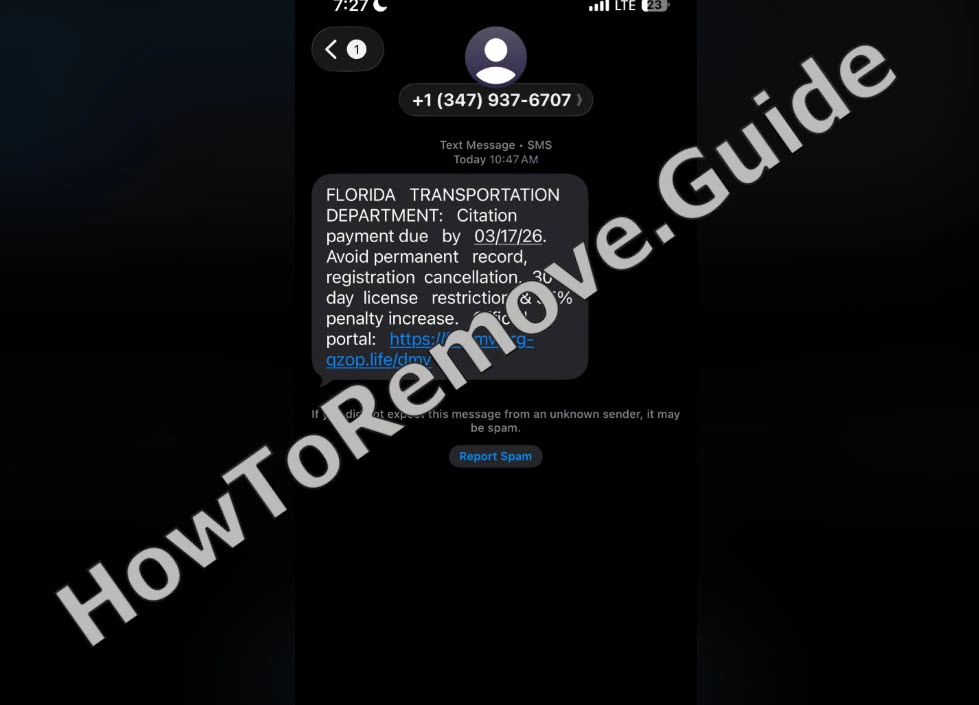
One reported version said: “FLORIDA DMV ACTION ALERT: Citation resolution is mandatory by 3/22/2026. Non-compliance will trigger permanent record retention, registration nullification, a 30-day driving limitation, and a 35% penalty inflation: Act:”. Time out here because this is one of the clearest red flags in the whole scam. It sounds official for a second, but once you slow down it is really just a stack of threats without the details a real notice should include.
One person clicked through and found a supposed parking citation for $6.99. But there was no date for the violation and no location showing where it allegedly happened. That matters. If a real agency were contacting you about a real citation, there should be specific information attached to it. Instead the page gives you fear, urgency, and a payment prompt.
What the Florida DMV Scam Sites Look Like
The site linked in the text is where the scam tries to finish the job. But if you look closely at the web address, things start breaking down fast.
The reported fake links often do not end in .gov. Instead they may use .cc, .com, or .life. Some use slight misspellings like flhsmu. One example specifically mentioned was flhsmv.org-qzop.life. The real domain referenced in the source material is FLHSMV.gov. And that matters because people tend to glance at a name, not study a full URL. Scammers know that. They count on you seeing a familiar set of letters, assuming it is official, and moving on before you notice the ending is wrong for even one second.
Why Florida DMV Scam Works on So Many People
What makes this scam effective is that it does not ask for a huge amount. It asks for something tiny and wraps it inside a threat. Instead of questioning whether the whole thing is fake, people start thinking about how to avoid the bigger punishment mentioned in the text.
And that reaction is very human. Your phone lights up. You read a message about a citation. You see talk of penalties, registration issues, and deadlines. Your brain starts filling in gaps. Did I miss something? Did a notice go to an old address?
The reports also show this is being sent very broadly. One person said they moved out of Florida over a year ago and had not even been in the state since January 2025. Another said a friend in New York got the same text despite never having lived in Florida. Someone else said similar scam messages were sent to a deceased family member. So no, this is not a narrowly targeted citation notice. It is a mass campaign.
Warning Signs to Watch For
Once you know the pattern, the message gets much easier to spot.
1. A government-style threat delivered by text
The message is written to sound official. But the extracted information says FLHSMV does not send texts regarding fines or license issues. Multiple people also stressed that real notices would come by mail, not by text.
2. Immediate pressure
The message tries to rush you. It threatens penalties, restrictions, or suspension-related consequences if you do not act quickly. Scammers love urgency because urgency keeps people from checking.
3. Missing citation details
One reported payment page showed a $6.99 citation with no date and no location. That is not a small detail missing. That is the story falling apart.
4. Suspicious domains
The links may end in .cc, .com, or .life. They may use lookalike wording such as flhsmu. One suspicious address that was specifically mentioned was flhsmv.org-qzop.life. The official domain referenced in the material is FLHSMV.gov.
5. Odd wording and formatting
Recipients pointed out strange wording and awkward spacing. Scam texts often try to sound official, but they do not quite sound normal.
6. Inconsistent sender details
One commenter mentioned a suspicious 347 area code. Another said they got a similar message from a number with a country code tied to the Philippines. Neither one makes sense for a Florida state agency.
What to Do If You Clicked the Link
If you clicked the link but did not enter anything, stop there. Close the page. Do not keep exploring it. Do not go back later.
If you entered card information, act fast. One person said they entered their card details and were never charged. That does not mean the card is safe. The advice in the source material was blunt and repeated several times: cancel the card immediately and contact the card issuer or fraud number right away.
After that, monitor your accounts for suspicious activity. Also be ready for more scam attempts by text, email, or phone.
How to Handle the Message Safely
Delete the text and do not respond. Do not click the link. Do not trust the contact details inside the message. And do not pay a small fee just because it seems easier than checking.
If you are worried there may be a real issue, verify it only through the official FLHSMV website by going there yourself. Not through the text. Through the real site. Some commenters also said citation matters would come by mail, and one said the local clerk of the court handles citations, not the DMV.
Reporting the Florida DMV Scam
The extracted information specifically says to report the scam to the Federal Trade Commission and the IC3 Internet Crime Complaint Center. Reporting helps track the pattern and helps warn other people before they get pulled into the same trap.
Useful Resources for Scam Reporting and Prevention (By Country)
Click here to report the scam in your country
| Country / Agency | URL | Category / Use-case | Phone/Email |
| Australia – Crime Stoppers | https://www.crimestoppers.com.au | Anonymous tips about crime | 1800 333 000 |
| Australia – National Anti-Scam Center (Scamwatch) | https://www.scamwatch.gov.au/report-a-scam | General scams; phishing; texts/emails | |
| Australia – Police Assistance Line (non-emergency) | https://www.police.gov.au | Local police report | 131 444 |
| Australia – ReportCyber (ACSC) | https://www.cyber.gov.au/report | Cybercrime (hacks, fraud, extortion) | |
| Canada – Canadian Anti-Fraud Center (CAFC) | https://www.antifraudcentre-centreantifraude.ca/report-signalez-eng.htm | General scams incl. phone/text/email | |
| France – DGCCRF (SignalConso) | https://signal.conso.gouv.fr | Consumer scams/deceptive practices | |
| France – PHAROS – Internet-Signalement | https://www.internet-signalement.gouv.fr | Online content & cybercrime reports | |
| Germany – Bundeskriminalamt / Local Police | https://www.polizei.de/Polizei/DE/Home/home_node.html | Report online fraud | |
| Germany – Weißer Ring – Victim Support | https://weisser-ring.de | Victim support | 116 006 |
| India – DoT Helpline (Sanchar Saathi) | https://sancharsaathi.gov.in | Fraudulent telecom/SIM related | 155260 |
| India – National Consumer Helpline | https://consumerhelpline.gov.in | Consumer scams | 1800-11-4000 / 1915 |
| India – National Cyber Crime Reporting Portal | https://cybercrime.gov.in | Cybercrime incl. online fraud | 1930 |
| Japan – Consumer Affairs Agency (CAA) | https://www.caa.go.jp/policies/policy/consumer_policy/caution/cybercrime/ | Consumer scams | |
| Japan – National Police Agency – Cybercrime | https://www.npa.go.jp/bureau/cyber/ | Cybercrime reporting | |
| Mexico – Guardia Nacional (National Guard) | https://www.gob.mx/gn | Cybercrime reporting | |
| Mexico – Instituto Federal de Telecomunicaciones (IFT) | https://www.ift.org.mx | Telecom/online services scams | |
| Mexico – PROFECO | https://www.gob.mx/profeco | Consumer fraud & ecommerce | |
| Netherlands – AFM – Report investment fraud | https://www.afm.nl/en/consumenten/themas/beleggen/misleiding-misbruik | Investment/crypto | |
| Netherlands – Fraudehelpdesk | https://www.fraudehelpdesk.nl/melden | General scams (incl. phishing/SMS) | 088-7867372 |
| Netherlands – Politie – Meldpunt Internetoplichting | https://www.politie.nl/themas/internetoplichting.html | Online shopping fraud | |
| New Zealand – CERT NZ | https://www.cert.govt.nz/individuals/report-an-issue/ | Phishing, identity scams | |
| New Zealand – Department of Internal Affairs – Spam | https://www.dia.govt.nz/Spam-Contact-Us | Email/SMS spam | [email protected] |
| New Zealand – IDCARE | https://www.idcare.org | Victim support (identity compromise) | 0800 121 068 |
| New Zealand – Netsafe – Report | https://www.netsafe.org.nz/report/ | Online harms & scams | |
| New Zealand – New Zealand Police (non-emergency) | https://www.police.govt.nz/use-105 | Report fraud/online crime | 105 |
| Nigeria – Economic & Financial Crimes Commission (EFCC) | https://www.efcc.gov.ng | Financial scams incl. crypto/investment | [email protected] |
| Nigeria – Nigeria Police Special Fraud Unit (SFU) | https://www.specialfraudunit.org.ng | Serious fraud | Voice/SMS: 0708 227 6895; WhatsApp: 0812 760 9914 |
| Poland – CERT Polska (CERT.PL) | https://cert.pl/en/report/ | Cyber incidents & phishing | |
| Poland – Dyzurnet.pl | https://dyzurnet.pl | Illegal online content (esp. child protection) | |
| Poland – Polish Police (Policja) | https://www.policja.pl | Report scams to police | |
| Singapore – Anti-Scam Centre / Anti-Scam Helpline | https://www.scamalert.sg | General scams; texts; calls | 1800-722-6688 |
| Singapore – Monetary Authority of Singapore (MAS) | https://www.mas.gov.sg/investor-alert-list | Investment/crypto checks | |
| Singapore – Singapore Police Force | https://www.police.gov.sg/iwitness | Police report (cybercrime) | |
| South Africa – Cybersecurity Hub (CSIRT) | https://www.cybersecurityhub.gov.za | Cyber incidents incl. scams | |
| South Africa – South African Fraud Prevention Service (SAFPS) | https://www.safps.org.za | Identity fraud support | 011-867-2234 |
| South Africa – South African Police Service (SAPS) | https://www.saps.gov.za | Police report (cybercrime unit) | |
| South Korea – Korea Communications Commission (KCC) | https://www.kcc.go.kr | Telecom-related fraud | |
| South Korea – Korea Internet & Security Agency (KISA) | https://www.kisa.or.kr | Phishing, online harms | |
| South Korea – Korean National Police Agency – Cyber Bureau | https://ecrm.cyber.go.kr | Cybercrime reporting | |
| Spain – INCIBE – Oficina de Seguridad del Internauta (OSI) | https://www.osi.es/es/reporte | Cybersecurity & online fraud | |
| Spain – Policía Nacional / Guardia Civil | https://www.policia.es | Report scams to police | |
| Sweden – Crime Victim Authority (Brottsoffermyndigheten) | https://www.brottsoffermyndigheten.se | Victim support & compensation | 090–70 82 00 |
| Sweden – Polisen (Swedish Police) | https://polisen.se | Report fraud/cybercrime | 114 14 (non-emergency); 112 (emergency) |
| Sweden – Swedish Consumer Agency (Konsumentverket) | https://www.konsumentverket.se | Unfair business practices | |
| United Arab Emirates – Abu Dhabi Police – Aman Service | https://www.adpolice.gov.ae | Cybercrime tips/reporting | SMS 2828; 800 2626 |
| United Arab Emirates – Dubai Police – eCrime | https://www.dubaipolice.gov.ae | Cybercrime reporting | 04 606 1600 |
| United Arab Emirates – Ministry of Interior – Cyber Crime Dept. | https://www.moi.gov.ae | Cybercrime incl. online scams | |
| United Arab Emirates – Telecommunications Regulatory Authority (TRA) / TDRA | https://www.tra.gov.ae | Telecom-related scams/phishing | |
| United Kingdom – Action Fraud (NFIB) | https://www.actionfraud.police.uk | General scams & cybercrime (non-emergency) | 0300 123 2040 |
| United Kingdom – Citizens Advice Consumer Service | https://www.citizensadvice.org.uk/consumer/get-more-help/if-you-need-more-help-about-a-consumer-issue/ | Consumer problems & scam guidance | 0808 223 1133 |
| United Kingdom – Financial Conduct Authority (FCA) | https://www.fca.org.uk/consumers/report-scam-us | Investment/crypto & financial services | |
| United Kingdom – National Cyber Security Centre (NCSC) | https://www.ncsc.gov.uk/collection/phishing-scams | Phishing emails & suspicious websites | |
| United Kingdom – Stop Scams UK ‘159’ | https://stopscamsuk.org.uk/159 | Banking APP fraud (direct to your bank) | 159 |
| United States – AARP Fraud Watch Network Helpline | https://www.aarp.org/money/scams-fraud/ | Victim support | 833-372-8311 |
| United States – Better Business Bureau – Scam Tracker | https://www.bbb.org/scamtracker | Business/marketplace scams | |
| United States – FBI Internet Crime Complaint Center (IC3) | https://www.ic3.gov | Internet crime incl. investment/crypto | |
| United States – Federal Trade Commission – ReportFraud | https://reportfraud.ftc.gov | General scams, phishing, texts/emails | 1-877-382-4357 |
| United States – National Center for Disaster Fraud | https://www.justice.gov/disaster-fraud | Disaster-related scams | (866) 720-5721 |
| United States – SEC Tips & Complaints | https://www.sec.gov/tcr | Investment & securities/crypto-asset offerings |
Final Takeaway
This scam runs on panic, not proof. It uses an official sounding name, a small payment like $6.99, scary consequences, a date like 3/22/2026, and a link that only looks real if you do not inspect it closely. Once you slow down, the cracks are everywhere.
So if you get one of these texts, do not let the pressure do the thinking for you. Real issues can be checked through FLHSMV.gov. Scams need urgency. They need confusion. And most of all they need you to react before you verify.
