

You probably found Fowatu through a loud (probably AI-generated) TikTok clip, X post, or flashy video featuring celebrities like Elon Musk or Bill Gates, which is already a red flag in itself.
These aggressive promotions paint Fowatu as a polished and prestigious crypto-gambling platform, but any external credibility that it may invoke quickly goes away once you put it under any sort of scrutiny.
In reality, this site follows a familiar scam pattern we’ve seen before with other scam platforms like Porewin129 and Drakewhale: you register, play with fake bonus funds, and invariably see impressive winnings appear in your account. But when you try to cash out, the site suddenly demands an extra deposit, transfer fee, or account activation payment.
Scams of Fowatu.com‘s type are known to steal personal data and passwords. Install SpyHunter Pro to scan for risks, remove any dangerous trackers, and enable real-time protection.

Try Free For 7 Days*
Buy now15% OFF if you buy straight without trial.
 OFFER
OFFERThat is the trap designed to claim your money without giving anything in return. Worse yet is that falling for this scheme can provide the scammers with access to your banking account and digital wallets.
VERY IMPORTANT!
If you have already made the mistake of trusting Fowatu.com with your personal data and your money, you need to take immediate measures to limit any further damage that the scammers may cause to your digital assets. The exact steps you need to take are outlined below.
IMPORTANT! READ BEFORE PROCEEDING!
If you already deposited funds, uploaded documents, or connected a wallet after interacting with Fowatu, treat the situation as active fraud and move into containment mode right away. The fastest wins come from cutting off the scam’s access and protecting what you still control:
- Stop sending any more crypto, even if support promises release after one final payment.
- Save screenshots, wallet addresses, emails, chats, and transaction hashes before anything disappears.
- Notify the exchange or payment service you used and flag the transfer as fraudulent.
- Move remaining assets to a fresh wallet if the old one may be exposed.
- Secure email, exchange, and wallet logins with new passwords and two-factor authentication.
How We Know Fowatu is a Scam
Several warning signs point in the same direction: this does not behave like a transparent gambling platform. Instead, it follows patterns long associated with fake crypto sites and prize-style payment traps.
Public praise is easy to fake
At first glance, the praise surrounding Fowatu may seem reassuring, yet public enthusiasm is easy to manufacture and should never stand in for independent proof.
Deceptive testimonials distort trust
Glowing testimonials and polished comments fit a broader fraud pattern in which deceptive reviews are used to create borrowed trust.
License claims prove nothing by themselves
A claim inside the site proves nothing unless the operator can be found in a real regulator database.
The payout wall is the loudest alarm
Any demand to send money before receiving supposed winnings is a classic scam indicator.
Late-stage verification is a bad sign
Sudden identity-check drama that appears only when you try to cash out is not how a compliant operator is expected to behave.
Busy-looking activity can be staged
A slick interface, fake chat windows, winner pop-ups, and staged activity can all be scripted.
Unknown domains deserve extra caution
A newly created or constantly rotating domain fits the broader pattern in which the same template reappears under a fresh name.
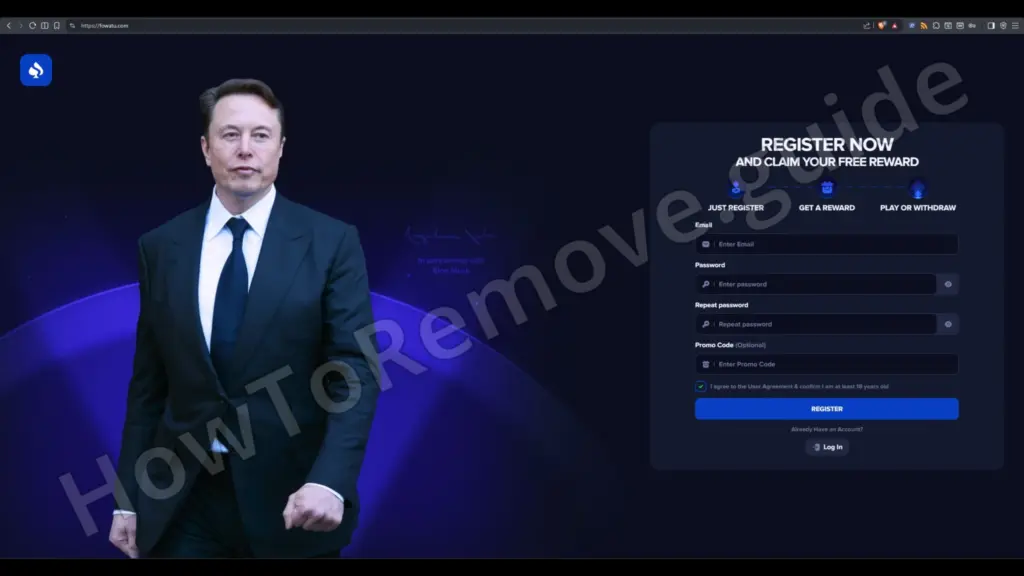

How the Fowatu Scam Deception Funnel Works
Knowing the sequence matters because this kind of fraud is engineered as a step-by-step pressure system, with each stage designed to make the next demand feel more believable.
Once you recognize the steps, you can interrupt them early and explain the incident more clearly if you need to report it.
Promo codes and social bait
Many victims are pulled into the first step through promo codes, social posts, direct messages, or branded clips that make the offer feel casual and low risk.
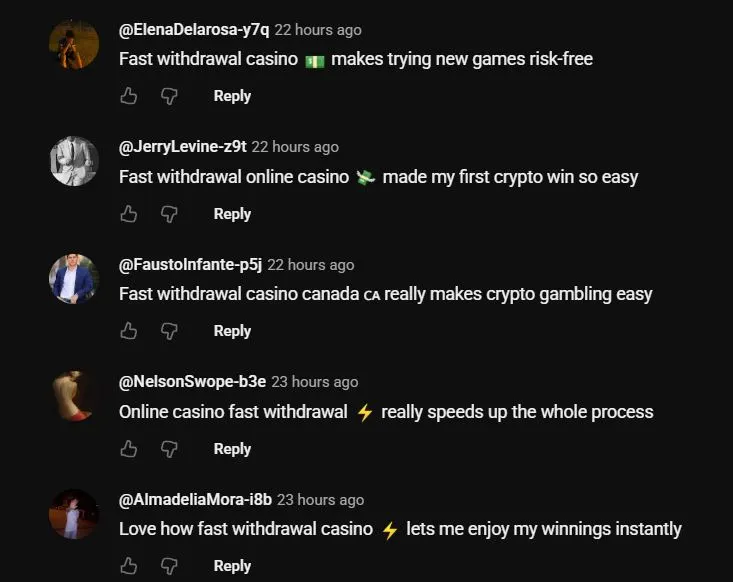
A polished front lowers your guard
The site is made to feel frictionless at first: a clean layout, familiar game names, and smooth onboarding make the next click easier.

A visible balance becomes the anchor
Typically, the victim is shown a number large enough to trigger hope, and that visible balance becomes the anchor that keeps later demands feeling almost reasonable.
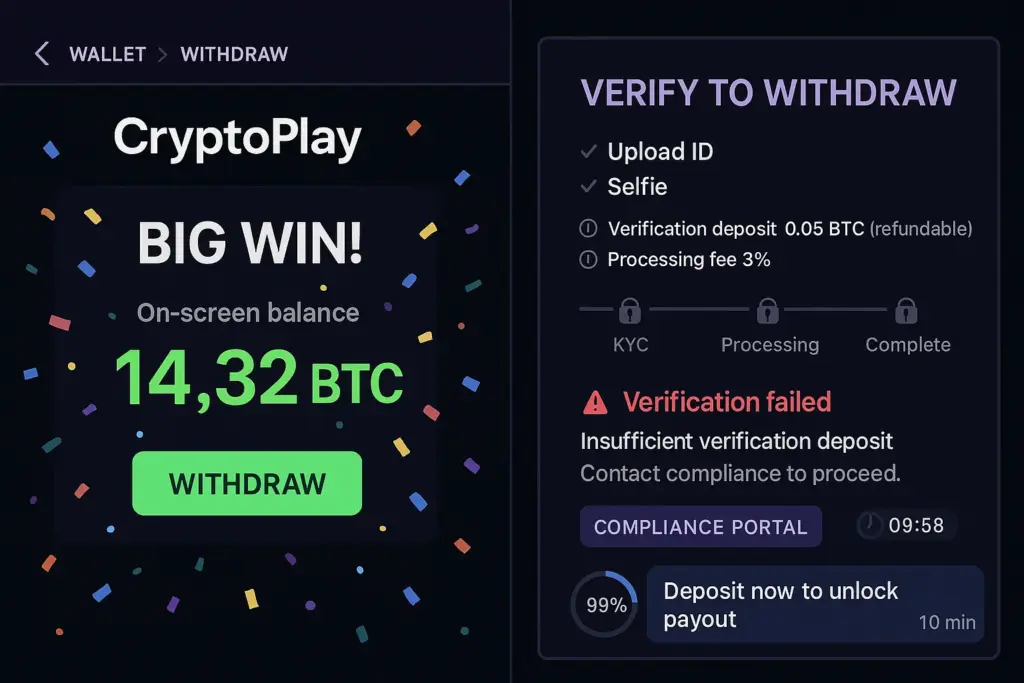
The withdrawal wall appears
Soon after that, the site blocks withdrawal and introduces a supposedly temporary payment such as a release fee, processing charge, or account unlock deposit.

The scheme escalates instead of paying
Paying once usually creates room for another excuse, another compliance story, or another wallet request, until the victim stops or the domain vanishes.
Staying safe from scams like Fowatu
The safest approach is to act as though every unfamiliar crypto casino must earn trust from zero, because presentation alone tells you almost nothing about legitimacy.
Verify the operator independently
Outside verification matters more than branding, so check whether the company can be confirmed through a regulator or another credible independent source.
Check domain age and history
Before depositing anything, look at the domain itself; a vague ownership trail or recent registration should lower confidence immediately.
Never pay to release a payout
Make a personal rule that you never send money to receive money, and treat any pay-to-withdraw demand as an instant dealbreaker.
Use safer separation between accounts
Use compartmentalization by keeping a separate email and a low-value wallet for experiments, so one bad site cannot wreck everything.
Move assets if wallet security is in doubt
If wallet security may already be in doubt, move what is left to a newly created wallet rather than assuming the original setup is still safe.
Distrust bot-like endorsement waves
Verify promotions through official channels rather than reposts, because bot-driven endorsements and copied praise are cheap and common.
Preserve evidence and report quickly
For your own records, keep copies of every message, wallet address, and transaction hash, since evidence tends to matter most after the platform goes quiet.
Build a deliberate pause
Under stress, people make harsher errors, so taking a pause is not weakness; it is an anti-scam technique.
Useful Resources for Scam Reporting and Prevention (By Country)
Stop sending money immediately. Save screenshots, website URLs, wallet addresses, transaction hashes, emails, chat logs, promo-code pages, and any ID-request messages. Then notify the exchange or payment service you used right away.
Report it.
| Country / Agency | URL | Category / Use-case | Phone/Email |
| Australia – Crime Stoppers | https://www.crimestoppers.com.au | Anonymous tips about crime | 1800 333 000 |
| Australia – National Anti-Scam Center (Scamwatch) | https://www.scamwatch.gov.au/report-a-scam | General scams; phishing; texts/emails | |
| Australia – Police Assistance Line (non-emergency) | https://www.police.gov.au | Local police report | 131 444 |
| Australia – ReportCyber (ACSC) | https://www.cyber.gov.au/report | Cybercrime (hacks, fraud, extortion) | |
| Canada – Canadian Anti-Fraud Center (CAFC) | https://www.antifraudcentre-centreantifraude.ca/report-signalez-eng.htm | General scams incl. phone/text/email | |
| France – DGCCRF (SignalConso) | https://signal.conso.gouv.fr | Consumer scams/deceptive practices | |
| France – PHAROS – Internet-Signalement | https://www.internet-signalement.gouv.fr | Online content & cybercrime reports | |
| Germany – Bundeskriminalamt / Local Police | https://www.polizei.de/Polizei/DE/Home/home_node.html | Report online fraud | |
| Germany – Weißer Ring – Victim Support | https://weisser-ring.de | Victim support | 116 006 |
| India – DoT Helpline (Sanchar Saathi) | https://sancharsaathi.gov.in | Fraudulent telecom/SIM related | 155260 |
| India – National Consumer Helpline | https://consumerhelpline.gov.in | Consumer scams | 1800-11-4000 / 1915 |
| India – National Cyber Crime Reporting Portal | https://cybercrime.gov.in | Cybercrime incl. online fraud | 1930 |
| Japan – Consumer Affairs Agency (CAA) | https://www.caa.go.jp/policies/policy/consumer_policy/caution/cybercrime/ | Consumer scams | |
| Japan – National Police Agency – Cybercrime | https://www.npa.go.jp/bureau/cyber/ | Cybercrime reporting | |
| Mexico – Guardia Nacional (National Guard) | https://www.gob.mx/gn | Cybercrime reporting | |
| Mexico – Instituto Federal de Telecomunicaciones (IFT) | https://www.ift.org.mx | Telecom/online services scams | |
| Mexico – PROFECO | https://www.gob.mx/profeco | Consumer fraud & ecommerce | |
| Netherlands – AFM – Report investment fraud | https://www.afm.nl/en/consumenten/themas/beleggen/misleiding-misbruik | Investment/crypto | |
| Netherlands – Fraudehelpdesk | https://www.fraudehelpdesk.nl/melden | General scams (incl. phishing/SMS) | 088-7867372 |
| Netherlands – Politie – Meldpunt Internetoplichting | https://www.politie.nl/themas/internetoplichting.html | Online shopping fraud | |
| New Zealand – CERT NZ | https://www.cert.govt.nz/individuals/report-an-issue/ | Phishing, identity scams | |
| New Zealand – Department of Internal Affairs – Spam | https://www.dia.govt.nz/Spam-Contact-Us | Email/SMS spam | [email protected] |
| New Zealand – IDCARE | https://www.idcare.org | Victim support (identity compromise) | 0800 121 068 |
| New Zealand – Netsafe – Report | https://www.netsafe.org.nz/report/ | Online harms & scams | |
| New Zealand – New Zealand Police (non-emergency) | https://www.police.govt.nz/use-105 | Report fraud/online crime | 105 |
| Nigeria – Economic & Financial Crimes Commission (EFCC) | https://www.efcc.gov.ng | Financial scams incl. crypto/investment | [email protected] |
| Nigeria – Nigeria Police Special Fraud Unit (SFU) | https://www.specialfraudunit.org.ng | Serious fraud | Voice/SMS: 0708 227 6895; WhatsApp: 0812 760 9914 |
| Poland – CERT Polska (CERT.PL) | https://cert.pl/en/report/ | Cyber incidents & phishing | |
| Poland – Dyzurnet.pl | https://dyzurnet.pl | Illegal online content (esp. child protection) | |
| Poland – Polish Police (Policja) | https://www.policja.pl | Report scams to police | |
| Singapore – Anti-Scam Centre / Anti-Scam Helpline | https://www.scamalert.sg | General scams; texts; calls | 1800-722-6688 |
| Singapore – Monetary Authority of Singapore (MAS) | https://www.mas.gov.sg/investor-alert-list | Investment/crypto checks | |
| Singapore – Singapore Police Force | https://www.police.gov.sg/iwitness | Police report (cybercrime) | |
| South Africa – Cybersecurity Hub (CSIRT) | https://www.cybersecurityhub.gov.za | Cyber incidents incl. scams | |
| South Africa – South African Fraud Prevention Service (SAFPS) | https://www.safps.org.za | Identity fraud support | 011-867-2234 |
| South Africa – South African Police Service (SAPS) | https://www.saps.gov.za | Police report (cybercrime unit) | |
| South Korea – Korea Communications Commission (KCC) | https://www.kcc.go.kr | Telecom-related fraud | |
| South Korea – Korea Internet & Security Agency (KISA) | https://www.kisa.or.kr | Phishing, online harms | |
| South Korea – Korean National Police Agency – Cyber Bureau | https://ecrm.cyber.go.kr | Cybercrime reporting | |
| Spain – INCIBE – Oficina de Seguridad del Internauta (OSI) | https://www.osi.es/es/reporte | Cybersecurity & online fraud | |
| Spain – Policía Nacional / Guardia Civil | https://www.policia.es | Report scams to police | |
| Sweden – Crime Victim Authority (Brottsoffermyndigheten) | https://www.brottsoffermyndigheten.se | Victim support & compensation | 090–70 82 00 |
| Sweden – Polisen (Swedish Police) | https://polisen.se | Report fraud/cybercrime | 114 14 (non-emergency); 112 (emergency) |
| Sweden – Swedish Consumer Agency (Konsumentverket) | https://www.konsumentverket.se | Unfair business practices | |
| United Arab Emirates – Abu Dhabi Police – Aman Service | https://www.adpolice.gov.ae | Cybercrime tips/reporting | SMS 2828; 800 2626 |
| United Arab Emirates – Dubai Police – eCrime | https://www.dubaipolice.gov.ae | Cybercrime reporting | 04 606 1600 |
| United Arab Emirates – Ministry of Interior – Cyber Crime Dept. | https://www.moi.gov.ae | Cybercrime incl. online scams | |
| United Arab Emirates – Telecommunications Regulatory Authority (TRA) / TDRA | https://www.tra.gov.ae | Telecom-related scams/phishing | |
| United Kingdom – Action Fraud (NFIB) | https://www.actionfraud.police.uk | General scams & cybercrime (non-emergency) | 0300 123 2040 |
| United Kingdom – Citizens Advice Consumer Service | https://www.citizensadvice.org.uk/consumer/get-more-help/if-you-need-more-help-about-a-consumer-issue/ | Consumer problems & scam guidance | 0808 223 1133 |
| United Kingdom – Financial Conduct Authority (FCA) | https://www.fca.org.uk/consumers/report-scam-us | Investment/crypto & financial services | |
| United Kingdom – National Cyber Security Centre (NCSC) | https://www.ncsc.gov.uk/collection/phishing-scams | Phishing emails & suspicious websites | |
| United Kingdom – Stop Scams UK ‘159’ | https://stopscamsuk.org.uk/159 | Banking APP fraud (direct to your bank) | 159 |
| United States – AARP Fraud Watch Network Helpline | https://www.aarp.org/money/scams-fraud/ | Victim support | 833-372-8311 |
| United States – Better Business Bureau – Scam Tracker | https://www.bbb.org/scamtracker | Business/marketplace scams | |
| United States – FBI Internet Crime Complaint Center (IC3) | https://www.ic3.gov | Internet crime incl. investment/crypto | |
| United States – Federal Trade Commission – ReportFraud | https://reportfraud.ftc.gov | General scams, phishing, texts/emails | 1-877-382-4357 |
| United States – National Center for Disaster Fraud | https://www.justice.gov/disaster-fraud | Disaster-related scams | (866) 720-5721 |
| United States – SEC Tips & Complaints | https://www.sec.gov/tcr | Investment & securities/crypto-asset offerings |
Crypto payments are usually hard to reverse, so the safest move is to step back, verify independently, and refuse any setup that tries to turn your own payout into another deposit.
