

Fuzawin looks, at first glance, like another crypto casino promising quick payouts, big bonuses, and some kind of decentralized safety layer. Okay, so pause here, because this is where a lot of people let their guard down: polished pages and crypto buzzwords do not automatically mean a platform is safe.
The hook is usually simple. Similar to Tunorex and Cofixplay, you see free rewards, hype on social media, maybe a familiar-looking face in a promo, and then your account appears to grow. But when you try to cash out, suddenly there are extra “verification,” “activation,” or transfer payments.
Scams of Fuzawin.com‘s type are known to steal personal data and passwords. Install SpyHunter Pro to scan for risks, remove any dangerous trackers, and enable real-time protection.

Try Free For 7 Days*
Buy now15% OFF if you buy straight without trial.
 OFFER
OFFERNow here’s the important part: that extra payment request is the real warning sign. A legitimate service should not keep asking you to deposit more money before releasing supposed winnings, especially when crypto transfers are hard to reverse once sent.
IMPORTANT! READ BEFORE PROCEEDING!
Anyone who used Fuzawin should assume the situation can extend beyond a single transaction. Passwords, wallet permissions, exchange sessions, personal documents, and browser security should all be reviewed, especially if the site asked you to install anything or sign a wallet prompt.
Do not keep using the same device for financial logins until it has been checked. In this case, we recommend running SpyHunter 5 to look for malware, unwanted extensions, and other changes that could expose accounts after the casino page is closed.
Fastest Removal Option: Use SpyHunter 5
- 1.1Click here to download and install the anti-malware tool on your PC.
- 1.2
 Start SpyHunter 5, click the Buy button and choose between starting your 7-days free trial or directly purchasing the tool.
If you choose to buy SpyHunter 5 now, you can use our discount code, “HTRG15“, for 15% off.
- 1.3
 Once you activate SpyHunter, click Start Scan Now, select the Full Scan option, and let the tool do its job.
 - 1.4
 Once the scan completes (it could take a while, so have patience), you’ll see all malware and other undesirables listed.
Click Next to review the detections and then click Next again to delete all rogue items.
After checking the system, follow these containment steps as well:
- Reset passwords and enable 2FA on your email, crypto exchanges, and wallets; terminate other active sessions.
- Notify any exchanges and services touched by the funds; provide TxIDs and ask that accounts/addresses be flagged per policy.
- Migrate assets to fresh wallets with new seed phrases and revoke any existing token approvals on connected chains.
- If you uploaded ID documents, place credit/fraud alerts where available and monitor for identity-theft signals.
- Assemble an evidence bundle – wallet addresses, TxIDs, site URLs, chats, and screenshots – and file reports with police/IC3 and any involved platforms.
How We Know Fuzawin is a Scam
The case against Fuzawin comes from patterns that repeat across fake crypto casinos. A real venue must make its ownership, license, payment rules, and withdrawal process clear before taking funds. Here, the important signals point the other way.
The bonus is oversized for the risk
Massive signup offers are often used to make users feel they are starting ahead. In reality, the bonus may be a lure that locks the user into impossible terms or a fake balance that cannot be withdrawn.
Withdrawals trigger new obligations
A user should not discover major conditions only after requesting a payout. Sudden requirements for clearance deposits, taxes, account activation, or identity checks show that the withdrawal stage is being used to extract more value.
Ownership is hard to verify
When a site handles money but hides the company behind it, caution is warranted. Real gambling businesses usually provide jurisdiction, legal entity details, licensing references, and complaint routes that can be checked independently.
Game results support the scam narrative
The early experience may feel unusually lucky because that helps the user commit. A fake platform can display any outcome it wants, so a rising balance is not evidence that funds exist or can be paid.
Payment design favors the operator
Crypto deposits can be routed quickly and are difficult for victims to reverse. A platform that avoids safer payment channels while demanding more transfers at withdrawal is choosing the rails that reduce accountability.
The domain trail suggests churn
Disposable scam brands often use fresh domains and cloned templates. Checking records through who.is helps reveal whether the site has a meaningful history or only a recent registration.
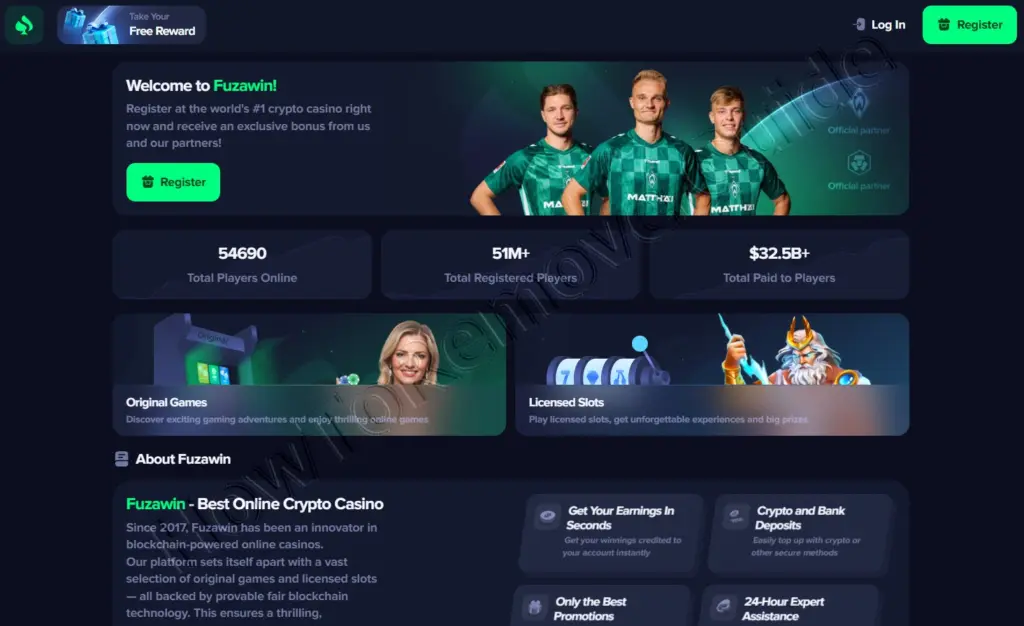

How the Fuzawin Scam Deception Funnel Works
Understanding the chain of events helps victims avoid the next demand. The scam works by changing the user’s focus from “Is this real?” to “How do I unlock what I already won?” That shift is where most extra payments happen.
The flow usually begins with an invitation, continues through a realistic-looking casino interface, and then tightens around a withdrawal block. Support uses official-sounding reasons to justify delays, while the user is pushed to keep paying or sharing data.
An invitation creates false exclusivity
Promotional posts may frame access as private, time-limited, or connected to a creator. The aim is to make the user feel selected, not skeptical, before they examine the domain or license.

The site borrows casino familiarity
Slots, jackpots, chat widgets, wallet buttons, and bonus pages make the environment feel recognizable. Familiar design lowers resistance even when the underlying company and payout mechanism remain unproven.

The fake win changes the victim’s priorities
Once the balance appears valuable, the user may focus on preserving it. That emotional investment is exactly why a request for a small “unlock” payment can feel reasonable in the moment.
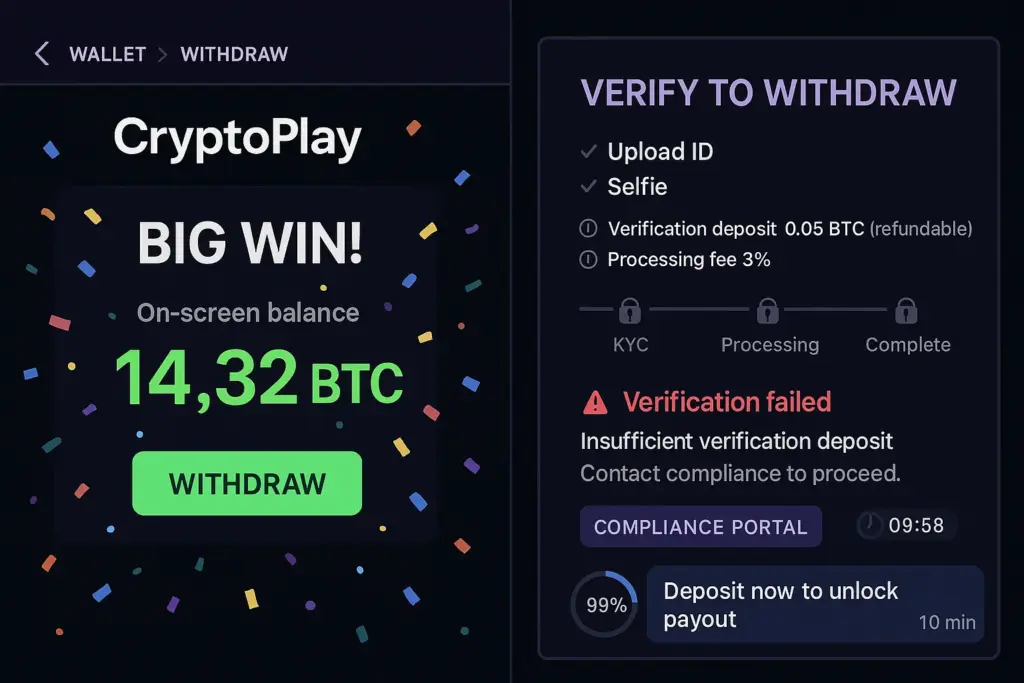
Identity checks increase the damage
The platform may ask for ID documents, selfies, or address information after blocking withdrawal. That material can create fraud risk long after the lost crypto has moved away from the victim’s wallet.

The brand can vanish and return renamed
When complaints grow, the same operators can abandon one domain and launch another. The graphics, scripts, and payment logic may stay similar even while the name changes.
Staying safe from crypto casino scams like Fuzawin
Prevention works best as a checklist. Before a deposit, confirm the license, examine the domain, search outside reviews, read withdrawal terms, and decide whether you would still trust the site if the bonus disappeared from the screen.
Use regulator sites as the source of truth
Search the licensing body directly instead of clicking badges on the casino page. Check whether the regulator recognizes the operator and whether the domain is actually connected to the licensed entity.
Investigate the age of the brand
A young domain is not automatically criminal, but a young domain handling crypto gambling deserves caution. Combine WHOIS, archives, and search results to see whether the business existed before the promotion campaign.
Stop at any pay-to-withdraw request
The moment a platform asks for more crypto to release money, assume the balance is being used against you. Paying usually produces a new explanation, not a completed withdrawal.
Value dispute paths before bonuses
A smaller offer from a verifiable operator is safer than a huge offer from a site with no accountability. Licensing, payment protection, and complaint channels matter more than the size of the displayed bonus.
Protect wallets like separate compartments
Keep long-term assets away from experimental sites. Use isolated wallets, remove approvals, limit balances, and never share seed phrases, screenshots of recovery phrases, or exchange security codes with support staff.
Ask for evidence that can be checked
If a platform claims fairness, audits, or reserves, it should point to proof that does not live only on its own page. Claims that cannot be tested should not influence your risk decision.
Prepare a clean incident record
If you were affected, collect transaction hashes, receiving addresses, chat transcripts, emails, screenshots, and the exact timestamps. Keep originals as well as copies, because investigators may need precise details.
Make delay your default reaction
Fraudsters want the victim to act while excited, embarrassed, or afraid of losing a payout. A deliberate pause gives logic time to catch up with the screen’s promises.
Useful Resources for Scam Reporting and Prevention (By Country)
Rapid reporting can help connect your case to others, even when immediate recovery is uncertain. Wallets, domains, and messages may match wider investigations, so submit evidence to the appropriate agencies and notify exchanges as soon as practical.
Find the correct reporting route
| Country / Agency | URL | Category / Use-case | Phone/Email |
| Australia – Crime Stoppers | https://www.crimestoppers.com.au | Anonymous tips about crime | 1800 333 000 |
| Australia – National Anti-Scam Center (Scamwatch) | https://www.scamwatch.gov.au/report-a-scam | General scams; phishing; texts/emails | |
| Australia – Police Assistance Line (non-emergency) | https://www.police.gov.au | Local police report | 131 444 |
| Australia – ReportCyber (ACSC) | https://www.cyber.gov.au/report | Cybercrime (hacks, fraud, extortion) | |
| Canada – Canadian Anti-Fraud Center (CAFC) | https://www.antifraudcentre-centreantifraude.ca/report-signalez-eng.htm | General scams incl. phone/text/email | |
| France – DGCCRF (SignalConso) | https://signal.conso.gouv.fr | Consumer scams/deceptive practices | |
| France – PHAROS – Internet-Signalement | https://www.internet-signalement.gouv.fr | Online content & cybercrime reports | |
| Germany – Bundeskriminalamt / Local Police | https://www.polizei.de/Polizei/DE/Home/home_node.html | Report online fraud | |
| Germany – Weißer Ring – Victim Support | https://weisser-ring.de | Victim support | 116 006 |
| India – DoT Helpline (Sanchar Saathi) | https://sancharsaathi.gov.in | Fraudulent telecom/SIM related | 155260 |
| India – National Consumer Helpline | https://consumerhelpline.gov.in | Consumer scams | 1800-11-4000 / 1915 |
| India – National Cyber Crime Reporting Portal | https://cybercrime.gov.in | Cybercrime incl. online fraud | 1930 |
| Japan – Consumer Affairs Agency (CAA) | https://www.caa.go.jp/policies/policy/consumer_policy/caution/cybercrime/ | Consumer scams | |
| Japan – National Police Agency – Cybercrime | https://www.npa.go.jp/bureau/cyber/ | Cybercrime reporting | |
| Mexico – Guardia Nacional (National Guard) | https://www.gob.mx/gn | Cybercrime reporting | |
| Mexico – Instituto Federal de Telecomunicaciones (IFT) | https://www.ift.org.mx | Telecom/online services scams | |
| Mexico – PROFECO | https://www.gob.mx/profeco | Consumer fraud & ecommerce | |
| Netherlands – AFM – Report investment fraud | https://www.afm.nl/en/consumenten/themas/beleggen/misleiding-misbruik | Investment/crypto | |
| Netherlands – Fraudehelpdesk | https://www.fraudehelpdesk.nl/melden | General scams (incl. phishing/SMS) | 088-7867372 |
| Netherlands – Politie – Meldpunt Internetoplichting | https://www.politie.nl/themas/internetoplichting.html | Online shopping fraud | |
| New Zealand – CERT NZ | https://www.cert.govt.nz/individuals/report-an-issue/ | Phishing, identity scams | |
| New Zealand – Department of Internal Affairs – Spam | https://www.dia.govt.nz/Spam-Contact-Us | Email/SMS spam | [email protected] |
| New Zealand – IDCARE | https://www.idcare.org | Victim support (identity compromise) | 0800 121 068 |
| New Zealand – Netsafe – Report | https://www.netsafe.org.nz/report/ | Online harms & scams | |
| New Zealand – New Zealand Police (non-emergency) | https://www.police.govt.nz/use-105 | Report fraud/online crime | 105 |
| Nigeria – Economic & Financial Crimes Commission (EFCC) | https://www.efcc.gov.ng | Financial scams incl. crypto/investment | [email protected] |
| Nigeria – Nigeria Police Special Fraud Unit (SFU) | https://www.specialfraudunit.org.ng | Serious fraud | Voice/SMS: 0708 227 6895; WhatsApp: 0812 760 9914 |
| Poland – CERT Polska (CERT.PL) | https://cert.pl/en/report/ | Cyber incidents & phishing | |
| Poland – Dyzurnet.pl | https://dyzurnet.pl | Illegal online content (esp. child protection) | |
| Poland – Polish Police (Policja) | https://www.policja.pl | Report scams to police | |
| Singapore – Anti-Scam Centre / Anti-Scam Helpline | https://www.scamalert.sg | General scams; texts; calls | 1800-722-6688 |
| Singapore – Monetary Authority of Singapore (MAS) | https://www.mas.gov.sg/investor-alert-list | Investment/crypto checks | |
| Singapore – Singapore Police Force | https://www.police.gov.sg/iwitness | Police report (cybercrime) | |
| South Africa – Cybersecurity Hub (CSIRT) | https://www.cybersecurityhub.gov.za | Cyber incidents incl. scams | |
| South Africa – South African Fraud Prevention Service (SAFPS) | https://www.safps.org.za | Identity fraud support | 011-867-2234 |
| South Africa – South African Police Service (SAPS) | https://www.saps.gov.za | Police report (cybercrime unit) | |
| South Korea – Korea Communications Commission (KCC) | https://www.kcc.go.kr | Telecom-related fraud | |
| South Korea – Korea Internet & Security Agency (KISA) | https://www.kisa.or.kr | Phishing, online harms | |
| South Korea – Korean National Police Agency – Cyber Bureau | https://ecrm.cyber.go.kr | Cybercrime reporting | |
| Spain – INCIBE – Oficina de Seguridad del Internauta (OSI) | https://www.osi.es/es/reporte | Cybersecurity & online fraud | |
| Spain – Policía Nacional / Guardia Civil | https://www.policia.es | Report scams to police | |
| Sweden – Crime Victim Authority (Brottsoffermyndigheten) | https://www.brottsoffermyndigheten.se | Victim support & compensation | 090–70 82 00 |
| Sweden – Polisen (Swedish Police) | https://polisen.se | Report fraud/cybercrime | 114 14 (non-emergency); 112 (emergency) |
| Sweden – Swedish Consumer Agency (Konsumentverket) | https://www.konsumentverket.se | Unfair business practices | |
| United Arab Emirates – Abu Dhabi Police – Aman Service | https://www.adpolice.gov.ae | Cybercrime tips/reporting | SMS 2828; 800 2626 |
| United Arab Emirates – Dubai Police – eCrime | https://www.dubaipolice.gov.ae | Cybercrime reporting | 04 606 1600 |
| United Arab Emirates – Ministry of Interior – Cyber Crime Dept. | https://www.moi.gov.ae | Cybercrime incl. online scams | |
| United Arab Emirates – Telecommunications Regulatory Authority (TRA) / TDRA | https://www.tra.gov.ae | Telecom-related scams/phishing | |
| United Kingdom – Action Fraud (NFIB) | https://www.actionfraud.police.uk | General scams & cybercrime (non-emergency) | 0300 123 2040 |
| United Kingdom – Citizens Advice Consumer Service | https://www.citizensadvice.org.uk/consumer/get-more-help/if-you-need-more-help-about-a-consumer-issue/ | Consumer problems & scam guidance | 0808 223 1133 |
| United Kingdom – Financial Conduct Authority (FCA) | https://www.fca.org.uk/consumers/report-scam-us | Investment/crypto & financial services | |
| United Kingdom – National Cyber Security Centre (NCSC) | https://www.ncsc.gov.uk/collection/phishing-scams | Phishing emails & suspicious websites | |
| United Kingdom – Stop Scams UK ‘159’ | https://stopscamsuk.org.uk/159 | Banking APP fraud (direct to your bank) | 159 |
| United States – AARP Fraud Watch Network Helpline | https://www.aarp.org/money/scams-fraud/ | Victim support | 833-372-8311 |
| United States – Better Business Bureau – Scam Tracker | https://www.bbb.org/scamtracker | Business/marketplace scams | |
| United States – FBI Internet Crime Complaint Center (IC3) | https://www.ic3.gov | Internet crime incl. investment/crypto | |
| United States – Federal Trade Commission – ReportFraud | https://reportfraud.ftc.gov | General scams, phishing, texts/emails | 1-877-382-4357 |
| United States – National Center for Disaster Fraud | https://www.justice.gov/disaster-fraud | Disaster-related scams | (866) 720-5721 |
| United States – SEC Tips & Complaints | https://www.sec.gov/tcr | Investment & securities/crypto-asset offerings |
Fuzawin should be handled as a high-risk crypto casino scam until proven otherwise by independent evidence. Do not send another unlock payment, do not trust recovery agents in your inbox, and do not reuse exposed credentials or wallets.
