

Giveawaybot.cc is a very low-effort, run-of-the-mill Robux scam, yet it still claims many victims because it primarily targets younger and inexperienced users. The page looks neat on purpose, borrowing its style from the real Roblox site, so that it feels legitimate enough to rope in some of the players who come across it.
The one good thing about Giveawaybot.cc and other similar fake sites like Giveaway Boat or Tipplow is that they don’t normally try to steal the player’s money. The goal here is different. They want you to click on some ads, complete some surveys, maybe download an app or two, and they promise you that you’ll eventually claim the promised Robux sum.
Scams of Giveawaybot.cc‘s type are known to steal personal data and passwords. Install SpyHunter Pro to scan for risks, remove any dangerous trackers, and enable real-time protection.

Try Free For 7 Days*
Buy now15% OFF if you buy straight without trial.
 OFFER
OFFERIn reality, it’s all just a way to farm your data and clicks and maybe promote some low-quality (borderline malware) apps. All of this is risky, but we’ve seen riskier, so if you disengage on time, there should be no lasting damage to your online privacy and security.
But if you did share any personal data on Giveawaybot.cc, downloaded any apps, or kept doing what the site asked you to for a bit too long, it’s important to take measures and secure your accounts and digital assets in the ways described below.
DO NOT TREAT THIS LIKE A REAL REWARD PAGE!
If you have already used Giveawaybot.cc, clicked through its prompts, or downloaded anything tied to it, respond as though your security may have been affected. The action list below is meant to help you contain damage quickly by checking accounts, removing risky apps, and tightening weak points scammers often target next.
- Change your passwords on Roblox/email/any reused accounts and enable 2-step verification. Log out of all other sessions.
- Contact your bank immediately and freeze/replace your card, dispute any unexpected charges, and block the merchant. Then cancel any “trial” subscriptions and enable real-time alerts.
- Run a full system scan with a reliable security tool and remove anything flagged. We recommend SpyHunter 5 for this action.
- Revoke suspicious OAuth permissions (Discord, Google, etc.), remove unfamiliar extensions, and clear sketchy site notifications.
- Screenshot any odd activity, contact Roblox Support, and report the scam where you found it.
How We Know Giveawaybot.cc is a Scam
The strongest clue is not one isolated detail but the whole routine playing out together. That routine is why it is reasonable to say Giveawaybot.cc is CERTAINLY a scam. The page uses the same manipulative ingredients seen across fake reward funnels: impossible payouts, staged system messages, outsourced “verification,” and no trustworthy operator behind it:
The prize claim is unrealistically huge
Huge Robux totals are not generosity. They are leverage. The number is supposed to light up the imagination so strongly that practical questions get ignored. A real business does not hand out valuable currency to unknown visitors through a random outside page with no transparent process.
The page performs a fake status show
The site’s status effects are there to mimic legitimacy. They give the impression that something technical is happening in the background when, in reality, the page is just moving the visitor along a script. Fake progress is useful to scammers because people are less likely to walk away after they feel invested.
It sends you through ad-heavy detours
Once a site starts funneling people to external offers, the real business model becomes obvious. Surveys, trials, ad clicks, and app installs are not reward fulfillment steps. They are monetized actions. The visitor absorbs the risk and inconvenience while someone else collects the benefit.
No accountable operator is visible
A trustworthy service can tell you who runs it, how to reach them, and why your data is needed. Scam pages often cannot do any of that clearly. Instead, they hide behind generic contact forms, copied policy text, or branding that raises more questions than it answers.
The hype surrounding it is manufactured
Scammers understand that people trust crowds, so they manufacture the appearance of crowd approval. Recycled testimonials, fake success claims, and spammed recommendations make the page look popular, but volume is not the same thing as credibility when every signal can be faked cheaply.
Disposable domains are part of the pattern
Short-lived infrastructure fits this scam model well. Operators can throw up a new domain, squeeze it for traffic, then swap to another one once warnings spread. A lookup at who.is will not answer everything, but it can add useful context when a “reward” page has almost no track record.
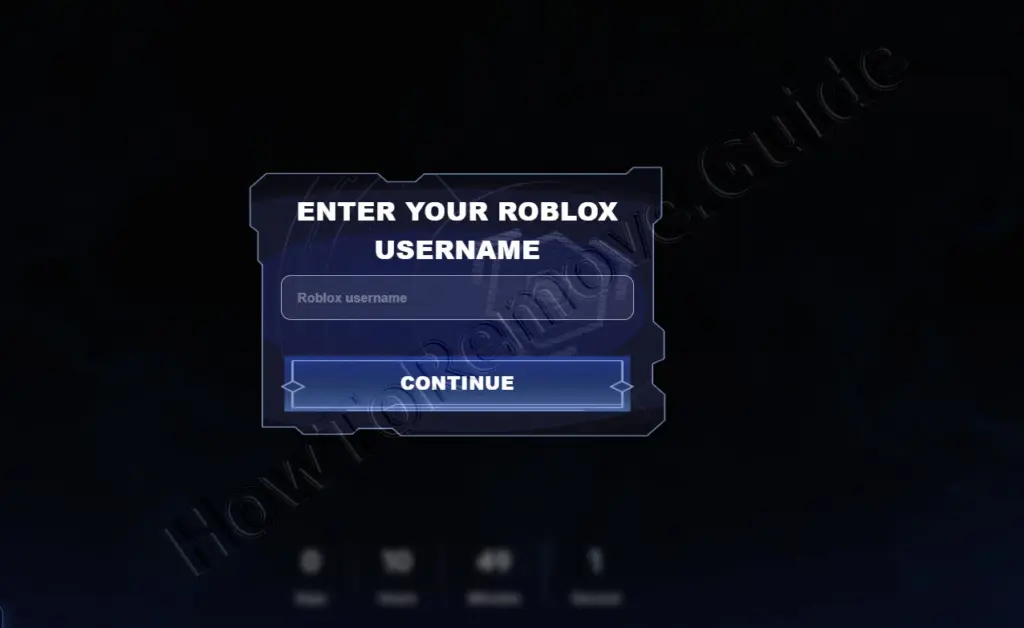

How the Giveawaybot.cc Scam Deception Funnel Works
Breaking the scam into stages makes it easier to resist. The page is not improvising; it is walking the visitor through a tested funnel. The general sequence tends to look like this: attention first, reassurance second, monetized detours third, and no reward at the end:
Traffic bait reaches players first
People rarely discover these pages in a trustworthy context. They are usually pushed through spammy recommendations, trend-chasing social posts, copied messages, or low-quality search results that promise an easy shortcut and direct the click straight to Giveawaybot.cc.

The landing page stages credibility
The landing page then works to calm suspicion. It may display game-related graphics, fake account lookups, or language that sounds official enough to make the visitor think the process is recognized somewhere by Roblox. That impression is artificial but very deliberate.

A scripted payout scene builds trust
After the user chooses a reward amount, the page tries to convert curiosity into commitment. Fake processing screens, countdowns, and “success pending” messages create the feeling that the prize is already halfway earned. That emotional setup makes the next demand seem easier to accept.

Off-site tasks become the money maker
The handoff to external tasks is the real purpose of the page. Each survey, install, signup, or share request can be monetized or used for further abuse. Sometimes the result is just wasted time; in worse cases it can also mean spam, unwanted subscriptions, invasive permissions, or malicious software.

The reward is always postponed
Nothing is ever truly finished because the reward was never real. The page may claim the task was incomplete, ask for one more verification step, or dump the visitor back into the offer wall. The longer the loop runs, the more chances the operators have to profit.
Staying safe from Robux-site traps like Giveawaybot.cc
Protection does not require special tools so much as consistent habits. Once you train yourself to distrust surprise rewards, urgent timers, and off-site verification demands, most of these pages become much easier to spot before they can do any real damage:
Stick to platform-owned announcements
Official rewards come from official channels. That is the simplest rule. If a free Robux claim is not clearly backed by Roblox through a source you can verify directly, it should be treated as untrusted no matter how polished the outside page looks.
Refuse “human checks” off-site
Human-verification language is often just a polite wrapper around exploitation. A reward page does not need you to complete ad offers, install promoted apps, or sign up for trials to “prove” you are real. Those steps exist because they are profitable to the people running the scam.
Reduce redirects with browser protection
Routine browser hygiene helps. Keeping the browser current, limiting noisy advertising, and leaving protective warnings enabled can reduce forced redirects and other tactics commonly used to keep visitors trapped in low-quality traffic funnels.
Strengthen your key accounts
Password reuse turns a small error into a wider incident. Separate your credentials across Roblox, email, and chat platforms, and enable two-step verification wherever possible. That way, one bad click is less likely to turn into a cascade of account takeovers.
Use parent tools for younger players
Younger players benefit from simple guardrails. Privacy settings, parent oversight, account PINs, and a rule that outside reward links must be checked with a trusted adult can stop a scam while it is still just a tempting message instead of a real problem.
Build a pause before you tap
Slow decisions are safer decisions here. Before acting, read the address carefully, question the payout, and notice whether the page is trying to manufacture urgency. Scam funnels depend on speed; even a brief pause takes power away from them.
Review connected apps regularly
It is also smart to review what already has access to your accounts and devices. Unused extensions, stale sign-ins, and forgotten app permissions create extra openings after a scam interaction, so clearing them out reduces future exposure.
Never install files for prizes
Software-for-rewards offers should be treated as an emergency stop sign. A page asking you to install a browser add-on, APK, profile, or desktop app for Robux is asking you to trade control of your device for a promise it does not intend to keep.
Useful Resources for Scam Reporting and Prevention (By Country)
The resource table below can help with reporting a page like Giveawaybot.cc to the right place. Individual reports may seem small, but they can provide useful signals to platforms and agencies tracking repeated fraud patterns across domains and campaigns.
Open the country-by-country reporting list
| Country / Agency | URL | Category / Use-case | Phone/Email |
| Australia – Crime Stoppers | https://www.crimestoppers.com.au | Anonymous tips about crime | 1800 333 000 |
| Australia – National Anti-Scam Center (Scamwatch) | https://www.scamwatch.gov.au/report-a-scam | General scams; phishing; texts/emails | |
| Australia – Police Assistance Line (non-emergency) | https://www.police.gov.au | Local police report | 131 444 |
| Australia – ReportCyber (ACSC) | https://www.cyber.gov.au/report | Cybercrime (hacks, fraud, extortion) | |
| Canada – Canadian Anti-Fraud Center (CAFC) | https://www.antifraudcentre-centreantifraude.ca/report-signalez-eng.htm | General scams incl. phone/text/email | |
| France – DGCCRF (SignalConso) | https://signal.conso.gouv.fr | Consumer scams/deceptive practices | |
| France – PHAROS – Internet-Signalement | https://www.internet-signalement.gouv.fr | Online content & cybercrime reports | |
| Germany – Bundeskriminalamt / Local Police | https://www.polizei.de/Polizei/DE/Home/home_node.html | Report online fraud | |
| Germany – Weißer Ring – Victim Support | https://weisser-ring.de | Victim support | 116 006 |
| India – DoT Helpline (Sanchar Saathi) | https://sancharsaathi.gov.in | Fraudulent telecom/SIM related | 155260 |
| India – National Consumer Helpline | https://consumerhelpline.gov.in | Consumer scams | 1800-11-4000 / 1915 |
| India – National Cyber Crime Reporting Portal | https://cybercrime.gov.in | Cybercrime incl. online fraud | 1930 |
| Japan – Consumer Affairs Agency (CAA) | https://www.caa.go.jp/policies/policy/consumer_policy/caution/cybercrime/ | Consumer scams | |
| Japan – National Police Agency – Cybercrime | https://www.npa.go.jp/bureau/cyber/ | Cybercrime reporting | |
| Mexico – Guardia Nacional (National Guard) | https://www.gob.mx/gn | Cybercrime reporting | |
| Mexico – Instituto Federal de Telecomunicaciones (IFT) | https://www.ift.org.mx | Telecom/online services scams | |
| Mexico – PROFECO | https://www.gob.mx/profeco | Consumer fraud & ecommerce | |
| Netherlands – AFM – Report investment fraud | https://www.afm.nl/en/consumenten/themas/beleggen/misleiding-misbruik | Investment/crypto | |
| Netherlands – Fraudehelpdesk | https://www.fraudehelpdesk.nl/melden | General scams (incl. phishing/SMS) | 088-7867372 |
| Netherlands – Politie – Meldpunt Internetoplichting | https://www.politie.nl/themas/internetoplichting.html | Online shopping fraud | |
| New Zealand – CERT NZ | https://www.cert.govt.nz/individuals/report-an-issue/ | Phishing, identity scams | |
| New Zealand – Department of Internal Affairs – Spam | https://www.dia.govt.nz/Spam-Contact-Us | Email/SMS spam | [email protected] |
| New Zealand – IDCARE | https://www.idcare.org | Victim support (identity compromise) | 0800 121 068 |
| New Zealand – Netsafe – Report | https://www.netsafe.org.nz/report/ | Online harms & scams | |
| New Zealand – New Zealand Police (non-emergency) | https://www.police.govt.nz/use-105 | Report fraud/online crime | 105 |
| Nigeria – Economic & Financial Crimes Commission (EFCC) | https://www.efcc.gov.ng | Financial scams incl. crypto/investment | [email protected] |
| Nigeria – Nigeria Police Special Fraud Unit (SFU) | https://www.specialfraudunit.org.ng | Serious fraud | Voice/SMS: 0708 227 6895; WhatsApp: 0812 760 9914 |
| Poland – CERT Polska (CERT.PL) | https://cert.pl/en/report/ | Cyber incidents & phishing | |
| Poland – Dyzurnet.pl | https://dyzurnet.pl | Illegal online content (esp. child protection) | |
| Poland – Polish Police (Policja) | https://www.policja.pl | Report scams to police | |
| Singapore – Anti-Scam Centre / Anti-Scam Helpline | https://www.scamalert.sg | General scams; texts; calls | 1800-722-6688 |
| Singapore – Monetary Authority of Singapore (MAS) | https://www.mas.gov.sg/investor-alert-list | Investment/crypto checks | |
| Singapore – Singapore Police Force | https://www.police.gov.sg/iwitness | Police report (cybercrime) | |
| South Africa – Cybersecurity Hub (CSIRT) | https://www.cybersecurityhub.gov.za | Cyber incidents incl. scams | |
| South Africa – South African Fraud Prevention Service (SAFPS) | https://www.safps.org.za | Identity fraud support | 011-867-2234 |
| South Africa – South African Police Service (SAPS) | https://www.saps.gov.za | Police report (cybercrime unit) | |
| South Korea – Korea Communications Commission (KCC) | https://www.kcc.go.kr | Telecom-related fraud | |
| South Korea – Korea Internet & Security Agency (KISA) | https://www.kisa.or.kr | Phishing, online harms | |
| South Korea – Korean National Police Agency – Cyber Bureau | https://ecrm.cyber.go.kr | Cybercrime reporting | |
| Spain – INCIBE – Oficina de Seguridad del Internauta (OSI) | https://www.osi.es/es/reporte | Cybersecurity & online fraud | |
| Spain – Policía Nacional / Guardia Civil | https://www.policia.es | Report scams to police | |
| Sweden – Crime Victim Authority (Brottsoffermyndigheten) | https://www.brottsoffermyndigheten.se | Victim support & compensation | 090–70 82 00 |
| Sweden – Polisen (Swedish Police) | https://polisen.se | Report fraud/cybercrime | 114 14 (non-emergency); 112 (emergency) |
| Sweden – Swedish Consumer Agency (Konsumentverket) | https://www.konsumentverket.se | Unfair business practices | |
| United Arab Emirates – Abu Dhabi Police – Aman Service | https://www.adpolice.gov.ae | Cybercrime tips/reporting | SMS 2828; 800 2626 |
| United Arab Emirates – Dubai Police – eCrime | https://www.dubaipolice.gov.ae | Cybercrime reporting | 04 606 1600 |
| United Arab Emirates – Ministry of Interior – Cyber Crime Dept. | https://www.moi.gov.ae | Cybercrime incl. online scams | |
| United Arab Emirates – Telecommunications Regulatory Authority (TRA) / TDRA | https://www.tra.gov.ae | Telecom-related scams/phishing | |
| United Kingdom – Action Fraud (NFIB) | https://www.actionfraud.police.uk | General scams & cybercrime (non-emergency) | 0300 123 2040 |
| United Kingdom – Citizens Advice Consumer Service | https://www.citizensadvice.org.uk/consumer/get-more-help/if-you-need-more-help-about-a-consumer-issue/ | Consumer problems & scam guidance | 0808 223 1133 |
| United Kingdom – Financial Conduct Authority (FCA) | https://www.fca.org.uk/consumers/report-scam-us | Investment/crypto & financial services | |
| United Kingdom – National Cyber Security Centre (NCSC) | https://www.ncsc.gov.uk/collection/phishing-scams | Phishing emails & suspicious websites | |
| United Kingdom – Stop Scams UK ‘159’ | https://stopscamsuk.org.uk/159 | Banking APP fraud (direct to your bank) | 159 |
| United States – AARP Fraud Watch Network Helpline | https://www.aarp.org/money/scams-fraud/ | Victim support | 833-372-8311 |
| United States – Better Business Bureau – Scam Tracker | https://www.bbb.org/scamtracker | Business/marketplace scams | |
| United States – FBI Internet Crime Complaint Center (IC3) | https://www.ic3.gov | Internet crime incl. investment/crypto | |
| United States – Federal Trade Commission – ReportFraud | https://reportfraud.ftc.gov | General scams, phishing, texts/emails | 1-877-382-4357 |
| United States – National Center for Disaster Fraud | https://www.justice.gov/disaster-fraud | Disaster-related scams | (866) 720-5721 |
| United States – SEC Tips & Complaints | https://www.sec.gov/tcr | Investment & securities/crypto-asset offerings |
