

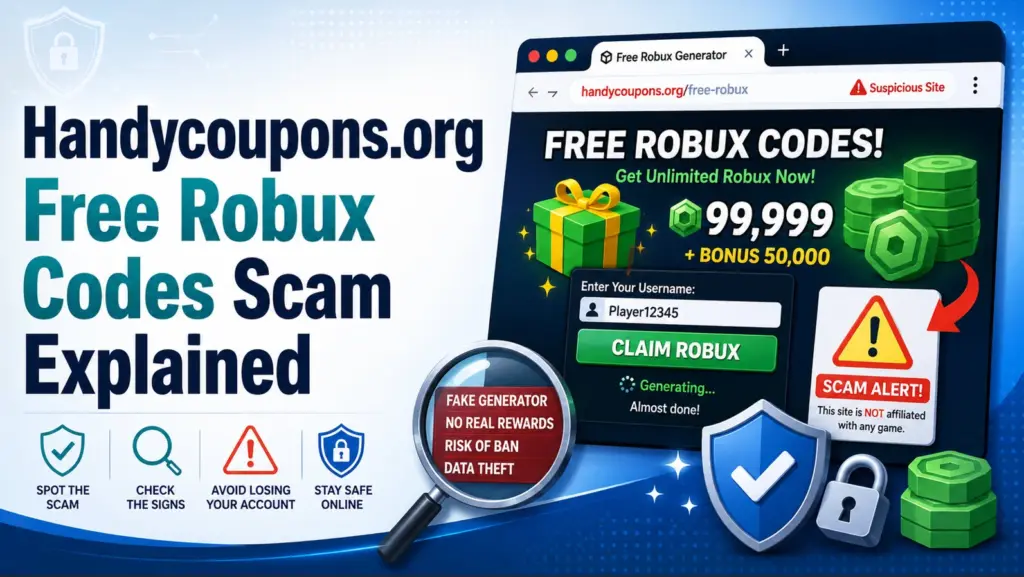
A lot of Roblox players, especially younger ones, meet the idea of a “free Robux generator” or “free Robux codes” before anyone gives them the boring truth: real ones are not a thing. If a page is not linked from Roblox itself, or backed by Roblox in a way you can verify there, I would not give its promise of free Robux codes much room to work.
That is the way I would read Handycoupons.org, no matter how generous its bonuses look. Sites like BloxForge or Isp64 belong in the same bucket, because the offer is there to pull you in rather than hand you something Roblox somehow forgot to charge for.
Scams of Handycoupons.org‘s type are known to steal personal data and passwords. Install SpyHunter Pro to scan for risks, remove any dangerous trackers, and enable real-time protection.

Try Free For 7 Days*
Buy now15% OFF if you buy straight without trial.
 OFFER
OFFERThe quick tell is almost embarrassingly simple. Put random nonsense into the username box and watch what happens. A fake generator will often “find” the account anyway, then show the Robux it says you can claim, because the username was never the point. The page only needs you to believe the number on the screen long enough to keep following its prompts.
From there, the work usually turns into ad junk and survey loops, with downloads pushed in when the page wants another way onto the PC. The site gets paid for the clicks and views while you spend your time doing tasks that were never going to produce real Robux.
The nuisance is not the only reason to care. If you have already interacted with Handycoupons.org or a similar scam, treat it as more than wasted time, because pages like this can expose you to uglier software and privacy trouble. The safer move is to stop engaging with it now and use the precaution steps below to clean up anything it may have pushed onto your device.
READ THIS BEFORE YOU CONTINUE!
If you already interacted with Handycoupons.org, do not shrug it off as a simple disappointment. Take it seriously enough to check your accounts, browser, downloads, and device settings now, because fake reward pages often lead into broader privacy and security problems.
- Change your passwords on Roblox/email/any reused accounts and enable 2-step verification. Log out of all other sessions.
- Contact your bank immediately and freeze/replace your card, dispute any unexpected charges, and block the merchant. Then cancel any “trial” subscriptions and enable real-time alerts.
- Run a full system scan with a reliable security tool and remove anything flagged. We recommend SpyHunter 5 for this action.
- Revoke suspicious OAuth permissions (Discord, Google, etc.), remove unfamiliar extensions, and clear sketchy site notifications.
- Screenshot any odd activity, contact Roblox Support, and report the scam where you found it.
How We Know Handycoupons.org is a Scam
Scam pages of this type tend to reuse the same blueprint over and over, and Handycoupons.org fits that blueprint closely enough to say Handycoupons.org is CERTAINLY a scam. The clues below point to a reward funnel designed to manipulate visitors, collect value from their actions, and leave them empty-handed:
The prize claim is unrealistically huge
A giant reward offer is doing psychological work. It gives the target something exciting to picture, which makes the page harder to leave. The larger the payout claim, the easier it is for the site to rush people past obvious doubts such as who is offering it, why they would offer it, and how the process could possibly be legitimate.
The page performs a fake status show
The fake progress sequence is there to lower resistance. Account checks, transfer animations, and “balance pending” messages make the process feel technical and real even though the site is only playing back a script. That illusion of movement keeps people from backing out.
It sends you through ad-heavy detours
Redirect chains reveal the scam’s true priorities. Instead of delivering a reward, the page routes visitors into surveys, promotional installs, notification prompts, or offers that generate payment for third parties. Each detour raises the risk while moving the visitor farther from anything legitimate.
No accountable operator is visible
Another major problem is the lack of clear accountability. Pages like these often provide weak contact details, generic promises, and legal text that looks copied from somewhere else. If there is no trustworthy identity behind the site, there is no reason to believe the reward story in front of you.
The hype surrounding it is manufactured
Fake popularity is one of the oldest tricks in this space. Operators seed comments, recycle screenshots, and flood social spaces with “worked for me” claims because people are more likely to trust something that seems widely used. That apparent buzz is part of the packaging, not proof that anyone was paid.
Disposable domains are part of the pattern
Many campaigns rely on disposable web addresses because switching names is easier than building credibility. A quick check through who.is can sometimes show a very thin history behind a page that is making unusually bold claims.

How the Handycoupons.org Scam Deception Funnel Works
Seeing the whole funnel laid out in plain language makes the trick less impressive. Most of these pages are built as assembly lines: attract a click, fake legitimacy, extract profitable actions, and avoid ever reaching a real payout:
Traffic bait reaches players first
The first stage usually starts somewhere noisy and low-trust, like a spam comment, a copied chat message, or a social post promising easy Robux. The message is supposed to create curiosity fast and send the visitor to Handycoupons.org before anyone asks where the offer really came from.

The landing page stages credibility
On arrival, the page starts performing credibility. It may borrow visual elements associated with Roblox, ask for a username to create a sense of personalization, or show fake verification text to make the visitor think an actual system is processing the request.

A scripted payout scene builds trust
The site then stretches out the moment before the trap becomes obvious. A pretend queue, a fake “checking inventory” screen, or a progress animation creates the impression that the reward has already been approved and only needs a final nudge to complete.

Off-site tasks become the money maker
That final nudge is the monetized part. Whether it is a survey, an app install, a trial signup, a push-notification request, or a “share with friends” demand, the action is useful to the operators and risky to the user. The reward itself remains imaginary throughout.

The reward is always postponed
Eventually the script circles back on itself. The task fails, another one is requested, or the visitor lands in the same offer wall again. No Robux appears because there is no payout mechanism waiting behind the page, only a loop meant to squeeze out more value.
Staying safe from Robux-site traps like Handycoupons.org
A few practical habits can block this entire style of scam before it gets traction. The goal is not to analyze every suspicious site in depth. The goal is to have simple rules that turn surprise reward claims into automatic skepticism:
Stick to platform-owned announcements
Check official channels first, not last. If Roblox has not announced the reward through places you can verify directly, an outside page should not be trusted with your time, your account details, or your device.
Refuse “human checks” off-site
The moment the page tries to send you off-site for verification, the answer should be no. Offer walls, app downloads, subscriptions, and ad views are not identity checks. They are the monetized core of the scam.
Reduce redirects with browser protection
Technical defenses help at the margins. Updated browsers, sensible filtering, and fewer intrusive ads can limit forced redirects and some malicious promotions, which reduces the chances that one bad click turns into a longer chain of problems.
Strengthen your key accounts
Account hardening matters because these scams do not always stop at one page visit. Use different passwords, protect email with extra care, and enable two-step verification so a stolen or reused credential has less room to cause damage elsewhere.
Use parent tools for younger players
Because the bait is colorful and easy to share, younger players need especially clear rules. Family discussions, privacy controls, account PINs, and adult approval for outside reward links can prevent excitement from turning into a security incident.
Build a pause before you tap
One of the most effective countermeasures is simply slowing down. Read the address. Notice the pressure tactics. Ask whether the reward sounds absurdly generous. Scams thrive on rushed reactions, so a pause interrupts the environment they are trying to create.
Review connected apps regularly
It also helps to prune old access points. Remove extensions you do not recognize, sign out of services you no longer use, and review connected apps periodically so a careless click has fewer ways to turn into ongoing exposure.
Never install files for prizes
Never accept software as part of a prize claim. A site that wants you to install an app, extension, or device profile for Robux is not sending a reward. It is trying to get deeper into your browser or your operating system.
Useful Resources for Scam Reporting and Prevention (By Country)
The reporting table below is included so pages like Handycoupons.org can be flagged through appropriate channels. Reporting will not undo every scam, but it can help create a record that supports takedowns, investigations, and faster recognition of repeat abuse.
Open the country-by-country reporting list
| Country / Agency | URL | Category / Use-case | Phone/Email |
| Australia – Crime Stoppers | https://www.crimestoppers.com.au | Anonymous tips about crime | 1800 333 000 |
| Australia – National Anti-Scam Center (Scamwatch) | https://www.scamwatch.gov.au/report-a-scam | General scams; phishing; texts/emails | |
| Australia – Police Assistance Line (non-emergency) | https://www.police.gov.au | Local police report | 131 444 |
| Australia – ReportCyber (ACSC) | https://www.cyber.gov.au/report | Cybercrime (hacks, fraud, extortion) | |
| Canada – Canadian Anti-Fraud Center (CAFC) | https://www.antifraudcentre-centreantifraude.ca/report-signalez-eng.htm | General scams incl. phone/text/email | |
| France – DGCCRF (SignalConso) | https://signal.conso.gouv.fr | Consumer scams/deceptive practices | |
| France – PHAROS – Internet-Signalement | https://www.internet-signalement.gouv.fr | Online content & cybercrime reports | |
| Germany – Bundeskriminalamt / Local Police | https://www.polizei.de/Polizei/DE/Home/home_node.html | Report online fraud | |
| Germany – Weißer Ring – Victim Support | https://weisser-ring.de | Victim support | 116 006 |
| India – DoT Helpline (Sanchar Saathi) | https://sancharsaathi.gov.in | Fraudulent telecom/SIM related | 155260 |
| India – National Consumer Helpline | https://consumerhelpline.gov.in | Consumer scams | 1800-11-4000 / 1915 |
| India – National Cyber Crime Reporting Portal | https://cybercrime.gov.in | Cybercrime incl. online fraud | 1930 |
| Japan – Consumer Affairs Agency (CAA) | https://www.caa.go.jp/policies/policy/consumer_policy/caution/cybercrime/ | Consumer scams | |
| Japan – National Police Agency – Cybercrime | https://www.npa.go.jp/bureau/cyber/ | Cybercrime reporting | |
| Mexico – Guardia Nacional (National Guard) | https://www.gob.mx/gn | Cybercrime reporting | |
| Mexico – Instituto Federal de Telecomunicaciones (IFT) | https://www.ift.org.mx | Telecom/online services scams | |
| Mexico – PROFECO | https://www.gob.mx/profeco | Consumer fraud & ecommerce | |
| Netherlands – AFM – Report investment fraud | https://www.afm.nl/en/consumenten/themas/beleggen/misleiding-misbruik | Investment/crypto | |
| Netherlands – Fraudehelpdesk | https://www.fraudehelpdesk.nl/melden | General scams (incl. phishing/SMS) | 088-7867372 |
| Netherlands – Politie – Meldpunt Internetoplichting | https://www.politie.nl/themas/internetoplichting.html | Online shopping fraud | |
| New Zealand – CERT NZ | https://www.cert.govt.nz/individuals/report-an-issue/ | Phishing, identity scams | |
| New Zealand – Department of Internal Affairs – Spam | https://www.dia.govt.nz/Spam-Contact-Us | Email/SMS spam | [email protected] |
| New Zealand – IDCARE | https://www.idcare.org | Victim support (identity compromise) | 0800 121 068 |
| New Zealand – Netsafe – Report | https://www.netsafe.org.nz/report/ | Online harms & scams | |
| New Zealand – New Zealand Police (non-emergency) | https://www.police.govt.nz/use-105 | Report fraud/online crime | 105 |
| Nigeria – Economic & Financial Crimes Commission (EFCC) | https://www.efcc.gov.ng | Financial scams incl. crypto/investment | [email protected] |
| Nigeria – Nigeria Police Special Fraud Unit (SFU) | https://www.specialfraudunit.org.ng | Serious fraud | Voice/SMS: 0708 227 6895; WhatsApp: 0812 760 9914 |
| Poland – CERT Polska (CERT.PL) | https://cert.pl/en/report/ | Cyber incidents & phishing | |
| Poland – Dyzurnet.pl | https://dyzurnet.pl | Illegal online content (esp. child protection) | |
| Poland – Polish Police (Policja) | https://www.policja.pl | Report scams to police | |
| Singapore – Anti-Scam Centre / Anti-Scam Helpline | https://www.scamalert.sg | General scams; texts; calls | 1800-722-6688 |
| Singapore – Monetary Authority of Singapore (MAS) | https://www.mas.gov.sg/investor-alert-list | Investment/crypto checks | |
| Singapore – Singapore Police Force | https://www.police.gov.sg/iwitness | Police report (cybercrime) | |
| South Africa – Cybersecurity Hub (CSIRT) | https://www.cybersecurityhub.gov.za | Cyber incidents incl. scams | |
| South Africa – South African Fraud Prevention Service (SAFPS) | https://www.safps.org.za | Identity fraud support | 011-867-2234 |
| South Africa – South African Police Service (SAPS) | https://www.saps.gov.za | Police report (cybercrime unit) | |
| South Korea – Korea Communications Commission (KCC) | https://www.kcc.go.kr | Telecom-related fraud | |
| South Korea – Korea Internet & Security Agency (KISA) | https://www.kisa.or.kr | Phishing, online harms | |
| South Korea – Korean National Police Agency – Cyber Bureau | https://ecrm.cyber.go.kr | Cybercrime reporting | |
| Spain – INCIBE – Oficina de Seguridad del Internauta (OSI) | https://www.osi.es/es/reporte | Cybersecurity & online fraud | |
| Spain – Policía Nacional / Guardia Civil | https://www.policia.es | Report scams to police | |
| Sweden – Crime Victim Authority (Brottsoffermyndigheten) | https://www.brottsoffermyndigheten.se | Victim support & compensation | 090–70 82 00 |
| Sweden – Polisen (Swedish Police) | https://polisen.se | Report fraud/cybercrime | 114 14 (non-emergency); 112 (emergency) |
| Sweden – Swedish Consumer Agency (Konsumentverket) | https://www.konsumentverket.se | Unfair business practices | |
| United Arab Emirates – Abu Dhabi Police – Aman Service | https://www.adpolice.gov.ae | Cybercrime tips/reporting | SMS 2828; 800 2626 |
| United Arab Emirates – Dubai Police – eCrime | https://www.dubaipolice.gov.ae | Cybercrime reporting | 04 606 1600 |
| United Arab Emirates – Ministry of Interior – Cyber Crime Dept. | https://www.moi.gov.ae | Cybercrime incl. online scams | |
| United Arab Emirates – Telecommunications Regulatory Authority (TRA) / TDRA | https://www.tra.gov.ae | Telecom-related scams/phishing | |
| United Kingdom – Action Fraud (NFIB) | https://www.actionfraud.police.uk | General scams & cybercrime (non-emergency) | 0300 123 2040 |
| United Kingdom – Citizens Advice Consumer Service | https://www.citizensadvice.org.uk/consumer/get-more-help/if-you-need-more-help-about-a-consumer-issue/ | Consumer problems & scam guidance | 0808 223 1133 |
| United Kingdom – Financial Conduct Authority (FCA) | https://www.fca.org.uk/consumers/report-scam-us | Investment/crypto & financial services | |
| United Kingdom – National Cyber Security Centre (NCSC) | https://www.ncsc.gov.uk/collection/phishing-scams | Phishing emails & suspicious websites | |
| United Kingdom – Stop Scams UK ‘159’ | https://stopscamsuk.org.uk/159 | Banking APP fraud (direct to your bank) | 159 |
| United States – AARP Fraud Watch Network Helpline | https://www.aarp.org/money/scams-fraud/ | Victim support | 833-372-8311 |
| United States – Better Business Bureau – Scam Tracker | https://www.bbb.org/scamtracker | Business/marketplace scams | |
| United States – FBI Internet Crime Complaint Center (IC3) | https://www.ic3.gov | Internet crime incl. investment/crypto | |
| United States – Federal Trade Commission – ReportFraud | https://reportfraud.ftc.gov | General scams, phishing, texts/emails | 1-877-382-4357 |
| United States – National Center for Disaster Fraud | https://www.justice.gov/disaster-fraud | Disaster-related scams | (866) 720-5721 |
| United States – SEC Tips & Complaints | https://www.sec.gov/tcr | Investment & securities/crypto-asset offerings |
