

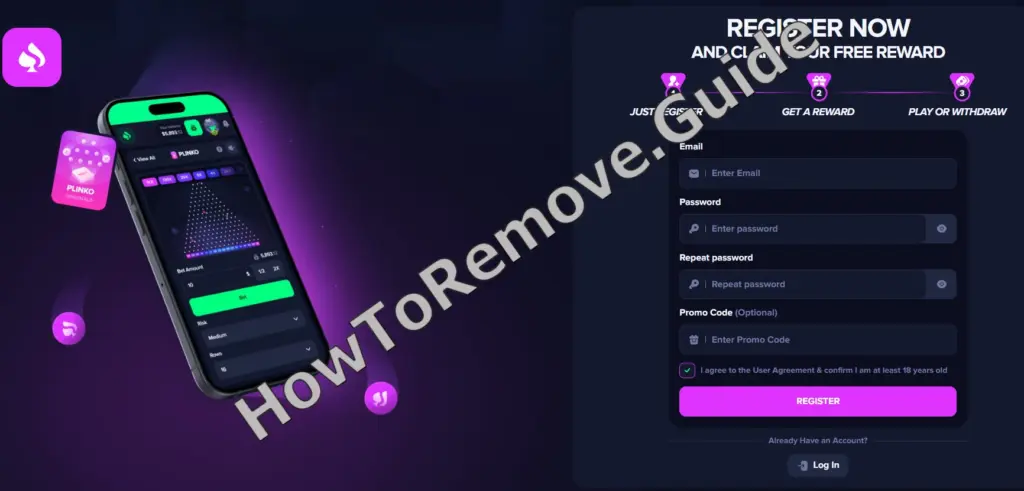
Holydex is a malicious site that pretends to be a legitimate crypto casino. It’s got shiny graphics, bold promises plastered all over its pages, and even provides a generous “starter bonus” that looks like a no-risk invitation to easy winnings.
If you register and start playing with your free bonus, the platform even feels generous and lets you win a couple of games and raise your balance. The small victories feel authentic enough to keep you engaged.
At a certain point, you’ll inevitably attempt to cash out, which is when the illusion breaks. Suddenly, Holydex insists you must first make a “transfer deposit” to unlock your funds, which is a classic maneuver used by countless clone-casino scams. The key here is to never pay such deposits because that’s how you get scammed and lose money!
No matter how much you send, the withdrawal never happens, and support becomes conveniently silent. The games themselves are rigged simulations, designed only to create the impression of real gambling while steering you toward that final deposit.
Treat any interaction with Holydex, Mozewex, or Raxebet as a security incident. Below you’ll find how these schemes operate, how to contain damage if you engaged with them, and how to avoid the next clone.
Scams of Holydex‘s type are known to steal personal data and passwords. Install SpyHunter Pro to scan for risks, remove any dangerous trackers, and enable real-time protection.

Try Free For 7 Days*
Buy now15% OFF if you buy straight without trial.
 OFFER
OFFERIMPORTANT! READ BEFORE PROCEEDING!
If you have already interacted with Holydex, cut contact immediately—no more chats, no fees, no screen sharing—and shift to containment. Prioritize account security, move remaining crypto to clean wallets, and preserve evidence for investigators. Here are five emergency steps we strongly recommend you take right now:
- Reset passwords and enable 2FA on email, exchanges, and wallets; terminate all active sessions before proceeding.
- Stop all payments immediately; ignore demands for “processing fees,” “taxes,” or “VIP upgrades” to unlock withdrawals.
- Migrate assets to fresh wallets with new seed phrases and move funds away from addresses you exposed.
- If you uploaded identity documents, place credit freezes/alerts where available and monitor for new-account openings.
- Assemble an evidence bundle—site URLs, wallet addresses, TXIDs, chats, screenshots—and file with your national cybercrime unit and any touched platforms.
How We Know Holydex is a Scam
Set aside the glitz and the same markers appear: pay-to-withdraw demands, counterfeit licensing claims, manipulated early wins, crypto-only rails, botted praise, and a fresh domain shell. Together they outline an advance-fee withdrawal scheme with identity harvesting layered on top.
Surprise withdrawal charges
“Processing,” “tax,” and “verification” payments are demanded before release. Reputable operators don’t charge up-front to pay your own balance.
Counterfeit licensing
Badges and license numbers on the page don’t match any public regulator register; it’s legitimacy theater, not oversight.
Inflated early “wins”
Balances rise conspicuously to build trust and nudge larger deposits, then stall the instant you try to withdraw.
Crypto-only rails
Lack of fiat payment options or chargebacks eliminates practical recourse; that isolation is part of the design.
Synthetic social proof
Popups, recycled testimonials, and influencer codes simulate a crowd, yet none of it stands up to independent verification.
Fresh, privacy-masked domains
Newly minted, owner-redacted domains with look-alike clones signal a network; public lookups like who.is reveal the churn.

How the Holydex Scam Deception Funnel Works
Mapping the playbook matters because predictability is your defense. Recognize each stage and the scheme telegraphs its next move; every element is tuned to convert deposits into fees and harvest high-value identity data.
The sequence is engineered: discovery via affiliates and influencer codes; on-boarding with oversized bonuses and “provably fair” buzzwords; conditioning through conspicuous early wins and fake leaderboards; withdrawal blocked by KYC loops and “verification deposits”; escalation through new pretexts; and finally ghosting while a cloned domain spins up.
Promo hooks and influencer codes
Glossy ads and seeded comments tout oversized sign-up credits and time-limited “codes,” priming urgency at the very first touch.

Casino skin and bonus theater
A polished UI mimics reputable brands and splashes giant bonuses beside “provably fair” jargon to borrow credibility.

Inflated balances, then the gate
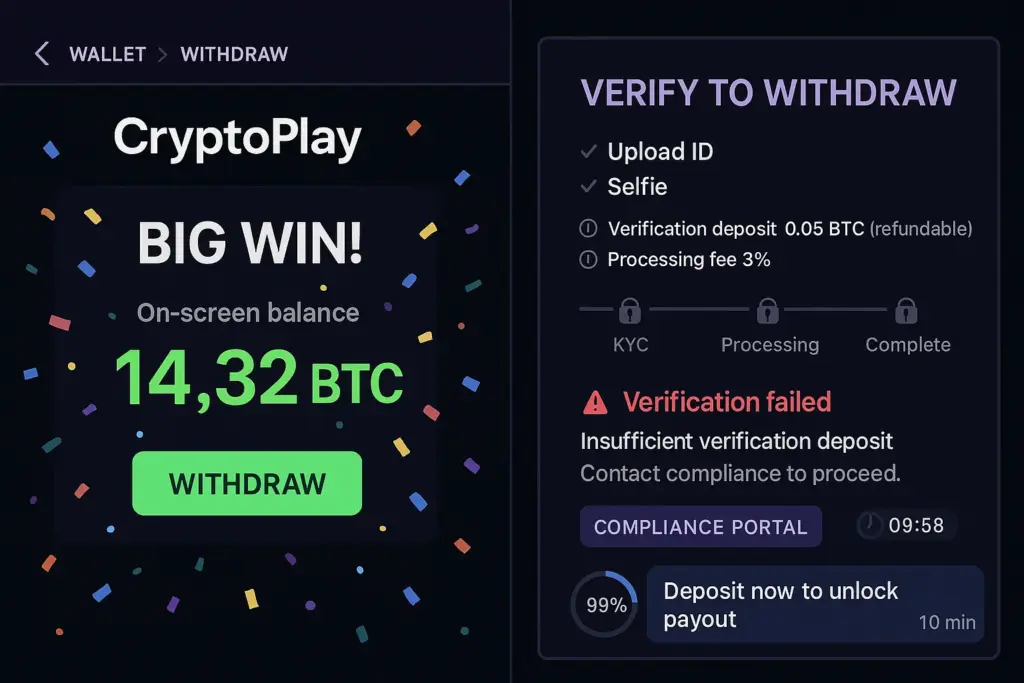
Early sessions show conspicuous “wins,” then the first withdrawal triggers KYC loops and a demand for a “verification deposit” or fee.
Fee-gates and KYC harvest
Each hurdle arrives with a pretext—VIP tiers, AML checks, “tax clearance”—extracting more crypto while harvesting identity documents.

Stalling, rebrands, and “recovery” bait
Support expresses empathy while inventing new hurdles; then the site ghosts and a sibling domain appears. Soon after, a “recovery agent” arrives to pitch the encore fraud.
Staying safe from crypto casino scams like Holydex
Future-proofing starts with boring checks before any deposit. The habits below harden your accounts and provide a repeatable way to separate genuine operators from paste-on fronts.
Verify license status in official registers
Check regulator registers by company name and domain; if there’s no record, treat the operator as unlicensed.
Check domain age and history
Use WHOIS and archives to spot newborn, privacy-masked domains and clusters of clones with recycled templates.
Reject withdrawal fees and “unlock” deposits
Legitimate operators never demand up-front “processing,” “tax,” or “collateral” payments to release your own funds.
Prefer venues with recourse
Favor operators with verifiable licenses, fiat rails, and transparent dispute processes; crypto-only fronts maximize irreversibility.
Limit wallet exposure
Use ring-fenced bankroll wallets, rotate seed phrases, enable app-based 2FA, and routinely revoke token approvals you no longer need.
Validate “provably fair” claims
If you can’t independently verify each bet with public seeds and hashes, treat the claim as marketing rather than math.
Document and report rapidly
Keep TXIDs, chats, and screenshots. File with your national cybercrime unit and any exchanges touched; speed expands options.
Build a deliberate slow-down reflex
Discipline beats dopamine: pause 24 hours before sending any extra deposit urged by a site; urgency theater loses power after a delay.
Useful Resources for Scam Reporting and Prevention (By Country)
Even if funds moved quickly, timely reporting still helps: law-enforcement mapping and exchange notices rely on evidence you provide. Use the directory to submit complaints and attach your documentation.
Click here to report the scam in your country
| Country / Agency | URL | Category / Use-case | Phone/Email |
| Australia – Crime Stoppers | https://www.crimestoppers.com.au | Anonymous tips about crime | 1800 333 000 |
| Australia – National Anti-Scam Center (Scamwatch) | https://www.scamwatch.gov.au/report-a-scam | General scams; phishing; texts/emails | |
| Australia – Police Assistance Line (non-emergency) | https://www.police.gov.au | Local police report | 131 444 |
| Australia – ReportCyber (ACSC) | https://www.cyber.gov.au/report | Cybercrime (hacks, fraud, extortion) | |
| Canada – Canadian Anti-Fraud Center (CAFC) | https://www.antifraudcentre-centreantifraude.ca/report-signalez-eng.htm | General scams incl. phone/text/email | |
| France – DGCCRF (SignalConso) | https://signal.conso.gouv.fr | Consumer scams/deceptive practices | |
| France – PHAROS – Internet-Signalement | https://www.internet-signalement.gouv.fr | Online content & cybercrime reports | |
| Germany – Bundeskriminalamt / Local Police | https://www.polizei.de/Polizei/DE/Home/home_node.html | Report online fraud | |
| Germany – Weißer Ring – Victim Support | https://weisser-ring.de | Victim support | 116 006 |
| India – DoT Helpline (Sanchar Saathi) | https://sancharsaathi.gov.in | Fraudulent telecom/SIM related | 155260 |
| India – National Consumer Helpline | https://consumerhelpline.gov.in | Consumer scams | 1800-11-4000 / 1915 |
| India – National Cyber Crime Reporting Portal | https://cybercrime.gov.in | Cybercrime incl. online fraud | 1930 |
| Japan – Consumer Affairs Agency (CAA) | https://www.caa.go.jp/policies/policy/consumer_policy/caution/cybercrime/ | Consumer scams | |
| Japan – National Police Agency – Cybercrime | https://www.npa.go.jp/bureau/cyber/ | Cybercrime reporting | |
| Mexico – Guardia Nacional (National Guard) | https://www.gob.mx/gn | Cybercrime reporting | |
| Mexico – Instituto Federal de Telecomunicaciones (IFT) | https://www.ift.org.mx | Telecom/online services scams | |
| Mexico – PROFECO | https://www.gob.mx/profeco | Consumer fraud & ecommerce | |
| Netherlands – AFM – Report investment fraud | https://www.afm.nl/en/consumenten/themas/beleggen/misleiding-misbruik | Investment/crypto | |
| Netherlands – Fraudehelpdesk | https://www.fraudehelpdesk.nl/melden | General scams (incl. phishing/SMS) | 088-7867372 |
| Netherlands – Politie – Meldpunt Internetoplichting | https://www.politie.nl/themas/internetoplichting.html | Online shopping fraud | |
| New Zealand – CERT NZ | https://www.cert.govt.nz/individuals/report-an-issue/ | Phishing, identity scams | |
| New Zealand – Department of Internal Affairs – Spam | https://www.dia.govt.nz/Spam-Contact-Us | Email/SMS spam | [email protected] |
| New Zealand – IDCARE | https://www.idcare.org | Victim support (identity compromise) | 0800 121 068 |
| New Zealand – Netsafe – Report | https://www.netsafe.org.nz/report/ | Online harms & scams | |
| New Zealand – New Zealand Police (non-emergency) | https://www.police.govt.nz/use-105 | Report fraud/online crime | 105 |
| Nigeria – Economic & Financial Crimes Commission (EFCC) | https://www.efcc.gov.ng | Financial scams incl. crypto/investment | [email protected] |
| Nigeria – Nigeria Police Special Fraud Unit (SFU) | https://www.specialfraudunit.org.ng | Serious fraud | Voice/SMS: 0708 227 6895; WhatsApp: 0812 760 9914 |
| Poland – CERT Polska (CERT.PL) | https://cert.pl/en/report/ | Cyber incidents & phishing | |
| Poland – Dyzurnet.pl | https://dyzurnet.pl | Illegal online content (esp. child protection) | |
| Poland – Polish Police (Policja) | https://www.policja.pl | Report scams to police | |
| Singapore – Anti-Scam Centre / Anti-Scam Helpline | https://www.scamalert.sg | General scams; texts; calls | 1800-722-6688 |
| Singapore – Monetary Authority of Singapore (MAS) | https://www.mas.gov.sg/investor-alert-list | Investment/crypto checks | |
| Singapore – Singapore Police Force | https://www.police.gov.sg/iwitness | Police report (cybercrime) | |
| South Africa – Cybersecurity Hub (CSIRT) | https://www.cybersecurityhub.gov.za | Cyber incidents incl. scams | |
| South Africa – South African Fraud Prevention Service (SAFPS) | https://www.safps.org.za | Identity fraud support | 011-867-2234 |
| South Africa – South African Police Service (SAPS) | https://www.saps.gov.za | Police report (cybercrime unit) | |
| South Korea – Korea Communications Commission (KCC) | https://www.kcc.go.kr | Telecom-related fraud | |
| South Korea – Korea Internet & Security Agency (KISA) | https://www.kisa.or.kr | Phishing, online harms | |
| South Korea – Korean National Police Agency – Cyber Bureau | https://ecrm.cyber.go.kr | Cybercrime reporting | |
| Spain – INCIBE – Oficina de Seguridad del Internauta (OSI) | https://www.osi.es/es/reporte | Cybersecurity & online fraud | |
| Spain – Policía Nacional / Guardia Civil | https://www.policia.es | Report scams to police | |
| Sweden – Crime Victim Authority (Brottsoffermyndigheten) | https://www.brottsoffermyndigheten.se | Victim support & compensation | 090–70 82 00 |
| Sweden – Polisen (Swedish Police) | https://polisen.se | Report fraud/cybercrime | 114 14 (non-emergency); 112 (emergency) |
| Sweden – Swedish Consumer Agency (Konsumentverket) | https://www.konsumentverket.se | Unfair business practices | |
| United Arab Emirates – Abu Dhabi Police – Aman Service | https://www.adpolice.gov.ae | Cybercrime tips/reporting | SMS 2828; 800 2626 |
| United Arab Emirates – Dubai Police – eCrime | https://www.dubaipolice.gov.ae | Cybercrime reporting | 04 606 1600 |
| United Arab Emirates – Ministry of Interior – Cyber Crime Dept. | https://www.moi.gov.ae | Cybercrime incl. online scams | |
| United Arab Emirates – Telecommunications Regulatory Authority (TRA) / TDRA | https://www.tra.gov.ae | Telecom-related scams/phishing | |
| United Kingdom – Action Fraud (NFIB) | https://www.actionfraud.police.uk | General scams & cybercrime (non-emergency) | 0300 123 2040 |
| United Kingdom – Citizens Advice Consumer Service | https://www.citizensadvice.org.uk/consumer/get-more-help/if-you-need-more-help-about-a-consumer-issue/ | Consumer problems & scam guidance | 0808 223 1133 |
| United Kingdom – Financial Conduct Authority (FCA) | https://www.fca.org.uk/consumers/report-scam-us | Investment/crypto & financial services | |
| United Kingdom – National Cyber Security Centre (NCSC) | https://www.ncsc.gov.uk/collection/phishing-scams | Phishing emails & suspicious websites | |
| United Kingdom – Stop Scams UK ‘159’ | https://stopscamsuk.org.uk/159 | Banking APP fraud (direct to your bank) | 159 |
| United States – AARP Fraud Watch Network Helpline | https://www.aarp.org/money/scams-fraud/ | Victim support | 833-372-8311 |
| United States – Better Business Bureau – Scam Tracker | https://www.bbb.org/scamtracker | Business/marketplace scams | |
| United States – FBI Internet Crime Complaint Center (IC3) | https://www.ic3.gov | Internet crime incl. investment/crypto | |
| United States – Federal Trade Commission – ReportFraud | https://reportfraud.ftc.gov | General scams, phishing, texts/emails | 1-877-382-4357 |
| United States – National Center for Disaster Fraud | https://www.justice.gov/disaster-fraud | Disaster-related scams | (866) 720-5721 |
| United States – SEC Tips & Complaints | https://www.sec.gov/tcr | Investment & securities/crypto-asset offerings |
That’s the whole pattern: learn the tells, contain exposure quickly, and run verifiable checks before any deposit or document upload.
