

Time out for a reality check. You see a pitch that says you can “Make Money Through Facebook, Instagram, SnapChat, Twitter” just by sharing a link, and a site called HunnyVine – оr sites that sound very similar and always have “Hunny” in their name, such as HunnyTank, HunnyBuzz, HunnyMe – promises to turn posts into payouts. Pause. When a message leans this hard on brand names and effortless income, slow down. The glossy page, the bouncing balance counter, the screenshots – those are stage lights. The story behind them is simpler: people post links because the site tells them to, numbers climb on the dashboard, and then withdrawals don’t happen.
Scams of HunnyVine‘s type are known to steal personal data and passwords. Install SpyHunter Pro to scan for risks, remove any dangerous trackers, and enable real-time protection.

Try Free For 7 Days*
Buy now15% OFF if you buy straight without trial.
 OFFER
OFFERWhat is the HunnyVine Scam?
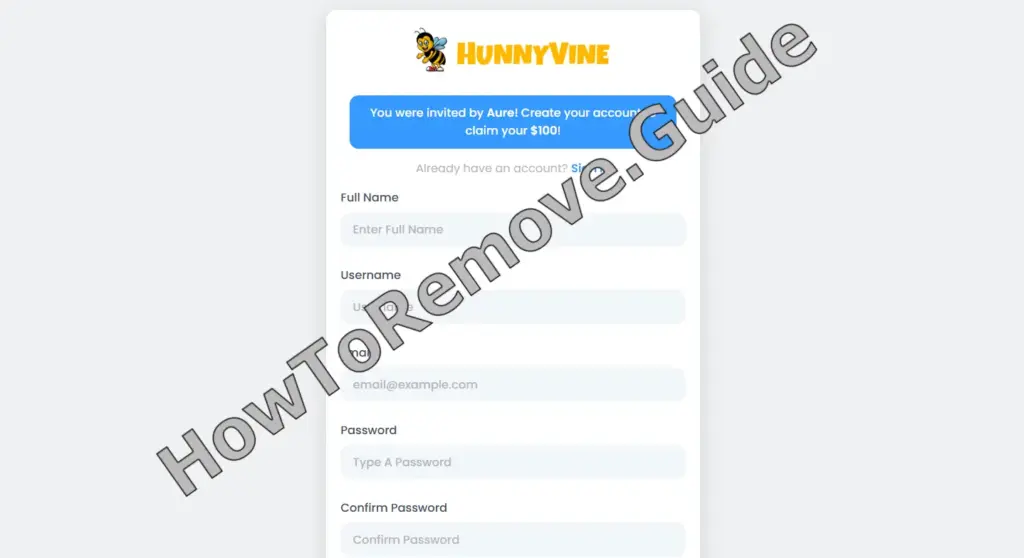
Let’s peel the wrapper, because the mechanics are the trick. You sign up. You’re handed a referral link. You’re told – explicitly – to push that link across Facebook, Instagram, SnapChat, and Twitter. The bait is memorable: “up to $50 per referral” or “claim your FREE $100 for just signing up.” That number is engineered to lodge in your head like a jingle. Meanwhile, the system keeps the number on the page. Balances climb on-screen and then stall at the only action that matters: getting paid. That endpoint isn’t a glitch; it’s the design. This thing needs your distribution, not your prosperity.
Is HunnyVine Legit?
Now a quick spotlight on what isn’t there, because absence is evidence. There’s no published address. No listed owners. No legal information. If something goes wrong – who do you contact? Where do you send a letter? Which jurisdiction are you even in? Silence. A site that hides its identity isn’t preparing to pay you; it’s preparing to fade when accountability shows up. And those “proof” elements – testimonials and screenshots – look official but function as decoration. They deliver a feeling, not verification.
Notice the preposition doing the heavy lifting: “through.” You’re told you can make money “through” well-known platforms, which smuggles in the idea that those platforms are the paymasters. They aren’t. The site is. Or, rather, the site says it is. Name-dropping blurs the line between familiarity and fantasy so your guard drops while your posting rate rises. You provide distribution; the site provides numbers on a screen. One side is real. One side is theater.
Let me name the pattern so it’s easier to spot when it shows up wearing a different shirt. The promise is easy passive income for minimal effort. The task is aggressive link-spamming across social media. The hook is “up to $50 per referral.” The “evidence” is fake testimonials and screenshots. The identity behind the page is missing – no address, no owners, no legal disclosures. The outcome reported by victims is consistent: cash-outs don’t happen. When these elements cluster, you’re not seeing opportunity; you’re seeing a machine that runs on your time and your audience.
And yes, there’s a sequel trick: rebranding. When a name gets scorched, the operation resurfaces under a fresh label with a similar design, the same promises, and the same dashboard theater. New name, same choreography. That’s not growth; that’s camouflage. If you notice the layout, the language, and the magic $50 carrot repeating, trust the echo more than the paint. Patterns don’t lie.
Let’s narrate how this plays out, because detail beats wishful thinking. A post lands in your feed or a DM pings your phone. The message is upbeat: share a link, help people sign up, watch your balance rise. The page looks busy enough to feel official, so you register. Your dashboard greets you with a near-zero balance and a shiny referral URL. You post the link – one platform, then another. Friends ask questions; some click. The counter ticks upward. Then you try to withdraw. Suddenly there are delays, conditions, and silence. The number on the screen keeps its distance.
Time out again. The missing company details are not a bug; they are the safety rail for the people on the other side. No address means no door to knock. No owners means no names to cite. No legal pages mean no promises you can hold them to. When the only tangible element is your own effort – your time, your reputation, your audience – what you’re providing is the fuel. What you’re getting is the show. And the show ends the moment you ask for the one thing that would make it real: a withdrawal.
Early warning signs the HunnyVine Scam is active
Let’s put the red flags in your pocket, because rehearsing them is how you inoculate yourself. First, the payout claim: “up to $50 per referral,” high enough to excite, vague enough to dodge. Second, the behavioral pressure: push the link everywhere, and do it now. Third, the identity void: no address, no owners, no legal information on the site. Fourth, the synthetic social proof: fake testimonials and screenshots. Fifth, the outcome people actually report: withdrawal attempts that never process. When these stack, you’re not being recruited for paid work; you’re being used as free advertising.
I want to address the voice that says maybe you can be the exception. Maybe you’re smarter, faster, luckier. Respectfully: the game is rigged at the rule level. You invest time and reputation; they invest anonymity and a domain name. You stake relationships by posting a link; they stake nothing they can’t replace with a new registration next week. If the site pays no one, it loses the price of a template. If you promote for weeks and then hit a dead withdrawal, you lose trust with the people who trusted you.
Now for the tell that never fails. In any real earning setup, the withdrawal function is the crown jewel – the proudest, loudest, most reliable feature – because paying you is the point. Here, it’s the quietest, fussiest, most failure-prone corner. That’s not a quirk. That’s the center of gravity. People push the button and get excuses. That is your cue to step away, not to push harder.
Let’s make this practical with a checklist you can run in seconds. Promise of easy passive income for minimal effort – check. Specific bait, “up to $50 per referral” – check. Strong nudge to spam links across big-name platforms – check. Fake testimonials and screenshots – check. No address, no owners, no legal information – check. Cash-outs that never process – check. A habit of resurfacing under new names – check. When the boxes light up, the decision isn’t complicated. Close the tab.
Final Recap
Final recap so it sticks. The site is HunnyVine. The hook is the line that you can “Make Money Through Facebook, Instagram, SnapChat, Twitter.” The number that gets waved is “up to $50 per referral.” The expected behavior is aggressive link-spamming on those platforms. The identity behind the page is missing – no address, no owners, no legal disclosures. The so-called proof consists of fake testimonials and screenshots. The reported outcome is straightforward: when people try to cash out, payouts never process. When the name becomes toxic, the same scheme resurfaces under a new one with a similar design.
Keep that fingerprint handy. If a page matches it, you’re not at the threshold of an income stream; you’re in a hall of mirrors built to keep you moving while nothing real changes. Step out. Save your time for work that pays in reality, not for a counter that only goes up until you press the one button that would make it mean something. To avoid being used as free advertising, remember the pattern and act on it: when the pitch leans on big platforms, when the number is eye-catching, when the identity is missing, and when the withdrawals never arrive, you already have your answer.
