

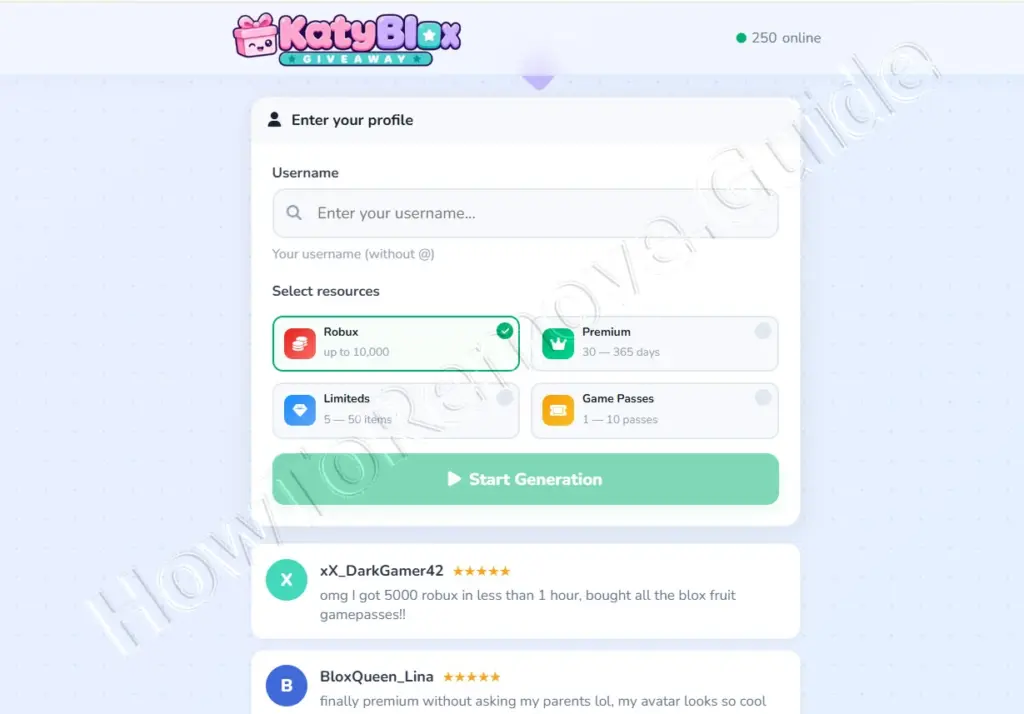
KatyBlox has the same first impression that makes free Robux scams work: it looks like a lucky opening you would feel silly to skip. That is the danger, not a reason to trust it. The page belongs among cloned giveaway sites, the ones that keep coming back under new names. It sells a big Robux payout through a claim process that feels harmless because each step looks small.
The catch is that the steps are the scam. The surveys and promotional pages are there to turn your attention into revenue for the people running the site. If the page starts pushing a download, I would treat that as the risk getting worse, not as the final step before a reward. The Robux never arrives because there was no real payout waiting behind the tasks.
Scams of KatyBlox.com‘s type are known to steal personal data and passwords. Install SpyHunter Pro to scan for risks, remove any dangerous trackers, and enable real-time protection.

Try Free For 7 Days*
Buy now15% OFF if you buy straight without trial.
 OFFER
OFFERMy read on KatyBlox is simple enough: it is another copy of an old fraud, similar to Apkguide or 5020.pro. Some versions also try to pull personal details or send people toward unsafe pages, so the problem is not only a wasted afternoon. Once you recognize the pattern, the offer stops looking lucky and starts looking like the bait it always was.
IMPORTANT! READ BEFORE PROCEEDING!
Anyone who interacted with KatyBlox should respond as though both account security and device safety may have been affected, especially if any prompts led to downloads, permission grants, browser alerts, or payment-related offers.
For that reason, we strongly recommend using SpyHunter 5 as the first practical step, so the device involved can be checked before you reuse it for sensitive logins or purchases.
Fastest Removal Option: Use SpyHunter 5
- 1.1Click here to download and install the anti-malware tool on your PC.
- 1.2
 Start SpyHunter 5, click the Buy button and choose between starting your 7-days free trial or directly purchasing the tool.
If you choose to buy SpyHunter 5 now, you can use our discount code, “HTRG15“, for 15% off.
- 1.3
 Once you activate SpyHunter, click Start Scan Now, select the Full Scan option, and let the tool do its job.
 - 1.4
 Once the scan completes (it could take a while, so have patience), you’ll see all malware and other undesirables listed.
Click Next to review the detections and then click Next again to delete all rogue items.
After the scan, finish the remaining protective steps as well, because account cleanup, permission review, and payment checks are just as important as removing suspicious files.
- Change your passwords on Roblox/email/any reused accounts and enable 2-step verification. Log out of all other sessions.
- Contact your bank immediately and freeze/replace your card, dispute any unexpected charges, and block the merchant. Then cancel any “trial” subscriptions and enable real-time alerts.
- Run a full system scan with a reliable security tool and remove anything flagged. We recommend SpyHunter 5 for this action.
- Revoke suspicious OAuth permissions (Discord, Google, etc.), remove unfamiliar extensions, and clear sketchy site notifications.
- Screenshot any odd activity, contact Roblox Support, and report the scam where you found it.
How We Know KatyBlox is a Scam
The case against KatyBlox is built from repeated scam traits that show up across this whole category. Once you know what those traits look like, the page stops appearing mysterious and starts looking like a familiar copy of an old fraud recipe.
Reward numbers built to overwhelm
Scam pages often start by choosing a number big enough to shut down skepticism. When an offer is so generous that it sounds detached from reality, that reaction is a signal worth trusting.
Progress screens with no real process
The page may pretend to verify a username, queue a transfer, or finalize a balance. In practice, those animations and status messages are often hard-coded theater with no link to any official system.
Traffic sent through risky side paths
A legitimate promotion does not need a trail of pop-ups, ad exchanges, survey brokers, installer pages, or notification prompts. When those appear, they usually reveal how the scam earns money.
Operator stays in the shadows
You will often find little to no reliable ownership information. Even the legal pages can feel generic or mismatched, which is a serious warning sign for any site asking users to trust it quickly.
Hype recycled across platforms
Look at the praise closely and it tends to feel mass-produced: similar wording, vague claims, no proof, and links passed around by strangers. That repetition supports the deception instead of disproving it.
Registration history that raises questions
A recent domain record does not prove fraud by itself, but it can become meaningful when layered on top of the other indicators. A quick look through who.is can help you judge whether the site has any real history behind it.

How the KatyBlox Scam Deception Funnel Works
These pages work best when their sequence stays invisible, so it helps to pull the stages apart. Once the flow is understood, the whole routine becomes much easier to recognize and reject earlier.
Lure and click-in:
The first stage is distribution. Operators place links where excitement spreads quickly: comments under gaming content, direct messages, reposted “tricks,” and search terms aimed at impatient players looking for shortcuts.

Fake legitimacy on arrival
The second stage is credibility theater. The victim arrives to a page that looks prepared, references Roblox-style language, and invites a username entry so the scam can imitate a genuine account-linked process.

Scripted progress, then “verification”
The third stage is momentum. The site acts as though it is processing something important, then pauses at a gate designed to make the user feel that quitting now would waste the progress already made.

Content-locker grind
The fourth stage is extraction. Surveys, trial offers, downloads, push notifications, and account signups appear because each completed action has value for the people operating the scam.

Endless loop, zero payout
The last stage is disappointment without resolution. No currency arrives, the promise keeps moving, and the victim is left sorting through wasted time, possible malware, spam, or unexpected charges.
Staying safe from Robux-site traps like KatyBlox
Staying safer in the future is less about memorizing every scam brand and more about learning the habits that expose the pattern behind them. Those habits are practical, repeatable, and worth building now.
Safety Tip 1
Start by distrusting any giveaway that begins away from official channels. Random posts, message links, and comment threads are easy to manipulate and should never carry the same weight as verified announcements.
Safety Tip 2
Treat “just one quick check” as the point where many scams reveal themselves. Legitimate rewards are not unlocked by unrelated offers, downloads, or permissions handed to third parties.
Safety Tip 3
Keep your software environment clean and current. Updated browsers, careful extension choices, and strong notification settings reduce the chance that a fake page can layer on extra prompts or malicious downloads.
Safety Tip 4
Invest in account resilience before you need it. Strong unique passwords, password-manager use, and multi-factor protection make a single bad decision much less likely to cascade into account theft.
Safety Tip 5
Where younger players are concerned, protection works best when it is shared. Adults should help review suspicious offers, lock down purchase settings, and normalize asking before clicking.
Safety Tip 6
Pause whenever the page insists that speed matters. The harder a site pushes urgency, the more important it is to slow down, inspect the domain, and ask what the operator gains from your next click.
Safety Tip 7
Review what outside apps can access your accounts. Old permissions, stale sign-ins, and unknown browser add-ons are worth pruning because they can remain useful to attackers after the original scam page disappears.
Safety Tip 8
A final rule is simple but important: do not install software from pages whose only promise is free currency. The danger there extends beyond disappointment and can include malware, tracking, and billing abuse.
Useful Resources for Scam Reporting and Prevention (By Country)
If you encounter KatyBlox again, report the link, the account sharing it, and the ad or platform carrying it. Reporting helps others, and it also creates a record that can support removal efforts.
Click here to report the scam in your country
| Country / Agency | URL | Category / Use-case | Phone/Email |
| Australia – Crime Stoppers | https://www.crimestoppers.com.au | Anonymous tips about crime | 1800 333 000 |
| Australia – National Anti-Scam Center (Scamwatch) | https://www.scamwatch.gov.au/report-a-scam | General scams; phishing; texts/emails | |
| Australia – Police Assistance Line (non-emergency) | https://www.police.gov.au | Local police report | 131 444 |
| Australia – ReportCyber (ACSC) | https://www.cyber.gov.au/report | Cybercrime (hacks, fraud, extortion) | |
| Canada – Canadian Anti-Fraud Center (CAFC) | https://www.antifraudcentre-centreantifraude.ca/report-signalez-eng.htm | General scams incl. phone/text/email | |
| France – DGCCRF (SignalConso) | https://signal.conso.gouv.fr | Consumer scams/deceptive practices | |
| France – PHAROS – Internet-Signalement | https://www.internet-signalement.gouv.fr | Online content & cybercrime reports | |
| Germany – Bundeskriminalamt / Local Police | https://www.polizei.de/Polizei/DE/Home/home_node.html | Report online fraud | |
| Germany – Weißer Ring – Victim Support | https://weisser-ring.de | Victim support | 116 006 |
| India – DoT Helpline (Sanchar Saathi) | https://sancharsaathi.gov.in | Fraudulent telecom/SIM related | 155260 |
| India – National Consumer Helpline | https://consumerhelpline.gov.in | Consumer scams | 1800-11-4000 / 1915 |
| India – National Cyber Crime Reporting Portal | https://cybercrime.gov.in | Cybercrime incl. online fraud | 1930 |
| Japan – Consumer Affairs Agency (CAA) | https://www.caa.go.jp/policies/policy/consumer_policy/caution/cybercrime/ | Consumer scams | |
| Japan – National Police Agency – Cybercrime | https://www.npa.go.jp/bureau/cyber/ | Cybercrime reporting | |
| Mexico – Guardia Nacional (National Guard) | https://www.gob.mx/gn | Cybercrime reporting | |
| Mexico – Instituto Federal de Telecomunicaciones (IFT) | https://www.ift.org.mx | Telecom/online services scams | |
| Mexico – PROFECO | https://www.gob.mx/profeco | Consumer fraud & ecommerce | |
| Netherlands – AFM – Report investment fraud | https://www.afm.nl/en/consumenten/themas/beleggen/misleiding-misbruik | Investment/crypto | |
| Netherlands – Fraudehelpdesk | https://www.fraudehelpdesk.nl/melden | General scams (incl. phishing/SMS) | 088-7867372 |
| Netherlands – Politie – Meldpunt Internetoplichting | https://www.politie.nl/themas/internetoplichting.html | Online shopping fraud | |
| New Zealand – CERT NZ | https://www.cert.govt.nz/individuals/report-an-issue/ | Phishing, identity scams | |
| New Zealand – Department of Internal Affairs – Spam | https://www.dia.govt.nz/Spam-Contact-Us | Email/SMS spam | [email protected] |
| New Zealand – IDCARE | https://www.idcare.org | Victim support (identity compromise) | 0800 121 068 |
| New Zealand – Netsafe – Report | https://www.netsafe.org.nz/report/ | Online harms & scams | |
| New Zealand – New Zealand Police (non-emergency) | https://www.police.govt.nz/use-105 | Report fraud/online crime | 105 |
| Nigeria – Economic & Financial Crimes Commission (EFCC) | https://www.efcc.gov.ng | Financial scams incl. crypto/investment | [email protected] |
| Nigeria – Nigeria Police Special Fraud Unit (SFU) | https://www.specialfraudunit.org.ng | Serious fraud | Voice/SMS: 0708 227 6895; WhatsApp: 0812 760 9914 |
| Poland – CERT Polska (CERT.PL) | https://cert.pl/en/report/ | Cyber incidents & phishing | |
| Poland – Dyzurnet.pl | https://dyzurnet.pl | Illegal online content (esp. child protection) | |
| Poland – Polish Police (Policja) | https://www.policja.pl | Report scams to police | |
| Singapore – Anti-Scam Centre / Anti-Scam Helpline | https://www.scamalert.sg | General scams; texts; calls | 1800-722-6688 |
| Singapore – Monetary Authority of Singapore (MAS) | https://www.mas.gov.sg/investor-alert-list | Investment/crypto checks | |
| Singapore – Singapore Police Force | https://www.police.gov.sg/iwitness | Police report (cybercrime) | |
| South Africa – Cybersecurity Hub (CSIRT) | https://www.cybersecurityhub.gov.za | Cyber incidents incl. scams | |
| South Africa – South African Fraud Prevention Service (SAFPS) | https://www.safps.org.za | Identity fraud support | 011-867-2234 |
| South Africa – South African Police Service (SAPS) | https://www.saps.gov.za | Police report (cybercrime unit) | |
| South Korea – Korea Communications Commission (KCC) | https://www.kcc.go.kr | Telecom-related fraud | |
| South Korea – Korea Internet & Security Agency (KISA) | https://www.kisa.or.kr | Phishing, online harms | |
| South Korea – Korean National Police Agency – Cyber Bureau | https://ecrm.cyber.go.kr | Cybercrime reporting | |
| Spain – INCIBE – Oficina de Seguridad del Internauta (OSI) | https://www.osi.es/es/reporte | Cybersecurity & online fraud | |
| Spain – Policía Nacional / Guardia Civil | https://www.policia.es | Report scams to police | |
| Sweden – Crime Victim Authority (Brottsoffermyndigheten) | https://www.brottsoffermyndigheten.se | Victim support & compensation | 090–70 82 00 |
| Sweden – Polisen (Swedish Police) | https://polisen.se | Report fraud/cybercrime | 114 14 (non-emergency); 112 (emergency) |
| Sweden – Swedish Consumer Agency (Konsumentverket) | https://www.konsumentverket.se | Unfair business practices | |
| United Arab Emirates – Abu Dhabi Police – Aman Service | https://www.adpolice.gov.ae | Cybercrime tips/reporting | SMS 2828; 800 2626 |
| United Arab Emirates – Dubai Police – eCrime | https://www.dubaipolice.gov.ae | Cybercrime reporting | 04 606 1600 |
| United Arab Emirates – Ministry of Interior – Cyber Crime Dept. | https://www.moi.gov.ae | Cybercrime incl. online scams | |
| United Arab Emirates – Telecommunications Regulatory Authority (TRA) / TDRA | https://www.tra.gov.ae | Telecom-related scams/phishing | |
| United Kingdom – Action Fraud (NFIB) | https://www.actionfraud.police.uk | General scams & cybercrime (non-emergency) | 0300 123 2040 |
| United Kingdom – Citizens Advice Consumer Service | https://www.citizensadvice.org.uk/consumer/get-more-help/if-you-need-more-help-about-a-consumer-issue/ | Consumer problems & scam guidance | 0808 223 1133 |
| United Kingdom – Financial Conduct Authority (FCA) | https://www.fca.org.uk/consumers/report-scam-us | Investment/crypto & financial services | |
| United Kingdom – National Cyber Security Centre (NCSC) | https://www.ncsc.gov.uk/collection/phishing-scams | Phishing emails & suspicious websites | |
| United Kingdom – Stop Scams UK ‘159’ | https://stopscamsuk.org.uk/159 | Banking APP fraud (direct to your bank) | 159 |
| United States – AARP Fraud Watch Network Helpline | https://www.aarp.org/money/scams-fraud/ | Victim support | 833-372-8311 |
| United States – Better Business Bureau – Scam Tracker | https://www.bbb.org/scamtracker | Business/marketplace scams | |
| United States – FBI Internet Crime Complaint Center (IC3) | https://www.ic3.gov | Internet crime incl. investment/crypto | |
| United States – Federal Trade Commission – ReportFraud | https://reportfraud.ftc.gov | General scams, phishing, texts/emails | 1-877-382-4357 |
| United States – National Center for Disaster Fraud | https://www.justice.gov/disaster-fraud | Disaster-related scams | (866) 720-5721 |
| United States – SEC Tips & Complaints | https://www.sec.gov/tcr | Investment & securities/crypto-asset offerings |
