

Kowau has the surface of a crypto casino, but that surface is doing most of the work. The flashy casino look and the winning messages are there to make the place feel alive long enough for you to trust the number in your account. The promotion usually comes through online bait, often with edited clips or fake celebrity angles that make the bonus seem like something already waiting for you.
Scams of Kowau.com‘s type are known to steal personal data and passwords. Install SpyHunter Pro to scan for risks, remove any dangerous trackers, and enable real-time protection.

Try Free For 7 Days*
Buy now15% OFF if you buy straight without trial.
 OFFER
OFFERI would not treat any of that balance as money. The site’s real move comes when you try to withdraw and a deposit suddenly stands in the way. They may call it verification or some other harmless-sounding step, but the only real payment in the whole setup is the one they are trying to get from you. The winnings are props.
Once crypto leaves your wallet, getting it back is rarely simple, and victims often see the trick only after the transfer is gone. Stay away from Kowau and othe similar scams like Hasowin or Kogwin, and use the signs below to recognize the same withdrawal-bait scam before it costs you.
IMPORTANT! READ BEFORE PROCEEDING!
If you sent funds, connected a wallet, shared ID, reused passwords, or downloaded anything connected to Kowau, focus on containment first, because the crypto loss may not be the only risk.
Begin with device hygiene and account lockdown; we strongly recommend using SpyHunter 5 for the scan process included below.
Fastest Removal Option: Use SpyHunter 5
- 1.1Click here to download and install the anti-malware tool on your PC.
- 1.2
 Start SpyHunter 5, click the Buy button and choose between starting your 7-days free trial or directly purchasing the tool.
If you choose to buy SpyHunter 5 now, you can use our discount code, “HTRG15“, for 15% off.
- 1.3
 Once you activate SpyHunter, click Start Scan Now, select the Full Scan option, and let the tool do its job.
 - 1.4
 Once the scan completes (it could take a while, so have patience), you’ll see all malware and other undesirables listed.
Click Next to review the detections and then click Next again to delete all rogue items.
When the scan is done, complete these protective steps before any further contact:
- Reset passwords and enable 2FA on your email, crypto exchanges, and wallets; terminate other active sessions.
- Notify any exchanges and services touched by the funds; provide TxIDs and ask that accounts/addresses be flagged per policy.
- Migrate assets to fresh wallets with new seed phrases and revoke any existing token approvals on connected chains.
- If you uploaded ID documents, place credit/fraud alerts where available and monitor for identity-theft signals.
- Assemble an evidence bundle – wallet addresses, TxIDs, site URLs, chats, and screenshots – and file reports with police/IC3 and any involved platforms.
How We Know Kowau is a Scam
The red flags concentrate around payment asymmetry. The user sends irreversible crypto into a platform that controls the balance display, controls support, controls withdrawal rules, and provides little independent evidence that payouts are real.
Advance-fee cashout demands
Any separate payment required before a payout turns the withdrawal into a trap. The site may call it a processing fee, tax, insurance deposit, or wallet validation, but the practical effect is another transfer away from you.
Licensing that cannot be traced
Official-sounding claims should be checked against regulator records. If the domain and operator are absent, inconsistent, or hidden, the compliance language should not be relied on.
Profit shown without proof
Fast winnings are persuasive because they change the victim’s risk calculation. A user may justify a fee when the screen suggests a much larger payout is waiting, even though the screen itself is not proof.
No meaningful chargeback path
Crypto deposits are designed to settle without a central reversal process. That makes them attractive to scams that want the money moved before the victim can challenge the transaction.
Hype that replaces evidence
Follower comments, winner alerts, and promotional codes can create the feeling that many people are cashing out. Without independent verification, those signals are marketing props.
Anonymous, new web footprint
A young domain with hidden ownership and copied site elements is not a strong foundation for trust. Checking who.is helps test whether the site has any real public history.


How the Kowau Scam Deception Funnel Works
The process is built to exploit irreversibility. Each stage nudges the user toward sending crypto before they can confirm that the prior promise was real, and each payment makes the victim more invested in believing the next one will work.
The path can begin with a bonus link, move through a convincing dashboard, and then produce a large apparent balance. Withdrawal triggers the trap: a fee, a deposit, a KYC step, a VIP upgrade, or a tax demand. The payout remains pending while the payments are real.
Promo hooks and influencer codes
A promotion may be framed as a limited code or special invite, often surrounded by comments claiming success. The point is to make the user act before checking whether the operator exists.
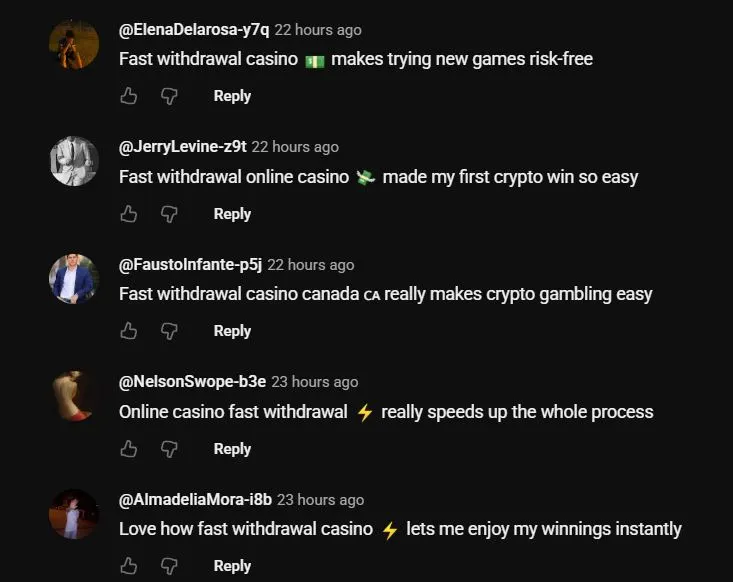
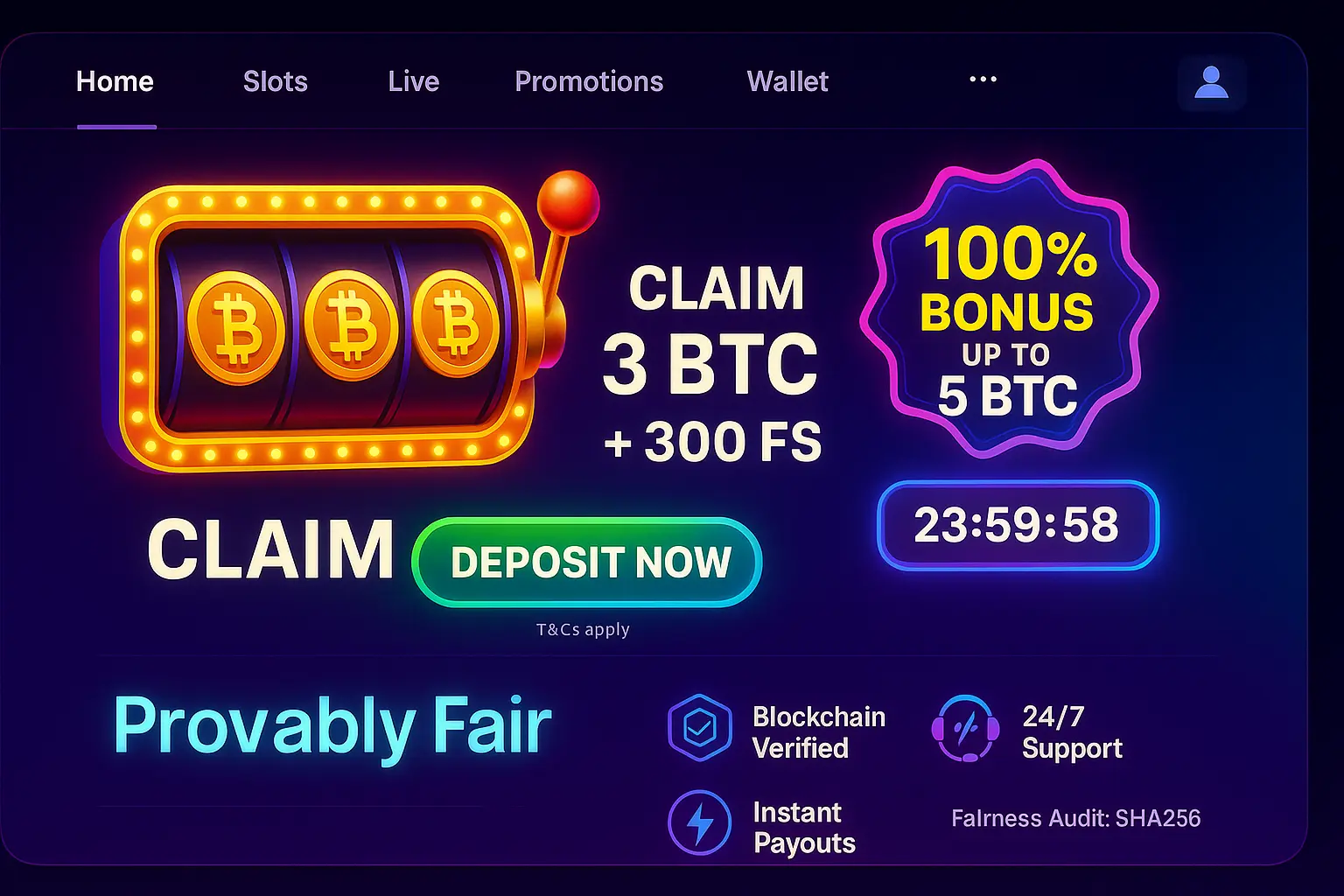
Casino skin and bonus theater
The website borrows the surface of a casino: games, balances, registration flows, bonus wallets, and support prompts. Those elements can be simulated without any fair play or redemption system.
Inflated balances, then the gate
The on-screen balance is the emotional anchor. Once it appears high enough, the user may see a requested fee as a bridge to winnings rather than a warning about the entire platform.
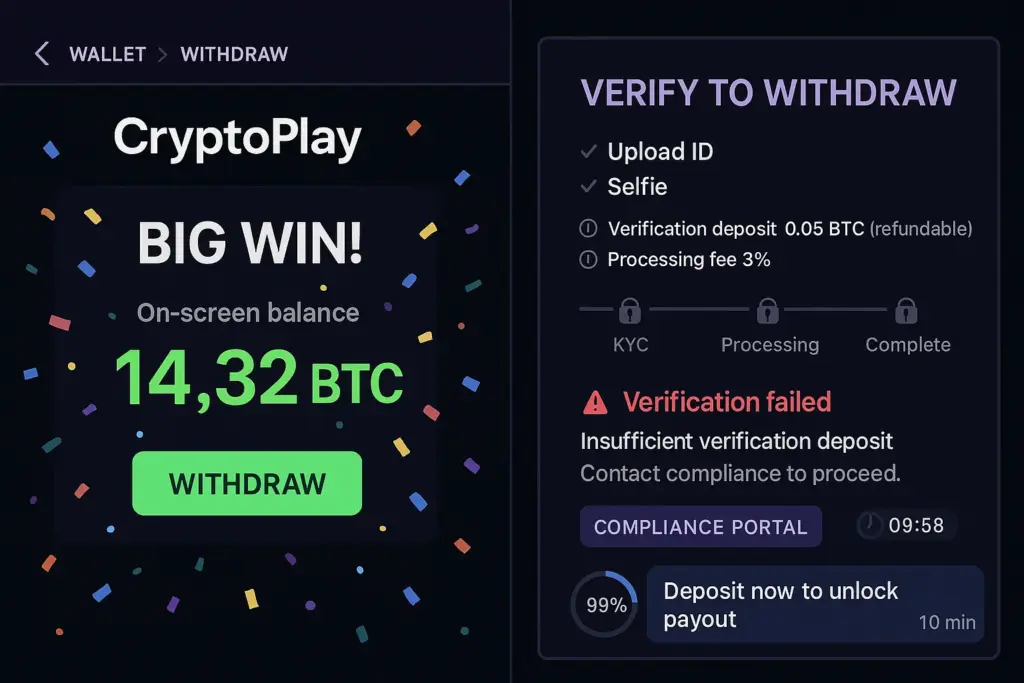
Fee-gates and KYC harvest
After the first barrier, additional barriers can follow. A tax deposit may lead to wallet validation, then to VIP clearance, then to another document request, each one extending the loss.

Stalling, rebrands, and “recovery” bait
Eventually the conversation may stall. Support can cite reviews and queues, the domain can become inactive, and a recovery actor may arrive claiming the funds can be retrieved for an upfront charge.
Staying safe from crypto casino scams like Kowau
Staying safe means treating irreversibility as a major risk factor. Before sending crypto, demand evidence that exists outside the website and keep your wallet exposure small. The following checks reduce the chance of being trapped by a fake payout.
Verify license status in official registers
Verify licensing from the primary source. Search official registers and confirm the company, domain, jurisdiction, and status rather than trusting badges or screenshots embedded in the casino page.
Check domain age and history
Investigate the domain before depositing. Registration age, hidden ownership, missing archives, and cloned layouts are all reasons to slow down or leave.
Reject withdrawal fees and “unlock” deposits
Never pay a new deposit to unlock an old balance. Real fees should be transparent and handled through the account balance, not demanded as a separate crypto transfer.
Prefer venues with recourse
Use services that give you some recourse. Named companies, fiat rails, complaint procedures, and transparent terms are safer than anonymous crypto-only pages with no accountable operator.
Limit wallet exposure
Separate risk wallets from savings wallets and keep balances minimal. Use unique credentials, enable 2FA, and revoke smart-contract permissions after interacting with unfamiliar sites.
Validate “provably fair” claims
Check whether fairness claims are verifiable. A serious system provides enough information to reproduce or audit outcomes; vague technical phrases are not protection.
Document and report rapidly
Document everything while it is still visible. Transaction hashes, wallet addresses, screenshots, chats, emails, and social posts may become important when the domain or accounts disappear.
Build a deliberate slow-down reflex
Force a delay whenever money must move quickly. Search independently, compare warnings, and ask why the platform needs a payment now if the displayed balance is already yours.
Useful Resources for Scam Reporting and Prevention (By Country)
Reporting gives exchanges, investigators, and hosting providers data they may use to connect cases. Include wallet addresses, TxIDs, URLs, screenshots, and communication logs so the report is more than a general complaint.
Click here to report the scam in your country
| Country / Agency | URL | Category / Use-case | Phone/Email |
| Australia – Crime Stoppers | https://www.crimestoppers.com.au | Anonymous tips about crime | 1800 333 000 |
| Australia – National Anti-Scam Center (Scamwatch) | https://www.scamwatch.gov.au/report-a-scam | General scams; phishing; texts/emails | |
| Australia – Police Assistance Line (non-emergency) | https://www.police.gov.au | Local police report | 131 444 |
| Australia – ReportCyber (ACSC) | https://www.cyber.gov.au/report | Cybercrime (hacks, fraud, extortion) | |
| Canada – Canadian Anti-Fraud Center (CAFC) | https://www.antifraudcentre-centreantifraude.ca/report-signalez-eng.htm | General scams incl. phone/text/email | |
| France – DGCCRF (SignalConso) | https://signal.conso.gouv.fr | Consumer scams/deceptive practices | |
| France – PHAROS – Internet-Signalement | https://www.internet-signalement.gouv.fr | Online content & cybercrime reports | |
| Germany – Bundeskriminalamt / Local Police | https://www.polizei.de/Polizei/DE/Home/home_node.html | Report online fraud | |
| Germany – Weißer Ring – Victim Support | https://weisser-ring.de | Victim support | 116 006 |
| India – DoT Helpline (Sanchar Saathi) | https://sancharsaathi.gov.in | Fraudulent telecom/SIM related | 155260 |
| India – National Consumer Helpline | https://consumerhelpline.gov.in | Consumer scams | 1800-11-4000 / 1915 |
| India – National Cyber Crime Reporting Portal | https://cybercrime.gov.in | Cybercrime incl. online fraud | 1930 |
| Japan – Consumer Affairs Agency (CAA) | https://www.caa.go.jp/policies/policy/consumer_policy/caution/cybercrime/ | Consumer scams | |
| Japan – National Police Agency – Cybercrime | https://www.npa.go.jp/bureau/cyber/ | Cybercrime reporting | |
| Mexico – Guardia Nacional (National Guard) | https://www.gob.mx/gn | Cybercrime reporting | |
| Mexico – Instituto Federal de Telecomunicaciones (IFT) | https://www.ift.org.mx | Telecom/online services scams | |
| Mexico – PROFECO | https://www.gob.mx/profeco | Consumer fraud & ecommerce | |
| Netherlands – AFM – Report investment fraud | https://www.afm.nl/en/consumenten/themas/beleggen/misleiding-misbruik | Investment/crypto | |
| Netherlands – Fraudehelpdesk | https://www.fraudehelpdesk.nl/melden | General scams (incl. phishing/SMS) | 088-7867372 |
| Netherlands – Politie – Meldpunt Internetoplichting | https://www.politie.nl/themas/internetoplichting.html | Online shopping fraud | |
| New Zealand – CERT NZ | https://www.cert.govt.nz/individuals/report-an-issue/ | Phishing, identity scams | |
| New Zealand – Department of Internal Affairs – Spam | https://www.dia.govt.nz/Spam-Contact-Us | Email/SMS spam | [email protected] |
| New Zealand – IDCARE | https://www.idcare.org | Victim support (identity compromise) | 0800 121 068 |
| New Zealand – Netsafe – Report | https://www.netsafe.org.nz/report/ | Online harms & scams | |
| New Zealand – New Zealand Police (non-emergency) | https://www.police.govt.nz/use-105 | Report fraud/online crime | 105 |
| Nigeria – Economic & Financial Crimes Commission (EFCC) | https://www.efcc.gov.ng | Financial scams incl. crypto/investment | [email protected] |
| Nigeria – Nigeria Police Special Fraud Unit (SFU) | https://www.specialfraudunit.org.ng | Serious fraud | Voice/SMS: 0708 227 6895; WhatsApp: 0812 760 9914 |
| Poland – CERT Polska (CERT.PL) | https://cert.pl/en/report/ | Cyber incidents & phishing | |
| Poland – Dyzurnet.pl | https://dyzurnet.pl | Illegal online content (esp. child protection) | |
| Poland – Polish Police (Policja) | https://www.policja.pl | Report scams to police | |
| Singapore – Anti-Scam Centre / Anti-Scam Helpline | https://www.scamalert.sg | General scams; texts; calls | 1800-722-6688 |
| Singapore – Monetary Authority of Singapore (MAS) | https://www.mas.gov.sg/investor-alert-list | Investment/crypto checks | |
| Singapore – Singapore Police Force | https://www.police.gov.sg/iwitness | Police report (cybercrime) | |
| South Africa – Cybersecurity Hub (CSIRT) | https://www.cybersecurityhub.gov.za | Cyber incidents incl. scams | |
| South Africa – South African Fraud Prevention Service (SAFPS) | https://www.safps.org.za | Identity fraud support | 011-867-2234 |
| South Africa – South African Police Service (SAPS) | https://www.saps.gov.za | Police report (cybercrime unit) | |
| South Korea – Korea Communications Commission (KCC) | https://www.kcc.go.kr | Telecom-related fraud | |
| South Korea – Korea Internet & Security Agency (KISA) | https://www.kisa.or.kr | Phishing, online harms | |
| South Korea – Korean National Police Agency – Cyber Bureau | https://ecrm.cyber.go.kr | Cybercrime reporting | |
| Spain – INCIBE – Oficina de Seguridad del Internauta (OSI) | https://www.osi.es/es/reporte | Cybersecurity & online fraud | |
| Spain – Policía Nacional / Guardia Civil | https://www.policia.es | Report scams to police | |
| Sweden – Crime Victim Authority (Brottsoffermyndigheten) | https://www.brottsoffermyndigheten.se | Victim support & compensation | 090–70 82 00 |
| Sweden – Polisen (Swedish Police) | https://polisen.se | Report fraud/cybercrime | 114 14 (non-emergency); 112 (emergency) |
| Sweden – Swedish Consumer Agency (Konsumentverket) | https://www.konsumentverket.se | Unfair business practices | |
| United Arab Emirates – Abu Dhabi Police – Aman Service | https://www.adpolice.gov.ae | Cybercrime tips/reporting | SMS 2828; 800 2626 |
| United Arab Emirates – Dubai Police – eCrime | https://www.dubaipolice.gov.ae | Cybercrime reporting | 04 606 1600 |
| United Arab Emirates – Ministry of Interior – Cyber Crime Dept. | https://www.moi.gov.ae | Cybercrime incl. online scams | |
| United Arab Emirates – Telecommunications Regulatory Authority (TRA) / TDRA | https://www.tra.gov.ae | Telecom-related scams/phishing | |
| United Kingdom – Action Fraud (NFIB) | https://www.actionfraud.police.uk | General scams & cybercrime (non-emergency) | 0300 123 2040 |
| United Kingdom – Citizens Advice Consumer Service | https://www.citizensadvice.org.uk/consumer/get-more-help/if-you-need-more-help-about-a-consumer-issue/ | Consumer problems & scam guidance | 0808 223 1133 |
| United Kingdom – Financial Conduct Authority (FCA) | https://www.fca.org.uk/consumers/report-scam-us | Investment/crypto & financial services | |
| United Kingdom – National Cyber Security Centre (NCSC) | https://www.ncsc.gov.uk/collection/phishing-scams | Phishing emails & suspicious websites | |
| United Kingdom – Stop Scams UK ‘159’ | https://stopscamsuk.org.uk/159 | Banking APP fraud (direct to your bank) | 159 |
| United States – AARP Fraud Watch Network Helpline | https://www.aarp.org/money/scams-fraud/ | Victim support | 833-372-8311 |
| United States – Better Business Bureau – Scam Tracker | https://www.bbb.org/scamtracker | Business/marketplace scams | |
| United States – FBI Internet Crime Complaint Center (IC3) | https://www.ic3.gov | Internet crime incl. investment/crypto | |
| United States – Federal Trade Commission – ReportFraud | https://reportfraud.ftc.gov | General scams, phishing, texts/emails | 1-877-382-4357 |
| United States – National Center for Disaster Fraud | https://www.justice.gov/disaster-fraud | Disaster-related scams | (866) 720-5721 |
| United States – SEC Tips & Complaints | https://www.sec.gov/tcr | Investment & securities/crypto-asset offerings |
The safest response is to stop the payment chain, secure remaining assets, and preserve records. Any future crypto casino should be checked for outside accountability before it receives funds, documents, or wallet access.
