

Just like the other countless clone-scam sites spreading across TikTok and Instagram, Kutowex relies on one simple trick: once you try to withdraw, you’re told you must pay a special activation or transfer deposit. The moment you send that money, it’s no longer recoverable. No winnings, no payout, no support team, and certainly no real company behind the fancy interface. These scammers count on users being dazzled by the promise of “free crypto” and not noticing the missing contact info or impossible policies. Understanding how these traps operate is essential if you want to stay safe online right now, because they are rampant – especially in the 2025 holiday season.
Treat any interaction with Kutowex, Limibet, or Vinewin.cc as a security incident. The notes below explain the red flags, the deception funnel, immediate containment steps, and the habits that prevent the next loss.
Scams of Kutowex.com‘s type are known to steal personal data and passwords. Install SpyHunter Pro to scan for risks, remove any dangerous trackers, and enable real-time protection.

Try Free For 7 Days*
Buy now15% OFF if you buy straight without trial.
 OFFER
OFFERIMPORTANT! READ BEFORE PROCEEDING!
If you have already interacted with Kutowex, cut contact now – no more deposits, no chats, no screen sharing – and switch to damage control. Move assets to clean wallets, harden accounts, and preserve proof for investigators. Here are five emergency steps we strongly recommend you take right now:
- Reset passwords and enable 2FA on email, exchanges, and your password manager; sign out other active sessions across devices.
- Notify any exchanges and services touched with your TXIDs and destination addresses so they can tag wallets and assist where policy allows.
- Migrate assets to fresh wallets created on uncompromised devices; revoke token approvals on EVM chains linked to the incident.
- If you uploaded ID documents, place credit/fraud alerts where available and watch for signs of identity misuse.
- Assemble an evidence bundle with screenshots, URLs, ads/videos, chats, wallet addresses, and TXIDs, then file with police/cybercrime units and report the posts that lured you.
How We Know Kutowex is a Scam
From the first click, the markers stack up: fake balances appear on signup, up-front crypto “unlock” payments block withdrawals, and unverifiable endorsements try to override skepticism. The hallmarks below consistently identify template fake exchanges.
Surprise withdrawal charges
“Activation,” “gas,” and “tax” fees are demanded before any release. Reputable platforms never require you to pre-pay crypto to withdraw alleged funds.
Counterfeit licensing
Logos and numbers on the page don’t match regulator registers; there’s no auditable company identity or jurisdictional disclosure you can validate.
Inflated early “wins”
Balances grow suspiciously fast to build confidence; the figures are UI decorations, not on-chain transfers or verifiable profits.
Crypto-only rails
No fiat on-ramps or chargebacks means minimal recourse for victims; the design maximizes irreversibility to trap deposits.
Synthetic social proof
Deepfake celebrity promos, botted comments, and fabricated media placements imitate legitimacy without evidence you can independently verify.
Fresh, privacy-masked domains
Recently registered, privacy-shielded domains match near-identical clones; rapid churn is typical for fake-exchange kits.
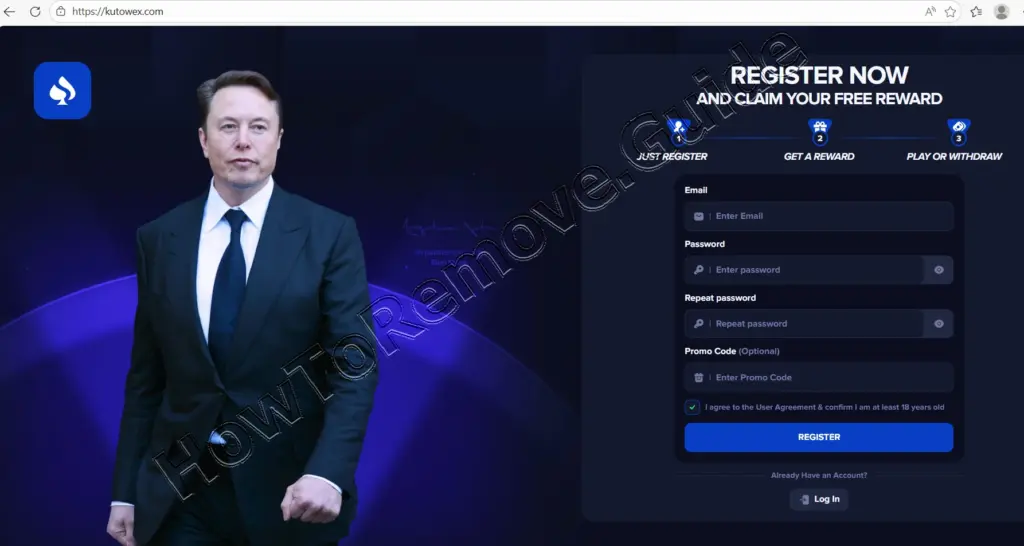

How the Kutowex Scam Deception Funnel Works
Understanding the sequence lets you break it: once you recognize the steps, you’ll anticipate the next ask and stop before money or documents leave your control.
The funnel is predictable: attention via deepfaked endorsements, signup plus a promo code, a fake balance on a dashboard, a small “unlock” deposit to withdraw, then serial excuses and a domain switch while “recovery” impostors circle.
Promo hooks and influencer codes
Short videos and DMs flaunt “limited” codes and fake testimonials, often with deepfaked celebrities, to kick off the funnel and press urgency.

Casino skin and bonus theater
A legitimate-looking interface mirrors real venues, pushes signup, and invites a promo code; submitting details triggers a dashboard credit that isn’t real.

Inflated balances, then the gate
A generous on-screen balance appears immediately; when you try to withdraw, a paywall appears in the form of “verification” or “processing” deposits.
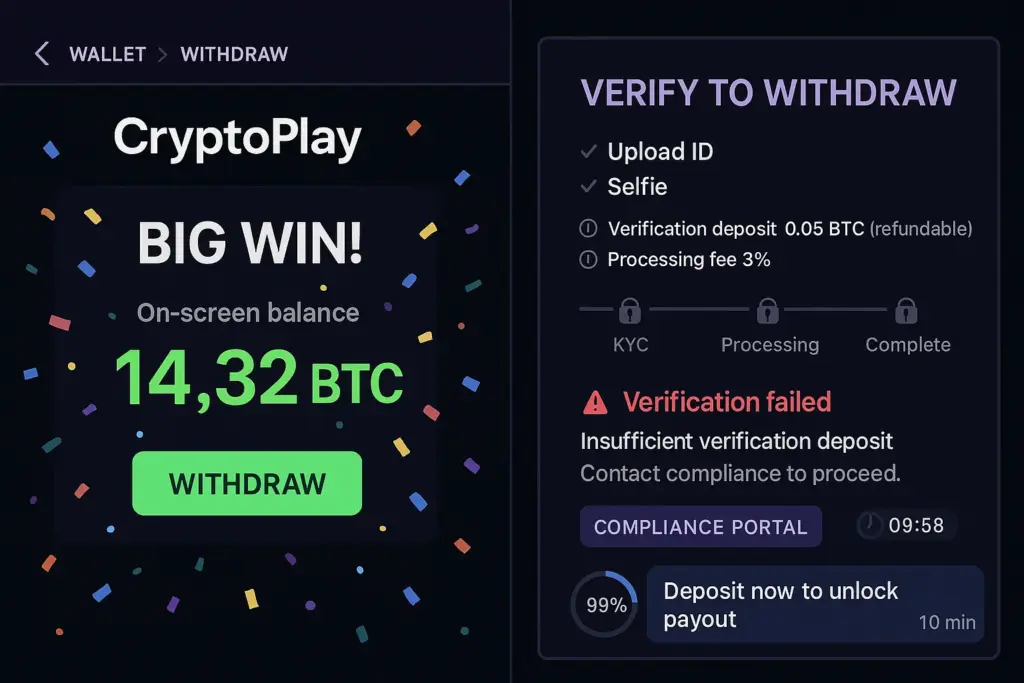
Fee-gates and KYC harvest
Each hurdle adds a pretext – AML, VIP tiers, taxes – extracting more crypto and harvesting identity documents without providing any real payout path.

Stalling, rebrands, and “recovery” bait
After fees escalate, chat widgets go quiet, the domain geoblocks or disappears, and a clone emerges; soon, “recovery agents” solicit payment for another fake rescue.
Staying safe from crypto casino scams like Kutowex
Future-proofing comes down to repeatable habits: practice verification before you deposit, compartmentalize risk, and treat unverified endorsements as counterfeit until proven otherwise.
Verify license status in official registers
Search regulator databases by company name and domain; absence or mismatches signal an unlicensed, high-risk operation.
Check domain age and history
Use WHOIS and web archives to spot newborn, privacy-masked domains and duplicated layouts across sister sites.
Reject withdrawal fees and “unlock” deposits
Treat any upfront “processing,” “tax,” or “KYC unlock” request as a disqualifier; legitimate venues don’t make you pay to access your own funds.
Prefer venues with recourse
Choose operators with verifiable licensing, documented dispute paths, and fiat rails; crypto-only fronts maximize irreversibility.
Limit wallet exposure
Use throwaway wallets for first contact, keep core holdings on hardware you don’t connect to unknown dapps, and routinely revoke stale approvals.
Validate “provably fair” claims
If you can’t independently verify outcomes with public seeds and hashes, treat the claim as marketing glitz rather than mathematics.
Document and report rapidly
Preserve TXIDs, chats, URLs, and screenshots. Submit to your national cybercrime portal and any affected exchanges; speed increases the odds of effective response.
Build a deliberate slow-down reflex
When urgency surges, pause: verify licensing, check domain history, use bookmarks to access services, and only then decide whether to proceed.
Useful Resources for Scam Reporting and Prevention (By Country)
Even if funds moved quickly, timely reporting can still help; exchanges and issuers sometimes act when authorities receive well-documented complaints. Use the directory below to submit reports and attach your evidence bundle.
Click here to report the scam in your country
| Country / Agency | URL | Category / Use-case | Phone/Email |
| Australia – Crime Stoppers | https://www.crimestoppers.com.au | Anonymous tips about crime | 1800 333 000 |
| Australia – National Anti-Scam Center (Scamwatch) | https://www.scamwatch.gov.au/report-a-scam | General scams; phishing; texts/emails | |
| Australia – Police Assistance Line (non-emergency) | https://www.police.gov.au | Local police report | 131 444 |
| Australia – ReportCyber (ACSC) | https://www.cyber.gov.au/report | Cybercrime (hacks, fraud, extortion) | |
| Canada – Canadian Anti-Fraud Center (CAFC) | https://www.antifraudcentre-centreantifraude.ca/report-signalez-eng.htm | General scams incl. phone/text/email | |
| France – DGCCRF (SignalConso) | https://signal.conso.gouv.fr | Consumer scams/deceptive practices | |
| France – PHAROS – Internet-Signalement | https://www.internet-signalement.gouv.fr | Online content & cybercrime reports | |
| Germany – Bundeskriminalamt / Local Police | https://www.polizei.de/Polizei/DE/Home/home_node.html | Report online fraud | |
| Germany – Weißer Ring – Victim Support | https://weisser-ring.de | Victim support | 116 006 |
| India – DoT Helpline (Sanchar Saathi) | https://sancharsaathi.gov.in | Fraudulent telecom/SIM related | 155260 |
| India – National Consumer Helpline | https://consumerhelpline.gov.in | Consumer scams | 1800-11-4000 / 1915 |
| India – National Cyber Crime Reporting Portal | https://cybercrime.gov.in | Cybercrime incl. online fraud | 1930 |
| Japan – Consumer Affairs Agency (CAA) | https://www.caa.go.jp/policies/policy/consumer_policy/caution/cybercrime/ | Consumer scams | |
| Japan – National Police Agency – Cybercrime | https://www.npa.go.jp/bureau/cyber/ | Cybercrime reporting | |
| Mexico – Guardia Nacional (National Guard) | https://www.gob.mx/gn | Cybercrime reporting | |
| Mexico – Instituto Federal de Telecomunicaciones (IFT) | https://www.ift.org.mx | Telecom/online services scams | |
| Mexico – PROFECO | https://www.gob.mx/profeco | Consumer fraud & ecommerce | |
| Netherlands – AFM – Report investment fraud | https://www.afm.nl/en/consumenten/themas/beleggen/misleiding-misbruik | Investment/crypto | |
| Netherlands – Fraudehelpdesk | https://www.fraudehelpdesk.nl/melden | General scams (incl. phishing/SMS) | 088-7867372 |
| Netherlands – Politie – Meldpunt Internetoplichting | https://www.politie.nl/themas/internetoplichting.html | Online shopping fraud | |
| New Zealand – CERT NZ | https://www.cert.govt.nz/individuals/report-an-issue/ | Phishing, identity scams | |
| New Zealand – Department of Internal Affairs – Spam | https://www.dia.govt.nz/Spam-Contact-Us | Email/SMS spam | [email protected] |
| New Zealand – IDCARE | https://www.idcare.org | Victim support (identity compromise) | 0800 121 068 |
| New Zealand – Netsafe – Report | https://www.netsafe.org.nz/report/ | Online harms & scams | |
| New Zealand – New Zealand Police (non-emergency) | https://www.police.govt.nz/use-105 | Report fraud/online crime | 105 |
| Nigeria – Economic & Financial Crimes Commission (EFCC) | https://www.efcc.gov.ng | Financial scams incl. crypto/investment | [email protected] |
| Nigeria – Nigeria Police Special Fraud Unit (SFU) | https://www.specialfraudunit.org.ng | Serious fraud | Voice/SMS: 0708 227 6895; WhatsApp: 0812 760 9914 |
| Poland – CERT Polska (CERT.PL) | https://cert.pl/en/report/ | Cyber incidents & phishing | |
| Poland – Dyzurnet.pl | https://dyzurnet.pl | Illegal online content (esp. child protection) | |
| Poland – Polish Police (Policja) | https://www.policja.pl | Report scams to police | |
| Singapore – Anti-Scam Centre / Anti-Scam Helpline | https://www.scamalert.sg | General scams; texts; calls | 1800-722-6688 |
| Singapore – Monetary Authority of Singapore (MAS) | https://www.mas.gov.sg/investor-alert-list | Investment/crypto checks | |
| Singapore – Singapore Police Force | https://www.police.gov.sg/iwitness | Police report (cybercrime) | |
| South Africa – Cybersecurity Hub (CSIRT) | https://www.cybersecurityhub.gov.za | Cyber incidents incl. scams | |
| South Africa – South African Fraud Prevention Service (SAFPS) | https://www.safps.org.za | Identity fraud support | 011-867-2234 |
| South Africa – South African Police Service (SAPS) | https://www.saps.gov.za | Police report (cybercrime unit) | |
| South Korea – Korea Communications Commission (KCC) | https://www.kcc.go.kr | Telecom-related fraud | |
| South Korea – Korea Internet & Security Agency (KISA) | https://www.kisa.or.kr | Phishing, online harms | |
| South Korea – Korean National Police Agency – Cyber Bureau | https://ecrm.cyber.go.kr | Cybercrime reporting | |
| Spain – INCIBE – Oficina de Seguridad del Internauta (OSI) | https://www.osi.es/es/reporte | Cybersecurity & online fraud | |
| Spain – Policía Nacional / Guardia Civil | https://www.policia.es | Report scams to police | |
| Sweden – Crime Victim Authority (Brottsoffermyndigheten) | https://www.brottsoffermyndigheten.se | Victim support & compensation | 090–70 82 00 |
| Sweden – Polisen (Swedish Police) | https://polisen.se | Report fraud/cybercrime | 114 14 (non-emergency); 112 (emergency) |
| Sweden – Swedish Consumer Agency (Konsumentverket) | https://www.konsumentverket.se | Unfair business practices | |
| United Arab Emirates – Abu Dhabi Police – Aman Service | https://www.adpolice.gov.ae | Cybercrime tips/reporting | SMS 2828; 800 2626 |
| United Arab Emirates – Dubai Police – eCrime | https://www.dubaipolice.gov.ae | Cybercrime reporting | 04 606 1600 |
| United Arab Emirates – Ministry of Interior – Cyber Crime Dept. | https://www.moi.gov.ae | Cybercrime incl. online scams | |
| United Arab Emirates – Telecommunications Regulatory Authority (TRA) / TDRA | https://www.tra.gov.ae | Telecom-related scams/phishing | |
| United Kingdom – Action Fraud (NFIB) | https://www.actionfraud.police.uk | General scams & cybercrime (non-emergency) | 0300 123 2040 |
| United Kingdom – Citizens Advice Consumer Service | https://www.citizensadvice.org.uk/consumer/get-more-help/if-you-need-more-help-about-a-consumer-issue/ | Consumer problems & scam guidance | 0808 223 1133 |
| United Kingdom – Financial Conduct Authority (FCA) | https://www.fca.org.uk/consumers/report-scam-us | Investment/crypto & financial services | |
| United Kingdom – National Cyber Security Centre (NCSC) | https://www.ncsc.gov.uk/collection/phishing-scams | Phishing emails & suspicious websites | |
| United Kingdom – Stop Scams UK ‘159’ | https://stopscamsuk.org.uk/159 | Banking APP fraud (direct to your bank) | 159 |
| United States – AARP Fraud Watch Network Helpline | https://www.aarp.org/money/scams-fraud/ | Victim support | 833-372-8311 |
| United States – Better Business Bureau – Scam Tracker | https://www.bbb.org/scamtracker | Business/marketplace scams | |
| United States – FBI Internet Crime Complaint Center (IC3) | https://www.ic3.gov | Internet crime incl. investment/crypto | |
| United States – Federal Trade Commission – ReportFraud | https://reportfraud.ftc.gov | General scams, phishing, texts/emails | 1-877-382-4357 |
| United States – National Center for Disaster Fraud | https://www.justice.gov/disaster-fraud | Disaster-related scams | (866) 720-5721 |
| United States – SEC Tips & Complaints | https://www.sec.gov/tcr | Investment & securities/crypto-asset offerings |
That’s the pattern in full: know the tells, act fast to contain exposure, and run verifiable checks before sending funds or documents to any platform.
Prevention always costs less than recovery; assume it’s fake until it proves itself real.
