

M777.bid works on people because it waits before asking for money. At first the place just feels safe enough to mess with before you look at it too hard. That softer entry point is the trick.
By the time the site finally asks for a deposit, a lot of the work has already been done. You may think you have already won something real and only need to clear one last fee before the withdrawal goes through. In fact, the balance itself is part of the setup, and there is nothing real waiting for you.
Scams of M777.bid‘s type are known to steal personal data and passwords. Install SpyHunter Pro to scan for risks, remove any dangerous trackers, and enable real-time protection.

Try Free For 7 Days*
Buy now15% OFF if you buy straight without trial.
 OFFER
OFFERThe payment may be dressed up as the last step before access is unlocked or the withdrawal is released. Either way, this is where the site stops acting generous and starts taking your money. If you send it, it goes straight to the people running the scam.
M777.bid and other crypto casino scams like Tustwin.com and Kastwin can vanish fast and show up again under a different name. The useful thing to recognize is the setup, because the same move can turn up again somewhere else.
IMPORTANT! READ BEFORE PROCEEDING!
Anyone who interacted with M777.bid should assume the exposure may include money, accounts, devices, and identity data, especially if the site requested uploaded documents or directed you to install a verification-related tool.
For device cleanup, we strongly recommend using SpyHunter 5 before you handle wallets, change credentials, or open exchange accounts on that device.
Fastest Removal Option: Use SpyHunter 5
- 1.1Click here to download and install the anti-malware tool on your PC.
- 1.2
 Start SpyHunter 5, click the Buy button and choose between starting your 7-days free trial or directly purchasing the tool.
If you choose to buy SpyHunter 5 now, you can use our discount code, “HTRG15“, for 15% off.
- 1.3
 Once you activate SpyHunter, click Start Scan Now, select the Full Scan option, and let the tool do its job.
 - 1.4
 Once the scan completes (it could take a while, so have patience), you’ll see all malware and other undesirables listed.
Click Next to review the detections and then click Next again to delete all rogue items.
After the scan, prioritize these containment steps so the damage does not spread beyond the original deposit or account interaction:
- Reset passwords and enable 2FA on your email, crypto exchanges, and wallets; terminate other active sessions.
- Notify any exchanges and services touched by the funds; provide TxIDs and ask that accounts/addresses be flagged per policy.
- Migrate assets to fresh wallets with new seed phrases and revoke any existing token approvals on connected chains.
- If you uploaded ID documents, place credit/fraud alerts where available and monitor for identity-theft signals.
- Assemble an evidence bundle – wallet addresses, TxIDs, site URLs, chats, and screenshots – and file reports with police/IC3 and any involved platforms.
How We Know M777.bid is a Scam
M777.bid shows the same practical problems seen in many fraudulent crypto-casino pages. The page may look polished, but the trust test is not design; it is whether the operator can be verified, withdrawals are honored, and the user is never asked to pay extra to receive funds.
Post-win payment demands
The moment a site says a payout depends on a separate payment from you, the relationship changes. The supposed winnings become bait for a new transfer rather than evidence of a real balance.
Licensing that exists only on the page
Scam sites often display official-looking badges because they know most visitors will not check them. A valid license should be traceable through the regulator and tied to the exact operator and domain.
Wins that serve the script
The early winning streak is not generosity. It is a confidence-building stage that makes the user more willing to deposit, verify, or pay a fee to unlock the account.
No easy refund route
Using cryptocurrency as the main payment channel makes the scheme harder to unwind. Once the victim sends funds, there is usually no card issuer or bank dispute process to rely on.
Trust signals built from noise
A page can simulate popularity with chat snippets, bot-like reviews, and fake winner alerts. None of those signals proves that ordinary users are receiving withdrawals.
Thin domain history
Check registration details before sending funds. A lookup through who.is can reveal whether the domain was created recently, hides ownership, or lacks the history expected from a real casino brand.


How the M777.bid Scam Deception Funnel Works
The deception funnel works because it turns suspicion into a series of small decisions. The user first risks time, then personal details, then a deposit, and finally additional payments tied to a fake payout.
A typical path begins with a promo, moves into a realistic-looking casino interface, shows a tempting balance, and then blocks withdrawal with administrative excuses. When no more payments are made, support can vanish or a new “help” contact may appear.
Promo hooks and influencer codes
The outreach often feels casual: a comment under a video, a message from an account pretending to help, or a code that appears to come from a trusted creator. Casual delivery makes the offer seem less like a financial risk.

Casino skin and bonus theater
The landing page then imitates legitimacy through layout. Game icons, balance panels, support chat, bonus language, and fairness claims make the user feel they are inside a normal platform.

Inflated balances, then the gate
Once the user engages, the displayed balance becomes the anchor. It can rise quickly, which encourages the belief that the platform has already produced value worth protecting.
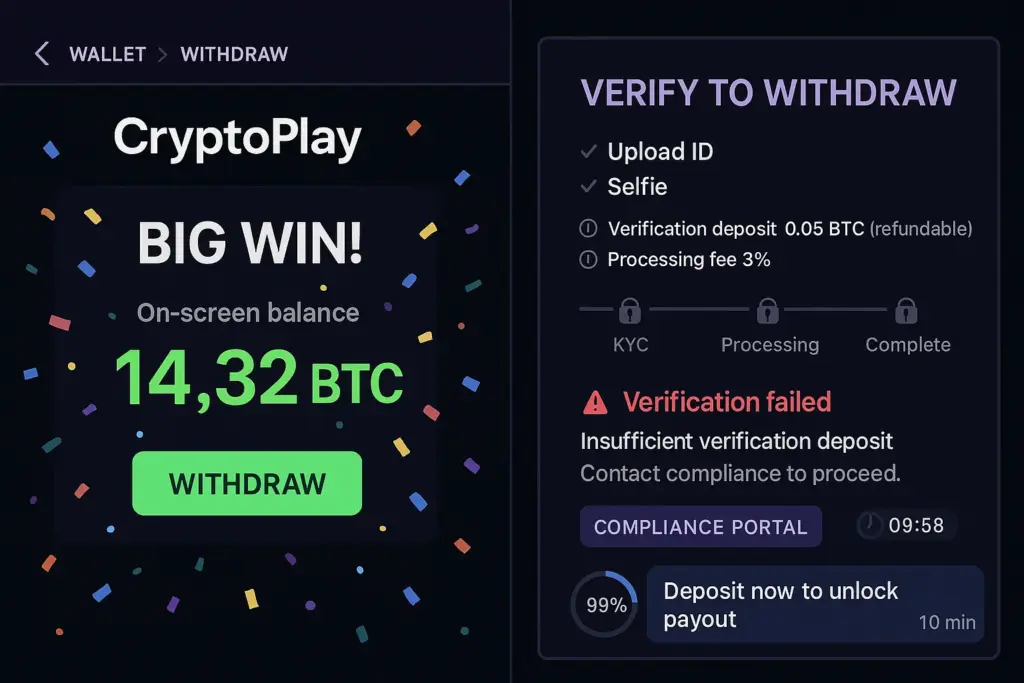
Fee-gates and KYC harvest
When withdrawal is requested, the site changes from entertainer to gatekeeper. It may ask for documents, taxes, compliance deposits, VIP upgrades, or wallet-confirmation payments, but each path requires giving more.

Stalling, rebrands, and “recovery” bait
If the victim resists, support may keep the conversation alive just long enough to extract another attempt. Later, access can fail, replies can stop, and similar pages may continue operating under different names.
Staying safe from crypto casino scams like M777.bid
Avoiding this kind of scam depends on proof before participation. Do not let a bonus, a comment, or a fake balance substitute for operator checks, licensing confirmation, and withdrawal transparency.
Verify license status in official registers
Verify the license directly with the relevant authority. The casino’s own screenshots, seals, and footer claims should be treated as advertising until an independent register confirms them.
Check domain age and history
Review the domain before trusting the brand. Fresh registration, hidden ownership, recycled design, and no credible external reputation are enough to walk away.
Reject withdrawal fees and “unlock” deposits
Reject payment-to-withdraw stories immediately. A platform that demands a new crypto transfer before releasing a balance is using the balance as pressure, not processing a legitimate payout.
Prefer venues with recourse
Use platforms that provide a real company trail, accessible complaint channels, clear withdrawal rules, and payment methods with accountability. Anonymous wallet-first casinos leave users exposed.
Limit wallet exposure
Protect wallets as if every unknown site is hostile. Keep large holdings separate, avoid signing unnecessary approvals, rotate compromised credentials, and secure the email account that controls exchange access.
Validate “provably fair” claims
Ask whether the fairness claim can be checked independently. If there are no visible seeds, hashes, or auditable result records, the phrase does not add trust.
Document and report rapidly
Keep a complete record of what happened: URLs, screenshots, chats, wallet addresses, transaction hashes, emails, and document-upload requests. Do this before the site changes or disappears.
Build a deliberate slow-down reflex
Slow the process down on purpose. Search outside the site, compare complaints, inspect terms, and ask why a supposedly legitimate platform needs urgency to get your money.
Useful Resources for Scam Reporting and Prevention (By Country)
Reports create a paper trail even when lost crypto cannot be reversed. They may help platforms flag wallets, connect related complaints, and reduce the chance that the same infrastructure keeps working unchecked.
Click here to report the scam in your country
| Country / Agency | URL | Category / Use-case | Phone/Email |
| Australia – Crime Stoppers | https://www.crimestoppers.com.au | Anonymous tips about crime | 1800 333 000 |
| Australia – National Anti-Scam Center (Scamwatch) | https://www.scamwatch.gov.au/report-a-scam | General scams; phishing; texts/emails | |
| Australia – Police Assistance Line (non-emergency) | https://www.police.gov.au | Local police report | 131 444 |
| Australia – ReportCyber (ACSC) | https://www.cyber.gov.au/report | Cybercrime (hacks, fraud, extortion) | |
| Canada – Canadian Anti-Fraud Center (CAFC) | https://www.antifraudcentre-centreantifraude.ca/report-signalez-eng.htm | General scams incl. phone/text/email | |
| France – DGCCRF (SignalConso) | https://signal.conso.gouv.fr | Consumer scams/deceptive practices | |
| France – PHAROS – Internet-Signalement | https://www.internet-signalement.gouv.fr | Online content & cybercrime reports | |
| Germany – Bundeskriminalamt / Local Police | https://www.polizei.de/Polizei/DE/Home/home_node.html | Report online fraud | |
| Germany – Weißer Ring – Victim Support | https://weisser-ring.de | Victim support | 116 006 |
| India – DoT Helpline (Sanchar Saathi) | https://sancharsaathi.gov.in | Fraudulent telecom/SIM related | 155260 |
| India – National Consumer Helpline | https://consumerhelpline.gov.in | Consumer scams | 1800-11-4000 / 1915 |
| India – National Cyber Crime Reporting Portal | https://cybercrime.gov.in | Cybercrime incl. online fraud | 1930 |
| Japan – Consumer Affairs Agency (CAA) | https://www.caa.go.jp/policies/policy/consumer_policy/caution/cybercrime/ | Consumer scams | |
| Japan – National Police Agency – Cybercrime | https://www.npa.go.jp/bureau/cyber/ | Cybercrime reporting | |
| Mexico – Guardia Nacional (National Guard) | https://www.gob.mx/gn | Cybercrime reporting | |
| Mexico – Instituto Federal de Telecomunicaciones (IFT) | https://www.ift.org.mx | Telecom/online services scams | |
| Mexico – PROFECO | https://www.gob.mx/profeco | Consumer fraud & ecommerce | |
| Netherlands – AFM – Report investment fraud | https://www.afm.nl/en/consumenten/themas/beleggen/misleiding-misbruik | Investment/crypto | |
| Netherlands – Fraudehelpdesk | https://www.fraudehelpdesk.nl/melden | General scams (incl. phishing/SMS) | 088-7867372 |
| Netherlands – Politie – Meldpunt Internetoplichting | https://www.politie.nl/themas/internetoplichting.html | Online shopping fraud | |
| New Zealand – CERT NZ | https://www.cert.govt.nz/individuals/report-an-issue/ | Phishing, identity scams | |
| New Zealand – Department of Internal Affairs – Spam | https://www.dia.govt.nz/Spam-Contact-Us | Email/SMS spam | [email protected] |
| New Zealand – IDCARE | https://www.idcare.org | Victim support (identity compromise) | 0800 121 068 |
| New Zealand – Netsafe – Report | https://www.netsafe.org.nz/report/ | Online harms & scams | |
| New Zealand – New Zealand Police (non-emergency) | https://www.police.govt.nz/use-105 | Report fraud/online crime | 105 |
| Nigeria – Economic & Financial Crimes Commission (EFCC) | https://www.efcc.gov.ng | Financial scams incl. crypto/investment | [email protected] |
| Nigeria – Nigeria Police Special Fraud Unit (SFU) | https://www.specialfraudunit.org.ng | Serious fraud | Voice/SMS: 0708 227 6895; WhatsApp: 0812 760 9914 |
| Poland – CERT Polska (CERT.PL) | https://cert.pl/en/report/ | Cyber incidents & phishing | |
| Poland – Dyzurnet.pl | https://dyzurnet.pl | Illegal online content (esp. child protection) | |
| Poland – Polish Police (Policja) | https://www.policja.pl | Report scams to police | |
| Singapore – Anti-Scam Centre / Anti-Scam Helpline | https://www.scamalert.sg | General scams; texts; calls | 1800-722-6688 |
| Singapore – Monetary Authority of Singapore (MAS) | https://www.mas.gov.sg/investor-alert-list | Investment/crypto checks | |
| Singapore – Singapore Police Force | https://www.police.gov.sg/iwitness | Police report (cybercrime) | |
| South Africa – Cybersecurity Hub (CSIRT) | https://www.cybersecurityhub.gov.za | Cyber incidents incl. scams | |
| South Africa – South African Fraud Prevention Service (SAFPS) | https://www.safps.org.za | Identity fraud support | 011-867-2234 |
| South Africa – South African Police Service (SAPS) | https://www.saps.gov.za | Police report (cybercrime unit) | |
| South Korea – Korea Communications Commission (KCC) | https://www.kcc.go.kr | Telecom-related fraud | |
| South Korea – Korea Internet & Security Agency (KISA) | https://www.kisa.or.kr | Phishing, online harms | |
| South Korea – Korean National Police Agency – Cyber Bureau | https://ecrm.cyber.go.kr | Cybercrime reporting | |
| Spain – INCIBE – Oficina de Seguridad del Internauta (OSI) | https://www.osi.es/es/reporte | Cybersecurity & online fraud | |
| Spain – Policía Nacional / Guardia Civil | https://www.policia.es | Report scams to police | |
| Sweden – Crime Victim Authority (Brottsoffermyndigheten) | https://www.brottsoffermyndigheten.se | Victim support & compensation | 090–70 82 00 |
| Sweden – Polisen (Swedish Police) | https://polisen.se | Report fraud/cybercrime | 114 14 (non-emergency); 112 (emergency) |
| Sweden – Swedish Consumer Agency (Konsumentverket) | https://www.konsumentverket.se | Unfair business practices | |
| United Arab Emirates – Abu Dhabi Police – Aman Service | https://www.adpolice.gov.ae | Cybercrime tips/reporting | SMS 2828; 800 2626 |
| United Arab Emirates – Dubai Police – eCrime | https://www.dubaipolice.gov.ae | Cybercrime reporting | 04 606 1600 |
| United Arab Emirates – Ministry of Interior – Cyber Crime Dept. | https://www.moi.gov.ae | Cybercrime incl. online scams | |
| United Arab Emirates – Telecommunications Regulatory Authority (TRA) / TDRA | https://www.tra.gov.ae | Telecom-related scams/phishing | |
| United Kingdom – Action Fraud (NFIB) | https://www.actionfraud.police.uk | General scams & cybercrime (non-emergency) | 0300 123 2040 |
| United Kingdom – Citizens Advice Consumer Service | https://www.citizensadvice.org.uk/consumer/get-more-help/if-you-need-more-help-about-a-consumer-issue/ | Consumer problems & scam guidance | 0808 223 1133 |
| United Kingdom – Financial Conduct Authority (FCA) | https://www.fca.org.uk/consumers/report-scam-us | Investment/crypto & financial services | |
| United Kingdom – National Cyber Security Centre (NCSC) | https://www.ncsc.gov.uk/collection/phishing-scams | Phishing emails & suspicious websites | |
| United Kingdom – Stop Scams UK ‘159’ | https://stopscamsuk.org.uk/159 | Banking APP fraud (direct to your bank) | 159 |
| United States – AARP Fraud Watch Network Helpline | https://www.aarp.org/money/scams-fraud/ | Victim support | 833-372-8311 |
| United States – Better Business Bureau – Scam Tracker | https://www.bbb.org/scamtracker | Business/marketplace scams | |
| United States – FBI Internet Crime Complaint Center (IC3) | https://www.ic3.gov | Internet crime incl. investment/crypto | |
| United States – Federal Trade Commission – ReportFraud | https://reportfraud.ftc.gov | General scams, phishing, texts/emails | 1-877-382-4357 |
| United States – National Center for Disaster Fraud | https://www.justice.gov/disaster-fraud | Disaster-related scams | (866) 720-5721 |
| United States – SEC Tips & Complaints | https://www.sec.gov/tcr | Investment & securities/crypto-asset offerings |
The best next step is containment, not another payment. Stop interacting with the site, protect accounts and identity data, save evidence, and ignore recovery offers that require any up-front transfer.
