

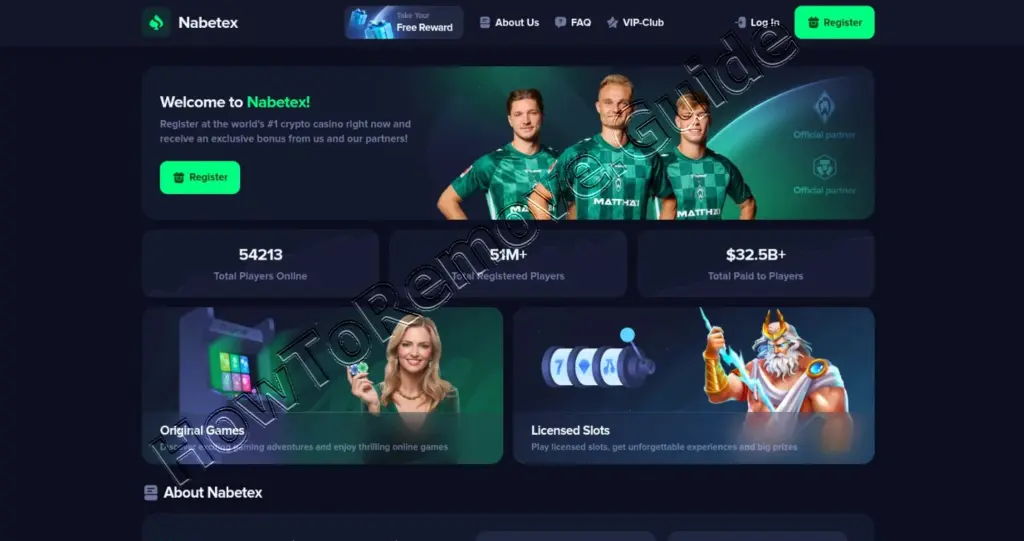
Nabetex is one of those newly minted crypto casino scams that rely on bold promises. The real trap appears when you attempt to withdraw your so-called profits. Nabetex demands a significant “verification deposit” before releasing anything, framing it as a routine security step. Once you send that payment, the site stalls and support becomes evasive. Your funds will never return. This is the same blueprint shared by countless short-lived crypto scam clones designed to disappear after pulling in enough victims. Stay alert to avoid falling into their trap today.
If you’ve interacted with Nabetex already, treat this as an urgent containment scenario. Move quickly, record everything, and prioritize security over chasing “release” or “unlock” promises. Time favors the scammers; decisive steps favor you. Treat any contact with Nabetex, Vyrobet.cc, or Grivanto as a security incident.
Scams of Nabetex‘s type are known to steal personal data and passwords. Install SpyHunter Pro to scan for risks, remove any dangerous trackers, and enable real-time protection.

Try Free For 7 Days*
Buy now15% OFF if you buy straight without trial.
 OFFER
OFFERIMPORTANT! READ BEFORE PROCEEDING!
If you have already interacted with Nabetex, stop contact immediately – no more chats, no more “fees,” no screen-sharing – and shift to containment. Lock down accounts, move funds to clean wallets, and preserve evidence for reports. Here are five emergency steps we strongly recommend you take right now:
- Change passwords and enable 2FA on email, exchanges, and wallets; assume previous credentials are compromised.
- Report promptly to your national cybercrime unit and alert any exchanges touched; quick reporting increases options.
- Move remaining crypto to fresh wallets with brand-new seed phrases and revoke old API keys or token approvals.
- If you shared identity documents, place fraud alerts or freezes where available and monitor for new-account activity.
- Document everything – site URLs, usernames, transaction hashes, addresses, chats, emails – and keep screenshots for investigators.
How We Know Nabetex is a Scam
Our confidence comes from a familiar cluster of signals: money-in is frictionless, money-out becomes a maze of invented hurdles; identity verification is weaponized; and the brand lives on throwaway domains while claiming fantasy regulation.
Surprise withdrawal charges
Second, payout attempts trigger “processing fees,” “collateral,” or “VIP upgrades,” which are classic advance-fee tactics dressed as compliance.
Counterfeit licensing
Third, the licensing claims don’t reconcile with public registries; seals are decorative, not verifiable against regulator databases.
Inflated early “wins”
First, the site mimics real casinos but only to cultivate deposits; early “wins” are scripted to nudge higher stakes.
Crypto-only rails
Operators offering only crypto, no recognized jurisdiction, and aggressive bonuses are selecting for unprotected deposits.
Synthetic social proof
Reviews and “recent payouts” are manufactured theater – bot comments, planted posts, and tickers without transaction IDs.
Fresh, privacy-masked domains
The domain is new, ownership is hidden, and identical page templates reappear under fresh names when heat rises.

How the Nabetex Scam Deception Funnel Works
Understanding the choreography helps you sidestep it next time; Nabetex doesn’t improvise so much as run a script that escalates commitment while manufacturing urgency, authority, and hope – each step engineered to keep you sending more.
The sequence is engineered: lure with bonuses, inflate on-screen balances, block withdrawals with fees and KYC, then stall and rebrand while “recovery” Nabetexs circle.
Promo hooks and influencer codes
To start, a splash of ads, influencer shout-outs, or social comments promises oversized signup credits and “no-risk” play, inviting a tiny first deposit that feels harmless.

Casino skin and bonus theater
Soon after, the games produce conspicuous streaks and fast-growing balances, encouraging the belief that you’ve cracked probability – and that cashing out would be leaving money on the table.

Inflated balances, then the gate
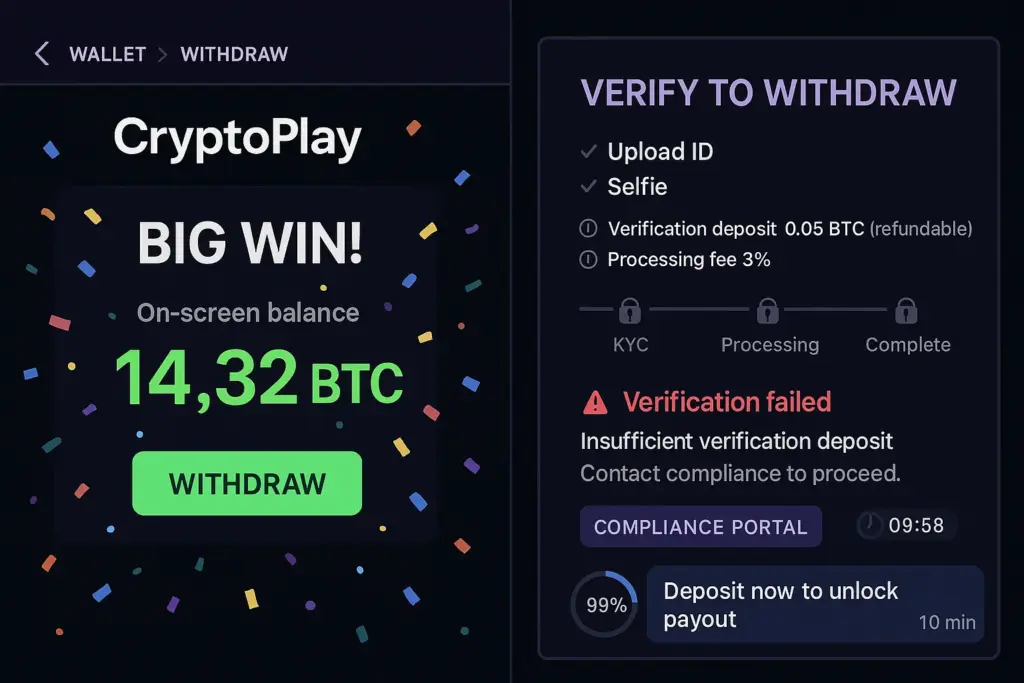
When you request a withdrawal, surprise conditions arrive: verification deposits, “upgrade tiers,” or “anti-fraud bonds,” each framed as standard policy and refundable “after processing.”
Fee-gates and KYC harvest
Next, KYC becomes a lever; the site insists on IDs or selfies “for compliance,” then uses delays and additional “fees” to stretch the timeline and raise sunk costs.

Stalling, rebrands, and “recovery” bait
If doubts surface, fake support escalates soothing language and pseudo-regulatory jargon, then accounts go “under review,” communication dries up, and the domain prepares to re-emerge under a new name while “recovery” Nabetexs circle.
Staying safe from crypto casino scams like Nabetex
The following practices won’t just protect your balances; they’ll help keep your identity, devices, and decision-making intact the next time a shiny platform tries to sprint you past skepticism.
Verify license status in official registers
License verification, not logos: find the claimed number and confirm it on the regulator’s public register.
Check domain age and history
Evaluate the domain and operator footprint: new registration, privacy-shielded ownership, and clone layouts are burn signals.
Reject withdrawal fees and “unlock” deposits
Any demand for up-front payment to withdraw – fees, VIP tiers, “taxes” – is incompatible with legitimate operations.
Prefer venues with recourse
Prefer regulated channels with fiat rails and clear dispute processes; crypto-only fronts maximize irreversibility.
Limit wallet exposure
Institute security hygiene as policy: unique passwords, app-based 2FA, minimal API permissions, and immediate revocation after suspicious activity.
Validate “provably fair” claims
Inspect fairness proofs the right way: credible casinos link to lab certificates that point back to the lab’s site; dead images and unclickable badges reveal theater, not testing.
Document and report rapidly
Aggregated victim reports help trace clusters of addresses and feed seizure/notification operations; timely filing improves outcomes.
Build a deliberate slow-down reflex
Discipline beats dopamine: pause before depositing, verify licensing and domain history, and only then decide.
Useful Resources for Scam Reporting and Prevention (By Country)
Aggregated victim reports help trace clusters of addresses and feed seizure/notification operations; agencies highlight proactive efforts to identify victims and prevent further loss. Even when funds move quickly, timely reporting can still help when authorities receive solid evidence.
Click here to report the scam in your country
| Country / Agency | URL | Category / Use-case | Phone/Email |
| Australia – Crime Stoppers | https://www.crimestoppers.com.au | Anonymous tips about crime | 1800 333 000 |
| Australia – National Anti-Scam Center (Scamwatch) | https://www.scamwatch.gov.au/report-a-scam | General scams; phishing; texts/emails | |
| Australia – Police Assistance Line (non-emergency) | https://www.police.gov.au | Local police report | 131 444 |
| Australia – ReportCyber (ACSC) | https://www.cyber.gov.au/report | Cybercrime (hacks, fraud, extortion) | |
| Canada – Canadian Anti-Fraud Center (CAFC) | https://www.antifraudcentre-centreantifraude.ca/report-signalez-eng.htm | General scams incl. phone/text/email | |
| France – DGCCRF (SignalConso) | https://signal.conso.gouv.fr | Consumer scams/deceptive practices | |
| France – PHAROS – Internet-Signalement | https://www.internet-signalement.gouv.fr | Online content & cybercrime reports | |
| Germany – Bundeskriminalamt / Local Police | https://www.polizei.de/Polizei/DE/Home/home_node.html | Report online fraud | |
| Germany – Weißer Ring – Victim Support | https://weisser-ring.de | Victim support | 116 006 |
| India – DoT Helpline (Sanchar Saathi) | https://sancharsaathi.gov.in | Fraudulent telecom/SIM related | 155260 |
| India – National Consumer Helpline | https://consumerhelpline.gov.in | Consumer scams | 1800-11-4000 / 1915 |
| India – National Cyber Crime Reporting Portal | https://cybercrime.gov.in | Cybercrime incl. online fraud | 1930 |
| Japan – Consumer Affairs Agency (CAA) | https://www.caa.go.jp/policies/policy/consumer_policy/caution/cybercrime/ | Consumer scams | |
| Japan – National Police Agency – Cybercrime | https://www.npa.go.jp/bureau/cyber/ | Cybercrime reporting | |
| Mexico – Guardia Nacional (National Guard) | https://www.gob.mx/gn | Cybercrime reporting | |
| Mexico – Instituto Federal de Telecomunicaciones (IFT) | https://www.ift.org.mx | Telecom/online services scams | |
| Mexico – PROFECO | https://www.gob.mx/profeco | Consumer fraud & ecommerce | |
| Netherlands – AFM – Report investment fraud | https://www.afm.nl/en/consumenten/themas/beleggen/misleiding-misbruik | Investment/crypto | |
| Netherlands – Fraudehelpdesk | https://www.fraudehelpdesk.nl/melden | General scams (incl. phishing/SMS) | 088-7867372 |
| Netherlands – Politie – Meldpunt Internetoplichting | https://www.politie.nl/themas/internetoplichting.html | Online shopping fraud | |
| New Zealand – CERT NZ | https://www.cert.govt.nz/individuals/report-an-issue/ | Phishing, identity scams | |
| New Zealand – Department of Internal Affairs – Spam | https://www.dia.govt.nz/Spam-Contact-Us | Email/SMS spam | [email protected] |
| New Zealand – IDCARE | https://www.idcare.org | Victim support (identity compromise) | 0800 121 068 |
| New Zealand – Netsafe – Report | https://www.netsafe.org.nz/report/ | Online harms & scams | |
| New Zealand – New Zealand Police (non-emergency) | https://www.police.govt.nz/use-105 | Report fraud/online crime | 105 |
| Nigeria – Economic & Financial Crimes Commission (EFCC) | https://www.efcc.gov.ng | Financial scams incl. crypto/investment | [email protected] |
| Nigeria – Nigeria Police Special Fraud Unit (SFU) | https://www.specialfraudunit.org.ng | Serious fraud | Voice/SMS: 0708 227 6895; WhatsApp: 0812 760 9914 |
| Poland – CERT Polska (CERT.PL) | https://cert.pl/en/report/ | Cyber incidents & phishing | |
| Poland – Dyzurnet.pl | https://dyzurnet.pl | Illegal online content (esp. child protection) | |
| Poland – Polish Police (Policja) | https://www.policja.pl | Report scams to police | |
| Singapore – Anti-Scam Centre / Anti-Scam Helpline | https://www.scamalert.sg | General scams; texts; calls | 1800-722-6688 |
| Singapore – Monetary Authority of Singapore (MAS) | https://www.mas.gov.sg/investor-alert-list | Investment/crypto checks | |
| Singapore – Singapore Police Force | https://www.police.gov.sg/iwitness | Police report (cybercrime) | |
| South Africa – Cybersecurity Hub (CSIRT) | https://www.cybersecurityhub.gov.za | Cyber incidents incl. scams | |
| South Africa – South African Fraud Prevention Service (SAFPS) | https://www.safps.org.za | Identity fraud support | 011-867-2234 |
| South Africa – South African Police Service (SAPS) | https://www.saps.gov.za | Police report (cybercrime unit) | |
| South Korea – Korea Communications Commission (KCC) | https://www.kcc.go.kr | Telecom-related fraud | |
| South Korea – Korea Internet & Security Agency (KISA) | https://www.kisa.or.kr | Phishing, online harms | |
| South Korea – Korean National Police Agency – Cyber Bureau | https://ecrm.cyber.go.kr | Cybercrime reporting | |
| Spain – INCIBE – Oficina de Seguridad del Internauta (OSI) | https://www.osi.es/es/reporte | Cybersecurity & online fraud | |
| Spain – Policía Nacional / Guardia Civil | https://www.policia.es | Report scams to police | |
| Sweden – Crime Victim Authority (Brottsoffermyndigheten) | https://www.brottsoffermyndigheten.se | Victim support & compensation | 090–70 82 00 |
| Sweden – Polisen (Swedish Police) | https://polisen.se | Report fraud/cybercrime | 114 14 (non-emergency); 112 (emergency) |
| Sweden – Swedish Consumer Agency (Konsumentverket) | https://www.konsumentverket.se | Unfair business practices | |
| United Arab Emirates – Abu Dhabi Police – Aman Service | https://www.adpolice.gov.ae | Cybercrime tips/reporting | SMS 2828; 800 2626 |
| United Arab Emirates – Dubai Police – eCrime | https://www.dubaipolice.gov.ae | Cybercrime reporting | 04 606 1600 |
| United Arab Emirates – Ministry of Interior – Cyber Crime Dept. | https://www.moi.gov.ae | Cybercrime incl. online scams | |
| United Arab Emirates – Telecommunications Regulatory Authority (TRA) / TDRA | https://www.tra.gov.ae | Telecom-related scams/phishing | |
| United Kingdom – Action Fraud (NFIB) | https://www.actionfraud.police.uk | General scams & cybercrime (non-emergency) | 0300 123 2040 |
| United Kingdom – Citizens Advice Consumer Service | https://www.citizensadvice.org.uk/consumer/get-more-help/if-you-need-more-help-about-a-consumer-issue/ | Consumer problems & scam guidance | 0808 223 1133 |
| United Kingdom – Financial Conduct Authority (FCA) | https://www.fca.org.uk/consumers/report-scam-us | Investment/crypto & financial services | |
| United Kingdom – National Cyber Security Centre (NCSC) | https://www.ncsc.gov.uk/collection/phishing-scams | Phishing emails & suspicious websites | |
| United Kingdom – Stop Scams UK ‘159’ | https://stopscamsuk.org.uk/159 | Banking APP fraud (direct to your bank) | 159 |
| United States – AARP Fraud Watch Network Helpline | https://www.aarp.org/money/scams-fraud/ | Victim support | 833-372-8311 |
| United States – Better Business Bureau – Scam Tracker | https://www.bbb.org/scamtracker | Business/marketplace scams | |
| United States – FBI Internet Crime Complaint Center (IC3) | https://www.ic3.gov | Internet crime incl. investment/crypto | |
| United States – Federal Trade Commission – ReportFraud | https://reportfraud.ftc.gov | General scams, phishing, texts/emails | 1-877-382-4357 |
| United States – National Center for Disaster Fraud | https://www.justice.gov/disaster-fraud | Disaster-related scams | (866) 720-5721 |
| United States – SEC Tips & Complaints | https://www.sec.gov/tcr | Investment & securities/crypto-asset offerings |
That’s the full picture: understand the pattern, contain exposure fast, and run verifiable checks before any deposit or document upload.
Understanding the choreography helps you sidestep it next time; once you recognize the steps, you’ll see the scam telegraph its next move.
