

This post is for anyone who has encountered a site called Nanofex.com and now considers engaging with its bold offers and promises of “no-strings-attached free starter bonuses”.
Though it may look like a legit gambling platform at first, Nanofex is the exact opposite. We’ve seen many, many similar scams before with platforms like Hestwin255 and Hestwin, so we know exactly how this site works and how it tricks people.
Scams of Nanofex.com‘s type are known to steal personal data and passwords. Install SpyHunter Pro to scan for risks, remove any dangerous trackers, and enable real-time protection.

Try Free For 7 Days*
Buy now15% OFF if you buy straight without trial.
 OFFER
OFFERTo learn how to protect yourself, I urge you to read on, but even if you don’t, the most important thing to know about Nanofex is that it only wants to steal your money, and none of its promises are real.
And in case you’ve already interacted with this site, know that any personal data shared on it might be compromised and is currently in the hands of scammers. Damage control security tips are also available in the next lines, so, once again, I advise you to stay on this page and inform yourself about this type of scam.
IMPORTANT! READ BEFORE PROCEEDING!
Where Nanofex already has your money, your documents, or any direct connection to your wallet or device, act as though the incident may affect more than the fake casino balance, especially if the platform persuaded you to install anything or follow outside links.
If that describes your situation, begin by checking the device with SpyHunter 5 so you can clear out suspicious software and reduce the chance that the scam extends into the system you used.
Fastest Removal Option: Use SpyHunter 5
- 1.1Click here to download and install the anti-malware tool on your PC.
- 1.2
 Start SpyHunter 5, click the Buy button and choose between starting your 7-days free trial or directly purchasing the tool.
If you choose to buy SpyHunter 5 now, you can use our discount code, “HTRG15“, for 15% off.
- 1.3
 Once you activate SpyHunter, click Start Scan Now, select the Full Scan option, and let the tool do its job.
 - 1.4
 Once the scan completes (it could take a while, so have patience), you’ll see all malware and other undesirables listed.
Click Next to review the detections and then click Next again to delete all rogue items.
After that scan, work through the added security steps below so the damage does not spread into email, exchanges, wallets, or identity records:
- Reset passwords and enable 2FA on your email, crypto exchanges, and wallets; terminate other active sessions.
- Notify any exchanges and services touched by the funds; provide TxIDs and ask that accounts/addresses be flagged per policy.
- Migrate assets to fresh wallets with new seed phrases and revoke any existing token approvals on connected chains.
- If you uploaded ID documents, place credit/fraud alerts where available and monitor for identity-theft signals.
- Assemble an evidence bundle – wallet addresses, TxIDs, site URLs, chats, and screenshots – and file reports with police/IC3 and any involved platforms.
How We Know Nanofex is a Scam
None of the signals below should be dismissed as minor oddities. Taken together, they show a platform that behaves like a cash-out extortion scheme built around casino imagery rather than a legitimate gaming service.
Release payments masquerading as procedure
The site waits until you request a withdrawal, then claims a fee, reserve, tax, or verification transfer is required first. That reversal of logic is one of the clearest signs you are not dealing with a real payout process.
Official language with nothing behind it
Scams of this sort frequently borrow the vocabulary of compliance and regulation, but their licenses, company names, and approval claims often fail the most basic external verification.
Early success that feels suspiciously generous
Large wins at the beginning are useful because they teach the victim to trust what appears on screen. The apparent generosity is there to increase later deposits and reduce caution.
Funding paths that trap the victim
When a platform keeps everything inside crypto, it also keeps victims away from card disputes, banking protections, and the accountability that comes with mainstream payment systems.
Social proof assembled like stage props
Winning notifications, comment sections, referral chatter, and promotional testimonials may all look lively while offering no reliable proof that any real users were paid.
Short-lived infrastructure
Crypto-casino scam networks often launch disposable sites with hidden registration data and closely related brand names. Tools such as who.is can help show whether the site is brand new or intentionally obscure.


How the Nanofex Scam Deception Funnel Works
Knowing the scam’s rhythm makes it easier to resist. What feels like a moving target is usually a fixed script with a small number of repeated stages dressed up in slightly different wording.
In practice, the pattern runs like this: lure the user, display easy gains, block the exit, gather more money or documents, and finally disappear or hand the victim off to a second con.
Urgency enters through promos and social channels
The opening hook may arrive as a viral-looking clip, a comment thread, a direct message, or a referral code that frames the offer as time-sensitive and widely trusted.

The site performs credibility on contact
From the first visit, Nanofex tries to compress decision-making with polished graphics, polished language, and polished promises. The idea is to make the environment feel established before any independent checks occur.

The fake bankroll becomes the leverage
Once the account shows a tempting amount, the scam flips the pressure point. Now the victim is no longer chasing a bonus, but trying to recover “their” money by satisfying yet another condition.
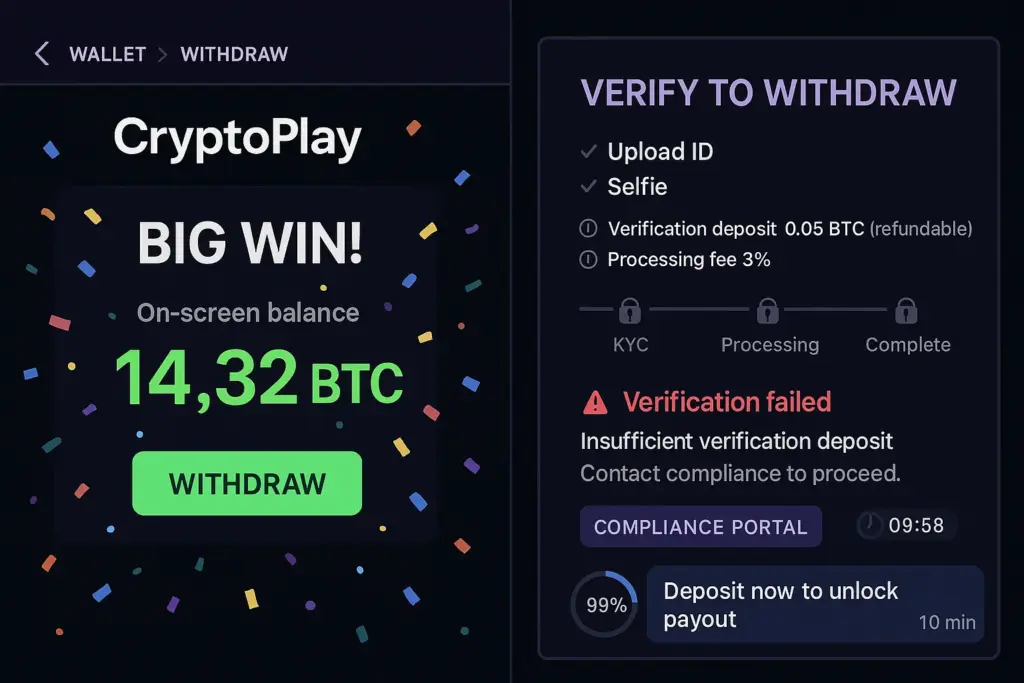
Every obstacle is designed to open another wallet transfer
KYC requests, blockchain clearance claims, anti-fraud holds, and VIP unlocks are stacked one after another so the victim keeps solving the wrong problem while the operators keep collecting value.

Exit denial is followed by rebranding and follow-on scams
Eventually replies thin out, the domain may vanish, and a new website or “asset recovery” contact appears to restart the exploitation under a different story.
Staying safe from crypto casino scams like Nanofex
Staying safer in the future means turning verification into a routine instead of a last-minute reaction. The habits below will not feel exciting, but they are exactly what these schemes hope you skip.
Check the legal footprint before the game lobby
Look up the operator in official databases, confirm the company behind the site, and compare the domain to what the regulator lists. If the legal footprint is missing, walk away.
Review the site’s age and reuse patterns
Clone networks often recycle layouts, promises, and registration tactics. A short lifespan, hidden ownership, and multiple similar domains should all raise the risk level immediately.
Refuse every pay-to-withdraw demand
No matter what label is attached to it, a request for money in order to release money is a signal to stop. Sending the extra amount usually just unlocks the next excuse.
Use platforms that can actually be challenged
Where there is licensing, public ownership, normal payments, and a complaints path, there is at least some leverage. Anonymous crypto-only sites remove that leverage on purpose.
Keep wallets, logins, and approvals on a short leash
Avoid exposing your primary holdings to risky sites. Separate activity by wallet, revoke token approvals you do not need, and secure every linked account with strong unique credentials and 2FA.
Do not take fairness slogans at face value
Claims about public seeds or mathematical fairness mean little unless you can independently reproduce what the platform says. When verification is impossible, the slogan has no protective value.
Preserve the paper trail before it disappears
Screenshots, emails, chat logs, transaction hashes, wallet addresses, and copied URLs matter because scam sites are built to be abandoned quickly. Save first, analyze second.
Train yourself to interrupt the rush
A forced pause is one of the best anti-scam tools available. Put time between the promotional trigger and any deposit, and use that gap to verify history, licensing, ownership, and reputation.
Useful Resources for Scam Reporting and Prevention (By Country)
Filing reports quickly can still be worthwhile, even in crypto cases that feel final. The sooner exchanges, wallet providers, stablecoin issuers, and authorities see a well-documented complaint, the better the chance of linking activity or limiting additional harm. The directory below helps you start that process.
Find your national reporting option below
| Country / Agency | URL | Category / Use-case | Phone/Email |
| Australia – Crime Stoppers | https://www.crimestoppers.com.au | Anonymous tips about crime | 1800 333 000 |
| Australia – National Anti-Scam Center (Scamwatch) | https://www.scamwatch.gov.au/report-a-scam | General scams; phishing; texts/emails | |
| Australia – Police Assistance Line (non-emergency) | https://www.police.gov.au | Local police report | 131 444 |
| Australia – ReportCyber (ACSC) | https://www.cyber.gov.au/report | Cybercrime (hacks, fraud, extortion) | |
| Canada – Canadian Anti-Fraud Center (CAFC) | https://www.antifraudcentre-centreantifraude.ca/report-signalez-eng.htm | General scams incl. phone/text/email | |
| France – DGCCRF (SignalConso) | https://signal.conso.gouv.fr | Consumer scams/deceptive practices | |
| France – PHAROS – Internet-Signalement | https://www.internet-signalement.gouv.fr | Online content & cybercrime reports | |
| Germany – Bundeskriminalamt / Local Police | https://www.polizei.de/Polizei/DE/Home/home_node.html | Report online fraud | |
| Germany – Weißer Ring – Victim Support | https://weisser-ring.de | Victim support | 116 006 |
| India – DoT Helpline (Sanchar Saathi) | https://sancharsaathi.gov.in | Fraudulent telecom/SIM related | 155260 |
| India – National Consumer Helpline | https://consumerhelpline.gov.in | Consumer scams | 1800-11-4000 / 1915 |
| India – National Cyber Crime Reporting Portal | https://cybercrime.gov.in | Cybercrime incl. online fraud | 1930 |
| Japan – Consumer Affairs Agency (CAA) | https://www.caa.go.jp/policies/policy/consumer_policy/caution/cybercrime/ | Consumer scams | |
| Japan – National Police Agency – Cybercrime | https://www.npa.go.jp/bureau/cyber/ | Cybercrime reporting | |
| Mexico – Guardia Nacional (National Guard) | https://www.gob.mx/gn | Cybercrime reporting | |
| Mexico – Instituto Federal de Telecomunicaciones (IFT) | https://www.ift.org.mx | Telecom/online services scams | |
| Mexico – PROFECO | https://www.gob.mx/profeco | Consumer fraud & ecommerce | |
| Netherlands – AFM – Report investment fraud | https://www.afm.nl/en/consumenten/themas/beleggen/misleiding-misbruik | Investment/crypto | |
| Netherlands – Fraudehelpdesk | https://www.fraudehelpdesk.nl/melden | General scams (incl. phishing/SMS) | 088-7867372 |
| Netherlands – Politie – Meldpunt Internetoplichting | https://www.politie.nl/themas/internetoplichting.html | Online shopping fraud | |
| New Zealand – CERT NZ | https://www.cert.govt.nz/individuals/report-an-issue/ | Phishing, identity scams | |
| New Zealand – Department of Internal Affairs – Spam | https://www.dia.govt.nz/Spam-Contact-Us | Email/SMS spam | [email protected] |
| New Zealand – IDCARE | https://www.idcare.org | Victim support (identity compromise) | 0800 121 068 |
| New Zealand – Netsafe – Report | https://www.netsafe.org.nz/report/ | Online harms & scams | |
| New Zealand – New Zealand Police (non-emergency) | https://www.police.govt.nz/use-105 | Report fraud/online crime | 105 |
| Nigeria – Economic & Financial Crimes Commission (EFCC) | https://www.efcc.gov.ng | Financial scams incl. crypto/investment | [email protected] |
| Nigeria – Nigeria Police Special Fraud Unit (SFU) | https://www.specialfraudunit.org.ng | Serious fraud | Voice/SMS: 0708 227 6895; WhatsApp: 0812 760 9914 |
| Poland – CERT Polska (CERT.PL) | https://cert.pl/en/report/ | Cyber incidents & phishing | |
| Poland – Dyzurnet.pl | https://dyzurnet.pl | Illegal online content (esp. child protection) | |
| Poland – Polish Police (Policja) | https://www.policja.pl | Report scams to police | |
| Singapore – Anti-Scam Centre / Anti-Scam Helpline | https://www.scamalert.sg | General scams; texts; calls | 1800-722-6688 |
| Singapore – Monetary Authority of Singapore (MAS) | https://www.mas.gov.sg/investor-alert-list | Investment/crypto checks | |
| Singapore – Singapore Police Force | https://www.police.gov.sg/iwitness | Police report (cybercrime) | |
| South Africa – Cybersecurity Hub (CSIRT) | https://www.cybersecurityhub.gov.za | Cyber incidents incl. scams | |
| South Africa – South African Fraud Prevention Service (SAFPS) | https://www.safps.org.za | Identity fraud support | 011-867-2234 |
| South Africa – South African Police Service (SAPS) | https://www.saps.gov.za | Police report (cybercrime unit) | |
| South Korea – Korea Communications Commission (KCC) | https://www.kcc.go.kr | Telecom-related fraud | |
| South Korea – Korea Internet & Security Agency (KISA) | https://www.kisa.or.kr | Phishing, online harms | |
| South Korea – Korean National Police Agency – Cyber Bureau | https://ecrm.cyber.go.kr | Cybercrime reporting | |
| Spain – INCIBE – Oficina de Seguridad del Internauta (OSI) | https://www.osi.es/es/reporte | Cybersecurity & online fraud | |
| Spain – Policía Nacional / Guardia Civil | https://www.policia.es | Report scams to police | |
| Sweden – Crime Victim Authority (Brottsoffermyndigheten) | https://www.brottsoffermyndigheten.se | Victim support & compensation | 090–70 82 00 |
| Sweden – Polisen (Swedish Police) | https://polisen.se | Report fraud/cybercrime | 114 14 (non-emergency); 112 (emergency) |
| Sweden – Swedish Consumer Agency (Konsumentverket) | https://www.konsumentverket.se | Unfair business practices | |
| United Arab Emirates – Abu Dhabi Police – Aman Service | https://www.adpolice.gov.ae | Cybercrime tips/reporting | SMS 2828; 800 2626 |
| United Arab Emirates – Dubai Police – eCrime | https://www.dubaipolice.gov.ae | Cybercrime reporting | 04 606 1600 |
| United Arab Emirates – Ministry of Interior – Cyber Crime Dept. | https://www.moi.gov.ae | Cybercrime incl. online scams | |
| United Arab Emirates – Telecommunications Regulatory Authority (TRA) / TDRA | https://www.tra.gov.ae | Telecom-related scams/phishing | |
| United Kingdom – Action Fraud (NFIB) | https://www.actionfraud.police.uk | General scams & cybercrime (non-emergency) | 0300 123 2040 |
| United Kingdom – Citizens Advice Consumer Service | https://www.citizensadvice.org.uk/consumer/get-more-help/if-you-need-more-help-about-a-consumer-issue/ | Consumer problems & scam guidance | 0808 223 1133 |
| United Kingdom – Financial Conduct Authority (FCA) | https://www.fca.org.uk/consumers/report-scam-us | Investment/crypto & financial services | |
| United Kingdom – National Cyber Security Centre (NCSC) | https://www.ncsc.gov.uk/collection/phishing-scams | Phishing emails & suspicious websites | |
| United Kingdom – Stop Scams UK ‘159’ | https://stopscamsuk.org.uk/159 | Banking APP fraud (direct to your bank) | 159 |
| United States – AARP Fraud Watch Network Helpline | https://www.aarp.org/money/scams-fraud/ | Victim support | 833-372-8311 |
| United States – Better Business Bureau – Scam Tracker | https://www.bbb.org/scamtracker | Business/marketplace scams | |
| United States – FBI Internet Crime Complaint Center (IC3) | https://www.ic3.gov | Internet crime incl. investment/crypto | |
| United States – Federal Trade Commission – ReportFraud | https://reportfraud.ftc.gov | General scams, phishing, texts/emails | 1-877-382-4357 |
| United States – National Center for Disaster Fraud | https://www.justice.gov/disaster-fraud | Disaster-related scams | (866) 720-5721 |
| United States – SEC Tips & Complaints | https://www.sec.gov/tcr | Investment & securities/crypto-asset offerings |
The safest conclusion is also the simplest one: if the site keeps inventing reasons you must pay or identify yourself before it will release funds, the balance was never truly yours. That is the core of the Nanofex scam model.
