

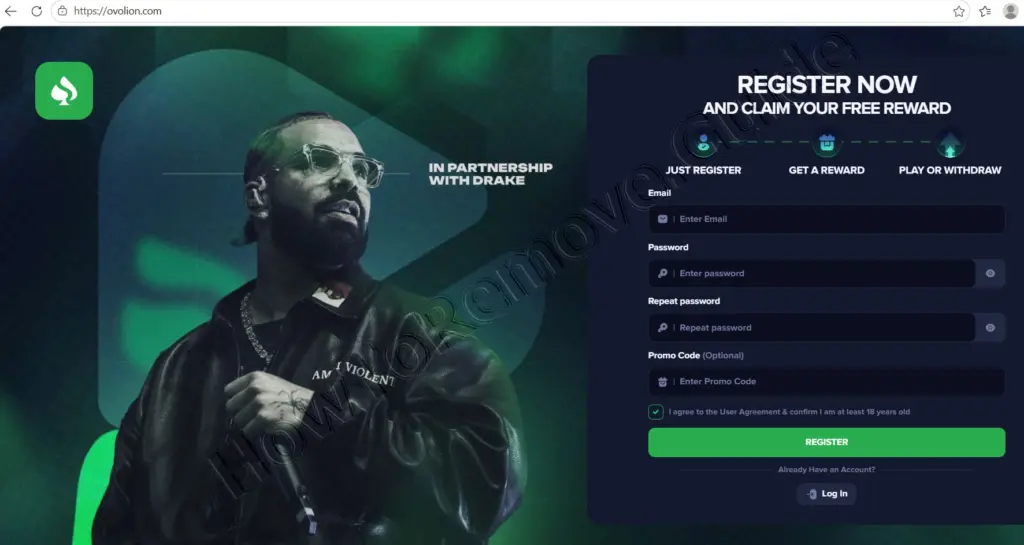
Ovolion has the exterior of a legitimate crypto casino, but in reality, it’s much closer to a fraudulent site that just wants to steal your money.
This and other similar sites like Rezowin and Besowin.com rope you in with a fat starter bonus and lets you gamble with house credit, no strings attached. Then your balance begins to climb quickly, and everything feels frictionless right up to the moment you request a payout.
That is when you suddenly get invented charges and verification deposit requests that you need to complete to claim your winnings.
Scams of Ovolion.com‘s type are known to steal personal data and passwords. Install SpyHunter Pro to scan for risks, remove any dangerous trackers, and enable real-time protection.

Try Free For 7 Days*
Buy now15% OFF if you buy straight without trial.
 OFFER
OFFERBy that point, many users would be too far down the rabbit hole to realize they aren’t getting anything out of Ovolion no matter what. That’s why they agree to any such deposit request and that’s how they get scammed.
Their deposits get stolen, and they are never allowed to withdraw anything because their winnings were never real. Worse yet, the scammers could also gain access to sensitive credentials and drain their victims’ wallets and bank accounts, which is the main danger of such scams.
Regard any interaction with Ovolion, as a security problem, not a customer-service issue. The guidance below explains the warning signs, the pressure sequence, and the practical steps that reduce the chance of further losses.
IMPORTANT! READ BEFORE PROCEEDING!
If you have already interacted with Ovolion, cut communication at once, refuse every new payment demand, and move into containment mode. Secure email, wallets, and exchange accounts before doing anything else, then preserve screenshots, wallet addresses, and chat logs. These are the five fastest containment moves to make now:
- Reset passwords and enable 2FA on your email, crypto exchanges, and wallets; terminate other active sessions.
- Notify any exchanges and services touched by the funds; provide TxIDs and ask that accounts/addresses be flagged per policy.
- Migrate assets to fresh wallets with new seed phrases and revoke any existing token approvals on connected chains.
- If you uploaded ID documents, place credit/fraud alerts where available and monitor for identity-theft signals.
- Assemble an evidence bundle – wallet addresses, TxIDs, site URLs, chats, and screenshots – and file reports with police/IC3 and any involved platforms.
How We Know Ovolion is a Scam
Look past the animations and bonus language: this page shows the same signals investigators see again and again on fake crypto-casino fronts. Each sign below matters on its own, but the combination is what makes the pattern especially hard to ignore.
Withdrawal blockers appear only at cash-out
Notice when the first real obstacle arrives: not at signup, not during play, but only when money is meant to leave the platform. That timing is typical of an advance-fee fraud rather than a legitimate gambling service.
Licensing claims fall apart on inspection
Verification usually fails the moment you move off-site. Claimed permits, registration numbers, or compliance badges either do not exist in regulator databases or belong to unrelated entities.
The early jackpot effect is manufactured
Instead of normal variance, the screen often shows unusually generous streaks designed to create confidence. Those apparent wins are persuasive theater meant to make the next deposit feel rational.
Crypto-only payments remove safety nets
With no card network, bank dispute path, or conventional merchant identity, victims are pushed onto rails where reversals are rare and accountability is thin. That is useful for the operator, not for the player.
Trust signals are staged, not earned
Pop-up win notices, glowing comments, countdown timers, and influencer-style promo codes can all be generated cheaply. Their job is to suggest a busy, successful platform without proving anything meaningful.
Short-lived domains reveal the cloning cycle
Open registration lookups such as who.is and you will often see recent creation dates, masked ownership, or churn across similar names. That turnover is consistent with disposable scam infrastructure, not a stable gaming business.

How the Ovolion Scam Deception Funnel Works
Understanding the sequence matters because these sites are predictable once you strip away the casino theme. The more clearly you can name each stage, the harder it becomes for urgency, excitement, or embarrassment to keep you moving in the wrong direction.
Here is the usual progression: attention is captured with promotion, trust is built through fake success, withdrawal is blocked by invented conditions, and the victim is pressed for one payment after another until the site disappears or reappears under a new label.
Ads, codes, and comment bait start the pull
Often the first contact does not feel like a scam at all. A short video, boosted comment thread, Telegram message, or copied “winner” story frames the site as a discovery that other people are already profiting from.

A polished casino shell lowers suspicion
Once you arrive, the presentation does heavy lifting. Familiar slot imagery, live-chat widgets, smooth account dashboards, and huge signup bonuses are arranged to make the platform look established before any real due diligence happens.

Fake winnings prepare the payment squeeze
After a small deposit or even a free-credit claim, the account balance can climb implausibly fast. That apparent success is the emotional setup for the first withdrawal attempt, when the fraud finally shows its teeth.
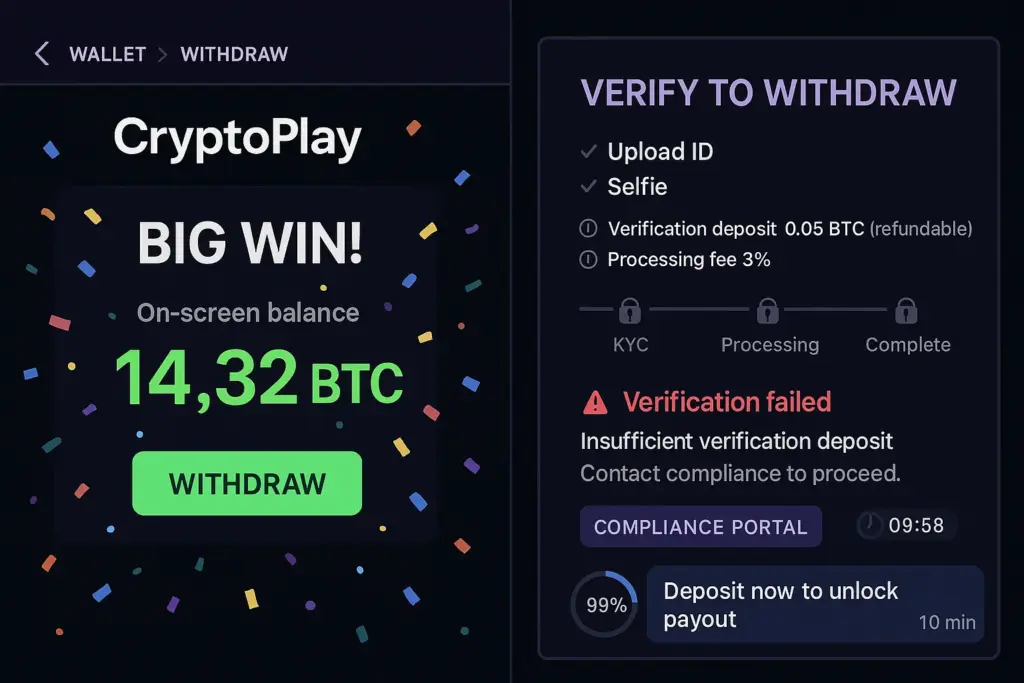
Documents and extra payments become the “solution”
From there, every obstacle comes with a supposed fix. Upload an ID, pay a release charge, cover an AML hold, upgrade the account tier, or send a confirming deposit—each excuse is framed as the last step before money is sent, and each one only deepens the loss.

Delay tactics, shutdowns, and the second scam
When a victim hesitates, support agents often switch to soothing language, partial promises, or new deadlines. If that fails, the domain may go quiet, and a separate “recovery” contact may appear later offering help for another fee.
Staying safe from crypto casino scams like Ovolion
Protection starts before any funds move. A few slow, unglamorous checks can stop most of these schemes long before they reach the stage where money, documents, and account access are all at risk together.
Check regulators first, not the homepage
Start outside the site itself. Search official gambling or financial regulator records using the business name, claimed jurisdiction, and domain to see whether the operator is genuinely listed and authorized.
Review domain age before risking funds
Newly registered domains are not automatically fraudulent, but a very recent launch paired with grand promises should make you cautious. Archive tools and registration history can also expose recycled designs and name changes.
Never pay to “unlock” a balance
Any request to send cryptocurrency in order to release winnings, clear tax, complete verification, or activate withdrawals should be treated as the scam revealing itself. Real payouts are not unlocked by extra deposits to the same party.
Choose services that leave a paper trail
Where possible, stick with operators that disclose ownership, publish real terms, support conventional payments, and can be matched to a known legal entity. The easier a company is to verify, the harder it is for it to vanish overnight.
Keep wallets compartmentalized
Use separate wallets for experimentation and never expose your main holdings to a site you have not fully vetted. Fresh addresses, new seed phrases after exposure, and revoked token approvals reduce the blast radius if something goes wrong.
Treat “provably fair” as a claim to verify
Fraudulent platforms borrow technical language because it sounds reassuring. If the site does not let you independently validate outcomes with transparent seeds, hashes, and documentation, the phrase is advertising, not evidence.
Collect evidence while it is still fresh
As soon as you suspect fraud, save the URL, wallet addresses, TxIDs, chat transcripts, emails, account pages, and every payment instruction. Fast, organized documentation makes reports stronger and helps exchanges or investigators follow the trail.
Build a pause between hype and payment
Create a personal rule that no deposit happens on first contact, first click, or first excitement. A pause long enough to check licensing, search independent complaints, and inspect the domain will block many impulse-driven losses.
Useful Resources for Scam Reporting and Prevention (By Country)
Although crypto transfers are difficult to reverse, prompt reporting is still worthwhile. Exchanges, analytics teams, and in some cases stablecoin issuers may be able to flag activity, preserve records, or assist authorities when victims submit detailed evidence quickly.
Open the reporting directory for your country
| Country / Agency | URL | Category / Use-case | Phone/Email |
| Australia – Crime Stoppers | https://www.crimestoppers.com.au | Anonymous tips about crime | 1800 333 000 |
| Australia – National Anti-Scam Center (Scamwatch) | https://www.scamwatch.gov.au/report-a-scam | General scams; phishing; texts/emails | |
| Australia – Police Assistance Line (non-emergency) | https://www.police.gov.au | Local police report | 131 444 |
| Australia – ReportCyber (ACSC) | https://www.cyber.gov.au/report | Cybercrime (hacks, fraud, extortion) | |
| Canada – Canadian Anti-Fraud Center (CAFC) | https://www.antifraudcentre-centreantifraude.ca/report-signalez-eng.htm | General scams incl. phone/text/email | |
| France – DGCCRF (SignalConso) | https://signal.conso.gouv.fr | Consumer scams/deceptive practices | |
| France – PHAROS – Internet-Signalement | https://www.internet-signalement.gouv.fr | Online content & cybercrime reports | |
| Germany – Bundeskriminalamt / Local Police | https://www.polizei.de/Polizei/DE/Home/home_node.html | Report online fraud | |
| Germany – Weißer Ring – Victim Support | https://weisser-ring.de | Victim support | 116 006 |
| India – DoT Helpline (Sanchar Saathi) | https://sancharsaathi.gov.in | Fraudulent telecom/SIM related | 155260 |
| India – National Consumer Helpline | https://consumerhelpline.gov.in | Consumer scams | 1800-11-4000 / 1915 |
| India – National Cyber Crime Reporting Portal | https://cybercrime.gov.in | Cybercrime incl. online fraud | 1930 |
| Japan – Consumer Affairs Agency (CAA) | https://www.caa.go.jp/policies/policy/consumer_policy/caution/cybercrime/ | Consumer scams | |
| Japan – National Police Agency – Cybercrime | https://www.npa.go.jp/bureau/cyber/ | Cybercrime reporting | |
| Mexico – Guardia Nacional (National Guard) | https://www.gob.mx/gn | Cybercrime reporting | |
| Mexico – Instituto Federal de Telecomunicaciones (IFT) | https://www.ift.org.mx | Telecom/online services scams | |
| Mexico – PROFECO | https://www.gob.mx/profeco | Consumer fraud & ecommerce | |
| Netherlands – AFM – Report investment fraud | https://www.afm.nl/en/consumenten/themas/beleggen/misleiding-misbruik | Investment/crypto | |
| Netherlands – Fraudehelpdesk | https://www.fraudehelpdesk.nl/melden | General scams (incl. phishing/SMS) | 088-7867372 |
| Netherlands – Politie – Meldpunt Internetoplichting | https://www.politie.nl/themas/internetoplichting.html | Online shopping fraud | |
| New Zealand – CERT NZ | https://www.cert.govt.nz/individuals/report-an-issue/ | Phishing, identity scams | |
| New Zealand – Department of Internal Affairs – Spam | https://www.dia.govt.nz/Spam-Contact-Us | Email/SMS spam | [email protected] |
| New Zealand – IDCARE | https://www.idcare.org | Victim support (identity compromise) | 0800 121 068 |
| New Zealand – Netsafe – Report | https://www.netsafe.org.nz/report/ | Online harms & scams | |
| New Zealand – New Zealand Police (non-emergency) | https://www.police.govt.nz/use-105 | Report fraud/online crime | 105 |
| Nigeria – Economic & Financial Crimes Commission (EFCC) | https://www.efcc.gov.ng | Financial scams incl. crypto/investment | [email protected] |
| Nigeria – Nigeria Police Special Fraud Unit (SFU) | https://www.specialfraudunit.org.ng | Serious fraud | Voice/SMS: 0708 227 6895; WhatsApp: 0812 760 9914 |
| Poland – CERT Polska (CERT.PL) | https://cert.pl/en/report/ | Cyber incidents & phishing | |
| Poland – Dyzurnet.pl | https://dyzurnet.pl | Illegal online content (esp. child protection) | |
| Poland – Polish Police (Policja) | https://www.policja.pl | Report scams to police | |
| Singapore – Anti-Scam Centre / Anti-Scam Helpline | https://www.scamalert.sg | General scams; texts; calls | 1800-722-6688 |
| Singapore – Monetary Authority of Singapore (MAS) | https://www.mas.gov.sg/investor-alert-list | Investment/crypto checks | |
| Singapore – Singapore Police Force | https://www.police.gov.sg/iwitness | Police report (cybercrime) | |
| South Africa – Cybersecurity Hub (CSIRT) | https://www.cybersecurityhub.gov.za | Cyber incidents incl. scams | |
| South Africa – South African Fraud Prevention Service (SAFPS) | https://www.safps.org.za | Identity fraud support | 011-867-2234 |
| South Africa – South African Police Service (SAPS) | https://www.saps.gov.za | Police report (cybercrime unit) | |
| South Korea – Korea Communications Commission (KCC) | https://www.kcc.go.kr | Telecom-related fraud | |
| South Korea – Korea Internet & Security Agency (KISA) | https://www.kisa.or.kr | Phishing, online harms | |
| South Korea – Korean National Police Agency – Cyber Bureau | https://ecrm.cyber.go.kr | Cybercrime reporting | |
| Spain – INCIBE – Oficina de Seguridad del Internauta (OSI) | https://www.osi.es/es/reporte | Cybersecurity & online fraud | |
| Spain – Policía Nacional / Guardia Civil | https://www.policia.es | Report scams to police | |
| Sweden – Crime Victim Authority (Brottsoffermyndigheten) | https://www.brottsoffermyndigheten.se | Victim support & compensation | 090–70 82 00 |
| Sweden – Polisen (Swedish Police) | https://polisen.se | Report fraud/cybercrime | 114 14 (non-emergency); 112 (emergency) |
| Sweden – Swedish Consumer Agency (Konsumentverket) | https://www.konsumentverket.se | Unfair business practices | |
| United Arab Emirates – Abu Dhabi Police – Aman Service | https://www.adpolice.gov.ae | Cybercrime tips/reporting | SMS 2828; 800 2626 |
| United Arab Emirates – Dubai Police – eCrime | https://www.dubaipolice.gov.ae | Cybercrime reporting | 04 606 1600 |
| United Arab Emirates – Ministry of Interior – Cyber Crime Dept. | https://www.moi.gov.ae | Cybercrime incl. online scams | |
| United Arab Emirates – Telecommunications Regulatory Authority (TRA) / TDRA | https://www.tra.gov.ae | Telecom-related scams/phishing | |
| United Kingdom – Action Fraud (NFIB) | https://www.actionfraud.police.uk | General scams & cybercrime (non-emergency) | 0300 123 2040 |
| United Kingdom – Citizens Advice Consumer Service | https://www.citizensadvice.org.uk/consumer/get-more-help/if-you-need-more-help-about-a-consumer-issue/ | Consumer problems & scam guidance | 0808 223 1133 |
| United Kingdom – Financial Conduct Authority (FCA) | https://www.fca.org.uk/consumers/report-scam-us | Investment/crypto & financial services | |
| United Kingdom – National Cyber Security Centre (NCSC) | https://www.ncsc.gov.uk/collection/phishing-scams | Phishing emails & suspicious websites | |
| United Kingdom – Stop Scams UK ‘159’ | https://stopscamsuk.org.uk/159 | Banking APP fraud (direct to your bank) | 159 |
| United States – AARP Fraud Watch Network Helpline | https://www.aarp.org/money/scams-fraud/ | Victim support | 833-372-8311 |
| United States – Better Business Bureau – Scam Tracker | https://www.bbb.org/scamtracker | Business/marketplace scams | |
| United States – FBI Internet Crime Complaint Center (IC3) | https://www.ic3.gov | Internet crime incl. investment/crypto | |
| United States – Federal Trade Commission – ReportFraud | https://reportfraud.ftc.gov | General scams, phishing, texts/emails | 1-877-382-4357 |
| United States – National Center for Disaster Fraud | https://www.justice.gov/disaster-fraud | Disaster-related scams | (866) 720-5721 |
| United States – SEC Tips & Complaints | https://www.sec.gov/tcr | Investment & securities/crypto-asset offerings |
The main lesson is straightforward: when a casino-looking site asks for more crypto before it lets you withdraw, assume the balance was never truly yours. Secure what remains, report with evidence, and treat every clone of this model as hostile by default.
