

Before you do anything on Ovotower.com site, there’s something you need to know. This is a crypto casino scam – and a pretty well-constructed one at that. So let’s slow down for a second, because this is important.
The setup is always the same. You land on the site, claim a free bonus, and start playing. Your balance goes up. It looks real. It feels real. And that’s exactly what they need you to think. Now here’s where it shifts – the moment you try to withdraw, suddenly there’s a condition.
Scams of Ovotower.com‘s type are known to steal personal data and passwords. Install SpyHunter Pro to scan for risks, remove any dangerous trackers, and enable real-time protection.

Try Free For 7 Days*
Buy now15% OFF if you buy straight without trial.
 OFFER
OFFERA deposit to “activate” the payout. A fee to verify your account. Some reason, any reason, to get you to send crypto first. That’s the scam. That’s always been the scam. There are no real winnings waiting on the other side.
Any money you send at that stage is almost certainly gone. So before this site convinces you otherwise, let’s break down exactly how it works.
Treat any interaction with Ovotower, Ovowhale.com, or Drakelux as a security incident. The guidance below summarizes how these scams operate, how to reduce the damage, and how to avoid the next lookalike site.
IMPORTANT! READ THIS BEFORE YOU CONTINUE!
If you have already dealt with Ovotower, cut off contact immediately – no more chats, no more “fees,” no screen-sharing – and move into containment. Secure your accounts, move funds into clean wallets, and keep evidence for reporting. These are five urgent actions we strongly advise you to take now:
- Change passwords and turn on 2FA for your email, crypto exchanges, and wallets; end any other active sessions.
- Alert any exchanges and services involved in the transfers; share TxIDs and ask whether the accounts or addresses can be flagged under policy.
- Move assets into fresh wallets with new seed phrases and revoke any existing token approvals on connected chains.
- If you uploaded identity documents, place credit or fraud alerts where available and watch for signs of identity theft.
- Collect an evidence package – wallet addresses, TxIDs, site URLs, chats, and screenshots – and file reports with police/IC3 and any affected platforms.
How We Can Tell Ovotower is a Scam
Put the glossy presentation aside for a moment: the same warning signs seen across fake crypto casinos appear here in batches. The points below are practical indicators of a pay-to-withdraw setup with identity harvesting added on top.
Unexpected withdrawal fees
“Processing,” “tax,” and “verification” charges appear before any payout. Legitimate operators do not ask for up-front payments to release your own balance.
Fake licensing claims
Badges and license numbers are placed on the site but do not match official regulator records – it is credibility theater, not proof.
Inflated early “wins”
Balances rise suspiciously fast to build confidence and push larger deposits; the generosity exists only on the screen.
Crypto-only payment rails
No fiat rails and no chargeback path mean there is little meaningful recourse; that isolation is deliberate.
Manufactured social proof
Popups, botted reviews, and influencer codes imitate activity and trust without providing verifiable evidence.
New, privacy-masked domains
Recently created sites with hidden ownership and a trail of near-identical clones are a strong signal; public lookup tools like who.is can reveal that churn.


How the Ovotower Scam Funnel Is Built
Understanding the sequence matters because predictability helps you defend yourself. Once you can spot the stages, the next move becomes easier to anticipate; every piece is designed to turn deposits into more fees and more identity data.
The pattern is deliberate: lure victims with bonuses, inflate the on-screen balance, block withdrawals with fees and KYC demands, then stall and rebrand while “recovery” scammers close in.
Promo bait and influencer codes
Polished ads, planted comments, and DMs offer “limited” bonuses and fake endorsements to start the funnel and create urgency.

Casino styling and bonus theater
The landing page copies the look of a legitimate casino, flashes oversized crypto bonuses, and promises “provably fair” play to create instant trust.

Inflated balances and the gate
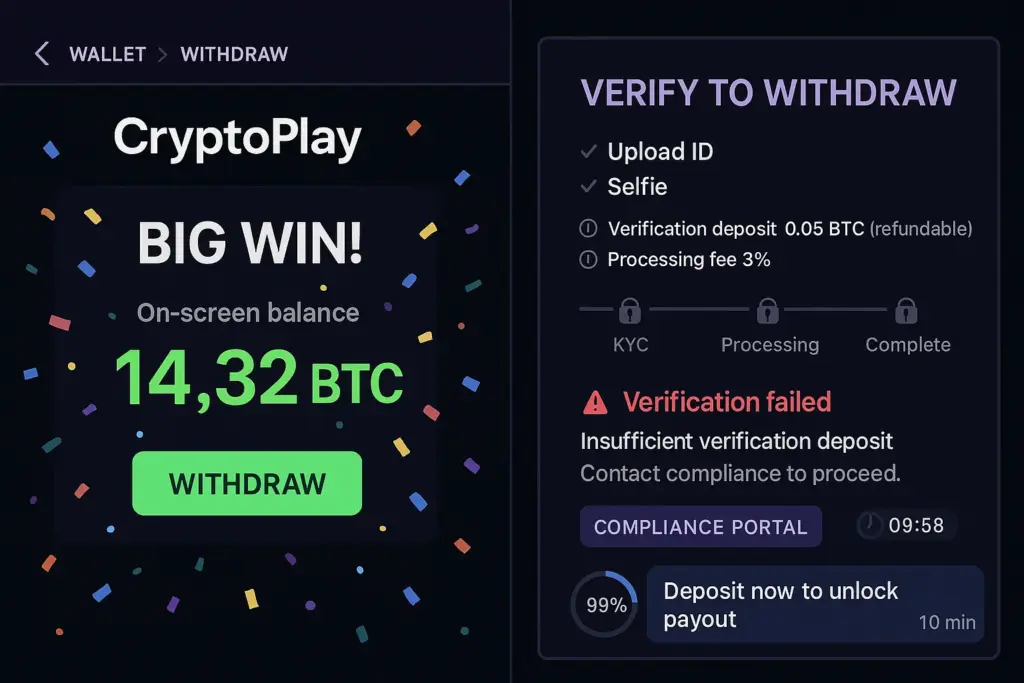
Early “wins” push the on-screen balance higher, then a withdrawal request triggers KYC and a “verification deposit” or “processing fee” before anything can continue.
Fee barriers and KYC collection
Each stage adds another excuse – VIP upgrades, AML checks, taxes – while draining more crypto and collecting high-value identity documents.

Delays, rebrands, and “recovery” bait
Support language sounds sympathetic while adding more hurdles, then the site vanishes and shifts to a new domain. Soon after, a “recovery agent” may arrive with the follow-up scam.
Staying protected from crypto casino scams like Ovotower
Protecting yourself starts with routine checks before any deposit ever leaves your wallet. The habits below make you harder to fool and give you a repeatable way to separate real operators from disposable scam fronts.
Confirm license claims in official registers
Search regulator databases by company name and domain, not by logos displayed on the page. No record usually means the operation is unlicensed.
Review domain age and history
Use public WHOIS tools and web archives to spot brand-new, privacy-masked domains and repeated clone behavior across different names.
Refuse withdrawal fees and “unlock” payments
Legitimate platforms do not require up-front “processing,” “tax,” or “verification” payments before releasing your funds.
Choose venues with recourse options
Favor operators with verifiable licensing, fiat rails, and clear dispute processes; crypto-only fronts are designed to maximize irreversibility.
Reduce wallet exposure
Use fresh addresses, enable 2FA everywhere, and regularly revoke token approvals you no longer need on connected chains.
Test “provably fair” claims
If you cannot independently confirm each bet with public seeds and hashes, treat the claim as advertising rather than proof.
Collect records and report quickly
Save TxIDs, chats, and screenshots. Report the case to your national cybercrime unit and any exchanges involved; speed can improve your options.
Build a deliberate pause before paying
Discipline beats urgency: pause before sending a deposit, verify licensing and domain history, and decide only after those checks are finished.
Useful Resources for Scam Reporting and Prevention (By Country)
Even when funds move fast, prompt reporting can still matter – stablecoin issuers and exchanges sometimes respond when authorities provide solid evidence. Use the directory below to file complaints and connect your documentation to wider cases.
Click here to report the scam in your country
| Country / Agency | URL | Category / Use-case | Phone/Email |
| Australia – Crime Stoppers | https://www.crimestoppers.com.au | Anonymous crime tips | 1800 333 000 |
| Australia – National Anti-Scam Center (Scamwatch) | https://www.scamwatch.gov.au/report-a-scam | General scams; phishing; texts/emails | |
| Australia – Police Assistance Line (non-emergency) | https://www.police.gov.au | Local police report | 131 444 |
| Australia – ReportCyber (ACSC) | https://www.cyber.gov.au/report | Cybercrime (hacks, fraud, extortion) | |
| Canada – Canadian Anti-Fraud Center (CAFC) | https://www.antifraudcentre-centreantifraude.ca/report-signalez-eng.htm | General scams including phone/text/email | |
| France – DGCCRF (SignalConso) | https://signal.conso.gouv.fr | Consumer scams/deceptive practices | |
| France – PHAROS – Internet-Signalement | https://www.internet-signalement.gouv.fr | Online content & cybercrime reports | |
| Germany – Bundeskriminalamt / Local Police | https://www.polizei.de/Polizei/DE/Home/home_node.html | Report online fraud | |
| Germany – Weißer Ring – Victim Support | https://weisser-ring.de | Victim support | 116 006 |
| India – DoT Helpline (Sanchar Saathi) | https://sancharsaathi.gov.in | Fraudulent telecom/SIM related | 155260 |
| India – National Consumer Helpline | https://consumerhelpline.gov.in | Consumer scams | 1800-11-4000 / 1915 |
| India – National Cyber Crime Reporting Portal | https://cybercrime.gov.in | Cybercrime including online fraud | 1930 |
| Japan – Consumer Affairs Agency (CAA) | https://www.caa.go.jp/policies/policy/consumer_policy/caution/cybercrime/ | Consumer scams | |
| Japan – National Police Agency – Cybercrime | https://www.npa.go.jp/bureau/cyber/ | Cybercrime reporting | |
| Mexico – Guardia Nacional (National Guard) | https://www.gob.mx/gn | Cybercrime reporting | |
| Mexico – Instituto Federal de Telecomunicaciones (IFT) | https://www.ift.org.mx | Telecom/online services scams | |
| Mexico – PROFECO | https://www.gob.mx/profeco | Consumer fraud & ecommerce | |
| Netherlands – AFM – Report investment fraud | https://www.afm.nl/en/consumenten/themas/beleggen/misleiding-misbruik | Investment/crypto | |
| Netherlands – Fraudehelpdesk | https://www.fraudehelpdesk.nl/melden | General scams (including phishing/SMS) | 088-7867372 |
| Netherlands – Politie – Meldpunt Internetoplichting | https://www.politie.nl/themas/internetoplichting.html | Online shopping fraud | |
| New Zealand – CERT NZ | https://www.cert.govt.nz/individuals/report-an-issue/ | Phishing, identity scams | |
| New Zealand – Department of Internal Affairs – Spam | https://www.dia.govt.nz/Spam-Contact-Us | Email/SMS spam | [email protected] |
| New Zealand – IDCARE | https://www.idcare.org | Victim support (identity compromise) | 0800 121 068 |
| New Zealand – Netsafe – Report | https://www.netsafe.org.nz/report/ | Online harms & scams | |
| New Zealand – New Zealand Police (non-emergency) | https://www.police.govt.nz/use-105 | Report fraud/online crime | 105 |
| Nigeria – Economic & Financial Crimes Commission (EFCC) | https://www.efcc.gov.ng | Financial scams including crypto/investment | [email protected] |
| Nigeria – Nigeria Police Special Fraud Unit (SFU) | https://www.specialfraudunit.org.ng | Serious fraud | Voice/SMS: 0708 227 6895; WhatsApp: 0812 760 9914 |
| Poland – CERT Polska (CERT.PL) | https://cert.pl/en/report/ | Cyber incidents & phishing | |
| Poland – Dyzurnet.pl | https://dyzurnet.pl | Illegal online content (especially child protection) | |
| Poland – Polish Police (Policja) | https://www.policja.pl | Report scams to police | |
| Singapore – Anti-Scam Centre / Anti-Scam Helpline | https://www.scamalert.sg | General scams; texts; calls | 1800-722-6688 |
| Singapore – Monetary Authority of Singapore (MAS) | https://www.mas.gov.sg/investor-alert-list | Investment/crypto checks | |
| Singapore – Singapore Police Force | https://www.police.gov.sg/iwitness | Police report (cybercrime) | |
| South Africa – Cybersecurity Hub (CSIRT) | https://www.cybersecurityhub.gov.za | Cyber incidents including scams | |
| South Africa – South African Fraud Prevention Service (SAFPS) | https://www.safps.org.za | Identity fraud support | 011-867-2234 |
| South Africa – South African Police Service (SAPS) | https://www.saps.gov.za | Police report (cybercrime unit) | |
| South Korea – Korea Communications Commission (KCC) | https://www.kcc.go.kr | Telecom-related fraud | |
| South Korea – Korea Internet & Security Agency (KISA) | https://www.kisa.or.kr | Phishing, online harms | |
| South Korea – Korean National Police Agency – Cyber Bureau | https://ecrm.cyber.go.kr | Cybercrime reporting | |
| Spain – INCIBE – Oficina de Seguridad del Internauta (OSI) | https://www.osi.es/es/reporte | Cybersecurity & online fraud | |
| Spain – Policía Nacional / Guardia Civil | https://www.policia.es | Report scams to police | |
| Sweden – Crime Victim Authority (Brottsoffermyndigheten) | https://www.brottsoffermyndigheten.se | Victim support & compensation | 090–70 82 00 |
| Sweden – Polisen (Swedish Police) | https://polisen.se | Report fraud/cybercrime | 114 14 (non-emergency); 112 (emergency) |
| Sweden – Swedish Consumer Agency (Konsumentverket) | https://www.konsumentverket.se | Unfair business practices | |
| United Arab Emirates – Abu Dhabi Police – Aman Service | https://www.adpolice.gov.ae | Cybercrime tips/reporting | SMS 2828; 800 2626 |
| United Arab Emirates – Dubai Police – eCrime | https://www.dubaipolice.gov.ae | Cybercrime reporting | 04 606 1600 |
| United Arab Emirates – Ministry of Interior – Cyber Crime Dept. | https://www.moi.gov.ae | Cybercrime including online scams | |
| United Arab Emirates – Telecommunications Regulatory Authority (TRA) / TDRA | https://www.tra.gov.ae | Telecom-related scams/phishing | |
| United Kingdom – Action Fraud (NFIB) | https://www.actionfraud.police.uk | General scams & cybercrime (non-emergency) | 0300 123 2040 |
| United Kingdom – Citizens Advice Consumer Service | https://www.citizensadvice.org.uk/consumer/get-more-help/if-you-need-more-help-about-a-consumer-issue/ | Consumer problems & scam guidance | 0808 223 1133 |
| United Kingdom – Financial Conduct Authority (FCA) | https://www.fca.org.uk/consumers/report-scam-us | Investment/crypto & financial services | |
| United Kingdom – National Cyber Security Centre (NCSC) | https://www.ncsc.gov.uk/collection/phishing-scams | Phishing emails & suspicious websites | |
| United Kingdom – Stop Scams UK ‘159’ | https://stopscamsuk.org.uk/159 | Banking APP fraud (direct to your bank) | 159 |
| United States – AARP Fraud Watch Network Helpline | https://www.aarp.org/money/scams-fraud/ | Victim support | 833-372-8311 |
| United States – Better Business Bureau – Scam Tracker | https://www.bbb.org/scamtracker | Business/marketplace scams | |
| United States – FBI Internet Crime Complaint Center (IC3) | https://www.ic3.gov | Internet crime including investment/crypto | |
| United States – Federal Trade Commission – ReportFraud | https://reportfraud.ftc.gov | General scams, phishing, texts/emails | 1-877-382-4357 |
| United States – National Center for Disaster Fraud | https://www.justice.gov/disaster-fraud | Disaster-related scams | (866) 720-5721 |
| United States – SEC Tips & Complaints | https://www.sec.gov/tcr | Investment & securities/crypto-asset offerings |
That is the full pattern: recognize how it works, contain exposure quickly, and perform verifiable checks before sending money or uploading documents.
