

Did you get a text saying you owe money for a parking ticket or a Penalty Charge Notice? Okay so stop right there because this is the first thing you need to notice, parking fines do not normally arrive as a random text message with a payment link sitting underneath it.
That alone should make you slow down. The message might look official, it might mention a PCN, a local council, or government looking page, and it might only ask for a small amount like £20, but that is exactly why it works. People see a small fine and think, fine, I will just pay it. That is the trap.
Scams of PCN Fine Scam Text‘s type are known to steal personal data and passwords. Install SpyHunter Pro to scan for risks, remove any dangerous trackers, and enable real-time protection.

Try Free For 7 Days*
Buy now15% OFF if you buy straight without trial.
 OFFER
OFFERUnderstanding the PCN Fine Scam Text
So here is what is happening. Scammers, similar to Toll Roads scam and Ilroads scam, are sending texts to people in the UK claiming they have an unpaid parking fine. The message pushes them toward a fake website that looks like a government or council payment page, and then it asks for personal details, vehicle details, and payment information. Now if you are someone who parks in council car parks or uses parking apps, I get why this might feel believable. One person even said it made sense to them because they used PayByPhone at a local train station. But believable is not the same as real.
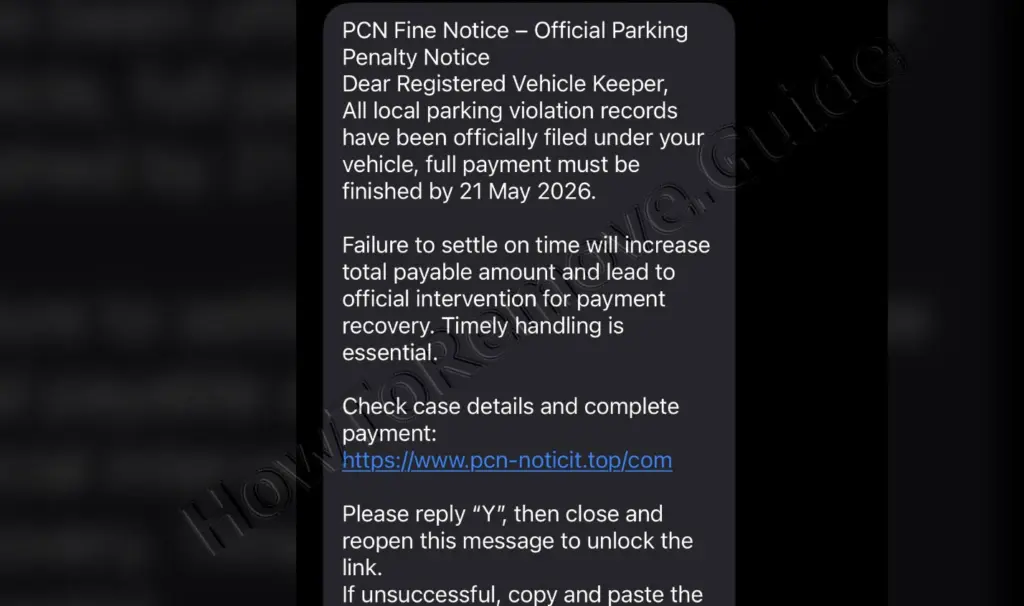
A real PCN is issued on the vehicle, handed to the driver, or sent by post. It is not normally blasted out by SMS to whoever happens to receive the scam text that day. Local authorities have also made this clear, they do not text customers about parking fines because they would not usually have your phone number. So when a message claims you owe money but gives you no proper PCN number, no photo, no location, no timestamp, and no clear vehicle details, this is where the alarm bells should be deafening.
Also, PCNs are handled by local authorities, not by some vague central government payment demand. If a genuine fine exists, you should be able to verify it through the relevant council directly. Not through a text link. Not through a site that just looks official. Directly.
What to Do If You’ve Fallen for the PCN Fine Scam
Now here is where people panic, and honestly that is understandable. If you clicked the link or typed something in, do not sit there spiraling, just move quickly. If you entered card details, contact your bank or card issuer immediately and ask them to freeze the card and replace it. If the scammers have those details, you do not want to give them time to test them or use them.
Then check your account for anything strange. If you see a transaction you do not recognize, report it to the bank straight away. If you entered personal details, be extra alert for more scam texts, calls, or emails, because once you interact with one of these messages the scammers may treat your number as active.
If you are still worried there might be a real PCN somewhere, do not go back to the text. Search for your local council yourself, find the official parking services page, and contact them. That is the clean way to check.
How the PCN Fine Scam Text Tricks You
The scam is not clever because the website is magical. It is clever because it gets you at the right emotional angle. It makes you feel like you have done something wrong and now you have to fix it before the cost goes up. That little feeling of guilt is powerful. Even if you are not sure you parked badly, you start thinking maybe I missed something, maybe there was a camera, maybe I forgot.
Then they add official sounding language. Penalty Charge Notice. Registered Vehicle Keeper. Legal proceedings. Official intervention. It is all there to make a basic text message feel heavier than it is.
Now notice the appearance trick. Some victims said the site looked like GOV.UK, but looking like it and being it are two very different things. A scam page can copy colours, layout, and wording. What it cannot do is become the real council site just because it has a serious looking header.
There is also the urgency trick. One person said the message demanded payment today. That is not a small detail, that is the whole engine of the scam. They want you moving before you think.
And then there is the strange reply trick, where some messages tell you to reply Y and reopen the message to unlock the link. Come on. A real council is not going to make you perform little SMS rituals just to pay a fine.
Recognizing Warning Signs of the PCN Fine Scam Text
The biggest warning sign is the delivery method. A parking fine by random text is suspicious from the start. Then look at the greeting. If it says something generic like Dear Registered Vehicle Keeper, but does not know your name, registration, or where the alleged offence happened, that is not precision, that is a mass message dressed up in official clothes.
The link is another giveaway. Reported addresses included things like pcn-noticit[.]top and pcn-NOTICIT[.]top/com. Now time out here, because this is exactly the kind of thing people skim past. The odd wording, the .top ending, and the fake looking /com are not tiny details. They are the scam showing its hand.
Also watch for poor English, a private mobile number, threats about legal action, pressure to pay immediately, and amounts that do not match normal PCN patterns. But the practical question is even simpler: how did they connect your phone number to your car? If they cannot even tell you the vehicle registration, what exactly are they claiming to know?
How to Handle a Suspicious Parking Fine Message
If you get one of these texts, do not click the link. Do not reply. Do not enter your name, address, registration, bank details, or card number. Just do not feed the machine.
Report it if you can, block the sender, and delete it. If it claims to be from a council, go to the council yourself using a website you found independently. Search the council name, find parking services, and verify. The important part is that you control the route. The scammer does not get to choose the doorway.
If the message says you must pay today, that is your cue to slow down, not speed up. Real processes give proper references.
Reporting the Scam
In the UK, scam texts can be forwarded to 7726. If the message relates to York, the reporting route given was Veritau on 0800 9179 247 or [email protected]. You can also use your phone’s spam or junk reporting option.
Useful Resources for Scam Reporting and Prevention (By Country)
Open the country-by-country reporting list
| Country / Agency | URL | Category / Use-case | Phone/Email |
| Australia – Crime Stoppers | https://www.crimestoppers.com.au | Anonymous tips about crime | 1800 333 000 |
| Australia – National Anti-Scam Center (Scamwatch) | https://www.scamwatch.gov.au/report-a-scam | General scams; phishing; texts/emails | |
| Australia – Police Assistance Line (non-emergency) | https://www.police.gov.au | Local police report | 131 444 |
| Australia – ReportCyber (ACSC) | https://www.cyber.gov.au/report | Cybercrime (hacks, fraud, extortion) | |
| Canada – Canadian Anti-Fraud Center (CAFC) | https://www.antifraudcentre-centreantifraude.ca/report-signalez-eng.htm | General scams incl. phone/text/email | |
| France – DGCCRF (SignalConso) | https://signal.conso.gouv.fr | Consumer scams/deceptive practices | |
| France – PHAROS – Internet-Signalement | https://www.internet-signalement.gouv.fr | Online content & cybercrime reports | |
| Germany – Bundeskriminalamt / Local Police | https://www.polizei.de/Polizei/DE/Home/home_node.html | Report online fraud | |
| Germany – Weißer Ring – Victim Support | https://weisser-ring.de | Victim support | 116 006 |
| India – DoT Helpline (Sanchar Saathi) | https://sancharsaathi.gov.in | Fraudulent telecom/SIM related | 155260 |
| India – National Consumer Helpline | https://consumerhelpline.gov.in | Consumer scams | 1800-11-4000 / 1915 |
| India – National Cyber Crime Reporting Portal | https://cybercrime.gov.in | Cybercrime incl. online fraud | 1930 |
| Japan – Consumer Affairs Agency (CAA) | https://www.caa.go.jp/policies/policy/consumer_policy/caution/cybercrime/ | Consumer scams | |
| Japan – National Police Agency – Cybercrime | https://www.npa.go.jp/bureau/cyber/ | Cybercrime reporting | |
| Mexico – Guardia Nacional (National Guard) | https://www.gob.mx/gn | Cybercrime reporting | |
| Mexico – Instituto Federal de Telecomunicaciones (IFT) | https://www.ift.org.mx | Telecom/online services scams | |
| Mexico – PROFECO | https://www.gob.mx/profeco | Consumer fraud & ecommerce | |
| Netherlands – AFM – Report investment fraud | https://www.afm.nl/en/consumenten/themas/beleggen/misleiding-misbruik | Investment/crypto | |
| Netherlands – Fraudehelpdesk | https://www.fraudehelpdesk.nl/melden | General scams (incl. phishing/SMS) | 088-7867372 |
| Netherlands – Politie – Meldpunt Internetoplichting | https://www.politie.nl/themas/internetoplichting.html | Online shopping fraud | |
| New Zealand – CERT NZ | https://www.cert.govt.nz/individuals/report-an-issue/ | Phishing, identity scams | |
| New Zealand – Department of Internal Affairs – Spam | https://www.dia.govt.nz/Spam-Contact-Us | Email/SMS spam | [email protected] |
| New Zealand – IDCARE | https://www.idcare.org | Victim support (identity compromise) | 0800 121 068 |
| New Zealand – Netsafe – Report | https://www.netsafe.org.nz/report/ | Online harms & scams | |
| New Zealand – New Zealand Police (non-emergency) | https://www.police.govt.nz/use-105 | Report fraud/online crime | 105 |
| Nigeria – Economic & Financial Crimes Commission (EFCC) | https://www.efcc.gov.ng | Financial scams incl. crypto/investment | [email protected] |
| Nigeria – Nigeria Police Special Fraud Unit (SFU) | https://www.specialfraudunit.org.ng | Serious fraud | Voice/SMS: 0708 227 6895; WhatsApp: 0812 760 9914 |
| Poland – CERT Polska (CERT.PL) | https://cert.pl/en/report/ | Cyber incidents & phishing | |
| Poland – Dyzurnet.pl | https://dyzurnet.pl | Illegal online content (esp. child protection) | |
| Poland – Polish Police (Policja) | https://www.policja.pl | Report scams to police | |
| Singapore – Anti-Scam Centre / Anti-Scam Helpline | https://www.scamalert.sg | General scams; texts; calls | 1800-722-6688 |
| Singapore – Monetary Authority of Singapore (MAS) | https://www.mas.gov.sg/investor-alert-list | Investment/crypto checks | |
| Singapore – Singapore Police Force | https://www.police.gov.sg/iwitness | Police report (cybercrime) | |
| South Africa – Cybersecurity Hub (CSIRT) | https://www.cybersecurityhub.gov.za | Cyber incidents incl. scams | |
| South Africa – South African Fraud Prevention Service (SAFPS) | https://www.safps.org.za | Identity fraud support | 011-867-2234 |
| South Africa – South African Police Service (SAPS) | https://www.saps.gov.za | Police report (cybercrime unit) | |
| South Korea – Korea Communications Commission (KCC) | https://www.kcc.go.kr | Telecom-related fraud | |
| South Korea – Korea Internet & Security Agency (KISA) | https://www.kisa.or.kr | Phishing, online harms | |
| South Korea – Korean National Police Agency – Cyber Bureau | https://ecrm.cyber.go.kr | Cybercrime reporting | |
| Spain – INCIBE – Oficina de Seguridad del Internauta (OSI) | https://www.osi.es/es/reporte | Cybersecurity & online fraud | |
| Spain – Policía Nacional / Guardia Civil | https://www.policia.es | Report scams to police | |
| Sweden – Crime Victim Authority (Brottsoffermyndigheten) | https://www.brottsoffermyndigheten.se | Victim support & compensation | 090–70 82 00 |
| Sweden – Polisen (Swedish Police) | https://polisen.se | Report fraud/cybercrime | 114 14 (non-emergency); 112 (emergency) |
| Sweden – Swedish Consumer Agency (Konsumentverket) | https://www.konsumentverket.se | Unfair business practices | |
| United Arab Emirates – Abu Dhabi Police – Aman Service | https://www.adpolice.gov.ae | Cybercrime tips/reporting | SMS 2828; 800 2626 |
| United Arab Emirates – Dubai Police – eCrime | https://www.dubaipolice.gov.ae | Cybercrime reporting | 04 606 1600 |
| United Arab Emirates – Ministry of Interior – Cyber Crime Dept. | https://www.moi.gov.ae | Cybercrime incl. online scams | |
| United Arab Emirates – Telecommunications Regulatory Authority (TRA) / TDRA | https://www.tra.gov.ae | Telecom-related scams/phishing | |
| United Kingdom – Action Fraud (NFIB) | https://www.actionfraud.police.uk | General scams & cybercrime (non-emergency) | 0300 123 2040 |
| United Kingdom – Citizens Advice Consumer Service | https://www.citizensadvice.org.uk/consumer/get-more-help/if-you-need-more-help-about-a-consumer-issue/ | Consumer problems & scam guidance | 0808 223 1133 |
| United Kingdom – Financial Conduct Authority (FCA) | https://www.fca.org.uk/consumers/report-scam-us | Investment/crypto & financial services | |
| United Kingdom – National Cyber Security Centre (NCSC) | https://www.ncsc.gov.uk/collection/phishing-scams | Phishing emails & suspicious websites | |
| United Kingdom – Stop Scams UK ‘159’ | https://stopscamsuk.org.uk/159 | Banking APP fraud (direct to your bank) | 159 |
| United States – AARP Fraud Watch Network Helpline | https://www.aarp.org/money/scams-fraud/ | Victim support | 833-372-8311 |
| United States – Better Business Bureau – Scam Tracker | https://www.bbb.org/scamtracker | Business/marketplace scams | |
| United States – FBI Internet Crime Complaint Center (IC3) | https://www.ic3.gov | Internet crime incl. investment/crypto | |
| United States – Federal Trade Commission – ReportFraud | https://reportfraud.ftc.gov | General scams, phishing, texts/emails | 1-877-382-4357 |
| United States – National Center for Disaster Fraud | https://www.justice.gov/disaster-fraud | Disaster-related scams | (866) 720-5721 |
| United States – SEC Tips & Complaints | https://www.sec.gov/tcr | Investment & securities/crypto-asset offerings |
Staying Safe in the Future
The safest rule is simple. Never pay a parking fine through an unexpected text link. If a PCN is real, you can verify it through the local authority. If the text is vague, rushed, and full of links, treat it like what it is, a scam trying to turn confusion into money. Slow down, check directly, and do not let a random message drive the whole decision.
