

At first glance, Polyglow.cc can pass as a working prediction-market site. The page leans on active markets and live trades to make the activity feel current. Odds and payout-style values do the financial framing; market volumes and the Bitcoin-or-Ethereum up-or-down examples make that framing look specific before a new visitor has checked who is behind it. The login and signup controls are the turn I would not ignore: they move the reader from watching a market page to handing over account access.
Scams of Polyglow.cc‘s type are known to steal personal data and passwords. Install SpyHunter Pro to scan for risks, remove any dangerous trackers, and enable real-time protection.

Try Free For 7 Days*
Buy now15% OFF if you buy straight without trial.
 OFFER
OFFERThe trust problem sits behind that invitation. Domain records put POLYGLOW.CC’s registration on 2026-07-11. That recent start matters because the operator and licensing trail is still unclear. ScamAdviser gives polyglow.cc a Trust Score of 0 with a “Very Likely Unsafe” label. For me, that is enough to treat the site as high risk. Do not share credentials or connect a wallet there; treat any request for money and any displayed market value as untrusted.

IMPORTANT! READ BEFORE PROCEEDING!
If you are on Polyglow.cc, do not let curiosity become an account. Stop before account creation; a reused password can turn one risky signup into a wider account problem. Keep money and wallet access away from it, and do not upload documents or pay an extra charge. If you already interacted with the site, save screenshots first. Add usernames and dates to that record, then include the account email plus any payment or wallet details that apply. Secure the related accounts before doing anything else.
In such cases, the first step we strongly recommend is using SpyHunter 5 to scan and secure your device, as shown below.
Protect Your System and Privacy Using SpyHunter 5
- 1.1Click here to download and install SpyHunter on your PC.
- 1.2Start SpyHunter 5, click the Buy button and choose between starting your 7-days free trial or directly purchasing the tool.
If you choose to buy SpyHunter 5 now, you can use our discount code, “HTRG15“, for 15% off.
- 1.3
 Once you activate SpyHunter, click Start Scan Now, select the Full Scan option, and let the tool do its job.
 - 1.4
 Once the scan completes (it could take a while, so have patience), you’ll see all undesirables listed as well as any system vulnerabilities that may endanger your privacy.
Click Next to review the detections and then click Next again to delete all rogue items.
After using SpyHunter, we strongly recommend that you also apply the following additional security measures:
- Reset any password you reused on Polyglow.cc and enable two-factor authentication on the related email or financial accounts.
- Save screenshots of the site, account page, market page, payment prompts, messages, and dates before pages change.
- Contact your bank, card provider, exchange, or wallet provider if money or assets were sent.
- Separate exposed wallets or accounts from clean funds only if you shared wallet, payment, or login details.
- Report the domain and any payment request through official platform, provider, or cybercrime channels.
How We Know Polyglow.cc is a Scam
What makes Polyglow.cc hard to excuse is how the signals compound. The site asks for trust around account access and value-facing market activity while marketing itself as a live prediction-market and betting-adjacent platform. Domain records then put that trust request on a very recent registration with no clear operator trail. ScamAdviser rates polyglow.cc at 0 and labels it “Very Likely Unsafe,” so signup or payment exposure is hard to justify unless stronger independent proof appears first.
Very new domain
Domain records show POLYGLOW.CC was registered on 2026-07-11 and is set to expire one year later. That fact alone does not make the site fraudulent. It does put the burden on a money-facing prediction-market site to show who owns it and what license applies. A practical recourse path has to be clear before the site asks for trust.
Trust score warning
ScamAdviser assigned polyglow.cc a Trust Score of 0 and labeled it “Very Likely Unsafe.” On a site built around trading-style or betting-adjacent value claims, I would not wave that away as a minor reputation issue; it is a strong reason to avoid account and payment exposure.
Prediction-market bait
Polyglow.cc does the confidence-building work on the page itself. The “Prediction Markets” label gives the visitor a familiar frame, while active markets and live trades make the page feel current. “How to trade” offers a next step, and the market volumes with Bitcoin up-or-down examples make the motion look specific enough to trust too quickly. That appearance should not carry the decision before the reader has verified who runs the site or what recourse would exist if something goes wrong.
Unclear accountability
A money-facing prediction-market service has to show accountability before trust. That standard matters even more when the product resembles betting or gambling. A reader should be able to confirm who runs the company and what license applies. Support also has to lead to a responsible party if there is a dispute. Polyglow.cc does not show enough verified accountability for me to trust it with signup or money-facing activity.
Thin public footprint
A urlscan search returned zero results for the target at the time of review. That does not prove malicious infrastructure, but it leaves the reader with less outside record to compare against the site’s own market claims, which matters when the page is asking for account-level trust.
Pattern risk, not proof
Similar online gambling and crypto-trading scam discussions matter because they show how this type of setup can move from display to pressure. Displayed balances can make betting-style activity feel normal; once that happens, a later payment step may seem less abrupt. Those reports are not Polyglow.cc-specific, but they are enough reason not to deposit on an unverified site. Wallet actions and document sharing should wait until the platform is independently trustworthy.

How the Polyglow.cc Scam Deception Funnel Works
The risk path starts with a page busy enough to lower suspicion. Live trades and volume cues make the markets look active, and the categories with crypto examples push that activity toward a money-facing product rather than a static pitch. Once the page feels believable, commitment gets easier to ask for. An account can come first, and displayed values can make a later payment-related prompt feel less strange if one appears.
For Polyglow.cc, the fair claim is risk, not proof that every scam stage has already happened. The visible features and warning signals are still enough to stop before the site turns attention into credentials or funds. Wallet exposure and personal documents belong on the same side of that line.
Market promise
Polyglow.cc uses prediction-market language, active markets, live trades, and trading instructions to make the site feel functional. A polished market interface can create trust faster than the independent record supports.

Account commitment
The login and signup controls are the first practical exposure point. If a reader creates an account with a reused password or sensitive email, the risk can spread beyond this one site.

Live-trade theater
Odds, volumes, live trades, and wallet-like short identifiers can create pressure to believe there is real liquidity or urgency. Treat those displays as claims until the platform is independently verified.
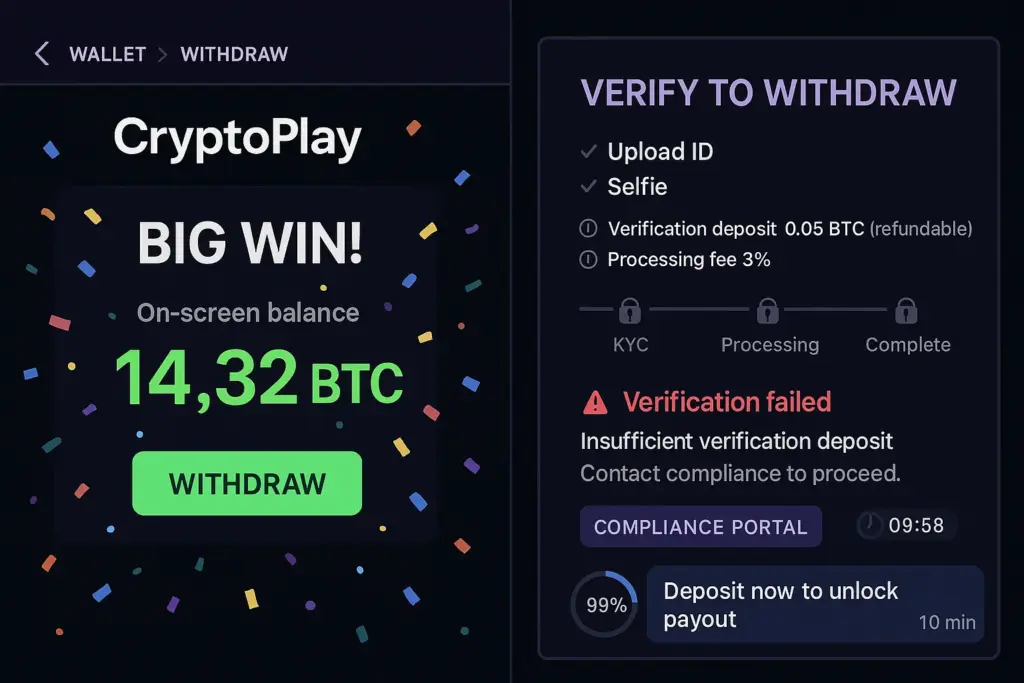
Crypto or payment pressure
The interface includes crypto examples, but that alone is not a reason to send funds or connect a wallet. If the site later asks for crypto, a wallet action, or another hard-to-reverse payment, stop and verify through trusted sources first.

Weak recourse
A very new domain, unclear operator details, and a severe public trust warning leave users with little practical confidence if something goes wrong. Do not add more information or money when accountability is unclear.
Staying safe from crypto casino scams like Polyglow.cc
Use Polyglow.cc as the point where you slow down before engaging with any betting-adjacent or prediction-market site. First check whether the domain age matches the trust the site is asking for and whether the operator is identifiable. Licensing and reputation should support that answer before you look at money movement. Read the withdrawal rules before money moves, then check whether payment recourse and support would still exist if something went wrong. Do that before you create an account or treat displayed market activity as real value.
Check domain age
WHOIS-style domain records show whether a site is new, short-lived, or recently changed. A very new money-facing site should be treated as unproven until its history and accountability are clear.
Verify the operator
A legitimate betting, gambling, or trading platform should make its company, license, regulator, and support route easy to confirm. Do not rely on a site simply because the interface looks professional.
Distrust displayed odds
Displayed balances, odds, volumes, and live activity are claims, not proof. Treat them as unverified until the platform has a trustworthy record and clear user recourse.
Avoid irreversible payments
Do not send crypto or other hard-to-reverse payments to an unverified prediction-market or betting-adjacent site. If a payment request appears, pause and verify outside the site before acting.
Protect credentials
Use a unique password for every account and avoid signing in with credentials you use elsewhere. If you already reused a password, change it quickly and secure the linked email account.
Keep wallets separate
If a wallet was connected during any interaction, review approvals using trusted wallet guidance and keep clean funds away from exposed wallets. Do not connect a primary wallet to an unverified site.
Preserve evidence
Save the domain name, screenshots, dates, usernames, account emails, messages, payment prompts, wallet addresses, transaction IDs, and support replies if they exist. Reports are stronger when the timeline is clear.
Slow down before engagement
New sites, crypto examples, betting categories, and severe public warnings are enough reason to pause. Do not let displayed activity or market-style urgency push you into signup or payment decisions.
Useful Resources for Scam Reporting and Prevention (By Country)
Even when funds move quickly, timely reporting can still help – stablecoin issuers and exchanges sometimes act when authorities provide solid evidence. Use the directory below to submit complaints and link your documentation to ongoing cases.
Click here to report the scam in your country
| Country / Agency | URL | Category / Use-case | Phone/Email |
| Australia – Crime Stoppers | https://www.crimestoppers.com.au | Anonymous tips about crime | 1800 333 000 |
| Australia – National Anti-Scam Center (Scamwatch) | https://www.scamwatch.gov.au/report-a-scam | General scams; phishing; texts/emails | |
| Australia – Police Assistance Line (non-emergency) | https://www.police.gov.au | Local police report | 131 444 |
| Australia – ReportCyber (ACSC) | https://www.cyber.gov.au/report | Cybercrime (hacks, fraud, extortion) | |
| Canada – Canadian Anti-Fraud Center (CAFC) | https://www.antifraudcentre-centreantifraude.ca/report-signalez-eng.htm | General scams incl. phone/text/email | |
| France – DGCCRF (SignalConso) | https://signal.conso.gouv.fr | Consumer scams/deceptive practices | |
| France – PHAROS – Internet-Signalement | https://www.internet-signalement.gouv.fr | Online content & cybercrime reports | |
| Germany – Bundeskriminalamt / Local Police | https://www.polizei.de/Polizei/DE/Home/home_node.html | Report online fraud | |
| Germany – Weißer Ring – Victim Support | https://weisser-ring.de | Victim support | 116 006 |
| India – DoT Helpline (Sanchar Saathi) | https://sancharsaathi.gov.in | Fraudulent telecom/SIM related | 155260 |
| India – National Consumer Helpline | https://consumerhelpline.gov.in | Consumer scams | 1800-11-4000 / 1915 |
| India – National Cyber Crime Reporting Portal | https://cybercrime.gov.in | Cybercrime incl. online fraud | 1930 |
| Japan – Consumer Affairs Agency (CAA) | https://www.caa.go.jp/policies/policy/consumer_policy/caution/cybercrime/ | Consumer scams | |
| Japan – National Police Agency – Cybercrime | https://www.npa.go.jp/bureau/cyber/ | Cybercrime reporting | |
| Mexico – Guardia Nacional (National Guard) | https://www.gob.mx/gn | Cybercrime reporting | |
| Mexico – Instituto Federal de Telecomunicaciones (IFT) | https://www.ift.org.mx | Telecom/online services scams | |
| Mexico – PROFECO | https://www.gob.mx/profeco | Consumer fraud & ecommerce | |
| Netherlands – AFM – Report investment fraud | https://www.afm.nl/en/consumenten/themas/beleggen/misleiding-misbruik | Investment/crypto | |
| Netherlands – Fraudehelpdesk | https://www.fraudehelpdesk.nl/melden | General scams (incl. phishing/SMS) | 088-7867372 |
| Netherlands – Politie – Meldpunt Internetoplichting | https://www.politie.nl/themas/internetoplichting.html | Online shopping fraud | |
| New Zealand – CERT NZ | https://www.cert.govt.nz/individuals/report-an-issue/ | Phishing, identity scams | |
| New Zealand – Department of Internal Affairs – Spam | https://www.dia.govt.nz/Spam-Contact-Us | Email/SMS spam | [email protected] |
| New Zealand – IDCARE | https://www.idcare.org | Victim support (identity compromise) | 0800 121 068 |
| New Zealand – Netsafe – Report | https://www.netsafe.org.nz/report/ | Online harms & scams | |
| New Zealand – New Zealand Police (non-emergency) | https://www.police.govt.nz/use-105 | Report fraud/online crime | 105 |
| Nigeria – Economic & Financial Crimes Commission (EFCC) | https://www.efcc.gov.ng | Financial scams incl. crypto/investment | [email protected] |
| Nigeria – Nigeria Police Special Fraud Unit (SFU) | https://www.specialfraudunit.org.ng | Serious fraud | Voice/SMS: 0708 227 6895; WhatsApp: 0812 760 9914 |
| Poland – CERT Polska (CERT.PL) | https://cert.pl/en/report/ | Cyber incidents & phishing | |
| Poland – Dyzurnet.pl | https://dyzurnet.pl | Illegal online content (esp. child protection) | |
| Poland – Polish Police (Policja) | https://www.policja.pl | Report scams to police | |
| Singapore – Anti-Scam Centre / Anti-Scam Helpline | https://www.scamalert.sg | General scams; texts; calls | 1800-722-6688 |
| Singapore – Monetary Authority of Singapore (MAS) | https://www.mas.gov.sg/investor-alert-list | Investment/crypto checks | |
| Singapore – Singapore Police Force | https://www.police.gov.sg/iwitness | Police report (cybercrime) | |
| South Africa – Cybersecurity Hub (CSIRT) | https://www.cybersecurityhub.gov.za | Cyber incidents incl. scams | |
| South Africa – South African Fraud Prevention Service (SAFPS) | https://www.safps.org.za | Identity fraud support | 011-867-2234 |
| South Africa – South African Police Service (SAPS) | https://www.saps.gov.za | Police report (cybercrime unit) | |
| South Korea – Korea Communications Commission (KCC) | https://www.kcc.go.kr | Telecom-related fraud | |
| South Korea – Korea Internet & Security Agency (KISA) | https://www.kisa.or.kr | Phishing, online harms | |
| South Korea – Korean National Police Agency – Cyber Bureau | https://ecrm.cyber.go.kr | Cybercrime reporting | |
| Spain – INCIBE – Oficina de Seguridad del Internauta (OSI) | https://www.osi.es/es/reporte | Cybersecurity & online fraud | |
| Spain – Policía Nacional / Guardia Civil | https://www.policia.es | Report scams to police | |
| Sweden – Crime Victim Authority (Brottsoffermyndigheten) | https://www.brottsoffermyndigheten.se | Victim support & compensation | 090–70 82 00 |
| Sweden – Polisen (Swedish Police) | https://polisen.se | Report fraud/cybercrime | 114 14 (non-emergency); 112 (emergency) |
| Sweden – Swedish Consumer Agency (Konsumentverket) | https://www.konsumentverket.se | Unfair business practices | |
| United Arab Emirates – Abu Dhabi Police – Aman Service | https://www.adpolice.gov.ae | Cybercrime tips/reporting | SMS 2828; 800 2626 |
| United Arab Emirates – Dubai Police – eCrime | https://www.dubaipolice.gov.ae | Cybercrime reporting | 04 606 1600 |
| United Arab Emirates – Ministry of Interior – Cyber Crime Dept. | https://www.moi.gov.ae | Cybercrime incl. online scams | |
| United Arab Emirates – Telecommunications Regulatory Authority (TRA) / TDRA | https://www.tra.gov.ae | Telecom-related scams/phishing | |
| United Kingdom – Action Fraud (NFIB) | https://www.actionfraud.police.uk | General scams & cybercrime (non-emergency) | 0300 123 2040 |
| United Kingdom – Citizens Advice Consumer Service | https://www.citizensadvice.org.uk/consumer/get-more-help/if-you-need-more-help-about-a-consumer-issue/ | Consumer problems & scam guidance | 0808 223 1133 |
| United Kingdom – Financial Conduct Authority (FCA) | https://www.fca.org.uk/consumers/report-scam-us | Investment/crypto & financial services | |
| United Kingdom – National Cyber Security Centre (NCSC) | https://www.ncsc.gov.uk/collection/phishing-scams | Phishing emails & suspicious websites | |
| United Kingdom – Stop Scams UK ‘159’ | https://stopscamsuk.org.uk/159 | Banking APP fraud (direct to your bank) | 159 |
| United States – AARP Fraud Watch Network Helpline | https://www.aarp.org/money/scams-fraud/ | Victim support | 833-372-8311 |
| United States – Better Business Bureau – Scam Tracker | https://www.bbb.org/scamtracker | Business/marketplace scams | |
| United States – FBI Internet Crime Complaint Center (IC3) | https://www.ic3.gov | Internet crime incl. investment/crypto | |
| United States – Federal Trade Commission – ReportFraud | https://reportfraud.ftc.gov | General scams, phishing, texts/emails | 1-877-382-4357 |
| United States – National Center for Disaster Fraud | https://www.justice.gov/disaster-fraud | Disaster-related scams | (866) 720-5721 |
| United States – SEC Tips & Complaints | https://www.sec.gov/tcr | Investment & securities/crypto-asset offerings |
That’s the full picture: understand the pattern, contain exposure fast, and run verifiable checks before any deposit or document upload.
If you interacted with Polyglow.cc, preserve the domain and screenshots first. Add account details and the ScamAdviser warning details, then attach payment or wallet records if they apply. The reporting route depends on where the exposure happened: bank-side movement starts with the bank, while crypto exposure belongs with the exchange or wallet provider that handled it. Use the platform channel for platform abuse, and use law-enforcement or the appropriate cybercrime route for formal reporting. Do not go back to chase displayed balances or pay extra charges, and do not trust unofficial recovery offers. Keep containment and account security ahead of everything else; clean reporting comes after that record is safe.