

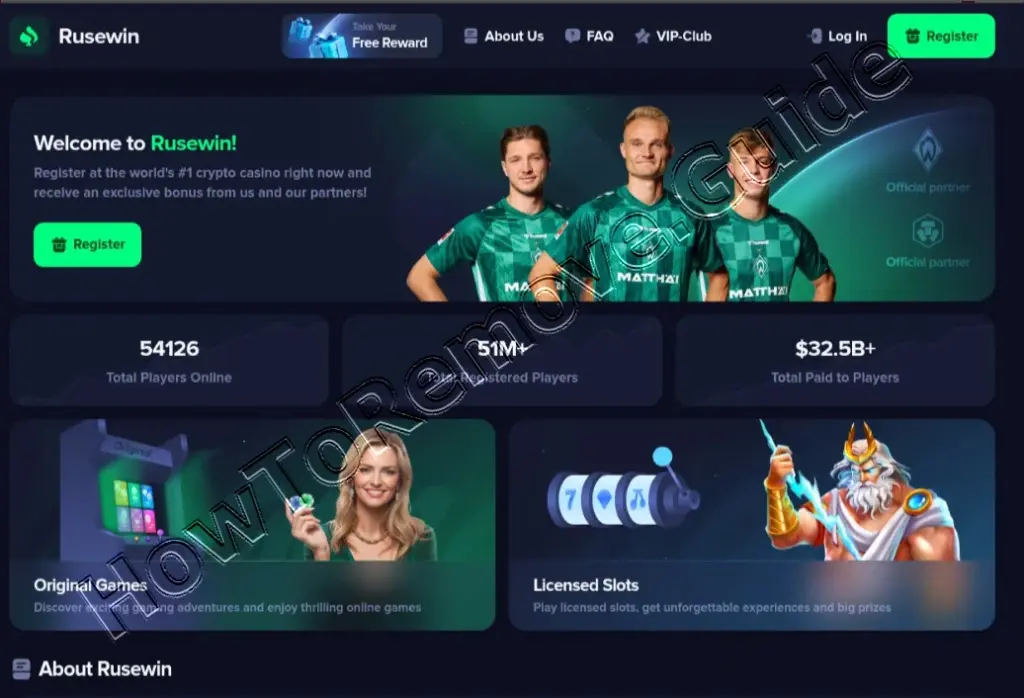
Rusewin.cc plays the oldest trick in the newest costume: “free money” with crypto glitter on top. You arrive, see its generous welcome bonus, and think that it’s a foolproof way to test your luck and not lose anything.
What really happens, however, is that you get lured into the scam without even realizing it. The site lets you gamble with bonus credit (no strings attached!) and may even make you “win” quickly, just enough to light up your brain’s reward circuitry and convince you it’s real.
Scams of Rusewin.cc‘s type are known to steal personal data and passwords. Install SpyHunter Pro to scan for risks, remove any dangerous trackers, and enable real-time protection.

Try Free For 7 Days*
Buy now15% OFF if you buy straight without trial.
 OFFER
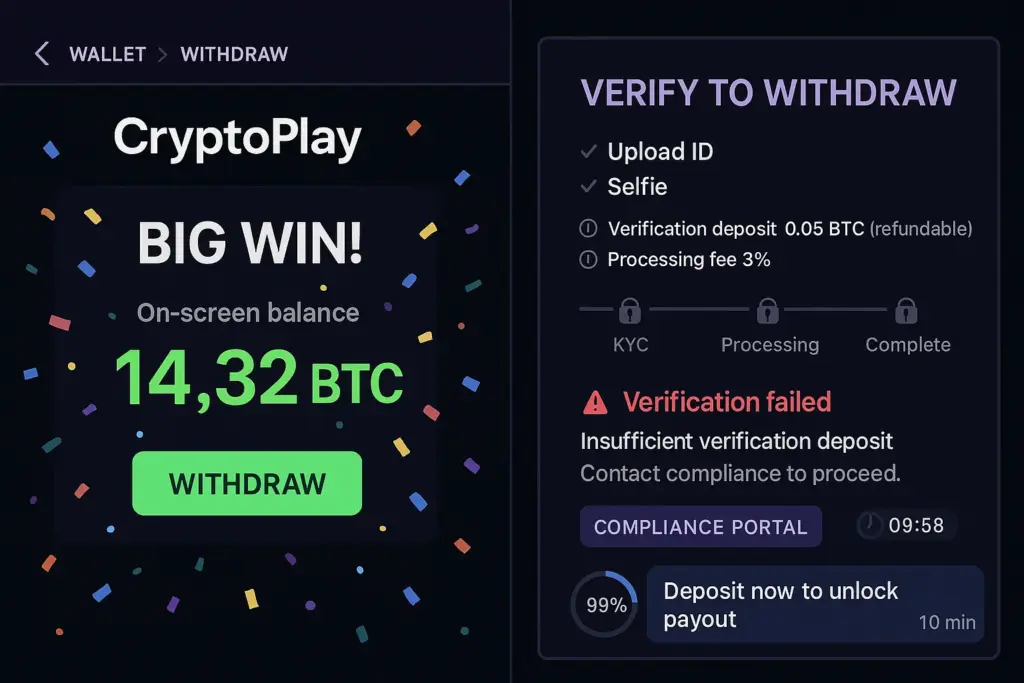
OFFERThat’s when most users try to withdraw, at which point Rusewin.cc asks for a moderate sum as a verification deposit (or some other made-up nonesense). But since you can already taste the smell of your winnings, you may not think much of the request and go through with it.
Doing so is a big NO-GO because that’s the gist of the scam. The fraudsters are after that “deposit,” and once they get it, you’ll never hear from them again.
This pattern used by Rusewin.cc isn’t limited to one domain – it repeats across a wider cluster of cloned sites with the same pay-to-withdraw pressure. Watomy and Winkai.cc are two other recent examples we’ve covered. Even when one domain disappears, a replacement often pops up quickly, which is why recognizing the playbook matters – and knowing what to do if you already engaged.
IMPORTANT – READ BEFORE YOU CONTINUE!
If you have already interacted with Rusewin.cc, stop sending payments and cut contact – no more chats, no more “unlock” transfers, no screen-sharing – and move straight into containment. Lock down any accounts that could be used to access others, move funds if you suspect compromise, and capture the details you will need for reporting. Here are five emergency steps we strongly recommend you take right now:
- Change passwords immediately for email, exchanges, and financial logins; turn on 2FA and sign out other sessions.
- Assume your identity layer is exposed if you shared documents; review key accounts and consider credit protections where available.
- Move remaining assets to a fresh wallet if you suspect compromise, using a new seed phrase and clean device hygiene.
- Revoke wallet approvals if you connected a wallet, and treat any typed seed phrase as an emergency migration event.
- Preserve evidence – screenshots, deposit addresses, TxIDs, chats, timestamps – and file reports with relevant authorities and platforms.
How We Spot Rusewin.cc is a Casino Scam
User reports for sites in this category tend to match the same cluster of warning signs. Any one red flag can be ambiguous by itself, but the full sequence is consistent: confidence-building visuals and early “wins,” followed by withdrawal roadblocks that demand extra crypto and keep changing until the person stops paying.
Surprise withdrawal “fees”
Right when you request a withdrawal, the platform may suddenly introduce “processing,” supposed taxes, or “verification” payments that can only be cleared by sending new crypto.
Decorative licensing claims
Badges and certificates can be pasted onto any page; what matters is whether the operator can be confirmed through official registers that exist outside the site.
Unrealistically strong early “wins”
Those first results can be manufactured, and the “balance” you see may be a controlled display value rather than funds you actually own or can access.
Crypto-only payment rails
Crypto-only deposits reduce consumer protections and make reversals difficult, which is why this approach is heavily favored by fraudulent operations.
Staged social proof
Pop-ups, testimonials, and “live” activity can be scripted to simulate popularity even when nothing can be verified outside the platform.
New, privacy-shielded domains
Sites like this can vanish and return under another name; checking domain age and history with public tools like domain lookups can help you spot fast churn and cloning.

How the Scam Pipeline Usually Plays Out
Understanding the sequence matters because this fraud model follows a repeatable script. When you can anticipate the next push, it’s easier to stop earlier: the design is to build reassurance first, then add withdrawal friction that pressures more payments and often collects additional personal data.
The loop tends to look the same: a promo entry point, nudges to deposit, early “wins” to build belief, a blocked withdrawal, shifting requirements, and then silence or a rebrand – sometimes followed by a “recovery” pitch trying to collect a second fee.
Referral promos and invite codes
For many people, the first contact is a promo link – an ad, a DM, or a “creator code” message that drops you into a signup flow and pushes a welcome reward.

Casino look-and-feel and bonus pressure
From there, spending is framed as “smart play” through VIP tiers, reward unlocks, and limited-time boosters that keep pointing back to deposits.

Bigger balances, then a lockout
Next come visible wins, because believable success turns skepticism into commitment and makes larger deposits feel “reasonable.”
Fee gates and ID capture
When you try to withdraw, the paywall appears: processing charges, tax claims, collateral demands, or KYC hurdles that conveniently require additional payments.

Delays, rebrands, and “recovery” bait
After you pay, the requirements shift again; eventually the site delays indefinitely or disappears, and later a “recovery specialist” may show up offering false hope for an upfront fee.
Staying safe from crypto casino scams like Rusewin.cc
Better protection comes from repeatable checks, not gut feelings. A short verification routine before you deposit can prevent most losses, and clear steps after a mistake can limit damage to accounts or identity. The guidance below focuses on confirming claims away from the site, tightening wallet and login security, and ignoring urgency cues that operations like Rusewin.cc depend on.
Verify license status using official registers
Do not rely on logos or screenshots as proof; check licensing outside the site. Legitimate operators appear in independent records, and missing entries or mismatched details should be treated as a strong warning.
Check domain age and background
Before you deposit, check whether the domain is recently created and whether the operator has a real corporate footprint; frequent churn and rebrands are common in this ecosystem.
Never pay withdrawal fees or “unlock” deposits
Keep one rule and apply it every time: if you must pay to receive your money, Rusewin.cc is likely pulling you into a loop built to extract additional crypto.
Pick venues with clear dispute options
Use operators that can be verified and that explain how disputes work, because scams thrive when payments are irreversible and complaints have no practical path forward.
Limit wallet exposure
Use unique passwords and strong 2FA, and revoke approvals you no longer need; if you typed a seed phrase, assume that wallet is compromised and migrate.
Validate “provably fair” promises
If you can’t confirm a claim outside the platform, treat it as marketing; the real risk is about what you can prove, not what a page says.
Document details and report quickly
Save screenshots of balances and withdrawal prompts, copy deposit addresses and TxIDs, and notify any exchanges you used so the activity is documented.
Practice a deliberate slow-down
Urgency is part of the technique: pause, confirm details off-platform, and remember that “one more step to unlock it” is the exact narrative used to keep payments flowing.
Useful Resources for Scam Reporting and Prevention (By Country)
Reporting can feel pointless until enough cases connect. Clear reports help link wallet addresses, domains, and infrastructure across incidents, and exchanges may at least flag addresses or preserve records. Keep the essentials: deposit addresses, TxIDs, timestamps, screenshots of withdrawal demands, and any messages that show pay-to-withdraw pressure.
Open to report the scam in your country
| Country / Agency | URL | Category / Use-case | Phone/Email |
| Australia – Crime Stoppers | https://www.crimestoppers.com.au | Anonymous tips about crime | 1800 333 000 |
| Australia – National Anti-Scam Center (Scamwatch) | https://www.scamwatch.gov.au/report-a-scam | General scams; phishing; texts/emails | |
| Australia – Police Assistance Line (non-emergency) | https://www.police.gov.au | Local police report | 131 444 |
| Australia – ReportCyber (ACSC) | https://www.cyber.gov.au/report | Cybercrime (hacks, fraud, extortion) | |
| Canada – Canadian Anti-Fraud Center (CAFC) | https://www.antifraudcentre-centreantifraude.ca/report-signalez-eng.htm | General scams incl. phone/text/email | |
| France – DGCCRF (SignalConso) | https://signal.conso.gouv.fr | Consumer scams/deceptive practices | |
| France – PHAROS – Internet-Signalement | https://www.internet-signalement.gouv.fr | Online content & cybercrime reports | |
| Germany – Bundeskriminalamt / Local Police | https://www.polizei.de/Polizei/DE/Home/home_node.html | Report online fraud | |
| Germany – Weißer Ring – Victim Support | https://weisser-ring.de | Victim support | 116 006 |
| India – DoT Helpline (Sanchar Saathi) | https://sancharsaathi.gov.in | Fraudulent telecom/SIM related | 155260 |
| India – National Consumer Helpline | https://consumerhelpline.gov.in | Consumer scams | 1800-11-4000 / 1915 |
| India – National Cyber Crime Reporting Portal | https://cybercrime.gov.in | Cybercrime incl. online fraud | 1930 |
| Japan – Consumer Affairs Agency (CAA) | https://www.caa.go.jp/policies/policy/consumer_policy/caution/cybercrime/ | Consumer scams | |
| Japan – National Police Agency – Cybercrime | https://www.npa.go.jp/bureau/cyber/ | Cybercrime reporting | |
| Mexico – Guardia Nacional (National Guard) | https://www.gob.mx/gn | Cybercrime reporting | |
| Mexico – Instituto Federal de Telecomunicaciones (IFT) | https://www.ift.org.mx | Telecom/online services scams | |
| Mexico – PROFECO | https://www.gob.mx/profeco | Consumer fraud & ecommerce | |
| Netherlands – AFM – Report investment fraud | https://www.afm.nl/en/consumenten/themas/beleggen/misleiding-misbruik | Investment/crypto | |
| Netherlands – Fraudehelpdesk | https://www.fraudehelpdesk.nl/melden | General scams (incl. phishing/SMS) | 088-7867372 |
| Netherlands – Politie – Meldpunt Internetoplichting | https://www.politie.nl/themas/internetoplichting.html | Online shopping fraud | |
| New Zealand – CERT NZ | https://www.cert.govt.nz/individuals/report-an-issue/ | Phishing, identity scams | |
| New Zealand – Department of Internal Affairs – Spam | https://www.dia.govt.nz/Spam-Contact-Us | Email/SMS spam | [email protected] |
| New Zealand – IDCARE | https://www.idcare.org | Victim support (identity compromise) | 0800 121 068 |
| New Zealand – Netsafe – Report | https://www.netsafe.org.nz/report/ | Online harms & scams | |
| New Zealand – New Zealand Police (non-emergency) | https://www.police.govt.nz/use-105 | Report fraud/online crime | 105 |
| Nigeria – Economic & Financial Crimes Commission (EFCC) | https://www.efcc.gov.ng | Financial scams incl. crypto/investment | [email protected] |
| Nigeria – Nigeria Police Special Fraud Unit (SFU) | https://www.specialfraudunit.org.ng | Serious fraud | Voice/SMS: 0708 227 6895; WhatsApp: 0812 760 9914 |
| Poland – CERT Polska (CERT.PL) | https://cert.pl/en/report/ | Cyber incidents & phishing | |
| Poland – Dyzurnet.pl | https://dyzurnet.pl | Illegal online content (esp. child protection) | |
| Poland – Polish Police (Policja) | https://www.policja.pl | Report scams to police | |
| Singapore – Anti-Scam Centre / Anti-Scam Helpline | https://www.scamalert.sg | General scams; texts; calls | 1800-722-6688 |
| Singapore – Monetary Authority of Singapore (MAS) | https://www.mas.gov.sg/investor-alert-list | Investment/crypto checks | |
| Singapore – Singapore Police Force | https://www.police.gov.sg/iwitness | Police report (cybercrime) | |
| South Africa – Cybersecurity Hub (CSIRT) | https://www.cybersecurityhub.gov.za | Cyber incidents incl. scams | |
| South Africa – South African Fraud Prevention Service (SAFPS) | https://www.safps.org.za | Identity fraud support | 011-867-2234 |
| South Africa – South African Police Service (SAPS) | https://www.saps.gov.za | Police report (cybercrime unit) | |
| South Korea – Korea Communications Commission (KCC) | https://www.kcc.go.kr | Telecom-related fraud | |
| South Korea – Korea Internet & Security Agency (KISA) | https://www.kisa.or.kr | Phishing, online harms | |
| South Korea – Korean National Police Agency – Cyber Bureau | https://ecrm.cyber.go.kr | Cybercrime reporting | |
| Spain – INCIBE – Oficina de Seguridad del Internauta (OSI) | https://www.osi.es/es/reporte | Cybersecurity & online fraud | |
| Spain – Policía Nacional / Guardia Civil | https://www.policia.es | Report scams to police | |
| Sweden – Crime Victim Authority (Brottsoffermyndigheten) | https://www.brottsoffermyndigheten.se | Victim support & compensation | 090–70 82 00 |
| Sweden – Polisen (Swedish Police) | https://polisen.se | Report fraud/cybercrime | 114 14 (non-emergency); 112 (emergency) |
| Sweden – Swedish Consumer Agency (Konsumentverket) | https://www.konsumentverket.se | Unfair business practices | |
| United Arab Emirates – Abu Dhabi Police – Aman Service | https://www.adpolice.gov.ae | Cybercrime tips/reporting | SMS 2828; 800 2626 |
| United Arab Emirates – Dubai Police – eCrime | https://www.dubaipolice.gov.ae | Cybercrime reporting | 04 606 1600 |
| United Arab Emirates – Ministry of Interior – Cyber Crime Dept. | https://www.moi.gov.ae | Cybercrime incl. online scams | |
| United Arab Emirates – Telecommunications Regulatory Authority (TRA) / TDRA | https://www.tra.gov.ae | Telecom-related scams/phishing | |
| United Kingdom – Action Fraud (NFIB) | https://www.actionfraud.police.uk | General scams & cybercrime (non-emergency) | 0300 123 2040 |
| United Kingdom – Citizens Advice Consumer Service | https://www.citizensadvice.org.uk/consumer/get-more-help/if-you-need-more-help-about-a-consumer-issue/ | Consumer problems & scam guidance | 0808 223 1133 |
| United Kingdom – Financial Conduct Authority (FCA) | https://www.fca.org.uk/consumers/report-scam-us | Investment/crypto & financial services | |
| United Kingdom – National Cyber Security Centre (NCSC) | https://www.ncsc.gov.uk/collection/phishing-scams | Phishing emails & suspicious websites | |
| United Kingdom – Stop Scams UK ‘159’ | https://stopscamsuk.org.uk/159 | Banking APP fraud (direct to your bank) | 159 |
| United States – AARP Fraud Watch Network Helpline | https://www.aarp.org/money/scams-fraud/ | Victim support | 833-372-8311 |
| United States – Better Business Bureau – Scam Tracker | https://www.bbb.org/scamtracker | Business/marketplace scams | |
| United States – FBI Internet Crime Complaint Center (IC3) | https://www.ic3.gov | Internet crime incl. investment/crypto | |
| United States – Federal Trade Commission – ReportFraud | https://reportfraud.ftc.gov | General scams, phishing, texts/emails | 1-877-382-4357 |
| United States – National Center for Disaster Fraud | https://www.justice.gov/disaster-fraud | Disaster-related scams | (866) 720-5721 |
| United States – SEC Tips & Complaints | https://www.sec.gov/tcr | Investment & securities/crypto-asset offerings |
The most damaging part of Rusewin.cc is the mental trap it tries to build: “I’m up a lot, the money is mine, and one more step will release it.” That belief is engineered. The practical defense is to refuse paid “unlock” steps, verify legitimacy outside the platform, and move quickly on account security when anything looks wrong.
Staying safer comes down to slowing down under pressure, never paying to withdraw, and treating any document upload or wallet connection to a questionable site as a signal to tighten security immediately.
