

Did a slick page just promise you “Get $1000 towards Apple products” if you knock out a couple of easy tasks? If that funnel led to something calling itself “Apple Student Rewards,” stop before you type a single letter. I get why it looks safe: a minimal layout, a familiar logo on top, and confident buttons nudging you to begin. It moves you along a path where your data, your time, and possibly your money, similar to TikApply and RamBucks scams, become the product.
Scams of Sidereward.com‘s type are known to steal personal data and passwords. Install SpyHunter Pro to scan for risks, remove any dangerous trackers, and enable real-time protection.

Try Free For 7 Days*
Buy now15% OFF if you buy straight without trial.
 OFFER
OFFERIs Sidereward.com Legit?
The hook usually arrives where you scroll the fastest. Short, peppy ads on TikTok, Instagram, or Snapchat hum the same tune: students are scooping up a $1000 gift card by doing a few quick surveys or app reviews. You tap, because curiosity is cheap. That click ushers you to a landing page that feels suspiciously familiar, like a cousin of a site you trust, because it’s wearing the same clothes.
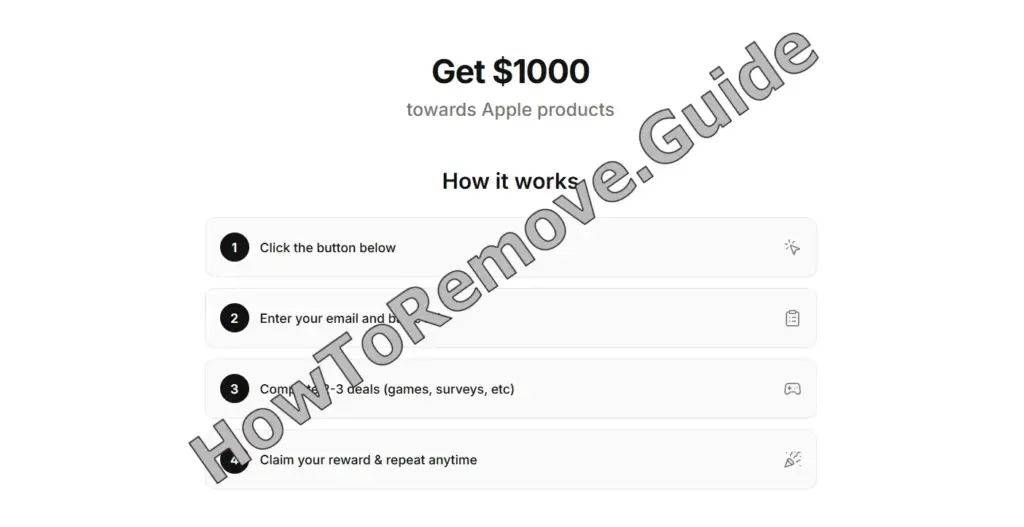
Here’s your first checkpoint. The page lays out an easy four-step path: click a button, enter your email and some basic info, complete “2–3 deals (games, surveys, etc),” then claim your reward and “repeat anytime.” Underneath, huge counters beat their drums: “50k+ Students Rewarded,” “$10M+ Rewards Claimed.” The FAQ whispers reassurance: most people finish in “1–2 hours,” and once “verified,” an email arrives with the gift card “within 3–5 business days.” That blend of simplicity and speed is engineered to feel inevitable – as if all you need to do is follow the steps.
Now notice what actually happens when you “start.” The first real step is data capture. Name, email, maybe a phone number. That alone has value. Then the page funnels you into an offer wall: download and test an app, sign up for a free trial, complete a survey, maybe share an address, and on some items provide a card number “for verification.” Each action is an affiliate event that pays the operator. Your clicks create revenue, not rewards. Meanwhile, a shiny dashboard displays a climbing “balance,” the numbers changing just enough to convince you that progress is real.
And when you try to finish, the finish line moves. New prompts pop up: “Just one more survey to go!” and “Complete one last offer to verify your account.” You’ve invested time, and the counter says you’re close, so you push through. This is the treadmill moment. People start giving more information than they planned to, and sometimes payment details tied to a trial they didn’t want. Later, they spot spam flooding their inboxes, subscription charges they don’t remember authorizing, and even unauthorized card activity after entering details on those “offers.” The promised gift card does not arrive.
Let’s talk about the trust makeup. The page borrows a brand’s look wholesale – the stark whites, restrained layout, gentle typography, and bold buttons. It sprinkles in testimonials from friendly first names attached to recognizable universities, all claiming the same happy ending with a new device. The point is not to inform you; it’s to surround you with cues that feel legitimate at a glance. But the quotes are fabricated, the counters are unverifiable, and the legitimacy is only skin-deep. Apple is not involved.
You might wonder whether this is just one bad apple. It isn’t. There’s a pattern here, and it’s older than this particular domain. The same structure rolls out under other names – fresh URLs, same moves. The details shift; the core remains: impersonate something trusted, promise “earn up to $750–$1000,” flash social proof, push an offer maze, withhold any real payout. When attention gets hot, the domain churns and a twin appears. Different label, identical choreography.
What to Do If You’ve Fallen for the Apple iPhone Student Discount Scam
So what do you do if you already engaged? First, stop interacting. Don’t answer follow-up emails. Don’t click “verification” links. Don’t complete a supposed final task. Change the password for the email account you entered, and for any other account where that password was reused. Turn on two-factor authentication, because a second gate slows down anyone holding your keys. Comb through your bank and card statements for unfamiliar charges, especially those tied to free trials. If a card number touched one of those offers, talk to your bank or card issuer and request a replacement.
Next, cancel any trial subscriptions you started on the way through that funnel. Run a full antivirus and malware scan on your device – no drama, just a thorough check. Prepare for an uptick in spam emails, calls, or texts; block and report instead of clicking. Then document what happened and report it. File with the Federal Trade Commission, submit a complaint to the Internet Crime Complaint Center, and add a record to the BBB Scam Tracker so others can see the pattern. Tell Apple Support their name and logo are being misused. If you shared sensitive personal details like your address or date of birth, consider a credit freeze with Experian, Equifax, and TransUnion, and use identity monitoring so you’ll get alerts.
Recognizing Warning Signs of the Sidereward.com Scam
Okay, let’s tune your radar so this doesn’t happen again. Start with the visuals. If a page leans hard on a famous logo and an imitation layout, that’s costume, not credibility. Check the numbers: a $1000 reward “for less than an hour” plus “repeat anytime” is not a sustainable offer; it’s a lure. Look for woolly trust language – “ Safe & Secure,” “No Hidden Fees,” “Free To Start” – with zero verifiable backing. Be wary of aggressive buttons yelling “CLAIM NOW” and “CLAIM YOUR $1000 NOW.” Note the unverifiable counters – “50k+ Students Rewarded,” “$10M+ Rewards Claimed” – and remember that testimonials tied to prestigious schools can be invented in seconds. Treat “complete 2–3 deals” as what it is: a pipeline into affiliate offers that reward the operator, not you.
Why does this work on smart people? Timing and targeting. The campaign is tuned for students and young adults who already want the exact things being dangled: a phone, a laptop, headphones, a watch. The headliner number – $1000 – lands like found money. The timeline – “1–2 hours” for tasks, “3–5 business days” for delivery – sounds efficient. The site even hints that no card is required, and then the offer wall quietly asks for one “to unlock” an item. That feeling of being close to done keeps you moving. That’s on purpose.
Let’s end with a simple rule and a short checklist. Rule: if a page promises a large payout for trivial actions while borrowing another company’s identity, assume it’s extracting value from you, not giving it to you. Checklist: stop contact, change reused passwords, enable two-factor, review statements, replace any exposed cards, cancel trials, scan your device, report the incident to the FTC, IC3, and the BBB Scam Tracker, notify Apple Support, and consider credit freezes plus monitoring if you shared sensitive data. Then tell a friend. Scams thrive on silence.
Bottom line, and I’m going to be direct because clarity helps more than comfort: this isn’t a reward engine built for you. It’s an affiliate engine wrapped in a costume, and the only consistent winner is the operator. Close the tab, keep your information, and save your yes for places that actually prove they deserve it. You’ll never miss the $1000 you didn’t get, but you will appreciate the time, money, and privacy you kept. That’s the real reward – boring, unflashy, and entirely yours. Keep your guard up, trust your instincts, and let urgency be your cue to pause, not proceed; when something feels too smooth, step back and verify before you commit.
