

Did you recently see an ad promising you could earn $35 an hour to “review songs on Spotify,” pick your own hours, and get paid from home, because if you did you’re not alone and that’s the setup, this pitch is being pushed through Songcheckus.com and it’s designed to look like a real Spotify hiring page, familiar wording, familiar layout, Spotify-ish colors, and a big “Apply” button that tries to get you moving before you start checking.
Scams of Songcheckus.com‘s type are known to steal personal data and passwords. Install SpyHunter Pro to scan for risks, remove any dangerous trackers, and enable real-time protection.

Try Free For 7 Days*
Buy now15% OFF if you buy straight without trial.
 OFFER
OFFERIs Songcheckus.com Legit?
When something leads with “Earn up to $35+ an hour” and then immediately hands you perks like Flexible Hours, Early Access, and Music Discovery, that’s not a hiring plan, that’s a hook. Then it stacks social proof on top like “Over 1,000+ New Auditors This Year,” plus testimonials from people labeled as Music Reviewer, names like Jessica Hart, Jordan Miles, Sam Rivera, and one of them even says they saw it on TikTok, applied on a random Tuesday, got accepted the next day, and made more in their first week than they expected, and they claim there was “no pressure” because they could work their own hours, which is exactly the kind of line that makes you feel like you’re missing out if you hesitate.
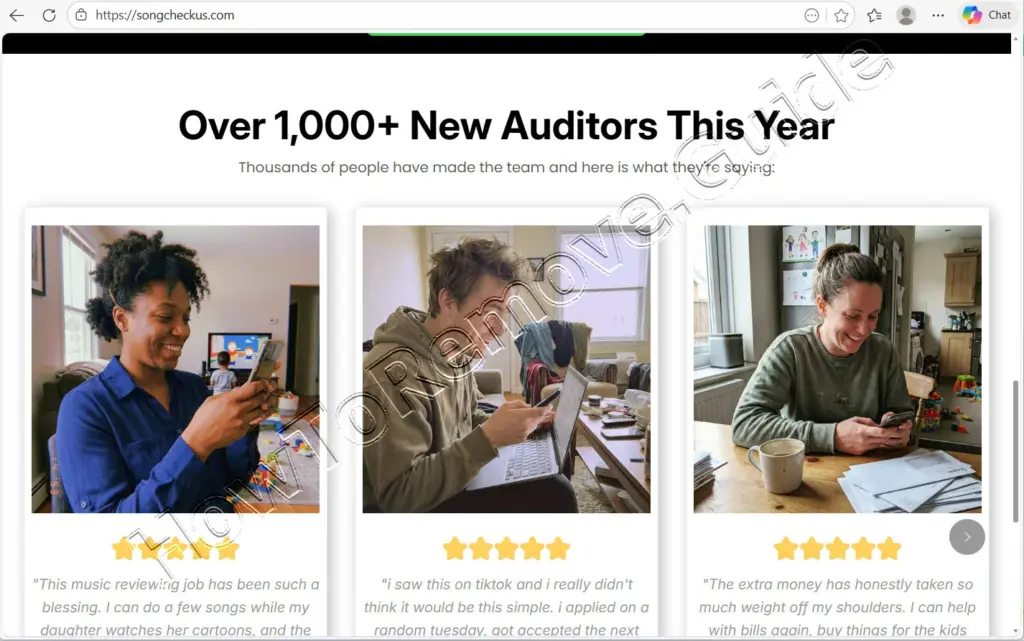
But the story changes after you click through, because Songcheckus.com, similar to WatcherJobs.com, is not trying to hire you, it’s trying to move you through affiliate offers, also called CPA offers, where the site owners get paid when visitors submit information, sign up for trials, install apps, or complete “required steps.” The “application” is laid out like a funnel, 3 simple steps, Click “Apply,” Create Profile, Get Matched, and it sometimes even throws in a little command like “Do not press ‘Skip’,” which is pressure dressed up as guidance.
How the Songcheckus.com Scam Works, Step by Step
So let’s walk it the way it’s described, because once you see the steps you stop treating it like a job.
Step 1: is the lure, most people arrive through paid ads or reposted listings that look like remote work, lines like “Now Hiring: Get Paid to Listen to Spotify,” “Earn $35/hour From Home, Music Reviewer Jobs,” and “Flexible Work Reviewing Music for Spotify.” These promotions show up on major ad networks and social platforms, and sometimes get republished on job boards by third parties, which makes the whole thing feel like normal remote work.
Step 2: is the polished landing page, Spotify-like branding cues, music-industry language, the bold pay claim, simple benefits, a prominent Apply button, and persuasion extras like testimonials, star ratings, and “recent signup” style popups. Remember, those elements are not verification, they are persuasion, they create momentum so you don’t pause to ask basic questions like who is the employer and where is the real workflow.
Now notice what you don’t see on these pages, you don’t see a real employer name you can verify, you don’t see a clear system for how reviews are submitted, scored, or paid, and you don’t see reliable independent validation from reputable reporting. Instead you see broad promises and a path made of buttons. That missing workflow is the tell, because a real job explains the work first and the payout second. Right away.
Step 3: is the data capture, to proceed the site asks for details such as name and email, and sometimes phone number, location, or age range. It’s framed as “building your reviewer profile,” but it functions as lead collection, and a common outcome described after submitting information is an immediate spike in spam emails, robocalls, and scam texts. That data can be used for aggressive marketing, resold to lead brokers, or leveraged for follow up scams, so the “profile” is really the product.
Step 4: is the offer wall, you are told to “complete 2–3 offers” to qualify before you can start reviewing music. Those offers commonly include free trials that convert to paid subscriptions, app installs, survey funnels that push for more personal data, and signups for unrelated services. This is classic CPA marketing, the operators get paid when you complete the action, and you do not get a job, you are being walked through revenue generating conversions. Some offers hide recurring charges in the fine print, and others route people toward low-quality downloads or pushy subscription traps.
Step 5: is the endless loop, after completing offers victims expect a dashboard, onboarding email, or review portal, but instead the funnel typically sends people into more surveys and redirects to malicious sites like secureshieldoffer[.]com, repeats the “complete another step” message, pushes “training” or “verification” that requires payment, or bounces them to unrelated marketing pages. Some warnings also describe a task or commission pattern where users are paid small commissions at first but then asked to pay “account verification” or “review fees” to withdraw larger amounts.
Step 6: is the viral layer, many funnels encourage users to “boost approval chances” by inviting friends or sharing a referral link. People end up posting the link in places like Facebook groups, Discord servers, and Reddit, which spreads the funnel for free and keeps the sharer feeling like they’re still progressing toward access.
What to do if you already interacted
Now what do you do if you already interacted, keep it concrete. If you shared name and email, and maybe phone number, location, or age range, don’t treat that as a job application, treat it as lead collection. If you notice that spike in spam emails, robocalls, or scam texts, that matches the described outcome. If you were pushed into free trials, check for unwanted subscriptions and recurring charges, because recurring charges hidden in fine print are explicitly mentioned. If you installed apps or got nudged toward downloads, remember the write-up literally includes “Is Your Device Infected? Scan for Malware,” so run a malware scan.
Recognizing warning signs
And if you want the warning signs in one place, here they are. There is no verified program on Spotify’s official channels supporting hourly pay for random users to review music. There is no real employer transparency, the description points to vague ownership, generic legal pages, and missing verifiable contact details. There is pressure and urgency through Apply Now framing and instructions like “Do not press ‘Skip’.” There is fake social proof, testimonials, “1,000+ new auditors,” star ratings, and “recent signup” style popups. And then there’s the big one, “qualification” via offers, being told to install apps, sign up for trials, or complete promotions just to proceed.
One more detail that matters is the naming trick, the site uses the generic label “SongCheck US,” and it’s described as mimicking legitimate sounding services like SongChecks, songchecks.com, which is referenced as a verified platform for professional song critiques. That similarity can nudge people into assuming a relationship that doesn’t exist. Online communities on platforms like Reddit and Spotify have flagged similar “music reviewer job” offers as scams, and when you line those community warnings up with the offer-wall steps, the fit is obvious.
Bottom line, Songcheckus.com sells a fantasy, easy money for listening to Spotify framed like a job, but the concrete reality described is a polished landing page with a $35/hour hook and “Over 1,000+ New Auditors This Year,” followed by data capture, an offer wall demanding 2–3 offers, free trials that convert, app installs, surveys, redirects to malicious sites like hxmu.secureshieldoffer[.]com, and sometimes “verification” fees. A legitimate role doesn’t turn into an offer wall, it doesn’t replace onboarding with popups, and it doesn’t keep moving the goalposts after you “qualify.”
