

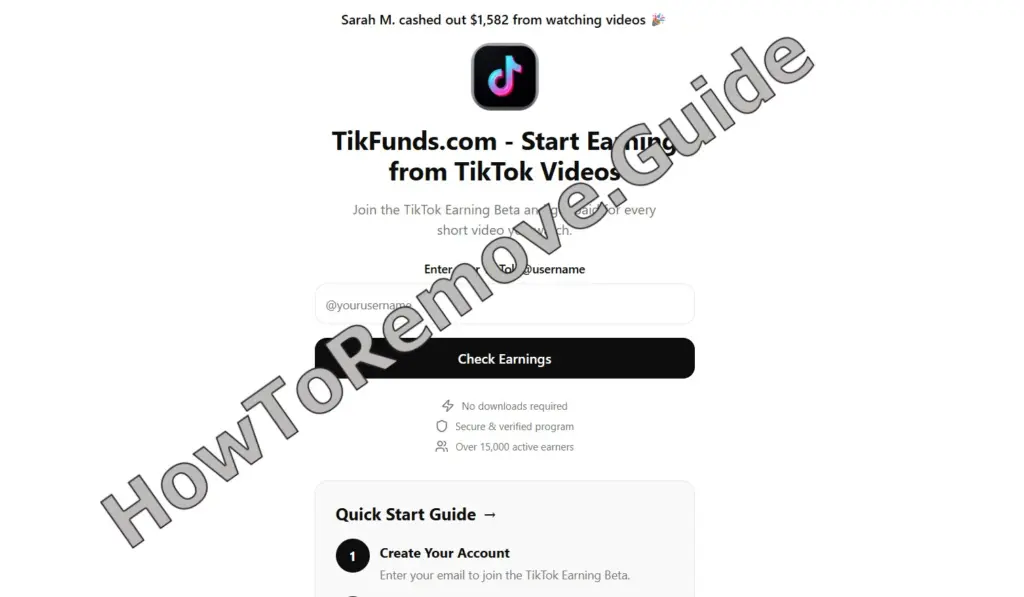
You just saw an ad promising easy money for watching and “reviewing” short videos, right? It tells you to click, sign up, and start earning “up to $1,000/week,” sometimes “$35 an hour,” maybe even “instant PayPal payouts.” Time out – first red flag. That pitch funnels you to TikFunds.com, or a near twin like TikApply.com, both dressed up with familiar logos and typography. Then come the pop-ups with first names and dollar amounts meant to look like live payouts. It feels official because that’s the intention.
Scams of TikFunds.com‘s type are known to steal personal data and passwords. Install SpyHunter Pro to scan for risks, remove any dangerous trackers, and enable real-time protection.

Try Free For 7 Days*
Buy now15% OFF if you buy straight without trial.
 OFFER
OFFERIs TikFunds Real? Is TikFunds Legit?
Here’s how the funnel usually goes. You hit the landing page and a big button says “Get Started Now.” A “Quick Start Guide” promises you’ll be reviewing content in minutes. Then the page nudges you to drop your email, your name, maybe your phone number. Immediately afterward, it adds the magic requirement: complete “2–3 recommended deals” to “unlock your TikTok earnings.” A progress bar chirps “Step 3 of 4 completed,” and a badge announces you’re “almost approved.” Almost is the operative word here.
Second red flag. Those “deals” aren’t work. One victim even saw a prompt to install “2 apps and complete their requirements to unlock your TikTok earnings,” and another deal waved around “free boxershorts.” When underwear shows up in a supposed media job pipeline, you already know where this is going. The deal wall is the job. The rest is theater meant to keep you clicking.
Let’s pop the hood. When you press that shiny button, your clicks route through affiliate tracking links – generic pipes like go2cloud.org – so that every app you install, survey you finish, or “free trial” you start pays the operators a commission. Not you. Them. That’s the engine. The reason you see fake dashboards, “live” pop-ups, and names rolling by – Logan X, Emma V., Samantha P., Jordan – is to simulate a bustling marketplace so you stay in the loop long enough to complete more deals. The loop is the product; your participation funds it.
And those numbers they flaunt? They’re script fodder designed to stick. “Over 15,000 active earners.” “Limited spots.” “Instant payouts.” Dollar amounts like $312, $732, and $828 flash because numbers feel like proof. The dashboard that shows your balance climbing is just pixels. There’s no verifiable work queue, no authenticated payout trail, and no real review pipeline that a legitimate employer would expose. It’s a costume, and once you learn to spot the seams, you can’t unsee them.
A quick reality check on risk, because this isn’t just about wasting an evening. Some users get asked for a card “for verification” or to start that “trial.” Trials flip into recurring charges; cards get dinged for subscriptions you never needed. Meanwhile, the same pages can plant tracking scripts or worse, which is how your inbox and phone start buzzing with spam and phishing. Also notice what’s missing on these sites: verifiable contact information, a clear privacy policy or terms, and transparent company details. The domain isn’t tiktok.com, even though the branding tries to make you forget that.
What to do if you’ve fallen for the TikFunds scam
So what do you do if you already stepped inside? First, stop feeding the wheel. Close the site. If you reused a password anywhere in this sequence, change it now, then enable two-factor authentication on the accounts that matter. If you entered card details for a “trial” or “verification,” call your bank or card issuer and explain exactly what happened – cancel the subscription, dispute anything that looks unfamiliar, and ask about a replacement card if necessary. Uninstall the apps you added only to satisfy “requirements,” and run a reputable antivirus or anti-malware scan on the device you used. Monitor your accounts and inbox for anything suspicious over the next few weeks.
One more thing – I’m a big believer in telling the people who can actually do something about it. Report the page or ad where you found it, then file with the authorities that track this stuff. The Federal Trade Commission’s portal at reportfraud.ftc.gov and the Internet Crime Complaint Center at ic3.gov both collect these patterns, and the platform whose branding was copied needs to hear about it too. When enough reports stack up, the pipes these schemes rely on get a lot narrower.
You might be thinking, “But what if someone really did get paid?” I hear this a lot. The pop-ups are built for that doubt. They seed the feed with names and dollar amounts to make it feel like money is flying around the room. Remember, those boxes aren’t receipts; they’re scripts. Your balance going up in a dashboard is not a payout. Until there’s an audited path from actual work to actual funds received, you’re looking at a scoreboard someone else controls.
Let me put a high-visibility vest on the most reliable signals. If a site leans on a household brand but doesn’t live on that brand’s domain, that’s a red flag. If the “job” requires you to install unrelated apps, start unrelated trials, or hand over a card “just to verify,” that’s a red flag. If progress is always “almost,” that’s a red flag. And if the only proof of success is a stream of anonymous first names and numbers flickering on the screen, that’s not proof; that’s ambience designed to keep you moving.
Dealing with friends? This is delicate, I know. When someone sends you a link like this, they’re not trying to hurt you; they’re trying to share a shortcut. You don’t need to lecture. Just say, “Double-check the domain. If it isn’t the platform’s actual site, and it wants your card for ‘verification,’ it’s a hard no.” Keep it that simple. Most people will hear it, and you’ll spare them a mess they don’t see coming.
Let’s talk practice, not just theory. Make a habit of unique passwords – no repeats – and add two-factor protection wherever you can. Set a calendar reminder to glance at your statements weekly for anything small and sneaky. If your phone starts lighting up with unfamiliar numbers or your email fills with “confirm your subscription” messages after you poked around one of these pages, treat that as a smoke alarm. Investigate, then clean up. And the next time an ad tries to sell you “instant PayPal payouts” paired with “limited spots,” remember the math: the “deals” are the real product.
In case you need a one-line takeaway to keep in your pocket, it’s this: the “deals” are the deal. If the path to getting paid is to make other people money first – by installing apps, finishing surveys, or starting trials – walk. The operators profit the moment you comply, which is why they’ll keep you in that “almost” zone as long as possible. Your time, your data, and your card are the actual targets, not your opinions about videos.
Bottom line – and I do mean bottom line – TikFunds.com, and Tikapply.com by association, aren’t gateways to paid reviewing. They’re funnels built to monetize your clicks and your curiosity. The branding is borrowed, the numbers are bait, and the payouts are fantasy. When you see the signs – off-brand domain, missing policies, “install 2 apps,” “complete 2–3 deals,” “instant PayPal,” and those cheery alerts about people you’ve never met “earning” right now – do the simple, smart thing. Back out, warn a friend, and take your attention somewhere it’s respected.
