

Time out for a quick reality check. You’re scrolling, you spot a slick promise that you can earn hundreds of dollars a week just by reviewing short videos, and the link drops you on TikReview.com. Familiar colors, friendly layout, the big “Get started now.” It feels safe enough to click before thinking. Pause there. When a page waves a weekly number like “$800” and claims, similar to Ads2Cash and ShopMy HR, only a couple of easy steps stand between you and money, that’s not a green light; that’s your cue to slow down and look under the hood.
Scams of TikReview.com‘s type are known to steal personal data and passwords. Install SpyHunter Pro to scan for risks, remove any dangerous trackers, and enable real-time protection.

Try Free For 7 Days*
Buy now15% OFF if you buy straight without trial.
 OFFER
OFFERWhat Is TikReview.com and How Does It Lure Victims
Here’s the staircase you’re nudged to climb. Step one: provide basic information. Step two: complete two or three “deals.” Step three: receive a reward. The path looks tidy – helpfully labeled with a “Quick Start Guide,” dressed in a recognizable logo, and sprinkled with fake notifications that mimic people “joining” and “getting paid” in real time. That choreography isn’t accidental. It’s designed to feel normal, and normal lowers your guard. When the flow seems routine, your skepticism gets drowsy and your clicks get faster.
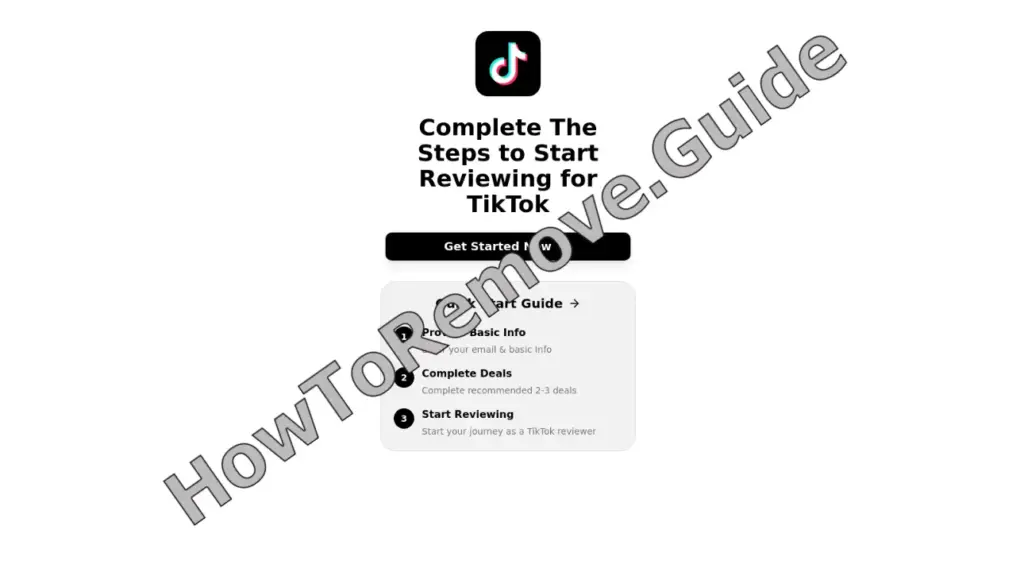
Those “deals” aren’t party favors; they’re financial hooks. The tasks commonly point to trial subscriptions or app sign-ups that start charging if you don’t cancel in time. You hand over details, you hand over card info, you run the gauntlet, and you wait for a payout that never lands. Meanwhile, the only value moving predictably is on their side: affiliate revenue generated by your sign-ups, and personal data collected from your forms. The supposed job of “paid reviewer” never materializes. No one is getting compensated to rate anything here; you’re just powering someone else’s marketing funnel.
Let’s read the signals instead of the slogans. One external scan lists a trust score of 65 out of 100 – labeled “fair.” That isn’t a gold star for the offer; it merely says the domain isn’t an obvious malware trap. Then there’s the age story. One claim suggests the site has been around for years, while another check pins domain registration to October 2025. New. Very new. That contradiction is not trivia. If the origin story wobbles, the promise demanding your data and card details deserves extra scrutiny, not extra clicks.
Behavior tells the rest of the tale. Tap “Get started now,” and you can be punted to a different, unrelated page. You answer a barrage of questions, progress bars creep along, and yet the supposed reward never appears. Try to find help and there’s no contact information. Look for a privacy policy and you come up empty. Search for social accounts and there are none to anchor the brand to real people. Check an independent review platform and you’ll find no verified user reviews confirming any payout. Not “mixed.” Not “mediocre.” Absent. When transparency is missing at every layer, that absence is evidence.
What to Do If You’ve Shared Your Info or Signed Up
If you already started down the staircase, map your next steps to how this actually operates. First, list every trial or app you touched to satisfy the “2–3 deals” requirement and cancel them now. Disable auto-renew before billing begins; recurring charges are the profit engine here. Second, scan your statements for anything tied to those sign-ups and shut down future renewals in advance. Third, if you provided personal details in the questionnaires, stop providing more. With no contact page, no policy, and no social presence, there’s no accountable channel for handling your data. Disengage from the funnel.
How does a setup like this keep people engaged? Familiarity and momentum. The promise finds you on platforms you already trust – social feeds like Facebook, Instagram, and YouTube – using official-adjacent language: “reviewer,” “team,” “get paid to rate.” The page borrows a recognizable logo, parades a “Quick Start Guide,” and tosses fake activity pop-ups into your periphery to create a sense of movement and crowd. Then it hands you the staircase: basic info → two or three deals → reward. That staircase is the business model. Your steps generate affiliate commissions; the “reward” is perpetually out of reach.
Major Red Flags That Reveal the TikReview.com Scam
Let’s name the red flags so you can spot them fast next time. Oversized earnings claims – “$800 weekly,” “hundreds a week” – with no verifiable employer behind them. Conflicting domain-age stories versus a registration in October 2025, which is very recent. A 65/100 “fair” trust score that does not validate the job itself. A call-to-action that misdirects you to unrelated pages. A loop of repeated questions with no reward delivered. No contact details. No privacy policy. No social links. And zero independent reviews on a major review platform. Each item is a blinking light; together they spell out the exit.
What to Do If You’ve Shared Your Info or Signed Up
So what do you do when this pops up again tomorrow? Treat the page as a sales funnel, not a job application. Don’t enter your basic information. Don’t press the shiny button. Don’t step onto the “2–3 deals” gauntlet. Now compare promises to facts. “Fair” is not “legitimate.” “Newly registered” is not “established.” “No contact details” is not “we’re organized.” “No independent reviews” is not “everyone is thrilled.” When specifics and slogans don’t rhyme, the slogans are the part that’s off-key. Walk away.
A word on transparency, because it’s the backbone of anything legitimate. Real outfits give you channels: a way to reach a human, a privacy policy to read, and a social presence you can scrutinize. This one withholds the lot. No contact page means no accountability. No privacy policy means no clarity on how your data is used. No social footprint means no way to triangulate who runs the show. Combine that with the empty slate on independent reviews and you’ve got appearance without substance. When the scaffolding is missing, the stage set is all you’re looking at.
How to Stay Safe from Similar Online Job Scams
Security here isn’t rocket science. Cancel the trials. Disable auto-renew. Monitor statements for charges tied to the sign-ups you completed. If you shared information through the questionnaires, freeze the flow and don’t share more. You’re not facing a cutting-edge exploit; you’re stepping out of a loop that depends on inertia and hope. The defense is simple because the scheme is simple: keep you clicking, keep you entering details, keep you forgetting to cancel, and keep the payout eternally theoretical.
Bottom line, rendered without the glitter. The promise is a weekly number dangled in front of a staircase of “easy steps.” The reality is a maze of redirects, repetitive forms, and no reward at the end, plus the risk of recurring charges. The structural supports you’d expect from a legitimate employer are missing: no contact page, no privacy policy, no social links, and no independent reviews confirming any payout. The credibility checks don’t rescue the pitch; a “fair” trust score and a very recent registration date point to a new, unestablished site whose function is to collect data and push trials, not to pay you.
Final Thoughts: Recognize and Avoid Fake Review Platforms
Keep a compact checklist handy. Big payouts for tiny tasks. Requirements that look like process but act like traps. A request for your details long before they offer theirs. No way to reach a human. No policy to read. No outside reviews to confirm results. See that cluster, and treat it as a pattern you’ve already learned to recognize. Close the tab. Keep your time, your data, and your money. Save your clicks for opportunities that come with contact details, policies, and public proof that real people actually get paid.
