

Fake crypto casinos like Topogamb can look more convincing than they deserve to, especially now that AI ads and deepfake celebrity clips move so easily through social feeds. A clip may seem to show someone famous enough to feel familiar recommending the site, while the page backs it up with big balances and easy-withdrawal promises. The familiar face and the number on the screen are doing the same job: getting you to relax before the site has earned any trust.
Scams of Topogamb.com‘s type are known to steal personal data and passwords. Install SpyHunter Pro to scan for risks, remove any dangerous trackers, and enable real-time protection.

Try Free For 7 Days*
Buy now15% OFF if you buy straight without trial.
 OFFER
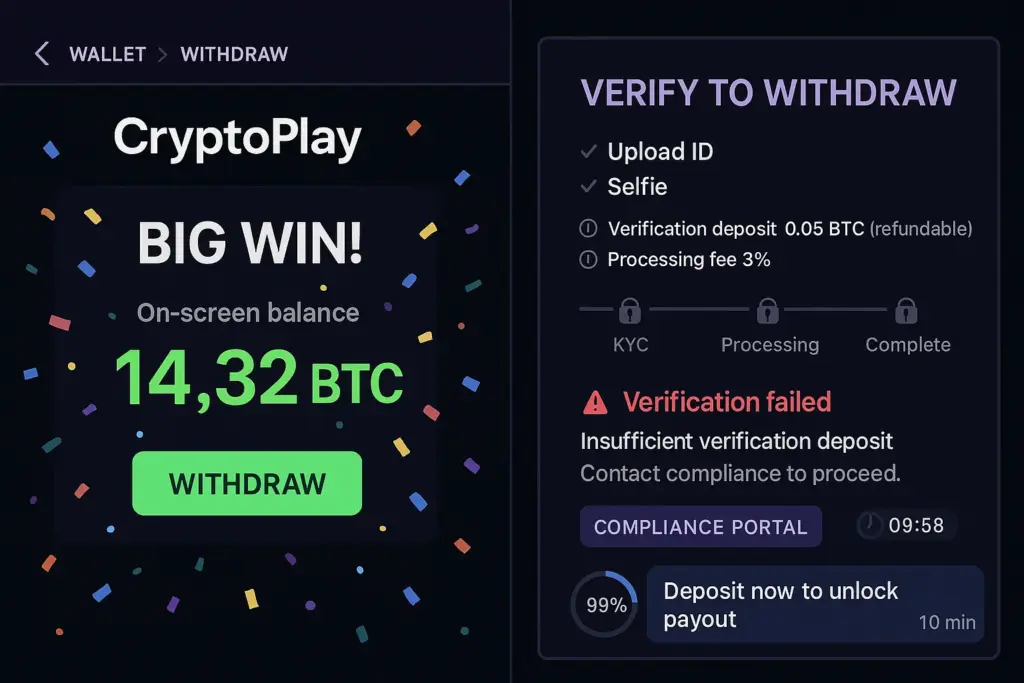
OFFERLike earlier scam sites of this type, such as Teupox and Teadux, Topogamb is not a casino opportunity I would treat as legitimate. I read it as fake-casino bait, with a polished front end wrapped around borrowed credibility and a “free” crypto bonus. The account balance is there to make the later withdrawal feel close enough to chase. When you try to take the money out, the site can hold the request behind a fake account-check excuse, with transfer language if that makes the charge sound more official. Paying that charge does not release real winnings. It turns your real money into the scammers’ payout. The sections below are for recognizing that setup early and staying out of its way.
IMPORTANT! READ BEFORE PROCEEDING!
Anyone who interacted with Topogamb should move quickly: deposits, ID uploads, wallet connections, browser notifications, and downloads can all create separate security problems, with downloads carrying the highest device-risk concern.
Start with the machine itself: use SpyHunter 5 to scan for threats and remove suspicious items, then secure your accounts from a clean session.
Fastest Removal Option: Use SpyHunter 5
- 1.1Click here to download and install the anti-malware tool on your PC.
- 1.2
 Start SpyHunter 5, click the Buy button and choose between starting your 7-days free trial or directly purchasing the tool.
If you choose to buy SpyHunter 5 now, you can use our discount code, “HTRG15“, for 15% off.
- 1.3
 Once you activate SpyHunter, click Start Scan Now, select the Full Scan option, and let the tool do its job.
 - 1.4
 Once the scan completes (it could take a while, so have patience), you’ll see all malware and other undesirables listed.
Click Next to review the detections and then click Next again to delete all rogue items.
Afterward, treat your crypto, email, and identity accounts as exposed until you have completed the additional protective steps below.
- Reset passwords and enable 2FA on your email, crypto exchanges, and wallets; terminate other active sessions.
- Notify any exchanges and services touched by the funds; provide TxIDs and ask that accounts/addresses be flagged per policy.
- Migrate assets to fresh wallets with new seed phrases and revoke any existing token approvals on connected chains.
- If you uploaded ID documents, place credit/fraud alerts where available and monitor for identity-theft signals.
- Assemble an evidence bundle – wallet addresses, TxIDs, site URLs, chats, and screenshots – and file reports with police/IC3 and any involved platforms.
How We Know Topogamb is a Scam
The warning signs are consistent with an advance-payment scam wearing a gambling costume. Topogamb presents the excitement of a casino, but its critical behavior appears at withdrawal, where payment, identity, and delay tactics replace normal payout handling. The strongest clue is the timing: the site becomes most demanding at the exact point where a legitimate platform should be least complicated.
Withdrawal rules appear late
Fees that were not clearly disclosed before play suddenly become mandatory. That late surprise is a classic way to convert a fake balance into real payments from the victim.
Licensing language is vague
Real operators identify the legal entity, regulator, and license status clearly. Scam pages often rely on official-sounding words that cannot be confirmed in the proper databases.
Good luck arrives on schedule
Large early wins are suspicious when they seem designed to push the next deposit. The result may be simulated, because the site controls the account display.
Payments avoid reversible channels
A crypto-only setup leaves victims with fewer dispute options and gives the operator faster movement of funds.
Reviews cluster around promotion
When praise appears mostly in comments, referral posts, or promotional clips, it may be part of the lure rather than a record of real payouts.
The web presence is thin
A legitimate casino should have history, compliance records, and outside coverage. If public tools like who.is show a recent or obscured registration, the risk picture worsens.


How the Topogamb Scam Deception Funnel Works
The scheme works because each stage feels only slightly more demanding than the previous one. By the time the withdrawal is blocked, the victim has already seen apparent wins and may feel that quitting means losing a prize. Once a user accepts the first unusual requirement, the scam can keep presenting the next demand as routine account maintenance.
A promotion pulls the user in, the casino shell builds confidence, the account balance becomes emotional bait, and the payout screen introduces the real objective: more deposits and more personal information.
Social bait before verification
The entry point often looks casual: a comment thread, influencer clip, direct message, or bonus code. The message is designed to feel like an opportunity discovered by insiders.

Familiar casino visuals
The site copies the layout of ordinary gambling platforms with game cards, balances, menus, and reward language. Familiarity lowers defenses even when the business behind it is unverifiable.

Fake progress toward cash-out
The balance may climb quickly and the withdrawal button may appear available. That appearance matters because it prepares the user to believe the final barrier is administrative, not fraudulent.
Compliance excuses for new payments
The site may cite KYC, AML, tax, wallet verification, or VIP status to justify another transfer. These labels sound official, but they do not make a pay-to-release demand legitimate.

Ghosting after extraction
When the victim refuses more payments, replies slow down or stop. A similar domain may later appear, while fake recovery contacts try to monetize the same loss again.
Staying safe from crypto casino scams like Topogamb
A safer routine is slower and more skeptical. Before depositing, check whether the platform can be tied to a real company, a real license, a long-lived domain, and payout history that exists outside its own advertising. You do not need to prove the site is criminal before walking away; unanswered verification questions are enough reason to keep your funds out.
Match the license to the domain
Search by the exact website and company name in regulator resources. A copied license number from another operator is not uncommon in scam pages.
Look beyond the landing page
Search archives, WHOIS data, independent reports, and scam discussions. A site with no footprint except its own promotions has not earned trust.
Stop at the first unlock payment
Treat any request for a deposit before withdrawal as a hard stop. Do not pay to prove ownership, cover tax, or activate a payout.
Prefer accountable payment routes
Platforms that support regulated payment channels and published complaint handling are easier to challenge than anonymous crypto-only sites.
Keep primary wallets away
Do not connect a main wallet to a site you have not verified. If you already did, move remaining assets, rotate credentials, and review token approvals.
Do not accept slogans as audits
Fairness claims should come with verifiable seeds, hashes, and clear explanations. Marketing words alone cannot prove that the games or balances are real.
Capture the evidence trail
Before contacting authorities or platforms, gather dates, wallet addresses, transaction IDs, screenshots, and messages. Organized records make reports stronger.
Break the urgency loop
Leave the page, sleep on the decision, and check independent sources. Scammers rely on the feeling that a bonus or withdrawal window will vanish.
Useful Resources for Scam Reporting and Prevention (By Country)
Reporting matters even when funds cannot be reversed. Exchanges, cybercrime units, and consumer agencies can use wallet addresses and URLs to connect victims and flag infrastructure. Reports are also useful for later identity-protection steps, because they create a dated record that the documents or wallet activity were connected to suspected fraud. The record can also help you explain later account freezes, fraud alerts, or exchange contacts.
Find the correct reporting route
| Country / Agency | URL | Category / Use-case | Phone/Email |
| Australia – Crime Stoppers | https://www.crimestoppers.com.au | Anonymous tips about crime | 1800 333 000 |
| Australia – National Anti-Scam Center (Scamwatch) | https://www.scamwatch.gov.au/report-a-scam | General scams; phishing; texts/emails | |
| Australia – Police Assistance Line (non-emergency) | https://www.police.gov.au | Local police report | 131 444 |
| Australia – ReportCyber (ACSC) | https://www.cyber.gov.au/report | Cybercrime (hacks, fraud, extortion) | |
| Canada – Canadian Anti-Fraud Center (CAFC) | https://www.antifraudcentre-centreantifraude.ca/report-signalez-eng.htm | General scams incl. phone/text/email | |
| France – DGCCRF (SignalConso) | https://signal.conso.gouv.fr | Consumer scams/deceptive practices | |
| France – PHAROS – Internet-Signalement | https://www.internet-signalement.gouv.fr | Online content & cybercrime reports | |
| Germany – Bundeskriminalamt / Local Police | https://www.polizei.de/Polizei/DE/Home/home_node.html | Report online fraud | |
| Germany – Weißer Ring – Victim Support | https://weisser-ring.de | Victim support | 116 006 |
| India – DoT Helpline (Sanchar Saathi) | https://sancharsaathi.gov.in | Fraudulent telecom/SIM related | 155260 |
| India – National Consumer Helpline | https://consumerhelpline.gov.in | Consumer scams | 1800-11-4000 / 1915 |
| India – National Cyber Crime Reporting Portal | https://cybercrime.gov.in | Cybercrime incl. online fraud | 1930 |
| Japan – Consumer Affairs Agency (CAA) | https://www.caa.go.jp/policies/policy/consumer_policy/caution/cybercrime/ | Consumer scams | |
| Japan – National Police Agency – Cybercrime | https://www.npa.go.jp/bureau/cyber/ | Cybercrime reporting | |
| Mexico – Guardia Nacional (National Guard) | https://www.gob.mx/gn | Cybercrime reporting | |
| Mexico – Instituto Federal de Telecomunicaciones (IFT) | https://www.ift.org.mx | Telecom/online services scams | |
| Mexico – PROFECO | https://www.gob.mx/profeco | Consumer fraud & ecommerce | |
| Netherlands – AFM – Report investment fraud | https://www.afm.nl/en/consumenten/themas/beleggen/misleiding-misbruik | Investment/crypto | |
| Netherlands – Fraudehelpdesk | https://www.fraudehelpdesk.nl/melden | General scams (incl. phishing/SMS) | 088-7867372 |
| Netherlands – Politie – Meldpunt Internetoplichting | https://www.politie.nl/themas/internetoplichting.html | Online shopping fraud | |
| New Zealand – CERT NZ | https://www.cert.govt.nz/individuals/report-an-issue/ | Phishing, identity scams | |
| New Zealand – Department of Internal Affairs – Spam | https://www.dia.govt.nz/Spam-Contact-Us | Email/SMS spam | [email protected] |
| New Zealand – IDCARE | https://www.idcare.org | Victim support (identity compromise) | 0800 121 068 |
| New Zealand – Netsafe – Report | https://www.netsafe.org.nz/report/ | Online harms & scams | |
| New Zealand – New Zealand Police (non-emergency) | https://www.police.govt.nz/use-105 | Report fraud/online crime | 105 |
| Nigeria – Economic & Financial Crimes Commission (EFCC) | https://www.efcc.gov.ng | Financial scams incl. crypto/investment | [email protected] |
| Nigeria – Nigeria Police Special Fraud Unit (SFU) | https://www.specialfraudunit.org.ng | Serious fraud | Voice/SMS: 0708 227 6895; WhatsApp: 0812 760 9914 |
| Poland – CERT Polska (CERT.PL) | https://cert.pl/en/report/ | Cyber incidents & phishing | |
| Poland – Dyzurnet.pl | https://dyzurnet.pl | Illegal online content (esp. child protection) | |
| Poland – Polish Police (Policja) | https://www.policja.pl | Report scams to police | |
| Singapore – Anti-Scam Centre / Anti-Scam Helpline | https://www.scamalert.sg | General scams; texts; calls | 1800-722-6688 |
| Singapore – Monetary Authority of Singapore (MAS) | https://www.mas.gov.sg/investor-alert-list | Investment/crypto checks | |
| Singapore – Singapore Police Force | https://www.police.gov.sg/iwitness | Police report (cybercrime) | |
| South Africa – Cybersecurity Hub (CSIRT) | https://www.cybersecurityhub.gov.za | Cyber incidents incl. scams | |
| South Africa – South African Fraud Prevention Service (SAFPS) | https://www.safps.org.za | Identity fraud support | 011-867-2234 |
| South Africa – South African Police Service (SAPS) | https://www.saps.gov.za | Police report (cybercrime unit) | |
| South Korea – Korea Communications Commission (KCC) | https://www.kcc.go.kr | Telecom-related fraud | |
| South Korea – Korea Internet & Security Agency (KISA) | https://www.kisa.or.kr | Phishing, online harms | |
| South Korea – Korean National Police Agency – Cyber Bureau | https://ecrm.cyber.go.kr | Cybercrime reporting | |
| Spain – INCIBE – Oficina de Seguridad del Internauta (OSI) | https://www.osi.es/es/reporte | Cybersecurity & online fraud | |
| Spain – Policía Nacional / Guardia Civil | https://www.policia.es | Report scams to police | |
| Sweden – Crime Victim Authority (Brottsoffermyndigheten) | https://www.brottsoffermyndigheten.se | Victim support & compensation | 090–70 82 00 |
| Sweden – Polisen (Swedish Police) | https://polisen.se | Report fraud/cybercrime | 114 14 (non-emergency); 112 (emergency) |
| Sweden – Swedish Consumer Agency (Konsumentverket) | https://www.konsumentverket.se | Unfair business practices | |
| United Arab Emirates – Abu Dhabi Police – Aman Service | https://www.adpolice.gov.ae | Cybercrime tips/reporting | SMS 2828; 800 2626 |
| United Arab Emirates – Dubai Police – eCrime | https://www.dubaipolice.gov.ae | Cybercrime reporting | 04 606 1600 |
| United Arab Emirates – Ministry of Interior – Cyber Crime Dept. | https://www.moi.gov.ae | Cybercrime incl. online scams | |
| United Arab Emirates – Telecommunications Regulatory Authority (TRA) / TDRA | https://www.tra.gov.ae | Telecom-related scams/phishing | |
| United Kingdom – Action Fraud (NFIB) | https://www.actionfraud.police.uk | General scams & cybercrime (non-emergency) | 0300 123 2040 |
| United Kingdom – Citizens Advice Consumer Service | https://www.citizensadvice.org.uk/consumer/get-more-help/if-you-need-more-help-about-a-consumer-issue/ | Consumer problems & scam guidance | 0808 223 1133 |
| United Kingdom – Financial Conduct Authority (FCA) | https://www.fca.org.uk/consumers/report-scam-us | Investment/crypto & financial services | |
| United Kingdom – National Cyber Security Centre (NCSC) | https://www.ncsc.gov.uk/collection/phishing-scams | Phishing emails & suspicious websites | |
| United Kingdom – Stop Scams UK ‘159’ | https://stopscamsuk.org.uk/159 | Banking APP fraud (direct to your bank) | 159 |
| United States – AARP Fraud Watch Network Helpline | https://www.aarp.org/money/scams-fraud/ | Victim support | 833-372-8311 |
| United States – Better Business Bureau – Scam Tracker | https://www.bbb.org/scamtracker | Business/marketplace scams | |
| United States – FBI Internet Crime Complaint Center (IC3) | https://www.ic3.gov | Internet crime incl. investment/crypto | |
| United States – Federal Trade Commission – ReportFraud | https://reportfraud.ftc.gov | General scams, phishing, texts/emails | 1-877-382-4357 |
| United States – National Center for Disaster Fraud | https://www.justice.gov/disaster-fraud | Disaster-related scams | (866) 720-5721 |
| United States – SEC Tips & Complaints | https://www.sec.gov/tcr | Investment & securities/crypto-asset offerings |
In practice, the best defense is to distrust locked winnings, secure your identity, and verify the operator before any crypto leaves your control. Keep the focus on assets and identity you can still protect, not on a dashboard number controlled by the site. Preserve screenshots before the page disappears.
