

Most “crypto casino” scams look boring from orbit and dazzling up close, but most of all, they rarely look particularly dangerous (at least to an inexperienced users). Tusewin.cc is one such scam that follows a familiar script.
First, it dangles an oversized signup reward, then it makes early play feel unusually lucky, and then switches from “fun” to “friction” the moment you try to take money out. By that, I mean, it asks you to “deposit” some of your money before you can withdraw.
It’s this deposit that the scammers are after. Once you send it, it’s gone into the fradusters’ pockets. Needless to say, the “winnings” you accumulated are nothing but numbers on a screen with no real value behind them.
If you have already deposited, connected a wallet, or sent documents to Tusewin.cc or a similar scam like Bevexo.cc, or Wixspins, treat it like a security incident and not a customer-support problem. Quick action won’t reverse a blockchain transfer, but it can prevent follow-on losses and reduce identity risk. Read below to learn more about the proper ways to react in such situations.
Scams of Tusewin.cc‘s type are known to steal personal data and passwords. Install SpyHunter Pro to scan for risks, remove any dangerous trackers, and enable real-time protection.

Try Free For 7 Days*
Buy now15% OFF if you buy straight without trial.
 OFFER
OFFERIMPORTANT! READ BEFORE PROCEEDING!
If you have already interacted with Tusewin.cc, treat it like a containment job, not a negotiation. Stop the back-and-forth, assume any shared details are compromised, and focus on preventing the next loss. Preserve what happened so you can report it, and harden your accounts before scammers (or copycats) try again. Here are five emergency steps we strongly recommend you take right now:
- Stop sending any additional payments or “unlock” deposits immediately.
- Save evidence: screenshots, chat logs, deposit addresses, and transaction hashes.
- Change passwords and turn on MFA for email, exchanges, and any related accounts.
- Move remaining crypto to a new wallet with a new seed phrase.
- Revoke wallet permissions and contact your exchange fast; speed matters more than arguments.
How We Know Tusewin.cc is a Scam
Several warning signs line up in a way that’s painfully consistent with fake-crypto-casino operations, and the pattern matters more than the brand name. When a site combines free-money bait, implausible early results, and “pay first” withdrawal hurdles, the safest assumption is that the winnings are fictional and the payments are permanent.
Surprise withdrawal charges
Withdrawal steps that add surprise requirements—fees, extra deposits, “tax” prepayments, or tier upgrades—are a signature move of advance-fee fraud.
Counterfeit licensing
A thin or uncheckable licensing story, combined with hard-to-trace ownership and a young-looking web presence, is another common tell.
Inflated early “wins”
Early winning streaks show up suspiciously often, creating confidence before the withdrawal trap is sprung.
Crypto-only rails
The balance you see is just a number on their server, not funds sitting somewhere you control.
Synthetic social proof
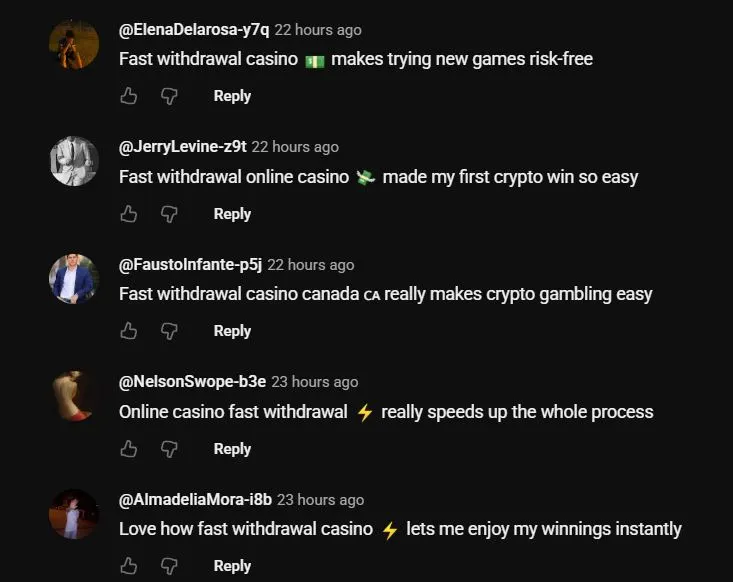
The site leans hard on staged credibility—chat pop-ups, “recent withdrawals,” or glowing comments that can’t be independently verified.
Fresh, privacy-masked domains
Newly minted sites with redacted ownership and a trail of near-identical clones are a strong indicator; public lookups like who.is expose the churn.


How the Tusewin.cc Scam Deception Funnel Works
Understanding the choreography helps you spot the trick mid-performance, before emotions and sunk costs start steering the wheel. These schemes are built like a sales funnel: excitement at the top, friction at the bottom, and constant prompts to send more funds in between.
Once you can name each stage, it becomes easier to step off the escalator before it reaches the extraction phase.
Promo hooks and influencer codes
First, a lure pulls you in—an ad, a promo code, a “limited” bonus, or a too-perfect testimonial that promises easy gains.
Casino skin and bonus theater
Next, the site builds trust by showing smooth gameplay and a rising balance, sometimes with unusually generous early results.

Inflated balances, then the gate
Then comes the excitement lock-in: you’re nudged to deposit “just a bit more” to qualify for bigger bonuses, better odds, or a faster payout tier.
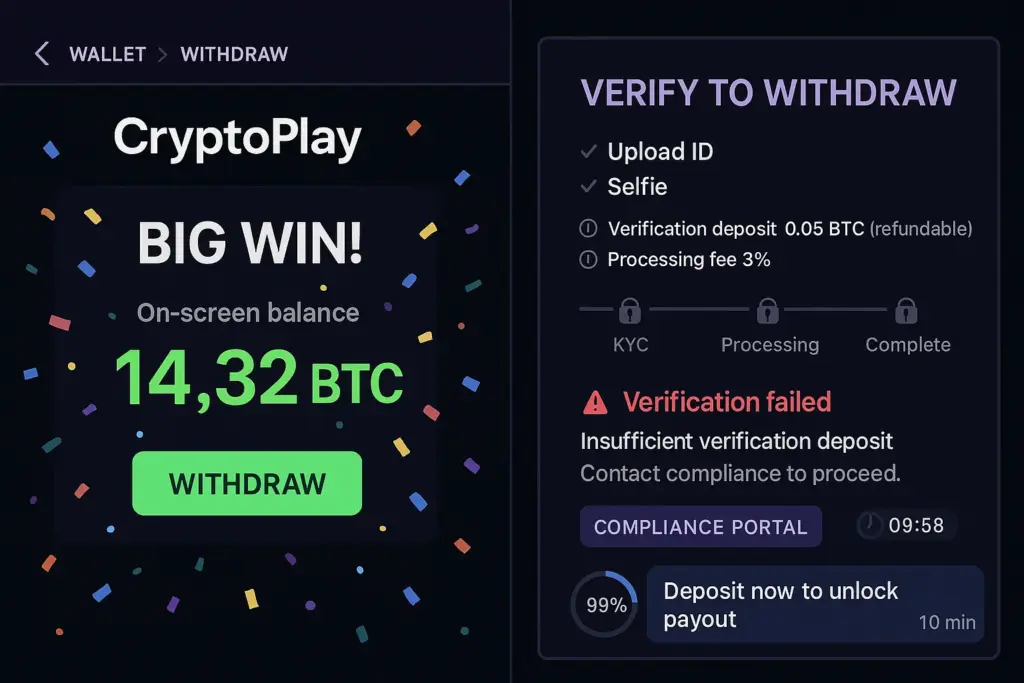
Fee-gates and KYC harvest
After that, the cash-out attempt triggers the gate: the system asks for documents, a processing payment, a collateral deposit, or an upgrade to “verify” you.

Stalling, rebrands, and “recovery” bait
Finally, each payment unlocks… another payment. When you slow down or question it, support stalls, the domain changes, or your account gets “reviewed” forever.
Staying safe from crypto casino scams like Tusewin.cc
Keeping your future self safe is mostly about refusing to be rushed and building a few verification habits that are boring—until they save you. None of these habits require advanced crypto skills; they simply slow the moment down, help you verify what’s real, and keep your main funds out of reach of random websites.
Verify license status in official registers
Before depositing anywhere, check whether the operator has a real, verifiable license from a recognized regulator, not just a logo in the footer.
Check domain age and history
Domain hygiene: brand-new domains, hidden ownership, zero company info = high risk.
Reject withdrawal fees and “unlock” deposits
Treat any request to pay money in order to receive money as a hard stop, regardless of whether it’s called a fee, tax, verification, or security bond.
Prefer venues with recourse
Prefer platforms with strong consumer protections and transparent ownership; “crypto-only, no questions asked” is often code for “no recourse.”
Limit wallet exposure
Avoid connecting your wallet casually: wallet “connect” + approvals can enable draining; revoke permissions if you slip.
Validate “provably fair” claims
Research the platform outside its own website: scam sites lean on fake testimonials, and the lack of independent verification is the point.
Document and report rapidly
Preserve evidence: screenshots, chat logs, deposit addresses, tx hashes, emails, site URLs.
Build a deliberate slow-down reflex
Be allergic to urgency cues—countdowns, expiring VIP offers, or “last chance” withdrawals—because pressure is part of the mechanism.
Useful Resources for Scam Reporting and Prevention (By Country)
Report the scam to your local cybercrime or financial fraud authority, and keep your report number. Even when individual victims don’t get refunds, aggregated reports can lead to domain takedowns, exchange blacklists, and occasional seizures when scammers slip up.
Click here to report the scam in your country
| Country / Agency | URL | Category / Use-case | Phone/Email |
| Australia – Crime Stoppers | https://www.crimestoppers.com.au | Anonymous tips about crime | 1800 333 000 |
| Australia – National Anti-Scam Center (Scamwatch) | https://www.scamwatch.gov.au/report-a-scam | General scams; phishing; texts/emails | |
| Australia – Police Assistance Line (non-emergency) | https://www.police.gov.au | Local police report | 131 444 |
| Australia – ReportCyber (ACSC) | https://www.cyber.gov.au/report | Cybercrime (hacks, fraud, extortion) | |
| Canada – Canadian Anti-Fraud Center (CAFC) | https://www.antifraudcentre-centreantifraude.ca/report-signalez-eng.htm | General scams incl. phone/text/email | |
| France – DGCCRF (SignalConso) | https://signal.conso.gouv.fr | Consumer scams/deceptive practices | |
| France – PHAROS – Internet-Signalement | https://www.internet-signalement.gouv.fr | Online content & cybercrime reports | |
| Germany – Bundeskriminalamt / Local Police | https://www.polizei.de/Polizei/DE/Home/home_node.html | Report online fraud | |
| Germany – Weißer Ring – Victim Support | https://weisser-ring.de | Victim support | 116 006 |
| India – DoT Helpline (Sanchar Saathi) | https://sancharsaathi.gov.in | Fraudulent telecom/SIM related | 155260 |
| India – National Consumer Helpline | https://consumerhelpline.gov.in | Consumer scams | 1800-11-4000 / 1915 |
| India – National Cyber Crime Reporting Portal | https://cybercrime.gov.in | Cybercrime incl. online fraud | 1930 |
| Japan – Consumer Affairs Agency (CAA) | https://www.caa.go.jp/policies/policy/consumer_policy/caution/cybercrime/ | Consumer scams | |
| Japan – National Police Agency – Cybercrime | https://www.npa.go.jp/bureau/cyber/ | Cybercrime reporting | |
| Mexico – Guardia Nacional (National Guard) | https://www.gob.mx/gn | Cybercrime reporting | |
| Mexico – Instituto Federal de Telecomunicaciones (IFT) | https://www.ift.org.mx | Telecom/online services scams | |
| Mexico – PROFECO | https://www.gob.mx/profeco | Consumer fraud & ecommerce | |
| Netherlands – AFM – Report investment fraud | https://www.afm.nl/en/consumenten/themas/beleggen/misleiding-misbruik | Investment/crypto | |
| Netherlands – Fraudehelpdesk | https://www.fraudehelpdesk.nl/melden | General scams (incl. phishing/SMS) | 088-7867372 |
| Netherlands – Politie – Meldpunt Internetoplichting | https://www.politie.nl/themas/internetoplichting.html | Online shopping fraud | |
| New Zealand – CERT NZ | https://www.cert.govt.nz/individuals/report-an-issue/ | Phishing, identity scams | |
| New Zealand – Department of Internal Affairs – Spam | https://www.dia.govt.nz/Spam-Contact-Us | Email/SMS spam | [email protected] |
| New Zealand – IDCARE | https://www.idcare.org | Victim support (identity compromise) | 0800 121 068 |
| New Zealand – Netsafe – Report | https://www.netsafe.org.nz/report/ | Online harms & scams | |
| New Zealand – New Zealand Police (non-emergency) | https://www.police.govt.nz/use-105 | Report fraud/online crime | 105 |
| Nigeria – Economic & Financial Crimes Commission (EFCC) | https://www.efcc.gov.ng | Financial scams incl. crypto/investment | [email protected] |
| Nigeria – Nigeria Police Special Fraud Unit (SFU) | https://www.specialfraudunit.org.ng | Serious fraud | Voice/SMS: 0708 227 6895; WhatsApp: 0812 760 9914 |
| Poland – CERT Polska (CERT.PL) | https://cert.pl/en/report/ | Cyber incidents & phishing | |
| Poland – Dyzurnet.pl | https://dyzurnet.pl | Illegal online content (esp. child protection) | |
| Poland – Polish Police (Policja) | https://www.policja.pl | Report scams to police | |
| Singapore – Anti-Scam Centre / Anti-Scam Helpline | https://www.scamalert.sg | General scams; texts; calls | 1800-722-6688 |
| Singapore – Monetary Authority of Singapore (MAS) | https://www.mas.gov.sg/investor-alert-list | Investment/crypto checks | |
| Singapore – Singapore Police Force | https://www.police.gov.sg/iwitness | Police report (cybercrime) | |
| South Africa – Cybersecurity Hub (CSIRT) | https://www.cybersecurityhub.gov.za | Cyber incidents incl. scams | |
| South Africa – South African Fraud Prevention Service (SAFPS) | https://www.safps.org.za | Identity fraud support | 011-867-2234 |
| South Africa – South African Police Service (SAPS) | https://www.saps.gov.za | Police report (cybercrime unit) | |
| South Korea – Korea Communications Commission (KCC) | https://www.kcc.go.kr | Telecom-related fraud | |
| South Korea – Korea Internet & Security Agency (KISA) | https://www.kisa.or.kr | Phishing, online harms | |
| South Korea – Korean National Police Agency – Cyber Bureau | https://ecrm.cyber.go.kr | Cybercrime reporting | |
| Spain – INCIBE – Oficina de Seguridad del Internauta (OSI) | https://www.osi.es/es/reporte | Cybersecurity & online fraud | |
| Spain – Policía Nacional / Guardia Civil | https://www.policia.es | Report scams to police | |
| Sweden – Crime Victim Authority (Brottsoffermyndigheten) | https://www.brottsoffermyndigheten.se | Victim support & compensation | 090–70 82 00 |
| Sweden – Polisen (Swedish Police) | https://polisen.se | Report fraud/cybercrime | 114 14 (non-emergency); 112 (emergency) |
| Sweden – Swedish Consumer Agency (Konsumentverket) | https://www.konsumentverket.se | Unfair business practices | |
| United Arab Emirates – Abu Dhabi Police – Aman Service | https://www.adpolice.gov.ae | Cybercrime tips/reporting | SMS 2828; 800 2626 |
| United Arab Emirates – Dubai Police – eCrime | https://www.dubaipolice.gov.ae | Cybercrime reporting | 04 606 1600 |
| United Arab Emirates – Ministry of Interior – Cyber Crime Dept. | https://www.moi.gov.ae | Cybercrime incl. online scams | |
| United Arab Emirates – Telecommunications Regulatory Authority (TRA) / TDRA | https://www.tra.gov.ae | Telecom-related scams/phishing | |
| United Kingdom – Action Fraud (NFIB) | https://www.actionfraud.police.uk | General scams & cybercrime (non-emergency) | 0300 123 2040 |
| United Kingdom – Citizens Advice Consumer Service | https://www.citizensadvice.org.uk/consumer/get-more-help/if-you-need-more-help-about-a-consumer-issue/ | Consumer problems & scam guidance | 0808 223 1133 |
| United Kingdom – Financial Conduct Authority (FCA) | https://www.fca.org.uk/consumers/report-scam-us | Investment/crypto & financial services | |
| United Kingdom – National Cyber Security Centre (NCSC) | https://www.ncsc.gov.uk/collection/phishing-scams | Phishing emails & suspicious websites | |
| United Kingdom – Stop Scams UK ‘159’ | https://stopscamsuk.org.uk/159 | Banking APP fraud (direct to your bank) | 159 |
| United States – AARP Fraud Watch Network Helpline | https://www.aarp.org/money/scams-fraud/ | Victim support | 833-372-8311 |
| United States – Better Business Bureau – Scam Tracker | https://www.bbb.org/scamtracker | Business/marketplace scams | |
| United States – FBI Internet Crime Complaint Center (IC3) | https://www.ic3.gov | Internet crime incl. investment/crypto | |
| United States – Federal Trade Commission – ReportFraud | https://reportfraud.ftc.gov | General scams, phishing, texts/emails | 1-877-382-4357 |
| United States – National Center for Disaster Fraud | https://www.justice.gov/disaster-fraud | Disaster-related scams | (866) 720-5721 |
| United States – SEC Tips & Complaints | https://www.sec.gov/tcr | Investment & securities/crypto-asset offerings |
Save transaction hashes, deposit addresses, chat logs, emails, and screenshots of the withdrawal demands, and ignore anyone promising guaranteed recovery for an upfront fee.
