

Uitgamb does not look like a one-off crypto casino that simply plays loose with the rules. I read it as part of a more familiar pattern: short-life gambling sites that borrow enough polish to look real while social posts do the pushing. Once enough money has moved, the site can disappear.
The trust work starts before anyone reaches the withdrawal page. The front end looks finished enough to lower suspicion, and the bonus offer makes the account balance feel closer than it is. Testimonials that cannot be checked are not a harmless decoration; they help the site borrow trust before it has earned any.
Scams of Uitgamb.com‘s type are known to steal personal data and passwords. Install SpyHunter Pro to scan for risks, remove any dangerous trackers, and enable real-time protection.

Try Free For 7 Days*
Buy now15% OFF if you buy straight without trial.
 OFFER
OFFERThe business basics are where the picture gets worse. A real operator should be easy to place behind the casino, and the withdrawal rules should be clear without a user having to guess. When those basics stay vague, even licensing language starts to feel like part of the set dressing.
Cash-out is where the pattern usually stops pretending. The site waits until a user tries to withdraw, then asks for real money under a label like activation or verification. After that, the promised payout never arrives. This article looks at Uitgamb through that clone-casino pattern, with other similar scams being Teadux and Kesowin, so the warning signs are easier to recognize before the site gets another payment out of someone.
IMPORTANT! READ BEFORE PROCEEDING!
If you have already dealt with Uitgamb beyond casually viewing it, act as though there is still something left to protect. Deposits, documents, wallet permissions, and downloads can all create follow-on damage if they are not addressed quickly.
Before you keep reading site messages or trust anyone who contacts you about getting the funds back, inspect the device involved. We strongly recommend using SpyHunter 5 first to look for malicious files, browser manipulation, unwanted extensions, or other hidden changes that may have accompanied the scam interaction.
Fastest Removal Option: Use SpyHunter 5
- 1.1Click here to download and install the anti-malware tool on your PC.
- 1.2
 Start SpyHunter 5, click the Buy button and choose between starting your 7-days free trial or directly purchasing the tool.
If you choose to buy SpyHunter 5 now, you can use our discount code, “HTRG15“, for 15% off.
- 1.3
 Once you activate SpyHunter, click Start Scan Now, select the Full Scan option, and let the tool do its job.
 - 1.4
 Once the scan completes (it could take a while, so have patience), you’ll see all malware and other undesirables listed.
Click Next to review the detections and then click Next again to delete all rogue items.
When that device review is finished, continue with the additional security steps below and assume that accounts, wallets, approvals, and identity material connected to Uitgamb may require immediate cleanup.
- Reset passwords and enable 2FA on your email, crypto exchanges, and wallets; terminate other active sessions.
- Notify any exchanges and services touched by the funds; provide TxIDs and ask that accounts/addresses be flagged per policy.
- Migrate assets to fresh wallets with new seed phrases and revoke any existing token approvals on connected chains.
- If you uploaded ID documents, place credit/fraud alerts where available and monitor for identity-theft signals.
- Assemble an evidence bundle – wallet addresses, TxIDs, site URLs, chats, and screenshots – and file reports with police/IC3 and any involved platforms.
How We Know Uitgamb is a Scam
The concern is not based on one strange detail alone. It comes from a cluster of warning signs that repeatedly show up in fake crypto-casino operations built to extract deposits and then obstruct withdrawals.
The payout only works after another payment
A major red flag is the idea that your balance can be released only if you first send more money. Whether the excuse is a processing charge, a tax hold, or a verification amount, the structure is the same: a fake obstacle placed between the victim and funds that were probably never withdrawable.
Trust symbols without real substance
These sites often try to look official with compliance language, licensing mentions, and polished badges. The problem is that those symbols frequently fail to point to any independently confirmed operator, leaving appearance to do the work of evidence.
Early luck that feels engineered
Another clue is how neatly the first results support the site’s narrative. The fast wins, rising balance, and smooth experience can all function as persuasion tools meant to keep the target optimistic and willing to go deeper.
Crypto rails with little room to reverse
Scammers benefit when all money movement happens in crypto because it narrows the victim’s recovery options. The less outside oversight and recourse involved, the easier it is to keep blame and pressure focused on the user instead of the operator.
Proof of popularity that proves very little
A busy-looking site is not automatically a trusted one. Notifications about winners, enthusiastic comments, referral chatter, and support responsiveness can all be simulated cheaply to create the feeling that many others are already succeeding there.
A short-lived home on the web
Fraudulent brands often rely on domains that are new, lightly documented, or protected behind privacy services. Public checks such as who.is can help reveal whether the site has the thin backstory typical of disposable operations.


How the Uitgamb Scam Deception Funnel Works
The better you understand the flow, the harder it is for the scam to steer you through it. These sites tend to follow a recognizable progression from attraction to commitment to extraction.
People usually arrive through a sequence that feels ordinary in the moment. That is why the funnel works: it presents each step as small and reasonable while quietly increasing emotional and financial exposure.
Referral culture and bonus temptation
The opening contact often leans on promotions, creator-style posts, direct outreach, or clips that make big returns sound normal. That borrowed enthusiasm gives the site momentum before the target has verified anything.

A polished layout that invites trust
Once on the page, users are met with familiar gaming visuals, bonus messaging, and design cues that resemble legitimate casino experiences. The polish is not proof of honesty, but it can temporarily suppress the instinct to investigate.

Displayed gains that change your judgment
As the on-screen balance rises, the victim’s decisions may start revolving around preserving access to those apparent winnings. That is exactly why the fake profits matter so much: they make later fees and identity requests seem like obstacles worth overcoming.
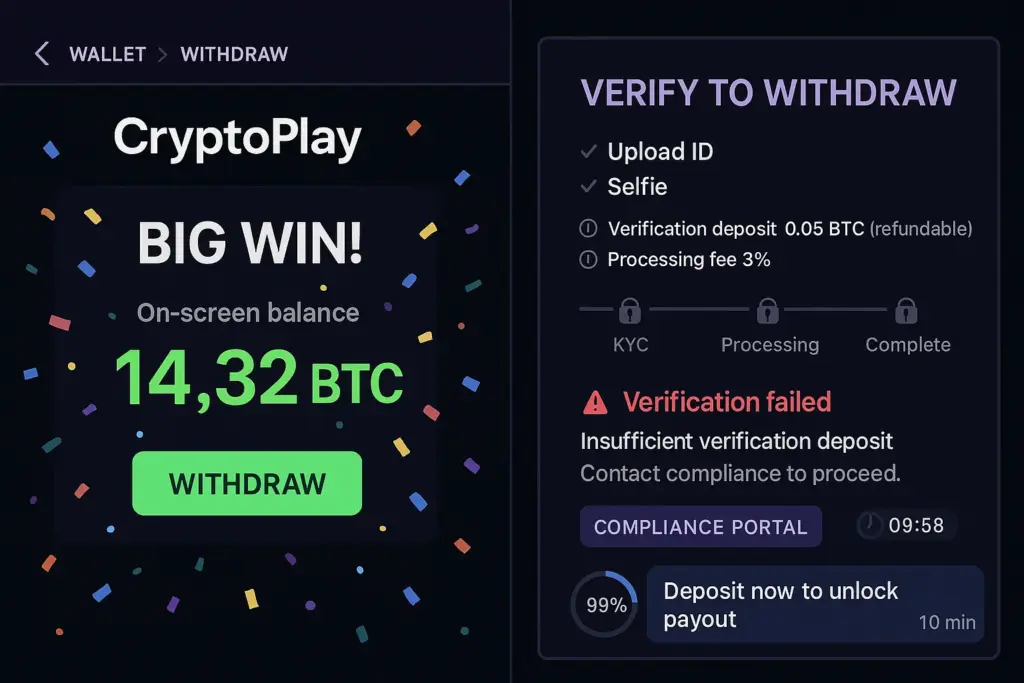
Checks, fees, and unlocks at withdrawal
When withdrawal is finally attempted, the site introduces a new layer of conditions. It may ask for KYC, AML review, tax settlement, wallet authentication, or a VIP unlock. All of those explanations serve the same function if they require new payments or new sensitive documents.

Draining patience before disappearing
Eventually the process often turns into waiting, chasing, and hoping. Support replies can become slower and more repetitive, deadlines keep moving, and then the site may simply stop engaging. Not long after, a separate actor may approach with a recovery pitch designed to exploit the same victim again.
Staying safe from crypto casino scams like Uitgamb
The safest countermeasure is disciplined verification before emotion gets involved. The guidance below is useful because it checks the specific weak points scam operators try hardest to hide.
Confirm who is really behind the site
Do not let the homepage be the only source of identity. Check the named operator, claimed regulator, and business details in independent records. If those claims do not stand up outside the site, the safest assumption is that the presentation is compensating for a lack of accountability.
Look at the domain before the bonus
A domain can expose risk faster than any promotional promise. Recent registration, redacted ownership, and clusters of similar addresses suggest a brand that may exist only long enough to collect deposits and then rotate.
Reject every unlock-fee narrative
Once a platform frames another payment as the path to withdrawal, the pattern has already shifted into extraction mode. Do not treat release fees, tax prepayments, or verification deposits as normal frictions of a healthy service.
Choose visibility over anonymity
Services are safer when you can clearly identify who operates them and how disputes would be handled. Anonymous entities working through crypto-only rails ask users to accept maximum risk with minimal accountability on the other side.
Shrink the damage a single compromise can do
Use separate wallets where practical, rotate linked credentials, enable 2FA, and review any token approvals or sessions granted during the interaction. The goal is to prevent one bad decision from expanding into several separate losses.
Question fairness claims aggressively
Words such as “provably fair” sound reassuring, but they deserve technical proof, not trust. If the operator does not clearly show how a user can independently verify the underlying process, the claim should not influence your decision.
Document everything while it still exists
Capture screenshots, copy wallet addresses, preserve transaction IDs, and save every email or chat transcript you can. Scam sites can vanish or mutate quickly, and early records are often the strongest ones.
Give yourself room to think
A pause is a protective tool, not a delay. Step back, inspect the domain, search for complaints, and ask someone outside the situation to evaluate the story. Distance often makes the contradictions far more obvious.
Useful Resources for Scam Reporting and Prevention (By Country)
Reports matter because they create pattern visibility. A single complaint may not recover funds, but multiple well-documented complaints can help platforms and authorities recognize linked wallets, cloned brands, and repeating tactics.
Review the reporting list below
| Country / Agency | URL | Category / Use-case | Phone/Email |
| Australia – Crime Stoppers | https://www.crimestoppers.com.au | Anonymous tips about crime | 1800 333 000 |
| Australia – National Anti-Scam Center (Scamwatch) | https://www.scamwatch.gov.au/report-a-scam | General scams; phishing; texts/emails | |
| Australia – Police Assistance Line (non-emergency) | https://www.police.gov.au | Local police report | 131 444 |
| Australia – ReportCyber (ACSC) | https://www.cyber.gov.au/report | Cybercrime (hacks, fraud, extortion) | |
| Canada – Canadian Anti-Fraud Center (CAFC) | https://www.antifraudcentre-centreantifraude.ca/report-signalez-eng.htm | General scams incl. phone/text/email | |
| France – DGCCRF (SignalConso) | https://signal.conso.gouv.fr | Consumer scams/deceptive practices | |
| France – PHAROS – Internet-Signalement | https://www.internet-signalement.gouv.fr | Online content & cybercrime reports | |
| Germany – Bundeskriminalamt / Local Police | https://www.polizei.de/Polizei/DE/Home/home_node.html | Report online fraud | |
| Germany – Weißer Ring – Victim Support | https://weisser-ring.de | Victim support | 116 006 |
| India – DoT Helpline (Sanchar Saathi) | https://sancharsaathi.gov.in | Fraudulent telecom/SIM related | 155260 |
| India – National Consumer Helpline | https://consumerhelpline.gov.in | Consumer scams | 1800-11-4000 / 1915 |
| India – National Cyber Crime Reporting Portal | https://cybercrime.gov.in | Cybercrime incl. online fraud | 1930 |
| Japan – Consumer Affairs Agency (CAA) | https://www.caa.go.jp/policies/policy/consumer_policy/caution/cybercrime/ | Consumer scams | |
| Japan – National Police Agency – Cybercrime | https://www.npa.go.jp/bureau/cyber/ | Cybercrime reporting | |
| Mexico – Guardia Nacional (National Guard) | https://www.gob.mx/gn | Cybercrime reporting | |
| Mexico – Instituto Federal de Telecomunicaciones (IFT) | https://www.ift.org.mx | Telecom/online services scams | |
| Mexico – PROFECO | https://www.gob.mx/profeco | Consumer fraud & ecommerce | |
| Netherlands – AFM – Report investment fraud | https://www.afm.nl/en/consumenten/themas/beleggen/misleiding-misbruik | Investment/crypto | |
| Netherlands – Fraudehelpdesk | https://www.fraudehelpdesk.nl/melden | General scams (incl. phishing/SMS) | 088-7867372 |
| Netherlands – Politie – Meldpunt Internetoplichting | https://www.politie.nl/themas/internetoplichting.html | Online shopping fraud | |
| New Zealand – CERT NZ | https://www.cert.govt.nz/individuals/report-an-issue/ | Phishing, identity scams | |
| New Zealand – Department of Internal Affairs – Spam | https://www.dia.govt.nz/Spam-Contact-Us | Email/SMS spam | [email protected] |
| New Zealand – IDCARE | https://www.idcare.org | Victim support (identity compromise) | 0800 121 068 |
| New Zealand – Netsafe – Report | https://www.netsafe.org.nz/report/ | Online harms & scams | |
| New Zealand – New Zealand Police (non-emergency) | https://www.police.govt.nz/use-105 | Report fraud/online crime | 105 |
| Nigeria – Economic & Financial Crimes Commission (EFCC) | https://www.efcc.gov.ng | Financial scams incl. crypto/investment | [email protected] |
| Nigeria – Nigeria Police Special Fraud Unit (SFU) | https://www.specialfraudunit.org.ng | Serious fraud | Voice/SMS: 0708 227 6895; WhatsApp: 0812 760 9914 |
| Poland – CERT Polska (CERT.PL) | https://cert.pl/en/report/ | Cyber incidents & phishing | |
| Poland – Dyzurnet.pl | https://dyzurnet.pl | Illegal online content (esp. child protection) | |
| Poland – Polish Police (Policja) | https://www.policja.pl | Report scams to police | |
| Singapore – Anti-Scam Centre / Anti-Scam Helpline | https://www.scamalert.sg | General scams; texts; calls | 1800-722-6688 |
| Singapore – Monetary Authority of Singapore (MAS) | https://www.mas.gov.sg/investor-alert-list | Investment/crypto checks | |
| Singapore – Singapore Police Force | https://www.police.gov.sg/iwitness | Police report (cybercrime) | |
| South Africa – Cybersecurity Hub (CSIRT) | https://www.cybersecurityhub.gov.za | Cyber incidents incl. scams | |
| South Africa – South African Fraud Prevention Service (SAFPS) | https://www.safps.org.za | Identity fraud support | 011-867-2234 |
| South Africa – South African Police Service (SAPS) | https://www.saps.gov.za | Police report (cybercrime unit) | |
| South Korea – Korea Communications Commission (KCC) | https://www.kcc.go.kr | Telecom-related fraud | |
| South Korea – Korea Internet & Security Agency (KISA) | https://www.kisa.or.kr | Phishing, online harms | |
| South Korea – Korean National Police Agency – Cyber Bureau | https://ecrm.cyber.go.kr | Cybercrime reporting | |
| Spain – INCIBE – Oficina de Seguridad del Internauta (OSI) | https://www.osi.es/es/reporte | Cybersecurity & online fraud | |
| Spain – Policía Nacional / Guardia Civil | https://www.policia.es | Report scams to police | |
| Sweden – Crime Victim Authority (Brottsoffermyndigheten) | https://www.brottsoffermyndigheten.se | Victim support & compensation | 090–70 82 00 |
| Sweden – Polisen (Swedish Police) | https://polisen.se | Report fraud/cybercrime | 114 14 (non-emergency); 112 (emergency) |
| Sweden – Swedish Consumer Agency (Konsumentverket) | https://www.konsumentverket.se | Unfair business practices | |
| United Arab Emirates – Abu Dhabi Police – Aman Service | https://www.adpolice.gov.ae | Cybercrime tips/reporting | SMS 2828; 800 2626 |
| United Arab Emirates – Dubai Police – eCrime | https://www.dubaipolice.gov.ae | Cybercrime reporting | 04 606 1600 |
| United Arab Emirates – Ministry of Interior – Cyber Crime Dept. | https://www.moi.gov.ae | Cybercrime incl. online scams | |
| United Arab Emirates – Telecommunications Regulatory Authority (TRA) / TDRA | https://www.tra.gov.ae | Telecom-related scams/phishing | |
| United Kingdom – Action Fraud (NFIB) | https://www.actionfraud.police.uk | General scams & cybercrime (non-emergency) | 0300 123 2040 |
| United Kingdom – Citizens Advice Consumer Service | https://www.citizensadvice.org.uk/consumer/get-more-help/if-you-need-more-help-about-a-consumer-issue/ | Consumer problems & scam guidance | 0808 223 1133 |
| United Kingdom – Financial Conduct Authority (FCA) | https://www.fca.org.uk/consumers/report-scam-us | Investment/crypto & financial services | |
| United Kingdom – National Cyber Security Centre (NCSC) | https://www.ncsc.gov.uk/collection/phishing-scams | Phishing emails & suspicious websites | |
| United Kingdom – Stop Scams UK ‘159’ | https://stopscamsuk.org.uk/159 | Banking APP fraud (direct to your bank) | 159 |
| United States – AARP Fraud Watch Network Helpline | https://www.aarp.org/money/scams-fraud/ | Victim support | 833-372-8311 |
| United States – Better Business Bureau – Scam Tracker | https://www.bbb.org/scamtracker | Business/marketplace scams | |
| United States – FBI Internet Crime Complaint Center (IC3) | https://www.ic3.gov | Internet crime incl. investment/crypto | |
| United States – Federal Trade Commission – ReportFraud | https://reportfraud.ftc.gov | General scams, phishing, texts/emails | 1-877-382-4357 |
| United States – National Center for Disaster Fraud | https://www.justice.gov/disaster-fraud | Disaster-related scams | (866) 720-5721 |
| United States – SEC Tips & Complaints | https://www.sec.gov/tcr | Investment & securities/crypto-asset offerings |
In the end, the important clue is not the site’s excuse but its structure. If the path is flashy entry, easy balance growth, blocked withdrawal, new payment demands, and eventual silence, the safest move is to secure what is left and stop treating the platform as legitimate.