

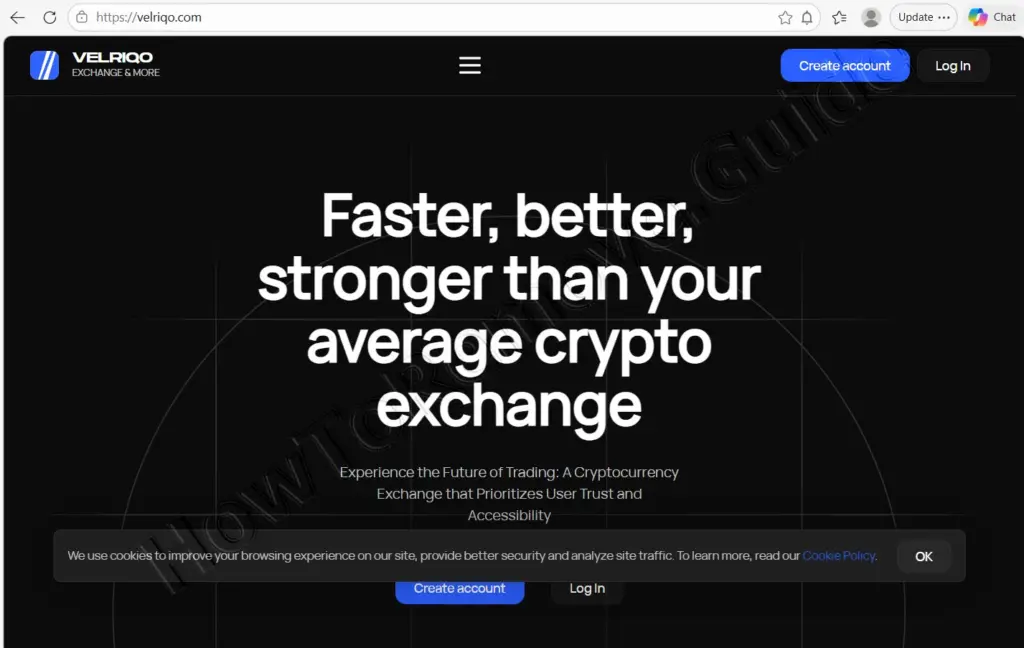
Velriqo.com IS NOT the latest and greatest crypto trading site that will make you rich (and even if it were, you should still not get on the bandwagon before doing your research).
The truth about this site is simple – it’s just a rehash of a tired, run-of-the-mill scam scheme, similar to Selviorex and Belonux, that tries to get you to invest and then disappear with your money and the money of anyone else it has managed to trick.
People are usually drawn in through social videos, copied branding, or messages promising bonus access, and after a signup, their profile page can show a large balance that was never placed on-chain and never belonged to the user.
Scams of Velriqo.com‘s type are known to steal personal data and passwords. Install SpyHunter Pro to scan for risks, remove any dangerous trackers, and enable real-time protection.

Try Free For 7 Days*
Buy now15% OFF if you buy straight without trial.
 OFFER
OFFERAny such numbers are an outright lie – just numbers on a screen with no value behind them. When the victim tries to withdraw, the site introduces clearance fees, account activation payments, or identity hurdles. Each step is aimed at extracting more value before the operators vanish or move the same setup to another domain.
The mechanics are simple and easy to spot, but only if you have the patience and prior knowledge to know what to look for. That’s why this article exists – to help you sniff out such scams in order to avoid them.
This guide explains the usual Velriqo playbook, the signals that expose it, the first safety steps to take after contact, and the habits that make future clone sites far easier to spot.
STOP AND REVIEW THIS NOW
If you already interacted with Velriqo – sent coins, connected a wallet, uploaded ID, or replied to support – move into containment mode immediately. Do not pay anything else, secure adjacent accounts, collect evidence while it still exists, and assume any recovery promise from strangers is another trap until proven otherwise.
- Move remaining assets to a fresh, clean wallet and revoke any suspicious token approvals linked to the scam touchpoint.
- Change passwords and enable app-based 2FA on email, exchanges, and chat accounts; review active sessions and delete unused API keys.
- Preserve evidence: screenshots, URLs, videos or ads, wallet addresses, TXIDs, and chat logs – keep everything for official reports.
- Notify the sending platform (your exchange or service) with TXIDs and the destination address so they can flag or freeze if possible.
- Report promptly to your national cybercrime unit (e.g., IC3 in the US, Action Fraud in the UK) and to the platform where you saw the promotion.
How We Know Velriqo is a Scam
The signs here do not point to a rough but legitimate startup. They point to a familiar crypto fraud model built around fake balances, payment demands, and disposable web infrastructure. Taken together, the red flags are hard to reconcile with any credible financial service.
Balance appears without a real source
Legitimate crypto does not materialize because a user entered a code or finished a quick registration form. If Velriqo suddenly credits a valuable balance with no verifiable funding trail, that display is functioning as bait rather than evidence.
Withdrawal blocked by a new payment
A request to pay before receiving assets is one of the strongest warning signs in this category. Services handling real customer funds do not normally require a separate crypto transfer just to unlock a withdrawal button.
Trust borrowed from other people
Operations like Velriqo often lean on celebrity imagery, copied company names, fabricated reviews, or AI-generated clips. The goal is to trigger recognition and lower skepticism before the victim checks anything independently.
Nothing independently verifiable
If the platform claims coins were sent, it should be able to point to a real transaction hash that survives outside its own interface. Missing proof, circular explanations, and evasive support replies suggest there is no genuine payout process behind the screen.
Compliance language without substance
A page can display certifications, licenses, seals, and legal text without any of it meaning anything. What matters is whether the operator can be confirmed through real registries, public records, and watchdog warnings.
Disposable-domain pattern
These schemes are often built to be abandoned. Once complaints grow, the same layout and script can be relaunched on a fresh domain with minor cosmetic edits, while the underlying deception stays the same.
How the Velriqo Scam Deception Funnel Works
Understanding the flow removes much of its power. Velriqo does not need advanced code or brilliant market insight to hurt people; it just needs a sequence that keeps each new request feeling small, temporary, and almost reasonable.
The pattern is usually consistent: a tempting promise appears, registration is frictionless, a fake balance creates optimism, a withdrawal attempt triggers fees or checks, and communication breaks down once the victim resists further payment.
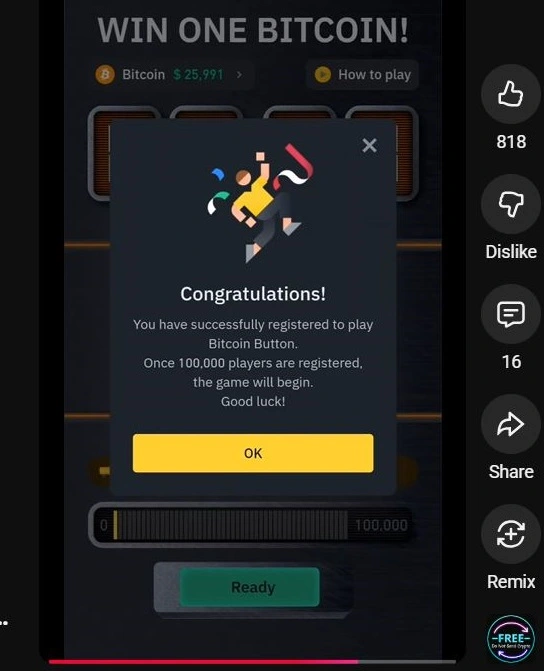
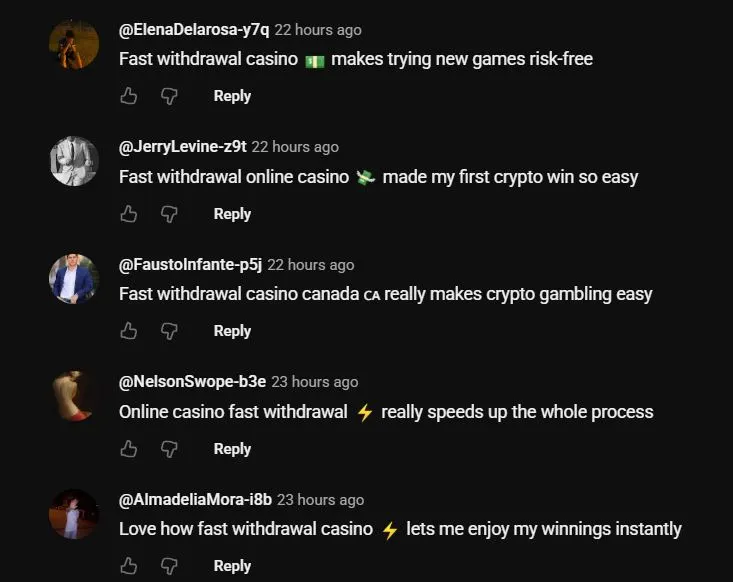
Promo hooks and influencer codes
The journey often starts with a post, ad, chat message, or comment claiming a private code, limited campaign, or time-sensitive reward. Velriqo uses that manufactured exclusivity to push users toward quick decisions instead of careful verification.
Casino skin and bonus theater
After arrival, the page tries to feel familiar and polished. Market widgets, polished branding, fake support panels, and live-looking counters are there to reduce doubt before the money request appears.

Inflated balances, then the gate
The dashboard may show a bonus, a trading profit, or a completed transfer, but none of that proves ownership. Without independent confirmation, the numbers inside Velriqo are only part of the persuasion mechanism.
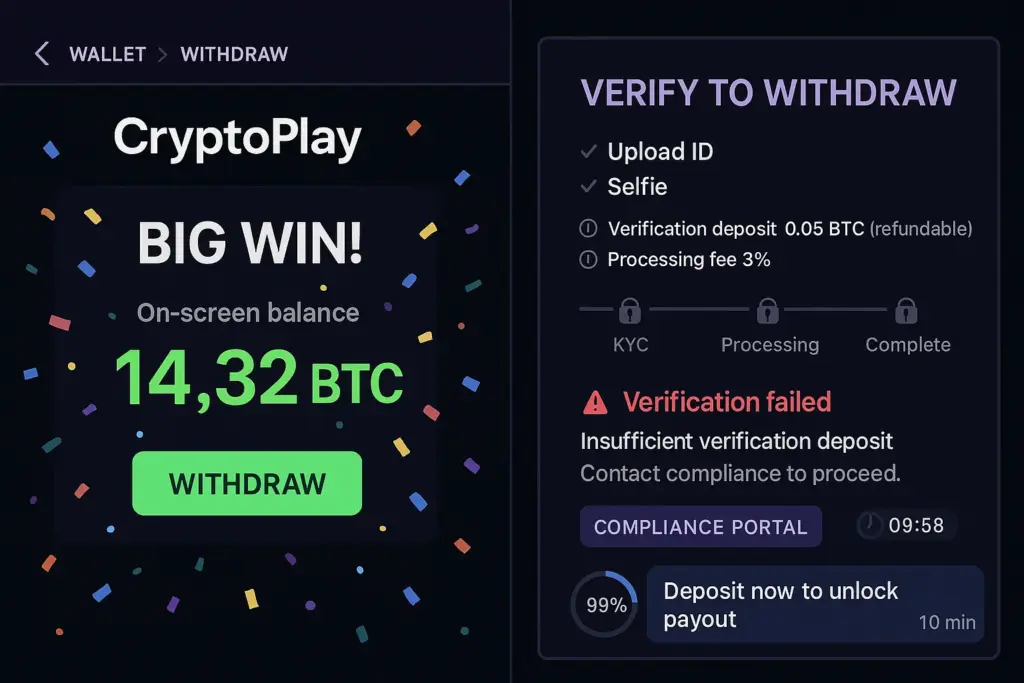
Fee-gates and KYC harvest
When the user asks to cash out, the script pivots to extra conditions. Velriqo may suddenly require anti-fraud checks, tax prepayment, wallet matching, account activation, or KYC uploads framed as the final step before funds are released.

Stalling, rebrands, and “recovery” bait
Once a victim has paid once, the fraud often escalates. Support may stall, invent new obstacles, ask for another transfer, or later re-approach the same person through fake tracing or refund services.
Staying safe from crypto scams like Velriqo
Staying safe is usually less about technical depth than about pace and discipline. People avoid Velriqo-style traps by checking claims at the source, refusing urgency-driven payment requests, and keeping any testing activity away from primary holdings and accounts.
Never pay to withdraw
Any demand for a release fee, verification deposit, synchronization payment, or tax transfer should end the interaction on the spot. That is the classic structure of an advance-fee scam translated into crypto language.
Verify endorsements at the source
A recognizable face or big brand logo should be treated as decoration until confirmed. Check official channels, corporate announcements, and verified social profiles before trusting any claim attached to Velriqo.
Navigate with your own bookmarks
Fake domains do best when people click quickly from ads and messages. Open exchanges and wallets through saved bookmarks or carefully typed addresses rather than links handed to you in promotional material.
Check regulator registers & warnings
Look beyond the site itself. Regulator notices, scam reports, missing corporate records, and contradictory business details can reveal the truth much faster than any homepage sales pitch.
Segregate risk with burner wallets
Do not expose your main wallet to unfamiliar services. A small isolated wallet for testing limits damage if Velriqo requests signatures, harvests approvals, or proves to be a cloned scam page.
Harden accounts with 2FA & hygiene
The risk does not stop at the wallet address. Email accounts, exchange logins, chat apps, and even phone-based authentication can become targets after contact, so unique passwords and app-based 2FA matter.
Revoke approvals & migrate
Anyone who connected a wallet should review allowances with reputable tools and consider migrating remaining funds. Old approvals can remain exploitable even after the original site stops responding.
Protect identity & slow down
If Velriqo collected ID cards, selfies, tax details, or proof of address, watch for secondary abuse and use local fraud-protection measures where available. Most importantly, slow down whenever an offer feels secretive, rushed, or unrealistically generous.
Where to report Velriqo-style crypto scams (by country)
Reporting may not bring assets back, but it helps limit further damage and can connect your case to wider activity. Save wallet addresses, screenshots, chat logs, email headers, URLs, and transaction IDs before they disappear. Report the incident to the relevant cybercrime, consumer-protection, or financial-intelligence channels in your country, and inform any exchange involved in sending the funds. Stay alert for people who contact you with guaranteed recovery offers, because that approach often leads into a second scam.
Click here to report the scam in your country
| Country / Agency | URL | Category / Use-case | Phone/Email |
| Australia – Crime Stoppers | https://www.crimestoppers.com.au | Anonymous tips about crime | 1800 333 000 |
| Australia – National Anti-Scam Center (Scamwatch) | https://www.scamwatch.gov.au/report-a-scam | General scams; phishing; texts/emails | |
| Australia – Police Assistance Line (non-emergency) | https://www.police.gov.au | Local police report | 131 444 |
| Australia – ReportCyber (ACSC) | https://www.cyber.gov.au/report | Cybercrime (hacks, fraud, extortion) | |
| Canada – Canadian Anti-Fraud Center (CAFC) | https://www.antifraudcentre-centreantifraude.ca/report-signalez-eng.htm | General scams incl. phone/text/email | |
| France – DGCCRF (SignalConso) | https://signal.conso.gouv.fr | Consumer scams/deceptive practices | |
| France – PHAROS – Internet-Signalement | https://www.internet-signalement.gouv.fr | Online content & cybercrime reports | |
| Germany – Bundeskriminalamt / Local Police | https://www.polizei.de/Polizei/DE/Home/home_node.html | Report online fraud | |
| Germany – Weißer Ring – Victim Support | https://weisser-ring.de | Victim support | 116 006 |
| India – DoT Helpline (Sanchar Saathi) | https://sancharsaathi.gov.in | Fraudulent telecom/SIM related | 155260 |
| India – National Consumer Helpline | https://consumerhelpline.gov.in | Consumer scams | 1800-11-4000 / 1915 |
| India – National Cyber Crime Reporting Portal | https://cybercrime.gov.in | Cybercrime incl. online fraud | 1930 |
| Japan – Consumer Affairs Agency (CAA) | https://www.caa.go.jp/policies/policy/consumer_policy/caution/cybercrime/ | Consumer scams | |
| Japan – National Police Agency – Cybercrime | https://www.npa.go.jp/bureau/cyber/ | Cybercrime reporting | |
| Mexico – Guardia Nacional (National Guard) | https://www.gob.mx/gn | Cybercrime reporting | |
| Mexico – Instituto Federal de Telecomunicaciones (IFT) | https://www.ift.org.mx | Telecom/online services scams | |
| Mexico – PROFECO | https://www.gob.mx/profeco | Consumer fraud & ecommerce | |
| Netherlands – AFM – Report investment fraud | https://www.afm.nl/en/consumenten/themas/beleggen/misleiding-misbruik | Investment/crypto | |
| Netherlands – Fraudehelpdesk | https://www.fraudehelpdesk.nl/melden | General scams (incl. phishing/SMS) | 088-7867372 |
| Netherlands – Politie – Meldpunt Internetoplichting | https://www.politie.nl/themas/internetoplichting.html | Online shopping fraud | |
| New Zealand – CERT NZ | https://www.cert.govt.nz/individuals/report-an-issue/ | Phishing, identity scams | |
| New Zealand – Department of Internal Affairs – Spam | https://www.dia.govt.nz/Spam-Contact-Us | Email/SMS spam | [email protected] |
| New Zealand – IDCARE | https://www.idcare.org | Victim support (identity compromise) | 0800 121 068 |
| New Zealand – Netsafe – Report | https://www.netsafe.org.nz/report/ | Online harms & scams | |
| New Zealand – New Zealand Police (non-emergency) | https://www.police.govt.nz/use-105 | Report fraud/online crime | 105 |
| Nigeria – Economic & Financial Crimes Commission (EFCC) | https://www.efcc.gov.ng | Financial scams incl. crypto/investment | [email protected] |
| Nigeria – Nigeria Police Special Fraud Unit (SFU) | https://www.specialfraudunit.org.ng | Serious fraud | Voice/SMS: 0708 227 6895; WhatsApp: 0812 760 9914 |
| Poland – CERT Polska (CERT.PL) | https://cert.pl/en/report/ | Cyber incidents & phishing | |
| Poland – Dyzurnet.pl | https://dyzurnet.pl | Illegal online content (esp. child protection) | |
| Poland – Polish Police (Policja) | https://www.policja.pl | Report scams to police | |
| Singapore – Anti-Scam Centre / Anti-Scam Helpline | https://www.scamalert.sg | General scams; texts; calls | 1800-722-6688 |
| Singapore – Monetary Authority of Singapore (MAS) | https://www.mas.gov.sg/investor-alert-list | Investment/crypto checks | |
| Singapore – Singapore Police Force | https://www.police.gov.sg/iwitness | Police report (cybercrime) | |
| South Africa – Cybersecurity Hub (CSIRT) | https://www.cybersecurityhub.gov.za | Cyber incidents incl. scams | |
| South Africa – South African Fraud Prevention Service (SAFPS) | https://www.safps.org.za | Identity fraud support | 011-867-2234 |
| South Africa – South African Police Service (SAPS) | https://www.saps.gov.za | Police report (cybercrime unit) | |
| South Korea – Korea Communications Commission (KCC) | https://www.kcc.go.kr | Telecom-related fraud | |
| South Korea – Korea Internet & Security Agency (KISA) | https://www.kisa.or.kr | Phishing, online harms | |
| South Korea – Korean National Police Agency – Cyber Bureau | https://ecrm.cyber.go.kr | Cybercrime reporting | |
| Spain – INCIBE – Oficina de Seguridad del Internauta (OSI) | https://www.osi.es/es/reporte | Cybersecurity & online fraud | |
| Spain – Policía Nacional / Guardia Civil | https://www.policia.es | Report scams to police | |
| Sweden – Crime Victim Authority (Brottsoffermyndigheten) | https://www.brottsoffermyndigheten.se | Victim support & compensation | 090–70 82 00 |
| Sweden – Polisen (Swedish Police) | https://polisen.se | Report fraud/cybercrime | 114 14 (non-emergency); 112 (emergency) |
| Sweden – Swedish Consumer Agency (Konsumentverket) | https://www.konsumentverket.se | Unfair business practices | |
| United Arab Emirates – Abu Dhabi Police – Aman Service | https://www.adpolice.gov.ae | Cybercrime tips/reporting | SMS 2828; 800 2626 |
| United Arab Emirates – Dubai Police – eCrime | https://www.dubaipolice.gov.ae | Cybercrime reporting | 04 606 1600 |
| United Arab Emirates – Ministry of Interior – Cyber Crime Dept. | https://www.moi.gov.ae | Cybercrime incl. online scams | |
| United Arab Emirates – Telecommunications Regulatory Authority (TRA) / TDRA | https://www.tra.gov.ae | Telecom-related scams/phishing | |
| United Kingdom – Action Fraud (NFIB) | https://www.actionfraud.police.uk | General scams & cybercrime (non-emergency) | 0300 123 2040 |
| United Kingdom – Citizens Advice Consumer Service | https://www.citizensadvice.org.uk/consumer/get-more-help/if-you-need-more-help-about-a-consumer-issue/ | Consumer problems & scam guidance | 0808 223 1133 |
| United Kingdom – Financial Conduct Authority (FCA) | https://www.fca.org.uk/consumers/report-scam-us | Investment/crypto & financial services | |
| United Kingdom – National Cyber Security Centre (NCSC) | https://www.ncsc.gov.uk/collection/phishing-scams | Phishing emails & suspicious websites | |
| United Kingdom – Stop Scams UK ‘159’ | https://stopscamsuk.org.uk/159 | Banking APP fraud (direct to your bank) | 159 |
| United States – AARP Fraud Watch Network Helpline | https://www.aarp.org/money/scams-fraud/ | Victim support | 833-372-8311 |
| United States – Better Business Bureau – Scam Tracker | https://www.bbb.org/scamtracker | Business/marketplace scams | |
| United States – FBI Internet Crime Complaint Center (IC3) | https://www.ic3.gov | Internet crime incl. investment/crypto | |
| United States – Federal Trade Commission – ReportFraud | https://reportfraud.ftc.gov | General scams, phishing, texts/emails | 1-877-382-4357 |
| United States – National Center for Disaster Fraud | https://www.justice.gov/disaster-fraud | Disaster-related scams | (866) 720-5721 |
| United States – SEC Tips & Complaints | https://www.sec.gov/tcr | Investment & securities/crypto-asset offerings |
Keep records, secure what is still under your control, and remember that a number displayed on a website is not evidence that any cryptocurrency exists behind it.
